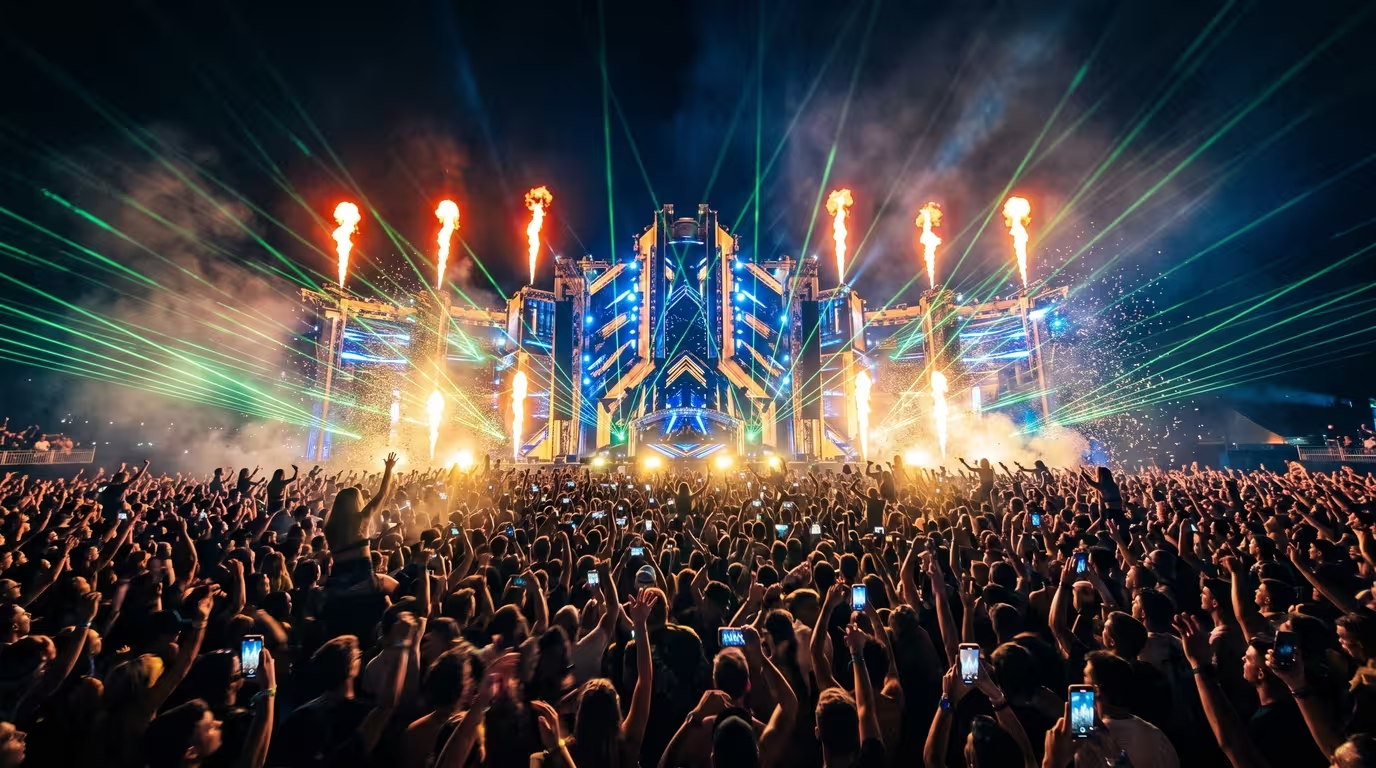
There is a specific sound that, for one improbable stretch of the 2010s, meant electronic music to more people than any other. It was loud, it was simple, and it was built around a single moment: the drop. Big room house was the genre engineered for the back row of a field holding 60,000 people, and for a few years it owned the biggest stages on earth before the very formula that made it unstoppable turned into its undoing.
Blog
Big Room and the Festival Mainstage Sound
How the simplest, loudest drop in dance music conquered the world's festivals, then collapsed under its own formula.
What Big Room House Actually Is
Big room house is a subgenre of house and EDM purpose-built for festival mainstages and arenas. It is, by design, an architecture of tension and release. A track typically runs at a four-on-the-floor pulse somewhere between 126 and 132 BPM, with 128 as the de facto standard, and arranges itself around a now-familiar blueprint: an atmospheric intro, an emotional or vocal breakdown, a build-up bristling with white-noise risers and snare rolls, and then the drop.
What made the big room drop distinctive was its restraint. Where other dance styles crammed the drop full of detail, big room often emptied it out: a huge, reverberant kick, a booming bass, and a single simple lead, frequently a supersaw or a stabbing pluck, with vast space around it. The name itself points at the sound design, since the heavily reverberated drums and synths create the illusion that the music is echoing through an enormous enclosed space. The result reads as minimalist and maximalist at once: very few elements, deployed for maximum physical impact on a giant sound system.
A loose anatomy of the classic big room track looks like this:
• A four-on-the-floor kick at roughly 128 BPM, layered for sub-heavy punch.
• A cinematic breakdown carrying the emotional or vocal hook.
• A build-up of snare rolls, risers and white noise that strips everything away.
• A sparse, hard-hitting drop built on kick, bass and one anthemic lead.
• Generous large-hall reverb to make it all sound vast.
The craft here is real even when the palette is small: the entire point is crowd impact, the moment when tens of thousands of people move at once. Understanding how a build resolves into a drop, and how little you can put in and still detonate a room, is a genuine production discipline, and one any DJ or producer who studies festival-ready records ends up reckoning with.
Out of Progressive, Electro and Dutch House
Big room did not appear from nowhere. It coalesced in the early 2010s at the meeting point of several styles: the aggressive sound design of electro house, the anthemic breakdowns of progressive house, and the rhythmic sensibility of Dutch house, the abrasive, high-synth Dirty Dutch sound pioneered in the Netherlands by producers like Afrojack, Chuckie and Sidney Samson. Earlier electro touchstones such as Benny Benassi's Satisfaction sit somewhere in its DNA, as do the mainstage-conquering anthems of Swedish House Mafia, who brought progressive house to stadium scale and, as much as any act, set the tone for the EDM boom.
That boom is the essential context. By the autumn of 2012, electronic dance music had exploded into the American mainstream, a rebranding of dance culture into the catch-all EDM, powered by a festival circuit that was ballooning in size. Ultra Music Festival announced a second weekend; Electric Daisy Carnival and Electric Zoo grew into multi-day behemoths. As DJs graduated from clubs to arenas and fields, they began making music specifically for those rooms. Big room was the answer to a practical question: what plays to a crowd of tens of thousands at once?
The Netherlands sat at the centre of it all. Spinnin' Records, founded in Hilversum in 1999, became the genre's commercial engine, while Hardwell's Revealed Recordings, launched in 2010, and its peers built an ecosystem of mainstage-ready releases. Many histories point to Sandro Silva and Quintino's Epic, released in October 2011, as the first true big room track, an instrumental that topped the Dutch charts and laid out the template wholesale.
The Rise: 2012 to 2015
If Epic lit the fuse, Hardwell's Spaceman, released in January 2012, confirmed the genre had a commercial future, detonating at Miami Music Week and helping crown the Dutchman as one of big room's godfathers. In 2013 he became the youngest-ever winner of DJ Mag's Top 100 DJs poll at 25, taking the crown from the five-time winner Armin van Buuren, and he held the number one spot again in 2014.
Martin Garrix - Animals

But the track that came to define the entire phenomenon belonged to a teenager. Martin Garrix released Animals on 17 June 2013 through Spinnin' Records, and it became the quintessential big room anthem. Garrix, who had only just turned 17, became the youngest producer ever to reach number one on Beatport. Animals went on to top the singles charts in the United Kingdom, Belgium and French-speaking Switzerland, reached number 21 on the Billboard Hot 100 and number one on the US Dance chart, an almost entirely instrumental record conquering pop radio. Its drop, all kick and a single hammered melodic figure, was the genre distilled to its essence.
The roll call around Garrix and Hardwell was deep. Dimitri Vegas & Like Mike, the Belgian brothers and Tomorrowland resident DJs, rode the wave to the top of DJ Mag's poll in 2015 and again in 2019, becoming the first duo ever to claim the crown. DVBBS and Borgeous scored a global smash with Tsunami, released on Doorn Records in August 2013 and written by KSHMR; Billboard called it the most played tune at that year's Tomorrowland, and it hit number one on Beatport within a week. Showtek, W&W, Nicky Romero, Blasterjaxx, R3hab, Dyro, Quintino and others filled out festival bills and Beatport charts alike. So pervasive was the formula that established acts from other genres pivoted toward it, and pop stars reached for its drops.
For roughly three years, big room simply was the festival mainstage. The DJ Mag Top 100 and the headliner economy cemented these acts as global stars; the mainstages of Tomorrowland, Ultra and EDC became temples where the build-and-drop ritual played out night after night.
The Backlash and the Oversaturation
The same qualities that made big room so effective also made it an easy target, and the critique arrived early. The genre's reliance on a single, repeatable structure meant that, in the wrong hands, tracks became near-interchangeable: the same build, the same snare roll, the same skeletal drop, often assembled from the same sample packs. The Pryda snare and the percussive supersaw lead became ubiquitous tells.
The defining moment of self-aware critique came in mid-2013, when the Swedish duo Daleri posted Epic Mashleg, a minute-long mash-up stitching together one-bar phrases from current big room tracks, singling out tunes from Dimitri Vegas & Like Mike, Krewella and W&W, plus records on Tiesto's Musical Freedom and Afrojack's Wall Recordings labels, to demonstrate how indistinguishable they had become. SPIN called it, in essence, a supersaw supercut. Writing about the same mash-up, MusicRadar assembled the drops of 16 tracks then near the top of Beatport's charts and found the results a blur of identikit percussive leads and beefy claps. Years later, Mixmag would look back on the mix as having effortlessly revealed the vapid bombast at the heart of big room production. The producer Wolfgang Gartner had already dubbed the broader trend the EDM Apocalypse. Even Saturday Night Live got in on it, satirising push-button DJ culture with a 2014 sketch about a DJ and a giant bass button.
It is worth being fair here. None of this means the music was worthless; millions of people experienced genuine euphoria to these records, and the best of them still land hard. The criticism was narrower and, by mid-decade, widely shared: that the genre had become formulaic, that oversaturation had set in as countless producers chased the same drop, and that a sound engineered for the lowest common denominator of crowd reaction had crowded out variety. By 2016 big room had become shorthand, for its detractors, for stereotypical EDM itself.
Tastes duly shifted. As listeners tired of the relentless drops, softer and more melodic sounds rushed into the gap: tropical house, championed by Kygo and others, offered a sun-bleached antidote, while future house, deep house and tech house pulled crowds toward groove and subtlety. The American EDM bubble cooled commercially, symbolised when the festival conglomerate SFX Entertainment filed for Chapter 11 bankruptcy in February 2016 in a debt-for-equity restructuring, with its founder Robert Sillerman stepping down, and the mainstage's monoculture broke apart. David Guetta and Showtek even released a 2016 single pointedly titled The Death of EDM.
Where It Went: Evolution and Legacy
Big room did not so much die as mutate. Many of its stars simply moved on: Martin Garrix broadened toward melodic and pop-leaning material with vocal hits like In the Name of Love and Scared to Be Lonely, and topped DJ Mag's poll three years running in 2016, 2017 and 2018. Hardwell stepped away from touring in 2018 and later returned reinvented as a big room techno artist.
The sound's DNA, meanwhile, kept surfacing in new hybrids. Producers folded big room's stadium-scale builds into harder territory: psytrance-influenced big room psy, festival trap and hardstyle crossovers, and a rawer, harder Dutch festival sound. Later in the decade, David Guetta and MORTEN's future rave reintroduced darker, techno-tinged tension while keeping the mainstage-sized hooks, and peak-time mainstage techno absorbed big room's explosive architecture wholesale. The build-and-drop logic big room perfected never really left the festival; it just changed costumes.
The fair verdict is a complicated one. Big room house was, at its core, the simple, massive, drop-focused sound engineered for festival mainstages, and that engineering was both its genius and its trap. It introduced millions of people to dance music, defined a genuine global moment, and minted a generation of superstar DJs. It also burned out fast, undone by the very repeatability that made it so easy to produce and so reliable on a Saturday night. Today it carries a strong streak of nostalgia: the soundtrack of a specific, deafening, confetti-strewn era that, for better and worse, dance music will never quite repeat.
Key takeaways
• Big room house is a festival-built EDM subgenre defined by a four-on-the-floor pulse around 128 BPM and a huge, minimal, drop-focused structure.
• It grew out of progressive, electro and Dutch house during the early-2010s EDM boom, with the Netherlands and Spinnin' Records at its core.
• Hardwell's Spaceman and especially Martin Garrix's Animals (2013) made it the dominant mainstage and Beatport sound from roughly 2012 to 2015.
• Backlash over its formulaic, oversaturated same-drop sound, crystallised by Daleri's Epic Mashleg, coincided with a shift toward tropical, future and deep house by 2015 and 2016.
• Its legacy is real but double-edged: a genre that opened dance music to millions, then evolved into psy, future rave and mainstage techno hybrids.
