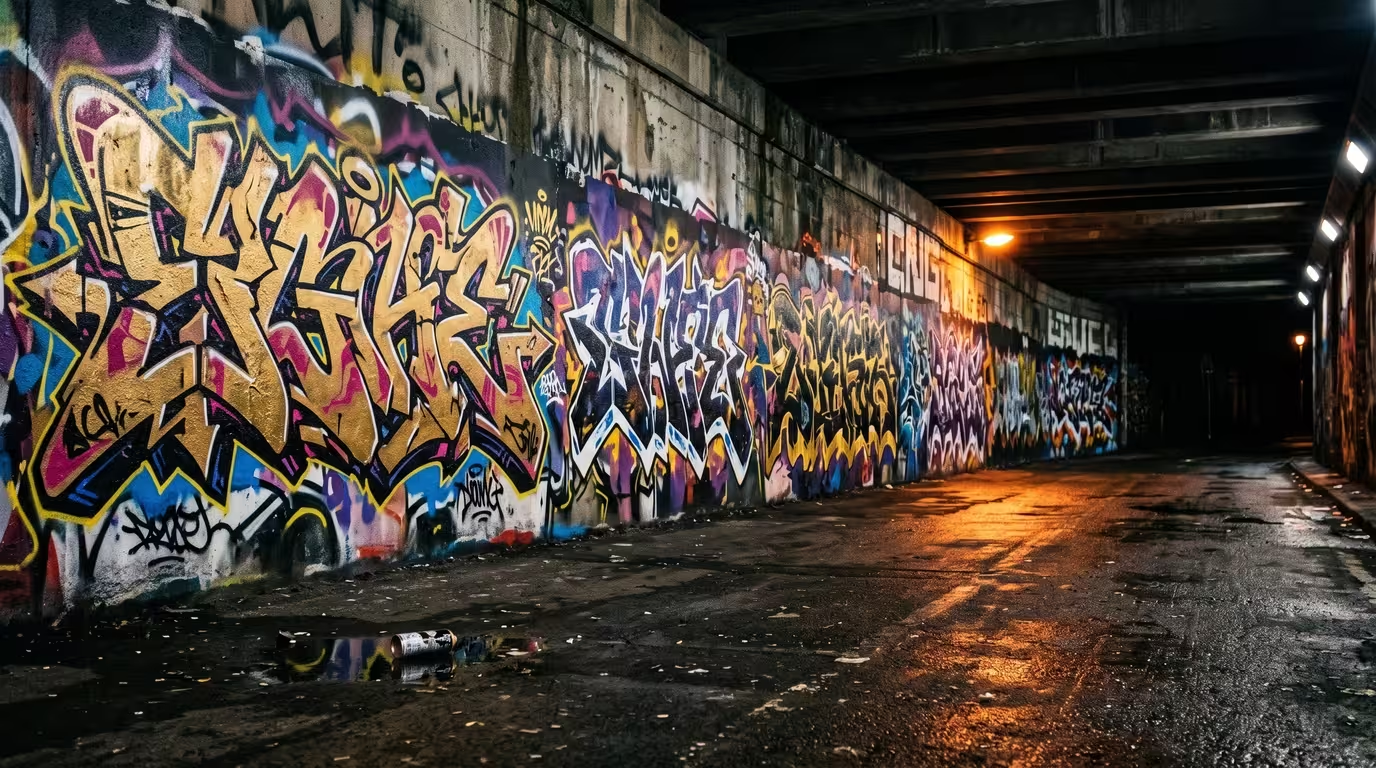
Before he was the king of jungle, before the MBE and the Bond villain and the orchestra, Goldie was a kid with a spray can and nowhere in particular to be. The line from those walls to the records is straighter than it looks: both are about layering, texture and making something unmistakably yours. This is the story of how a graffiti writer from the West Midlands took a music born on pirate radio and made the wider world listen.
Blog
Goldie: From Graffiti to Drum and Bass
How a graffiti artist from Walsall turned jungle from pirate-radio noise into album-length art.
The Kid Who Came From Nothing
Goldie was born Clifford Joseph Price on 19 September 1965 in Walsall, England, and raised largely in nearby Wolverhampton. His heritage is Jamaican and Scottish; his mother, Margaret, was a Scottish pub singer. Put into care around the age of three, he grew up in children's homes and with several foster families, an upbringing he has spoken about with unusual candour in two memoirs. It is the fact that sits under everything else he made: a self-invented man who, as he put it after collecting his MBE, believes music and art well and truly saved his life.
The name came before the gold teeth. Goldie is a shortening of Goldielocks, a nickname from his b-boy days that referenced the dreadlocks he wore at the time. By the mid-1980s he had thrown himself into imported hip-hop culture, first breakdancing and then graffiti, and became one of the most accomplished writers in the country.
Bombin', New York and Gold Teeth
His graffiti work around Birmingham and Wolverhampton earned him a starring turn in Bombin', Dick Fontaine's documentary about hip-hop culture crossing the Atlantic, first broadcast on Channel 4 around 1987. The film took the young Goldie to New York, where he connected with American writers and, as the story is usually told, absorbed the mentality of a scene far bigger than the one back home.
He then spent time in the United States, in New York and Miami, where he made a living selling gold teeth and jewellery, a trade he carried on after returning to Britain in 1988. Those grills would later become his visual signature.

Kemistry, Rage and the Road Into Jungle
The turn toward music came through DJ Kemistry, his then-girlfriend, who dragged him into London's breakbeat underground around 1991. She took him to Rage, the Thursday night at Heaven where Fabio and Grooverider were pitching up breakbeats and inventing what would become jungle. Kemistry also introduced him to Dego and Marc Mac, the duo 4hero, and their Reinforced Records label, where Goldie learned production and did design and A&R work.
He debuted in 1992 on a record by the Icelandic group Ajax Project, then began releasing his own material as Rufige Kru. The pivotal track was Terminator, released in 1992, widely credited as an early and influential use of time-stretching, the technique of slowing a breakbeat without dropping its pitch, which gave the music its eerie, elongated new texture. The critic Simon Reynolds, writing in The Wire, put it plainly: Goldie revolutionised jungle not once but three times, first with Terminator and its time-stretching, then with Angel, which fused Diane Charlemagne's live vocal with David Byrne and Brian Eno samples to prove hardcore could be conventionally musical, and finally with Timeless, a 22-minute hardcore symphony.
Timeless: The Record That Changed the Conversation
In 1995 came the album that reframed everything. Timeless, released on FFRR in partnership with his own Metalheadz imprint, entered the UK Albums Chart at number seven, a startling result for a genre most people still associated with illegal raves and pirate frequencies. Made with the engineer Rob Playford, with additional work from Dillinja and 4hero, it fused jungle's breakbeats and sub-bass with orchestral textures and soul vocals.
Its centrepiece was the 21-minute title suite, built around the extraordinary voice of Diane Charlemagne. Lifted as a single, Inner City Life reached number 39 on the UK singles chart and number six on the UK Dance chart, with NME later placing it 11th in its 50 best songs of 1994, and it became the track that made jungle legible to outsiders, the song people heard on late-night radio and understood. The AllMusic critic Paul Simpson summed up its standing: Timeless was a major breakthrough, hitting the UK top ten on release, earning across-the-board praise as one of the best albums of 1995 and remaining, decades later, a singularly powerful experience. The Guardian later listed the album's release among the 50 key events in the history of dance music. It made the case, once and for all, that this music could be album-length art.
Goldie - Inner City Life

Metalheadz and the Blue Note
If Timeless was the statement, Metalheadz was the institution. Goldie founded the label in 1994 with Kemistry and DJ Storm, and it quickly became the crucible for drum and bass's darker, more cerebral wing. In July 1995 the label began its legendary Sunday-night sessions at the Blue Note in Hoxton, a tiny room of around 200 capacity where dubplate rivalry was fierce and the musical policy uncompromising.
The roster reads like a genre canon: Photek, Doc Scott, Dillinja, Source Direct, Peshay, J Majik and Lemon D all passed through. The Red Bull Music Academy oral history of the club captures how small it started, with Goldie breakdancing on a near-empty floor, before it became one of the most important club nights in British dance music.
The label's story carries a deep sadness. On 25 April 1999, Kemistry, born Valerie Olukemi Olusanya in 1963, was killed in a freak road accident on the M3 near Winchester while returning from a gig, when a cat's eye flung up from the motorway came through the windscreen of the car in which Storm was driving. She was 35. Months earlier she and Storm had released a landmark mix in the DJ-Kicks series. Goldie's 1992 track Kemistry was named for her.
Saturnz Return and the Long Career
Goldie followed Timeless in 1998 with the double album Saturnz Return, which opened with Mother, an hour-long orchestral drum and bass piece. At the time the record drew mixed to hostile reviews for its ambition and length; it has since been partly reappraised, with Pitchfork among those rating it far more generously in hindsight. Whatever the verdict, it was a producer refusing to repeat himself.
From there his career fanned outward. He became a genuine mainstream figure: a Bond henchman in The World Is Not Enough (1999), a role in Guy Ritchie's Snatch (2000), and the gangster Angel Hudson in EastEnders. In 2008 he learned to conduct on the BBC's Maestro, finishing as runner-up, and he later appeared on Strictly Come Dancing and Celebrity Big Brother. In the 2016 New Year Honours he was appointed MBE for services to music and young people. He kept making records too, returning in 2017 with The Journey Man, which Resident Advisor noted returned to the lengthy, emotive compositions of his 1990s peak. He and his family relocated to Thailand in 2015.
Why Goldie Matters
Goldie's real achievement was translation. He took a music that was deliberately inaccessible, fast, aggressive and confined to pirate radio and specific rooms, and, without diluting it, made it something the outside world could hear as art. He built infrastructure, in Metalheadz, that outlasted the hype. And he modelled the idea of the electronic producer as auteur: not a faceless technician but an artist with a signature.
The through-line, from the underpass walls of the Midlands to the studio, is the same instinct: layer, texture, build something that could only be yours. In 2025, London Records marked the 30th anniversary of Timeless with a remastered reissue, proof that the record still sets the terms. Not bad for a kid who came from nothing.
Key takeaways
• Goldie, born Clifford Joseph Price in Walsall in 1965, rose from the care system and UK graffiti to become drum and bass's most visible ambassador.
• His 1995 album Timeless, with Diane Charlemagne on Inner City Life, hit UK number seven and carried jungle into the mainstream.
• With Kemistry and Storm he founded Metalheadz in 1994 and the legendary Blue Note Sunday sessions.
• After the divisive Saturnz Return in 1998, he became a broadcaster, actor and MBE, still releasing music.
• His legacy: he made jungle legible without softening it, and built a label that outlived the moment.
