If you have ever wondered why a dubstep tune analysed at 140 BPM feels slow and heavy enough to nod along at half that speed, you have already met half-time. Half-time and double-time are rhythmic feels — ways of arranging the drums that make music seem slower or faster — without the actual tempo ever changing. Understanding them unlocks one of the most useful tricks a DJ has: bridging tracks whose BPMs look impossibly far apart. This article goes deep on the mechanism and its practical use; for the counting foundation it builds on, see the companion article on bars, beats, and time signatures, and for full tempo tables see BPM Ranges by Genre.
What Half-Time and Double-Time Mean
The single most important idea is this: the BPM on the grid does not change — the rhythmic feel does. According to Wikipedia's article on half-time, half-time alters the rhythmic feel by roughly doubling the metric resolution compared with common time, so that two bars of 4/4 start to feel like one long bar. The notes keep the same actual time value, but the groove is stretched so it feels half as fast. Double-time is the mirror image: the feel is twice as fast, the music seems more urgent and energetic, yet the underlying pulse is unchanged.
These are songwriting and production tools, not tempo edits. A drummer can drop a chorus into half-time for weight, then snap back to regular time, all at one steady tempo. The chord changes and the metronome keep marching; only the drum pattern's sense of speed moves. That distinction — feel versus actual tempo — is the thing most newcomers blur, and it is the key to everything that follows.
How It Works on the 4/4 Grid
Regular Time, Half-Time, Half as Fast
Start from the everyday backbeat. In a standard 4/4 groove the kick lands on beats 1 and 3, the snare cracks the backbeat on beats 2 and 4, and the hi-hats tick along on eighth notes. That is regular or common time, the pattern Ableton's Learning Music site builds beats from.
To go half-time, you move the snare. Instead of hitting beats 2 and 4, the snare hits only beat 3 of the bar, and the kick anchors beat 1. The backbeat now arrives half as often, so the interval between snare hits doubles and the groove feels as if it has slowed to half speed. Crucially, the hi-hats usually keep running at the original rate, which is what keeps the track tethered to its real tempo even as the body-nod slows down. As Wikipedia describes it, a half-time groove expands one measure across the span of two — each note's length is doubled while it recurs half as often.
Double-Time, Twice as Busy
Double-time packs twice as many rhythmic events into the same clock. The backbeat that used to land twice a bar now effectively lands four times, snare accents fall onto the offbeats, and the ride or hat pattern subdivides into sixteenths. The result feels frantic and propulsive — common in punk, gospel, fast country, and the busier moments of electronic music — while, again, the tempo itself has not moved.
A handy way to picture all three: at one fixed tempo, half-time spreads the drums over two bars, regular time fills one bar, and double-time crams the action into half a bar. Same grid, three energy levels.
Why 140 Feels Like 70: The Dubstep and Trap Case
This is where the concept becomes a DJ's daily reality. Dubstep is produced and analysed at roughly 140 BPM, but the kick-on-1, snare-on-3 pattern is pure half-time, so listeners perceive a groove closer to 70 BPM. Both numbers describe the same music — one counts the grid, the other counts the feel.
Trap works identically. Native Instruments' production tutorial lists the common elements of a trap beat as a half-time drum pattern, a deep 808 bass, hi-hat rolls and triplets, and tempos ranging from about 130 to 200 BPM; its step-by-step example sets the tempo to 140 BPM, places claps on the third beat of each bar, and adds 32nd-note hat rolls. Move the snare to beat 3 and the beat grooves like 70, even as those rapid-fire rolls run at full speed on top.
So why not just produce at 70? Because the higher grid tempo gives finer rhythmic resolution. Working at 140 doubles the number of grid divisions per perceived beat, which makes programming those signature 32nd-note hi-hat rolls, snare fills, and intricate percussion far easier and more precise. The kick and snare stay sparse and heavy in half-time while everything decorative gets room to move fast above them. Attack Magazine's dubstep beat breakdown places the combined kick and clap hit on the third beat of each bar to give that distinctive half-time dubstep feel — the textbook recipe. Producers also flip a section into half-time inside a track for drops, using the sudden spacing for maximum weight and impact.
The 2:1 BPM Relationship
Tempo behaves like musical octaves: double or halve a BPM and the downbeats still line up, because every other beat of the faster track lands exactly on a beat of the slower one. That is why genres that look an octave apart in tempo can share the same perceived groove. A track's feel tempo is simply its grid tempo halved (or its grid tempo doubled).
The exact doubling/halving pairs are worth committing to memory:
| Feel tempo (BPM) | Grid tempo (BPM) | Example pairing |
|---|---|---|
| 70 | 140 | Hip-hop / dubstep, trap |
| 75 | 150 | Downtempo / future bass |
| 80 | 160 | Hip-hop / footwork, juke |
| 85 | 170 | Hip-hop / drum & bass, halftime |
| 87.5 | 175 | Boom-bap / drum & bass |
| 64 | 128 | Slow groove / house, techno |
Because these relationships are exact, a 174 BPM drum and bass track and an 87 BPM hip-hop loop can play at the same time and stay locked — every other DnB kick coincides with a hip-hop kick. The genres that seem furthest apart on a BPM readout are quietly connected by simple arithmetic.
Mixing Across Tempos with Half-Time and Double-Time
When Your Software Reads Half or Double
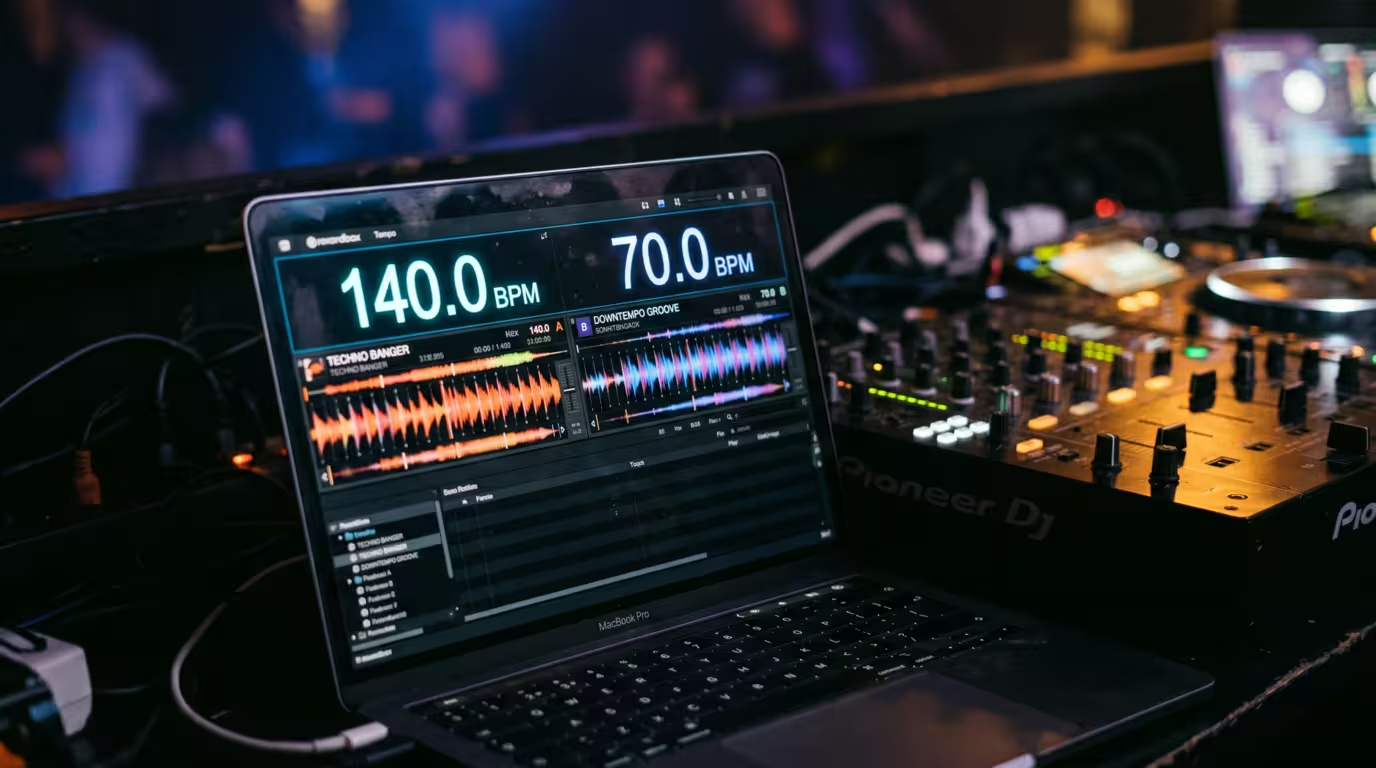
Every major DJ platform sometimes misdetects tempo by exactly a factor of two, because the analyser latches onto the wrong pulse. Drum and bass is the classic victim, frequently showing up as 87 instead of 174. The fix is built in. Serato's analysis settings let you set a BPM range — as Serato puts it, if your tracks are being analysed at 140 BPM and you want them read as 70, choose a 68 to 135 range. Traktor offers /2 and x2 buttons to halve or double the detected tempo instantly, plus a BPM Range setting in its analysis preferences. Rekordbox uses x2 and 1/2 grid buttons for the same job, and Serato also responds to the Alt + arrow shortcut on the BPM field. The practical habit: keep a genre's tracks in one consistent reading so they sort correctly and beatmatch predictably.
Beatmatching and Transitions Across the 2:1
The mixing payoff is huge. As Digital DJ Tips explains in its guide to half- and double-time mixing, a 120 BPM track and a 60 BPM track will beatmix smoothly, and the same works from 70 to 140 — you are simply lining up every other beat of the faster track with the slower one. The one thing to watch is phrasing: when you bridge with half-time, one bar of the slow track equals two bars of the fast track, so you must count in the slower track's bars to keep your 8- and 16-bar phrases aligned.
In practice this lets you cross genre boundaries that look impossible. You can drop a 70 BPM hip-hop track out of a 140 dubstep tune, slide from house into slow hip-hop, or pivot a 95 BPM set into 170-plus liquid drum and bass by aligning kicks rather than matching the displayed numbers. Many DJs layer a half-time track over a double-time one and let the kicks lock. It also gives you energy control without a tempo change: drop into a half-time-feeling track to bring the room down, or lift into a double-time feel to raise it — useful because half-time material often works best in short bursts to build tension rather than for whole sets.
A Quick Genre Map
Half-time and double-time thinking explains a lot of the EDM tempo landscape. Use the table below as a starting point, and the BPM Ranges by Genre article for complete ranges.
| Genre | Typical grid | Feel |
|---|---|---|
| Dubstep | ~140 | Half-time, ~70 |
| Trap | ~130–150 | Half-time, ~65–75 |
| Future bass | ~150 | Half-time, ~75 |
| Halftime DnB | ~170 | Half-time, ~85 |
| Drum & bass | ~170–175 | Full pulse; pairs with hip-hop ~85–87.5 |
Halftime emerged as a named drum and bass subgenre out of the Autonomic project that dBridge and Instra:mental launched in 2009; as Bandcamp Daily notes, halftime tracks flex around the 80 to 85 BPM region rather than drum and bass's traditional double-time, white-knuckle 160 to 170 BPM framework. Genre reference Melodigging describes the style as the drum and bass palette played at half-time — hip-hop swagger at roughly 85 BPM over a 170 grid — with Ivy Lab helping popularise the sound in the mid-2010s via their 20/20 imprint alongside artists such as Fracture and Alix Perez. Footwork and juke sit around 160 BPM and, per Wikipedia, deliberately switch back and forth between hi-speed full-time and half-time sections over a roughly 80 BPM pulse. And the half-time feel itself has deep roots: reggae's one-drop — popularised by Carlton Barrett of Bob Marley and the Wailers — places both the dominant snare stroke and the bass drum on the third beat of every four while leaving beat one empty, according to Wikipedia's one-drop article. That same beat-3 emphasis is exactly what defines half-time, and dub and hip-hop have leaned on its spacious, behind-the-beat pocket for decades.
Common Confusions to Avoid
Keep two distinctions clean. First, a half-time feel is not the same as halving the tempo. Half-time keeps the same BPM and grid and only rearranges the groove; literally changing the tempo moves the clock and re-pitches or time-stretches the audio. The reggae one-drop and a dubstep drop are half-time feels; dragging a pitch fader from 140 to 70 is an actual tempo change.
Second, the production term half-time feel and the DJ-software half-BPM button are related but not identical. The software toggle simply flips between two valid readings of one track's tempo so your grid lands correctly; the production feel is a creative choice baked into how the drums were written. They share the same 2:1 arithmetic, but one is a display fix and the other is musical intent.
Key takeaways
• Half-time and double-time are rhythmic feels: the grid BPM stays fixed while the groove feels slower or faster.
• Half-time moves the snare to beat 3, spacing the backbeat twice as far apart so the music feels half-speed.
• Dubstep and trap are produced near 140 BPM but feel like ~70 because of half-time drums; the higher grid gives finer resolution for fast hi-hat rolls.
• The exact 2:1 pairs (70/140, 75/150, 80/160, 85/170, 87.5/175, 64/128) line up downbeats, so genres an octave apart in tempo can mix.
• DJ software often misreads tempo by half or double; use the x2 and /2 controls or a BPM analysis range to fix it.
• Use half/double-time relationships to bridge big tempo gaps and to control set energy without changing tempo.
Ready-made, exclusive EDM tracks with full rights — released as your own.
