House Music: Born Underground, Now the Backbone of Global Dance Culture
House music is the foundational genre of modern electronic dance music, a four on the floor revolution born in Chicago's Black and Latino queer communities that conquered the world and never stopped evolving. From Frankie Knuckles spinning at The Warehouse in 1977 to PAWSA and Mochakk commanding stages at DC-10 Ibiza in 2026, house has spent nearly five decades reinventing itself while keeping its core groove intact. What began as a post disco underground movement became the rhythmic backbone of global pop culture, influencing everything from Beyoncé's "Renaissance" to Drake's "Honestly, Nevermind" and powering a global electronic music industry valued at $12.9 billion according to the IMS Business Report 2025. House music's endless subgenres, constant demand for fresh releases, and DJ centric culture create an ideal ecosystem for professional ghost production services.
Its most commercially dominant offspring - Tech house, now holds the #1 position on Beatport and has earned its own dedicated page on this site.
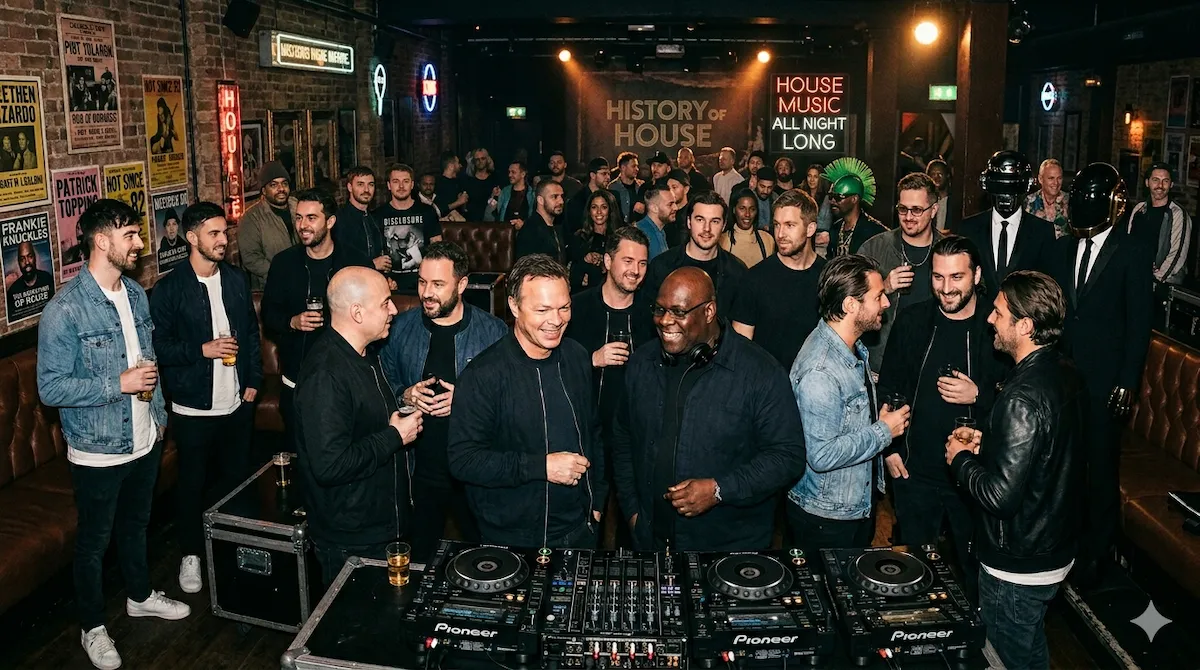
House music's origin story is inseparable from a single building at 206 South Jefferson Street, Chicago. In 1977, promoter Robert Williams opened The Warehouse, a three story former factory in the West Loop, and installed Frankie Knuckles (January 18, 1955 to March 31, 2014) as resident DJ. Larry Levan had been offered the gig first but chose to stay in New York at Paradise Garage, and Knuckles took the Chicago residency instead. That decision changed music forever. The Warehouse catered primarily to Black and Latino gay men, roughly 500 patrons arriving at midnight on Saturday, dancing until midday Sunday, paying $5 admission. Knuckles blended Philadelphia soul, Salsoul disco, European electronic music, and emerging synth pop, using reel to reel tape machines to re-edit songs by extending breaks, layering drum machine percussion, and crafting seamless journeys. The music he played and shaped became known simply as "house," a term originating from Chicago record store Importes Etc., where employee Chip E. labeled bins of Knuckles style tracks "As Heard at the Warehouse," later shortened to "House." Knuckles won the Grammy for Remixer of the Year in 1997 and was officially proclaimed the "Godfather of House Music" by the city of Chicago.
The Warehouse, The Music Box, and Chicago's First Wave
When Knuckles left The Warehouse in late 1982 over a dispute about doubled admission fees, promoter Williams opened the Music Box and hired Ron Hardy as resident DJ. Hardy's style was the raw, combative yin to Knuckles' smoother yang: where Knuckles crafted elegant transitions, Hardy played unconventional DIY mixtapes, added live synths and drum machines to tracks mid set, and embraced a fierce experimental energy. Marshall Jefferson later said he wasn't even into dance music before he went to the Music Box. Hardy premiered some of the most important house records ever made, including playing Phuture's "Acid Tracks" on cassette repeatedly until the crowd finally responded. Hardy died in 1992 at age 34, but his influence on the raw, uncompromising character of house music was immeasurable.
The first house records emerged between 1984 and 1987 in a burst of creativity. Jesse Saunders' "On and On" (January 1984) is widely cited as the first house record pressed to vinyl, recorded using a Roland TR-808, Korg Poly-61, and Roland TB-303, then pressed in 500 copies at Larry Sherman's plant and released on Saunders' own Jes Say Records label. Its success inspired Sherman to launch Trax Records (~1984), which became ground zero for house releases alongside DJ International Records, founded by Rocky Jones in 1985. Larry Heard, recording as Mr. Fingers, created "Can You Feel It" (1986) in a single session using only a Roland Juno-60 and TR-909, a warm jazzy deeply soulful track that became the founding document of deep house. Marshall Jefferson's "Move Your Body (The House Music Anthem)" (1986) introduced piano to house music and became Chicago's signature anthem. Phuture's "Acid Tracks" (1987), created by DJ Pierre, Spanky, and Herb J using a second hand Roland TB-303 bass synthesizer, birthed acid house with its squelching resonant basslines. Steve "Silk" Hurley's "Jack Your Body" became the first house record to reach UK #1 in January 1987, and Farley "Jackmaster" Funk's "Love Can't Turn Around" was among the first house records to chart in Britain in 1986.
Trax Records and DJ International exported Chicago house to the world, though their legacies are complicated. Trax, run by Larry Sherman, released landmark records by Mr. Fingers, Marshall Jefferson, Phuture, Adonis, and Frankie Knuckles but became notorious for unpaid royalties and exploitative contracts, with artists commonly signing tracks away for $1,500–$3,000 and never seeing another penny. Larry Heard and Robert Owens filed suit against Trax in 2020 for unpaid royalties spanning 34 years. Together, though, these labels ensured that Chicago house reached UK and European distributors, setting the stage for the genre's global explosion.
The Second Summer of Love and UK Explosion
In the summer of 1987, four London DJs (Danny Rampling, Paul Oakenfold, Nicky Holloway, and Johnny Walker) traveled to Ibiza for Oakenfold's birthday. At the open air club Amnesia, they experienced the residency of Argentine DJ Alfredo Fiorito, who played an eclectic genre defying mix of Chicago house imports alongside rock, pop, and Latin music. Upon returning to England, they set about recreating the experience. On December 5, 1987, Danny Rampling and his wife Jenni opened Shoom in a Southwark gym basement. Carl Cox installed the sound system. The yellow smiley face from Shoom's third flyer became the iconic symbol of acid house culture. Within 12 weeks, over 2,000 people queued for a 300 capacity venue.
In Manchester, The Haçienda (FAC 51, opened May 21, 1982 by Factory Records' Tony Wilson, financed by New Order) had initially struggled, but DJ Mike Pickering's Friday "Nude" night became one of the first British club nights to play house music in 1986. By 1988, The Haçienda was the epicenter of the Madchester scene. The 1988 Second Summer of Love saw acid house explode across Britain with illegal raves proliferating in warehouses, fields, and abandoned buildings. A Guy Called Gerald's "Voodoo Ray" became the biggest selling UK independent single of 1989, S'Express' "Theme from S'Express" hit UK #1, and 808 State's "Pacific State" became Manchester's acid house anthem. The government eventually responded with the Criminal Justice and Public Order Act 1994, which notoriously outlawed large unlicensed parties featuring "repetitive beats."
Ministry of Sound opened on September 21, 1991, founded by Justin Berkmann and James Palumbo in a former bus garage in Elephant & Castle. Opening night DJs included Larry Levan, David Morales, Roger Sanchez, and Tony Humphries. Alongside Cream in Liverpool (1992) and Gatecrasher in Sheffield, Ministry of Sound defined the superclub era where nightclubs became global brands with compilation albums, merchandise, and record labels.
Detroit Crossover, NYC Garage, and the 1990s
House music didn't develop in isolation. In nearby Detroit, the Belleville Three (Juan Atkins, Derrick May, and Kevin Saunderson) forged Detroit techno: a harder, more futuristic, machine driven cousin influenced by Kraftwerk. Saunderson's Inner City project, featuring Chicago vocalist Paris Grey, produced "Big Fun" and "Good Life" (both 1988), massive worldwide hits that bridged Detroit techno's futurism with Chicago house's soulful warmth. In New York, the garage house scene (named after Larry Levan's Paradise Garage) developed a deeper, more soulful, R&B inflected sound. Todd Terry exploded in 1987–88 as "Todd the God," creating sample heavy hip-hop influenced house. Masters at Work (Louie Vega and Kenny "Dope" Gonzalez) became arguably the most influential production duo in house history, blending Latin rhythms, gospel influenced vocals, and deep basslines into the definitive NYC sound. Their Nuyorican Soul project (1996) featured Roy Ayers, George Benson, and Tito Puente.
Labels like Strictly Rhythm (1989, founded by Gladys Pizarro and Mark Finkelstein) and Nervous Records (1991, founded by Michael Weiss) became NYC house powerhouses. Nervous Records, still operating today, is America's longest standing independent dance label with over 5,000 releases. Kerri Chandler, the New Jersey deep house king, founded Madhouse Records in 1992 and Kaoz Theory in 2016, winning DJ Mag Lifetime Achievement in 2020. The 1990s also saw Green Velvet (Curtis Alan Jones, also known as Cajmere) found Cajual Records (1992) and Relief Records (1993), releasing classics like "Brighter Days" (with Dajae, #2 Billboard Hot Dance) and establishing a quirky, funky Chicago house legacy that extends to the present day. Sasha and John Digweed defined progressive house through extended journey like sets at Renaissance and later Twilo in NYC. Armand Van Helden bridged US garage and UK speed garage, charting UK #1 with "You Don't Know Me" (1999).
