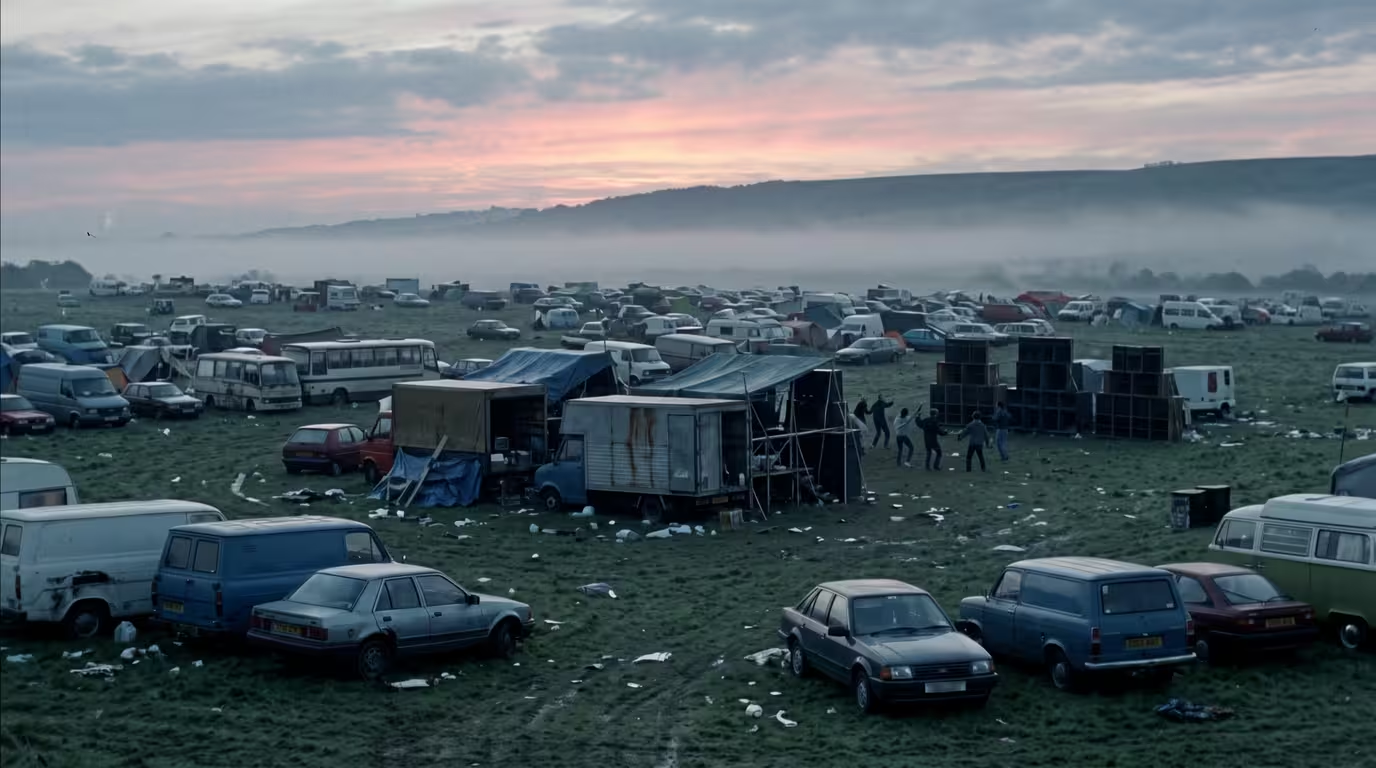
For one week in May 1992, a stretch of common land beneath the Malvern Hills became the largest illegal gathering Britain had seen in a generation. There was no ticket, no promoter, no gate. There were only sound systems, generators, a convoy that stretched for miles, and up to 40,000 people dancing in a Worcestershire field. Castlemorton was the high-water mark of the free party movement, and, almost immediately, its undoing. Within two years the government had written a law that did something extraordinary: it defined a genre of music and then made playing it, in the wrong field, a criminal act.
Blog
Castlemorton and the Free Party Reckoning
How a week-long mega-rave in the Malvern Hills became the moment Britain legislated a musical genre out of existence.
After the Summer of Love
The free party movement was what came next. When acid house detonated across Britain in 1988 and 1989, the orbital raves around the M25 were quickly commercialised, ticketed and, after the 1990 Entertainments (Increased Penalties) Act, pushed toward licensed venues. A section of the scene refused that trajectory. Instead of paying to get into someone else's warehouse, they built their own rigs and threw parties with no admission, no profit and no permission, in fields, quarries, disused buildings and on common land.
Its roots ran deeper than house music. The movement fused the surviving free festival tradition, the New Age Traveller communities who lived on the road in converted coaches and trucks, and the anarcho-punk and squat scenes of Thatcher's Britain. That older world had already collided violently with the state. The Battle of the Beanfield took place on 1 June 1985, when Wiltshire Police stopped a convoy of several hundred travellers heading to set up the Stonehenge Free Festival, enforcing a High Court injunction. Around 1,300 officers confronted roughly 600 travellers; vehicles were smashed, and 537 people were arrested in what is often described as the largest mass arrest of civilians in English legal history. The ITN reporter Kim Sabido, on camera at the scene, called it some of the most brutal police treatment of people he had witnessed in his entire career as a journalist. The Stonehenge festival, which had grown through the 1970s and early 1980s into a gathering of tens of thousands, was over. The grievance it left behind did not go away.
By the early 1990s, ravers and travellers had found each other, a meeting often traced to the traveller fields of Glastonbury. Crusties, squatters, sound-system crews and weekend clubbers pooled into something new, built around autonomy, anti-commercialism and the idea of the temporary autonomous zone: a patch of ground, held for a night or a week, where the ordinary rules were suspended.
The Sound Systems
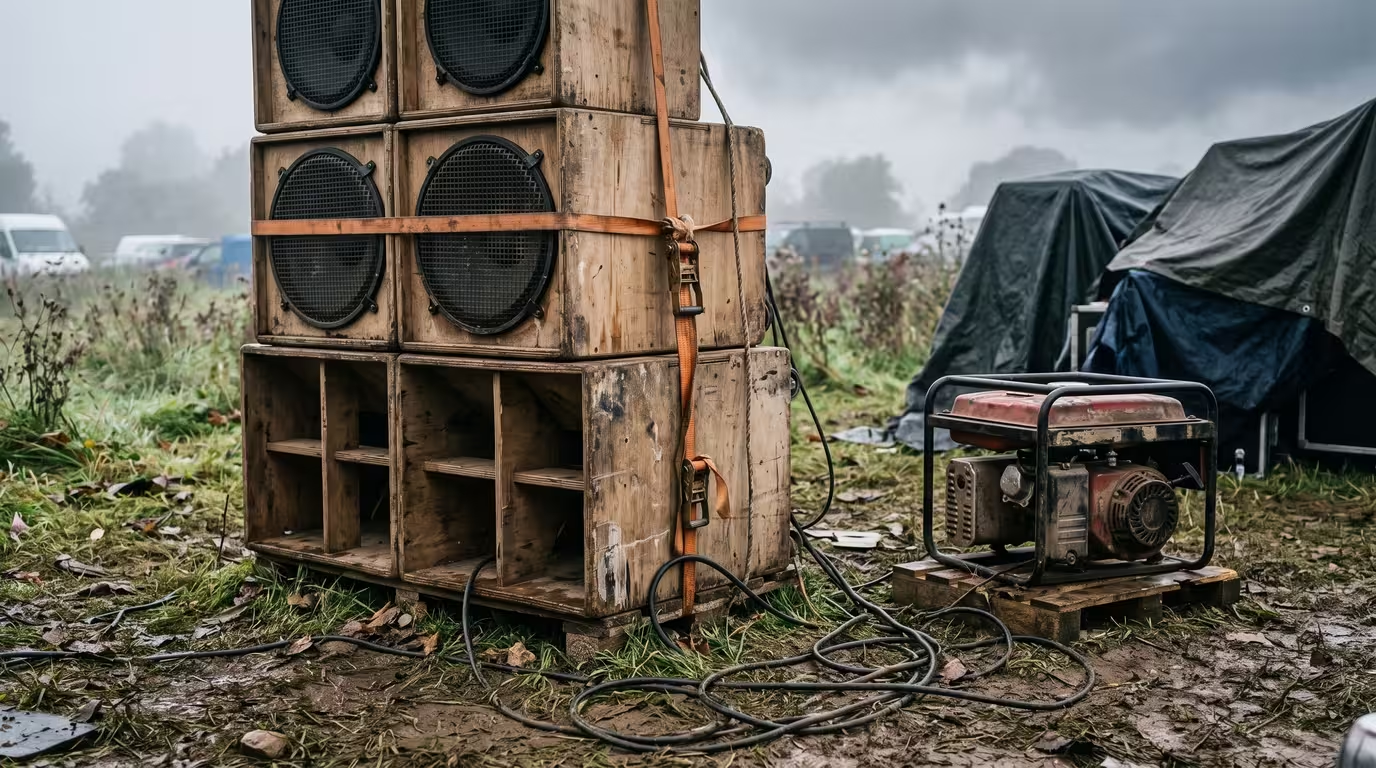
A sound system in this world was two things at once: a stack of speakers, and a tight social organisation that transported, powered, defended and programmed it. The most notorious was Spiral Tribe, formed in 1990 out of the squats of west London. Its founders included Mark Harrison, Debbie Griffith and Simone Feeney; the name, Harrison said, came to him staring at the interlocking spirals of an ammonite shell. Their iconography, from the recurring number 23 to a defiantly profane slogan about making noise, went with a relentless, 24-hour, never-stop ethos. They saw themselves, in Harrison's words, as the people's soundsystem, and their militant hardcore-techno approach became a template for European free-party sound.
They were far from alone. Nottingham's DiY Sound System, formed in 1989 by Harry Harrison, Rick Digs Down, Simon DK Smith and Pete Woosh Birch, came from the same anarcho-punk and free-festival roots but played house, acting as a bridge between counterculture and the club mainstream. Bedlam, Circus Warp, Adrenalin and other crews ran their own rigs. The music sprawled across breakbeat hardcore, acid techno and the harder styles that would soon coalesce into European free tekno.
Castlemorton
Castlemorton happened partly by accident. In May 1992, Avon and Somerset Police mounted Operation Nomad to prevent the annual Avon Free Festival near Bristol. Travellers already on the road were shunted from county to county until West Mercia Police decided to contain them on common land at Castlemorton, in the Malvern Hills of Worcestershire. The first vehicles arrived on 22 May 1992, and by that morning seven sound systems had assembled on the common.
Word spread by phone tree, flyer and, crucially, the national media, which turned the gathering into front-page news and drew ever more people toward it. Estimates of the crowd vary widely and are best treated as reported figures: sources put attendance at somewhere between 20,000 and 40,000 over the week, which ran to 29 May 1992. Police, badly outnumbered, effectively contained the site rather than shutting it down, watching from a distance while the rigs pounded around the clock.
For local residents the week was genuinely miserable, and it deserves to be treated as such rather than as comic relief. The common had no toilets, no sanitation and no first aid; the noise was ceaseless. In a House of Commons debate on 29 June 1992, the local Conservative MP Michael Spicer described the arrivals to Parliament as an invasion and said they had terrorised the local community to the extent that some residents had to undergo psychiatric treatment. Drug use at the site was open, a factual feature of the event rather than something to romanticise. Castlemorton was, all at once, an astonishing feat of self-organisation and a week that a village never asked for.
Free Party: A Folk History

The Trial
After the festival, the state went looking for someone to blame, and it chose Spiral Tribe. Thirteen members were arrested and charged with conspiracy to cause a public nuisance. The prosecution that followed, held at Wolverhampton Crown Court, became one of the longest-running and most expensive criminal cases in British legal history: Simon Reynolds' Energy Flash describes it as lasting four months and costing the UK four million pounds, while other accounts put the trial nearer ten weeks. In March 1994, the jury acquitted all the defendants. The Tribe wore their slogan on T-shirts into the courtroom.
It was a hollow victory. By the time the verdict came, the law was already being rewritten, and the acquittal changed nothing about what was coming.
The Law That Named a Genre
Castlemorton was cited again and again as the spur for new legislation. Introduced by the Home Secretary Michael Howard under John Major's Conservative government, the Criminal Justice and Public Order Act 1994 contained, in Sections 63 to 67, sweeping powers aimed squarely at raves. Police could order people to leave land where a rave was being set up or held, seize vehicles and sound equipment, and, under Section 65, stop people within five miles of a gathering and direct them not to proceed.
Its most infamous passage was the definition. Section 63 defined the relevant music as including sounds wholly or predominantly characterised by the emission of a succession of repetitive beats. A gathering of 100 or more people playing such music at night, likely to cause serious distress to locals, was enough to trigger the powers. Parliament had, in effect, put a working description of dance music on the statute books. That threshold of 100 was later cut to just 20 by Section 58 of the Anti-social Behaviour Act 2003, which also extended the powers to raves held in buildings.
The Bill met fierce resistance. The Advance Party, a collective linked to the free party scene, and the broader Freedom Network coordinated three large London demonstrations in 1994. The first, on May Day, drew an estimated 20,000 people from Hyde Park to Trafalgar Square; the second, on 24 July, was larger, with estimates between 20,000 and 50,000; the third, on 9 October, ended in a violent confrontation in Hyde Park, with organisers claiming as many as 100,000 marchers. Musicians answered too. The Prodigy's Their Law, on Music for the Jilted Generation, released on 4 July 1994, became the pushback's unofficial anthem. And in September 1994, Autechre released the Anti EP on Warp, sealed with a now-legendary sticker: two tracks, it warned, contained repetitive beats and should not be played if the Bill became law, while Flutter had been programmed so that no two bars were identical and could therefore be played legally, though DJs were advised to have a lawyer and a musicologist present at all times. Profits went to the civil-liberties group Liberty.
Diaspora
The Act did not so much kill the scene as scatter it. After their acquittal, Spiral Tribe left for continental Europe, and from the summer of 1993 members organised free parties that grew into teknivals, open-invitation gatherings of many sound systems. The first is generally traced to Beauvais in northern France; the movement seeded CzechTek, which began in 1994 at Hostomice and eventually drew tens of thousands, along with events across France, Italy and beyond. The music they carried, released on Spiral Tribe's Network 23 label, became the blueprint for European free tekno.
At home, the scene fragmented. Much of the energy flowed into the licensed superclub era of Cream and Ministry of Sound, while jungle, drum and bass and hardcore kept evolving in the clubs and on pirate radio. A smaller free party underground survived, and illegal raves never fully stopped; they resurfaced conspicuously during the COVID-19 pandemic, when police broke up unlicensed events from Thetford Forest to a quarry car park in Malvern itself, and organisers faced fines of up to 10,000 pounds.
What It Meant
Castlemorton endures because of what it exposed: an old, unresolved argument in Britain about youth, land, property and the state. A generation had discovered it could seize a piece of ground and hold it, briefly, outside the market, and the state answered not by out-arguing them but by legislating the sound itself out of the open air. It is remembered now as legend, as cautionary tale, and as the rare moment a government tried to ban a rhythm.
There is a quieter legacy too. The movement's DIY logic, to build your own rig, cut your own records and put them out without asking a label's permission, outlived the parties. For any independent producer today, that instinct to make the thing yourself and get it to the floor without a gatekeeper still reads less like nostalgia than a working method.
Key takeaways
• The free party movement was the anti-commercial, traveller-rooted successor to acid house, run by mobile sound systems throwing no-ticket parties on land they did not own.
• Castlemorton, from 22 to 29 May 1992, drew a reported 20,000 to 40,000 people after police diverted travellers from the Avon Free Festival, making it Britain's biggest illegal rave.
• Thirteen Spiral Tribe members were charged with conspiracy to cause a public nuisance and acquitted in March 1994 after a trial reported to have cost around four million pounds.
• The Criminal Justice and Public Order Act 1994 targeted repetitive beats in Sections 63 to 67; the 100-person threshold was cut to 20 in 2003.
• Suppressed at home, the scene scattered into Europe's teknivals and the licensed superclub era, but its DIY ethos survived.
