In the spring of 1982, a much-in-demand Bombay session musician carried three Roland machines into an HMV studio and, over just two days, recorded ten Indian ragas over a stiff disco pulse. The album sold almost nothing and vanished. Nearly thirty years later, a Dutch collector dropped the needle on a battered copy and heard something impossible: acid house, fully formed, half a decade before Chicago gave it a name. This is the story of Charanjit Singh, and of how the same machine can lead two strangers to the same sound on opposite sides of the planet.
Blog
Charanjit Singh: Acid House Before Acid House
How a Bombay session musician built the acid house recipe in 1982, five years before Chicago knew it existed.
The Go-To Man of Hindi Film Music
Charanjit Singh was born on 15 December 1940 in Bombay, into a family that made and sold instruments. He became one of the most reliable session players in the Hindi film industry, working steadily from the 1960s into the 1980s across guitar, bass, violin, keyboards and synthesizer. He was the kind of musician composers built their schedules around, playing on hundreds of soundtracks for the biggest names of the era, among them R. D. Burman, S. D. Burman, Laxmikant-Pyarelal and Shankar-Jaikishan, and touring with the singer Kishore Kumar.
His fingerprints are on records millions of people know without knowing his name. That dreamlike electric-accordion drone opening Dum Maro Dum, from 1971's Hare Rama Hare Krishna, is Singh. He was, by wide agreement, among the first Indian musicians to smuggle synthesizers into film scores, always returning from tours abroad with the newest gear to test at morning rehearsals. By the early 1980s, restless with anonymous session work, he wanted to make something of his own. A warm-up for that ambition already existed: his 1981 record of synthesizer versions of the Silsila soundtrack, released, like most of his work, through the Gramophone Company of India.
Three Machines and an Idea
The idea behind Synthesizing: Ten Ragas to a Disco Beat was disarmingly simple. Disco had arrived late in India but was thriving, powered by hits from Nazia Hassan, Biddu and Bappi Lahiri while the West was declaring it dead. Singh's plan, in his own words, was to try something different using disco music only: to play all the Indian ragas, give them a disco beat and turn off the tabla. He did it, and, as he put it, it turned out good.
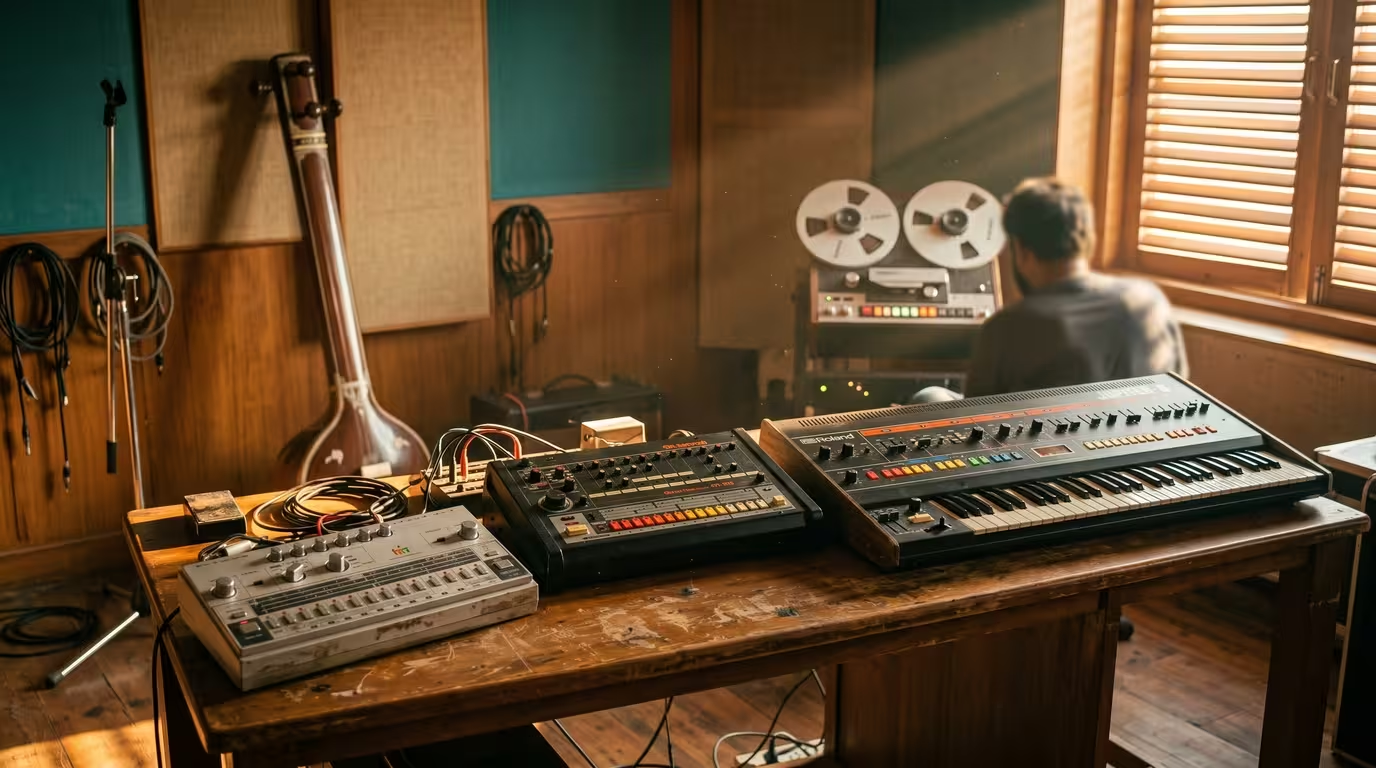
The gear made it extraordinary. On a trip to Singapore, soon after its late-1981 introduction, Singh picked up a Roland TB-303 Bass Line and paired it with a Roland TR-808 drum machine and a Roland Jupiter-8 synthesizer. He spent time at home learning to lock the three together. Crucially, he found the 303 clumsy at the bass-guitar imitation it was built for, but its glissando, the slide from note to note, was perfect for the fluid movement of a raga. So he programmed raga lines into the 303, set the 808 to a brisk disco clip, soloed over the top on the Jupiter-8, and cut the whole thing live at HMV's Bombay studio, reportedly in a modest room in the city's Cuffe Parade.
The tracklist is exactly what the title promises: ten pieces named for the ragas that anchor them, among them Raga Bhairavi, which opens with a vocoder murmuring a Sanskrit invocation, along with Raga Lalit, Raga Bhupali, Raga Todi, Raga Yaman and Raga Malkauns. And the sound that emerges, squelching, resonant, filter-swept 303 lines locked to 808 drums, is note for note the recipe that would later define acid house. Singh had no such word for it. There was not one yet. It got a few plays on All India Radio, filling dead air, then disappeared.
Charanjit Singh - Raga Bhairav (1982)

The Record That Came Back From the Dead
The second life of Ten Ragas began by accident. In 2002, the Dutch DJ and record collector Edo Bouman found a copy in a Delhi shop; back at his hotel he played it and, as he put it, was blown away. He tracked Singh down in Mumbai and met a man baffled by the attention. Bouman recalled that Singh was most friendly and surprised anyone knew the album, and that when asked how he had arrived at such an acid-like sound, he did not quite get the point; he had no idea how stunningly modern it was.
Bouman spent years securing rights and, in 2010, reissued the album on his label, Bombay Connection. What followed was a small detonation in the electronic-music world. The Guardian ran features in 2010 and 2011, the second headlined around Singh inventing acid house by mistake. Resident Advisor reviewed it; Pitchfork, Rolling Stone, Dazed and Vice followed. Rumours briefly circulated online that the record was an elaborate Aphex Twin prank. It was not.
Did He Invent Acid House?
Here the story needs a steady hand. The chronology is real: Ten Ragas (1982) predates Phuture's Acid Tracks, the 1987 Trax Records release that codified acid house, by five years, and predates the Chicago scene entirely. But chronology is not lineage. There is no evidence anyone in Chicago ever heard Singh's album; as Rolling Stone put it plainly in its obituary, there was no connection between Singh and the Chicago scene that helped spread acid house. DJ Pierre, Spanky and Herb J stumbled onto the 303's expressive potential on their own, tweaking its knobs in real time until a friend's demo turned alien.
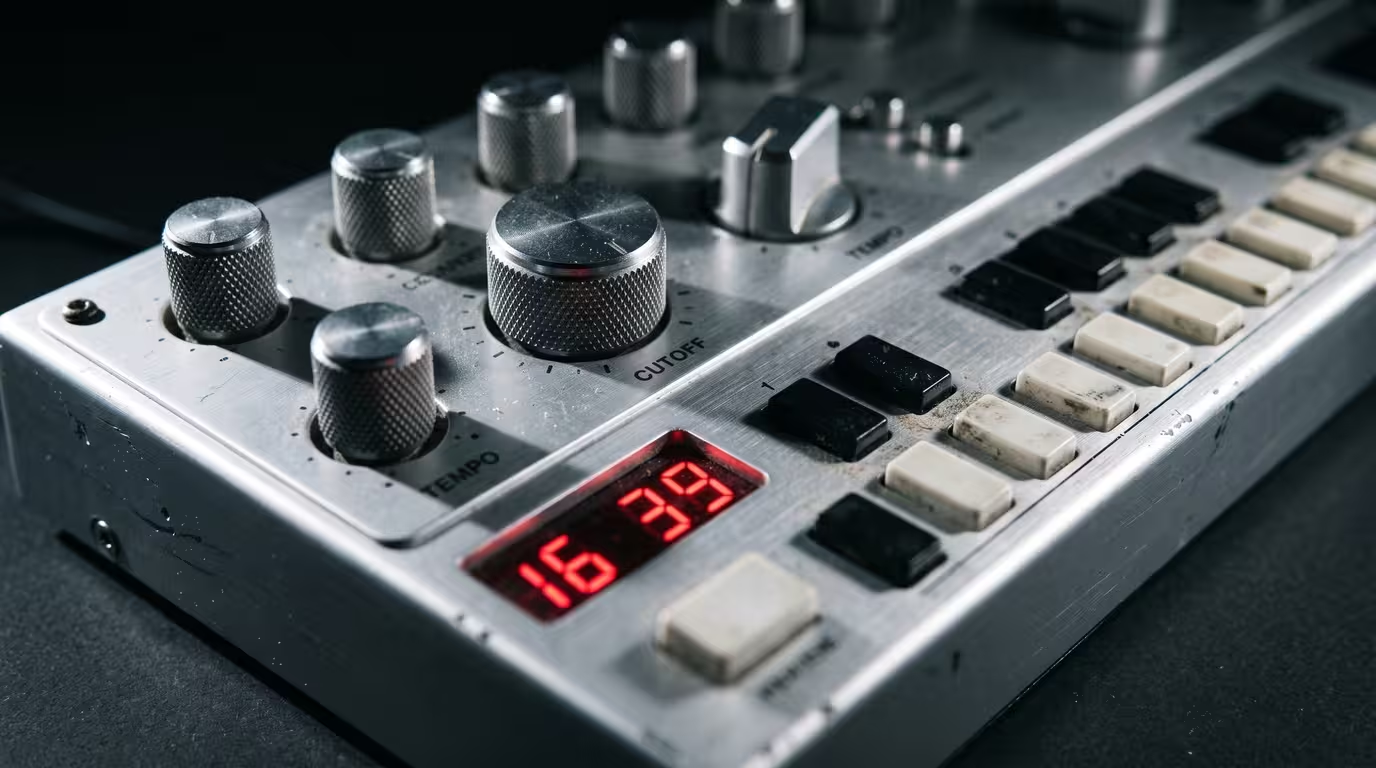
What Singh and Phuture share is not a bloodline but a box. The Roland TB-303 was released in 1981 as a bass-guitar substitute for practising guitarists, flopped commercially, and was discontinued in 1984 after selling only around 10,000 units, after which cheap second-hand units drifted into the hands of experimenters. The machine's sound almost pulls you toward acid. Singh got there through the raga's glissando; Chicago got there through the drug-blurred hedonism of the Music Box. Two independent discoveries, one instrument.
Serious writers have pushed back on the tidy first-acid-house-record headline. In the reissue's liner notes, Discostan's Arshia Fatima Haq and Jeremy Loudenback argue the album is more fittingly placed within the expansion of Bollywood's experiments in disco than within acid house. The Resident Advisor review noted that even the word disco in the title is a misnomer, since there was simply no genre called techno or house that could be invoked. Both are right. Ten Ragas is a genuine curiosity and a testament to the TB-303's character, not a rewrite of acid house's history. Tellingly, when his manager Rana Ghose finally played Singh Acid Tracks in 2010, Singh reportedly found it repetitive and lacking in variation.
A Late, Warm Bow
The best part of the story is that Singh lived to enjoy it. From 2012 he toured internationally for the first time, performing Ten Ragas live with his original 303, 808 and Jupiter-8, with a UK debut in late 2012 and then a 2013 European run through Belgium, France and beyond. On 16 May 2013 he played Berghain in Berlin for CTM Festival, alongside A Guy Called Gerald, the two billed as pioneers who fed the birth of acid house. Audiences met a soft-spoken, endlessly modest man who seemed gently amused that a forgotten record was now treated as prophecy.
Charanjit Singh died in his sleep at his home in Bandra, Mumbai, on 5 July 2015, of cardiac arrest; he was 75, and had reportedly been diagnosed with blockages in his heart only weeks earlier. He was, by all accounts, still working, preparing another London show and sketching an album of folk songs from around the world. His son Raju Singh is an established film composer, and his grandchildren are carrying the name into a third generation of Indian music.
What the Story Really Tells Us
Strip away the clickbait and Singh's record makes a deeper point than the claim that an Indian musician invented acid house. It shows how often innovation happens simultaneously and independently, and how much of what we call inventing a genre is really about scenes, distribution and context, the club, the label and the crowd, rather than who pressed a machine first. It shows how an instrument can shape its makers: give enough curious people a TB-303 and some will inevitably find the acid inside it.
It is also a reminder that electronic music's map is far bigger than Detroit, Chicago and Berlin. Parallel scenes bloomed in India, Japan, Nigeria, Brazil and beyond, and reissue culture and record collecting keep redrawing the borders. And it carries a quiet lesson for anyone making tracks today: the wrong use of a machine, the 303 that refused to sound like a bass, is exactly where new genres tend to come from.
That is what makes Ten Ragas to a Disco Beat sound so uncanny even now. It did not descend from anything and it did not lead to anything; it simply arrived, whole and strange, from nowhere. Charanjit Singh was not chasing the future. He just wanted to make something good, and, decades early, he did.
Key takeaways
• Charanjit Singh (1940 to 2015) was a prolific Bombay session musician who, in 1982, made Synthesizing: Ten Ragas to a Disco Beat using a Roland TB-303, TR-808 and Jupiter-8.
• The record sounds like acid house but predates Phuture's 1987 Acid Tracks by five years, with no evidence of influence on Chicago.
• It is best understood as parallel discovery driven by the TB-303's character, and as part of Bollywood's disco experiments rather than acid house's lineage.
• Rediscovered by Edo Bouman and reissued on Bombay Connection in 2010, it made Singh a late-life cult figure who toured Europe before his death in 2015.
• The bigger lesson: genres are born from scenes and from the unintended uses of machines, and electronic music's history is global.
