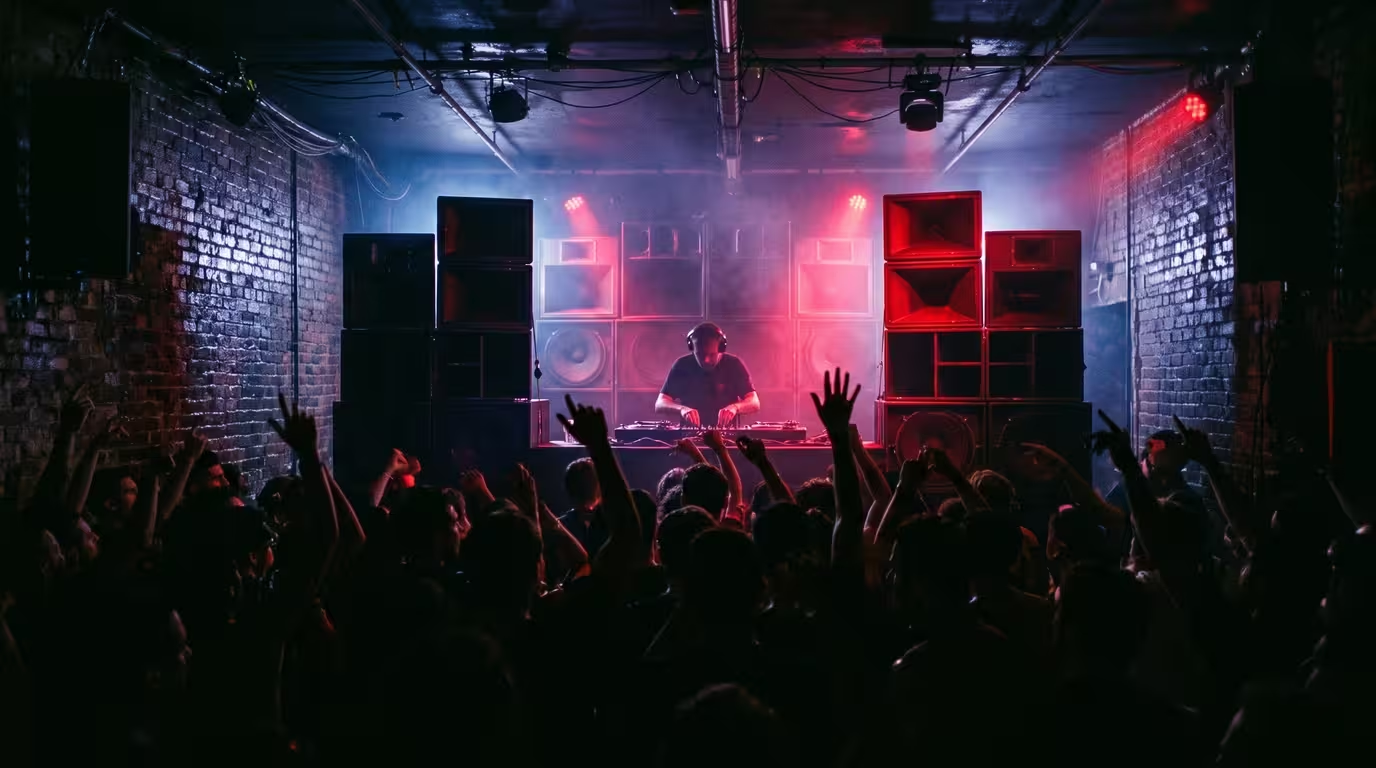
Stand in the right corner of a pitch-black London basement, let a sub-bass note crawl up through the floor and into your chest, and you are standing inside dubstep history. The genre did not arrive fully formed. It was assembled, record by record, by a small circle of South Londoners obsessed with low end, and its unlikely cradle was a record shop in Croydon with a banana for a logo.
Blog
Dubstep's Roots in South London
How a Croydon record shop and a handful of teenagers turned sub-bass into a global language.
A Record Shop in Croydon
Ten miles south of central London, on Surrey Street's fruit-and-veg market in Croydon, sat Big Apple Records, open from 1992 until it closed in 2004. By the turn of the millennium it had quietly become the engine room of a new sound. The head buyer was Terry Leonard, better known as DJ Hatcha, who ran the shop alongside Arthur Artwork Smith and John Kennedy. As UK garage went glossy and commercial, Hatcha pulled in the other direction, stocking darker, sparser, bass-heavier 2-step and playing it on pirate radio.
The shop became a clubhouse. A teenage Oliver Jones, better known as Skream, worked weekends after his brother Hijak introduced him to Hatcha; there he met Adegbenga Adejumo, aka Benga, another kid making tunes on a PlayStation. Mala, Coki and Loefah were regulars too. As Artwork told DJ Mag, when he hears dubstep on television today he still thinks that it started with five or six people in a shop in Croydon. Crucially, it was a daytime space to talk shop, a meeting point for everybody who was into music, somewhere you could compare notes and ask how a record was made rather than shouting over a club PA.
Out of that came the Big Apple label, whose first release was Artwork's 2-step-meets-techno hybrid Red. Its next releases came from his two proteges, Benga and Skream.
From Garage to Something Darker
Dubstep emerged in the late 1990s and early 2000s in South London, splintering off UK garage's 2-step while absorbing jungle, drum and bass, grime, dub techno and, above all, the bass-first philosophy of Jamaican dub and sound-system culture. The earliest proto-dubstep came on the B-sides of garage singles: darker, near-vocal-less remixes by producers like El-B, Steve Gurley, Oris Jay and Zed Bias around 1999 and 2000, with Horsepower Productions sketching the dubbier blueprint.
What set the new sound apart was its commitment to space and weight. It typically runs around 140 BPM but feels much slower thanks to a half-time pulse: kick on the one, snare on the three, with swung garage hi-hats and a lot of silence for the bass to move in. The low end was the point, sub frequencies you feel in the ribcage rather than hear, designed for big sound systems. The dub influence showed in the echo, reverb and emptiness; the very name dubstep was coined to fuse dub with the step of 2-step garage.
Then there was the wobble. The signature dubstep wub is, at its core, a bassline whose filter cutoff is modulated rhythmically by an LFO, often built on a Reese bass, the thick, detuned sound first cut by Detroit's Kevin Saunderson in 1988 and later adopted by jungle and drum and bass. Early on, in Skream's hands, that wobble was a subtle, sub-heavy thing. Later it would be cranked to the ceiling.
The Clubs and Radio That Built It
If Croydon was the foundation, the testing ground was east of the river. FWD>>, founded in 2001, first at the Velvet Rooms in Soho and then settling at the tiny, pitch-black Plastic People in Shoreditch, was the first club devoted to the sound and the place where the dubstep identity took shape. It was here Hatcha road-tested exclusive one-off dubplates cut from Skream, Benga, Mala, Coki and Loefah tracks, igniting an arms race for the heaviest, most exclusive tune. Plastic People's audiophile system and dim red bulb made even unknown DJs feel like giants; the venue closed in early 2015.
The term itself spread through the label ecosystem. Tempa, founded in 2000 by Neil Jolliffe under the Ammunition Promotions umbrella, is credited with coining dubstep around 2002, and a 2002 XLR8R cover feature on Horsepower Productions cemented the word. In 2003, Hatcha's Dubstep Allstars Vol. 1 for Tempa became the first release to carry the name. Pirate-turned-legitimate station Rinse FM carried the sound to bedrooms across London.
Then came two epicentres. DMZ, launched on 5 March 2005 by Mala, Coki (together Digital Mystikz) and Loefah in the basement of Mass in Brixton, a part of London steeped in reggae, became the spiritual home of the deep, meditative strain. Its flyers carried the now-famous invitation to come meditate on bass weight, and its first anniversary, when a 600-strong queue forced a move to the venue's main room, is remembered as a turning point. Brixton's DMZ and Shoreditch's FWD>> are routinely cited as the scene's two most influential nights.
Anthems and Acclaim
A few records pushed dubstep into wider consciousness. Skream's Midnight Request Line, released on Tempa in 2005, was the breakout. As Resident Advisor notes, it started life as a stoned Christmas-Day grime experiment in FruityLoops and ended up the scene's first true crossover anthem, drawing play from house and techno DJs far outside the genre and becoming Tempa's biggest-selling 12-inch. In late 2007, Benga and Coki's Night scored another crossover; per UKF it gained widespread play across genres, and it later registered on the official charts, peaking at number 98 on the UK Singles Chart in 2008 while lingering near the top of the UK dance chart well into that year.
Then there was Burial. Signed to Kode9's Hyperdub, the label Steve Goodman founded in 2004, the anonymous South Londoner released a self-titled debut on 15 May 2006 that topped The Wire's critics' poll as its Record of the Year, ahead of Scott Walker and Joanna Newsom. His second, Untrue (2007), built from crackle, rain and pitch-shifted vocal ghosts, was nominated for the 2008 Mercury Prize and is widely regarded as one of the decade's defining electronic records. It brought serious critical weight to a music born in record-shop back rooms.
The catalyst for a global audience was radio. On 10 January 2006, BBC Radio 1 DJ Mary Anne Hobbs, who had discovered the sound at DMZ, broadcast Dubstep Warz on her Breezeblock show, gathering Mala, Skream, Kode9, Loefah, Hatcha, Distance and Vex'd for a showcase that introduced the scene to listeners worldwide. By 2007 Hobbs was curating dubstep showcases at Spain's Sonar festival, taking the sound onto an international stage.
Skream - Midnight Request Line

The Wobble Goes Global
As dubstep crossed the Atlantic in the late 2000s, it mutated. UK producers Rusko and Caspa had already dragged the bass up out of the sub and into a screeching, aggressive mid-range; Dazed describes Rusko's 2010 album O.M.G! as one of the first fully-fledged articulations of the new style. American and Canadian artists pushed it further. The harder, louder, drop-obsessed style picked up the half-mocking name brostep, coined as a joke by producer Kozee before a 2011 SPIN profile popularised it, a jab at the frat-bro audience the music was drawing.
Its breakout figure was Skrillex. The Los Angeles producer's 2010 EP Scary Monsters and Nice Sprites took the wobble and cranked every parameter to maximum; on 12 February 2012, at the 54th Annual Grammy Awards, the title track won Best Dance Recording and the EP won Best Dance/Electronica Album, two of the three trophies he took that night. The sound became inescapable, soundtracking festivals, films and video-game montages. Excision, Datsik, Doctor P, Flux Pavilion and Nero rode the same wave.
This split the scene. To many UK originators, brostep had thrown away the dub: the space, the sub-bass, the meditative weight. Rusko himself came to regret it, telling BBC 1Xtra that brostep was sort of his fault, and comparing it to someone screaming in your face for an hour. Tempa A&R Sarah Lockhart spoke for the purists when she lamented that the music had lost its original soul. Yet there is no clean villain here: Rusko and Caspa, the figures most blamed, were British dubstep veterans, and the aggression had roots in Coki's own wobblers. Brostep was a mutation of the family tree, not an invasion from outside it.
The Long Echo
Dubstep never really left South London. The deep, system-driven sound lives on through Mala's Deep Medi Musik (founded 2006), DMZ and a global network of festivals and labels, while its DNA seeded post-dubstep, future garage and the broader churn of UK bass music; Burial's ghostly template alone shaped a generation. The wobble made it onto pop records and main stages from Las Vegas to Tokyo, and the meditative strain still draws purists to dark rooms to feel the low end move the air.
It is a remarkable arc for music with such modest origins: a bass-obsessed sound, rooted in dub and garage and the physics of a good sound system, built by a handful of South London kids around a Croydon record shop, and the kind of weighty, system-first music a lot of producers and DJs still chase today. Whether you came to it through Mala's dubplates or a Skrillex drop, you are listening to something that started on Surrey Street.
Key takeaways
• Dubstep was born in South London, with Croydon's Big Apple Records acting as the incubator for Hatcha, Skream, Benga and Digital Mystikz.
• The sound fused UK garage's rhythms with dub and reggae sound-system culture: around 140 BPM, half-time, sub-bass weight, space, and the LFO-modulated wobble.
• FWD>> in Shoreditch and DMZ in Brixton were the key club nights; Tempa, Hyperdub, DMZ and Deep Medi the key labels; Rinse FM and Mary Anne Hobbs' 2006 Dubstep Warz spread the word.
• Skream's Midnight Request Line (2005) and Burial's Mercury-nominated Untrue (2007) were defining moments.
• The genre exploded globally as the harder, mid-range brostep (Skrillex, two 2012 Grammys), creating a lasting tension with the original deep, meditative UK sound.
