Some records describe a scene. A few invent one. In the summer of 1977, a track called I Feel Love arrived from a windowless basement studio in Munich and made almost everything around it sound suddenly old. There was no orchestra, no funk band, just a synthesizer pulsing like a machine that had learned to breathe. The man who built it, Giorgio Moroder, would come to be called the father of disco. The title undersells him. He is arguably the single most influential producer in the history of electronic dance music.
Blog
Giorgio Moroder, the Father of Disco
How a self-taught guitarist from the Dolomites locked dance music to a click track and invented the future.
From the Dolomites to the Road
Giovanni Giorgio Moroder was born on 26 April 1940 in Urtijei, known in Italian as Ortisei, a mountain town in the largely Ladin-speaking region of South Tyrol, in the Italian Dolomites. He grew up in a mixed Ladin-, Italian- and German-speaking household; his father worked as a hotel concierge. He taught himself guitar at 15, and by 18 he was touring Europe as a professional musician, playing clubs by night and tinkering with tape recorders by day.
By the mid-1960s he had drifted into songwriting and production, releasing singles under the name Giorgio after a spell in Berlin. In 1968 he settled in Munich, where his bubblegum novelty Looky Looky earned a gold disc in 1970. His breakthrough as a writer came with Son of My Father: Moroder's own 1972 version flopped in Britain, but a rushed cover by the English band Chicory Tip, recorded on Christmas Eve 1971 at AIR Studios in London, went to number one on the UK Singles Chart for three weeks from 20 February 1972. It is remembered as the first UK chart-topper to feature a Moog synthesizer as its lead instrument, the Moog part played by the engineer Chris Thomas.
The Munich Sound
With the proceeds, Moroder founded Musicland Studios in the basement of Munich's Arabella High-Rise, expanding the room in 1973 with the engineer Reinhold Mack. It became one of the most storied rooms in music: Led Zeppelin, Queen, the Rolling Stones, Deep Purple, Electric Light Orchestra and Elton John all cut records there, many overseen by Mack. But the studio's defining sound came from Moroder himself and his long-time collaborator, the English writer-producer Pete Bellotte.
Around 1974 they met an American singer stranded in Munich after a run in the musical Hair: Donna Summer. In 1975 the three recorded Love to Love You Baby, inspired by the heavy-breathing eroticism of Serge Gainsbourg and Jane Birkin. Stretched, at the request of the Casablanca boss Neil Bogart, into a nearly 17-minute side-long epic, it was banned by some radio stations for its simulated moans and became Summer's first US hit, reaching number two on the Billboard Hot 100, as Billboard later recounted. Summer was crowned the Queen of Disco, and the hits kept coming, including the twin 1979 US number ones Hot Stuff and Bad Girls.
The Record That Rewired Everything
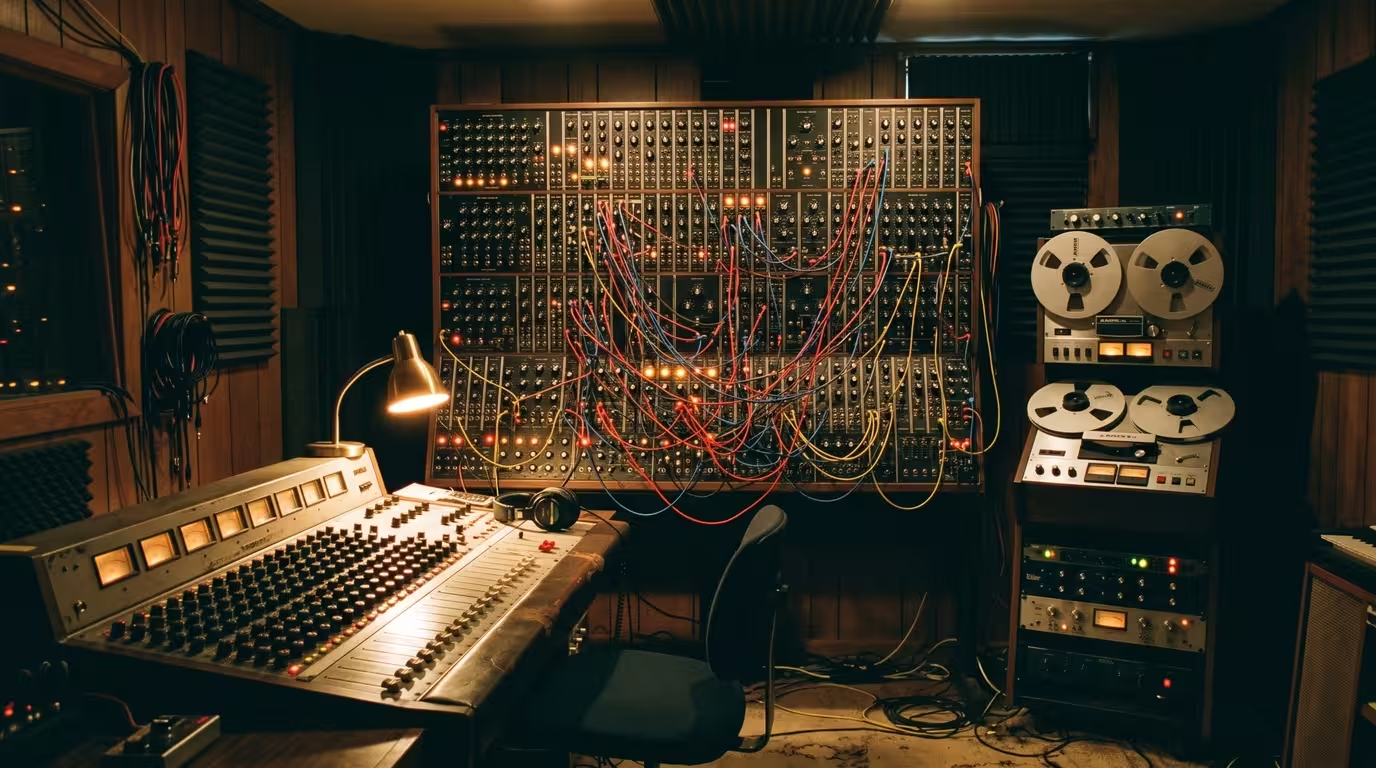
Then came I Feel Love. Recorded for Summer's 1977 concept album I Remember Yesterday, where each track evoked a different musical era, the closing song was meant to sound like the future. Moroder and Bellotte built the entire backing track on a Moog modular synthesizer borrowed from the classical composer Eberhard Schoener. The breakthrough came from Schoener's engineer, Robby Wedel, who showed them how to lock every synth part to a click track so the machine parts stayed in perfect sync, a technique Moroder called a revelation, and one that, by his account, even Robert Moog did not know his instrument could do. The only human element was the drummer Keith Forsey; everything else pulsed out of the Moog. The Sound on Sound account of the session remains the definitive technical record.
The result topped the UK Singles Chart and reached number six on the US Hot 100, but its real impact was philosophical. In the liner notes to his Sound + Vision retrospective, David Bowie recalled the moment: one day in Berlin, Eno came running in saying he had heard the sound of the future, put on I Feel Love, and declared that this was it, that there was no need to look further, and that the single would change the sound of club music for the next fifteen years. Which was, Bowie noted, more or less right. Mixmag has called it the moment dance music's template was set.
Giorgio Moroder on Synthesizers, Donna Summer and Hollywood

The Machine Template
What Moroder actually invented was a method. Fuse a four-on-the-floor kick with a sequenced, arpeggiated synthesizer bassline; lock the players to a click; treat the studio as the instrument and the producer as the author. It made dance music repeatable, extendable and endlessly DJ-friendly. His own 1977 instrumental album From Here to Eternity carried the sleeve boast that only electronic keyboards were used on the recording, complete with vocoder textures that pointed a straight line toward house and techno.
He kept moving through the gear as it arrived: the Moog modular, the Minimoog, the vocoder, sequencers and the digital synths of the 1980s. The lesson producers still take from him is simple: a genuinely new sound usually comes from a new process, not a new preset.
Hollywood and the 1980s
Moroder translated that futurism to film and collected three Academy Awards. He won Best Original Score for Midnight Express in 1978, whose instrumental The Chase became a hi-NRG landmark and an enduring club record, later played by Daft Punk, then Best Original Song twice, for Flashdance... What a Feeling from Flashdance (1983) and for Berlin's Take My Breath Away from Top Gun, which took the prize at the 59th Academy Awards. He has also won four Grammy Awards, two for Flashdance, one for Donna Summer's Carry On and one as a contributor to Album of the Year, and four Golden Globes.
His fingerprints are all over the decade's pop: Blondie's Call Me (1980), a US and UK number one from American Gigolo; David Bowie's Cat People (Putting Out Fire) (1982); the Scarface soundtrack (1983); and The NeverEnding Story theme (1984). That same year he mounted a personal restoration of Fritz Lang's silent Metropolis, adding tint, a new edit and a pop-rock soundtrack that included Freddie Mercury's Love Kills.
The Long Quiet and the Rediscovery
Then he mostly stopped. After 1992's Forever Dancing, Moroder released no new solo album for over two decades, drifting into a comfortable semi-retirement of remixes and visual art. The phone rang again in 2013, when Daft Punk built a nine-minute track around his voice, Giorgio by Moroder, on Random Access Memories, letting him narrate his own life over shifting decades of sound, recorded, famously, on period-correct microphones. The album won Album of the Year at the 56th Grammy Awards in January 2014, and Moroder, then in his seventies, played his first-ever DJ set at the Red Bull Music Academy in New York. A career revival followed: his 2015 album Deja Vu, with Sia, Kylie Minogue, Britney Spears, Charli XCX and Kelis; his first live tour, A Celebration of the 80s, in 2019; and, in 2025, a return on The Weeknd's album Hurry Up Tomorrow.
Why He Matters
Almost every four-on-the-floor record made since 1977 owes something to a basement in Munich. Moroder electrified disco and, in the same stroke, drew the blueprint for hi-NRG, Italo disco, house, techno, trance and synth-pop, the whole machine-driven family tree that modern dance music sits atop. Producers revere him not for a signature chord but for a way of working. You can hear the full arc on his official site and across the catalogue. He is, simply, the man who taught dance music to run on machines.
Key takeaways
• Giorgio Moroder, born in 1940 in South Tyrol, moved to Munich and built Musicland Studios, the crucible of the Munich sound.
• With Donna Summer and Pete Bellotte, his 1977 track I Feel Love set the all-electronic, click-locked template for modern dance music.
• He won three Academy Awards, for Midnight Express, Flashdance... What a Feeling and Take My Breath Away, plus four Grammys.
• Daft Punk's 2013 Giorgio by Moroder sparked a late-career revival, including a DJ debut in his seventies and the 2015 album Deja Vu.
• His real lesson for producers: a new sound comes from a new process, not a new preset.
