Turn the bass up loud enough and it stops being something you hear. It becomes weather: pressure on the chest, a tremor in the floor, a physical fact you stand inside. That sensation is the whole point of a sound system, and it is the thread that runs from a Kingston street corner in the late 1940s all the way to a dubstep night in south London. Before jungle, before garage, before grime, there was the sound: a custom rig, a crew, a box of records nobody else could play, and a crowd that came to be moved.
Blog
Jamaican Sound Systems and UK Bass
How Kingston's hand-built rigs, selectors and dubplates became the blueprint for every British bass genre.
What a Sound System Actually Is
A sound system is not a PA. It is a mobile institution. At its core sits a hand-built rig, towering wooden bass bins and folded-horn scoops designed to reproduce low frequencies you feel more than hear, but the hardware is only half of it. A proper sound is a team: the operator who owns and names it, the selector who chooses and cues the records, the deejay or MC on the microphone, and the following that travels with it. It carries its own exclusive music and its own crowd.
The social function came first. In postwar Kingston, most people could not afford a radio or a record player, and the uptown clubs were closed to them. A sound system solved that in one move: load a truck with a generator, a turntable and a stack of speakers, set up on a corner or in a dancehall lawn, charge a small fee, and the whole neighbourhood had a party. It was a dancehall for people locked out of formal venues, and that idea of building your own space, on your own terms, would travel everywhere the music went.
Kingston, Where It Began
The early sound systems ran on imported American rhythm and blues, from Louis Jordan to Wynonie Harris and Roy Brown, records that scouts hunted down in the United States and guarded jealously. The pioneering operator was Tom Wong, a Chinese-Jamaican hardware-store owner whose sound, Tom the Great Sebastian, was founded around 1950 and is widely regarded as the first great Kingston sound. He was soon joined by two rivals who would shape the island's entire music industry: Arthur Duke Reid, known as The Trojan, who ran his sound from 1953 and later founded the Treasure Isle label, and Clement Coxsone Dodd, whose Downbeat sound led him to found the legendary Studio One.
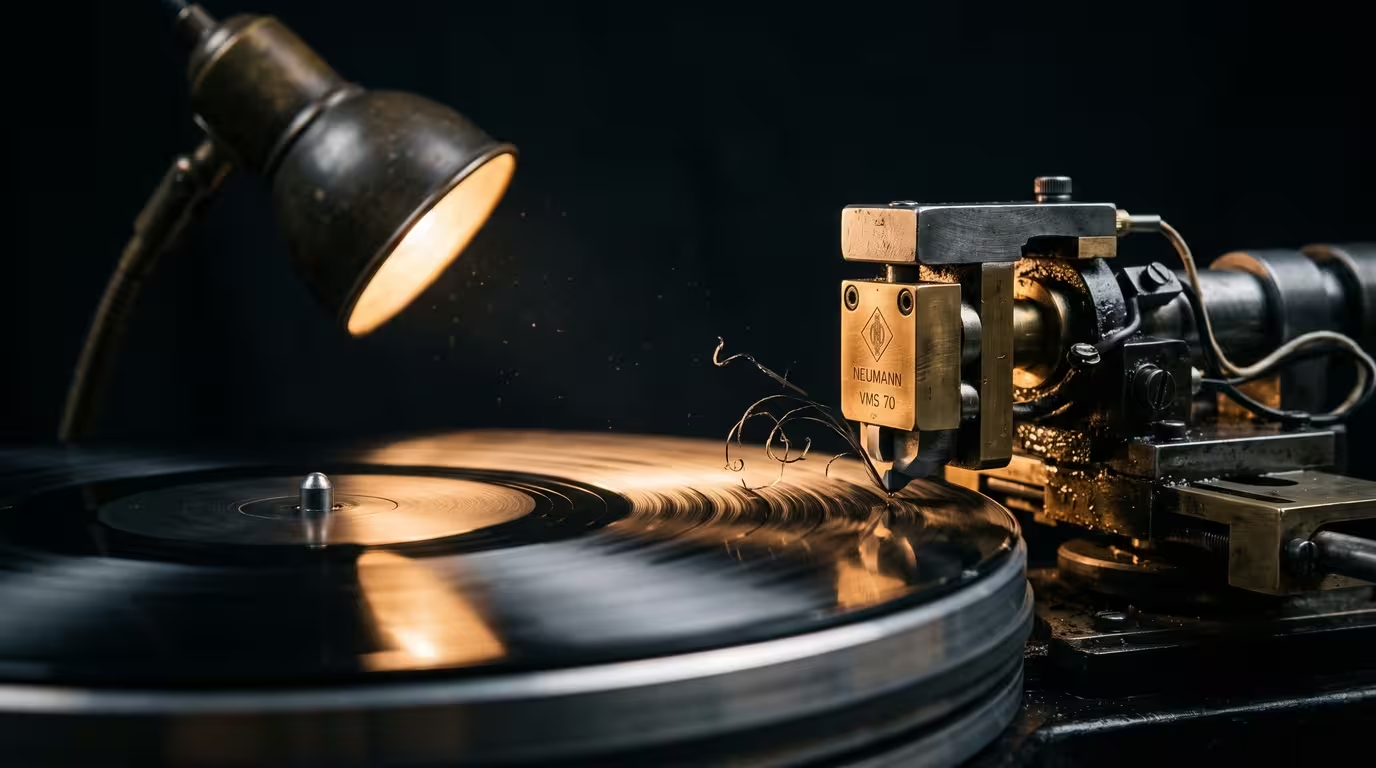
Their rivalry produced the tradition that still defines the culture: the sound clash. Two systems would set up near each other and battle, tune for tune, the crowd deciding the winner. To win, you needed records nobody else had, which produced the practice of cutting a dubplate or special: a one-off acetate cut just for one sound, often with a singer re-recording a hit to big up that specific system. Exclusivity was everything, and in that era the idea of manufacturing those cuts for sale was far from anyone's mind.
Then the supply changed. As American tastes shifted from raucous R&B toward smoother soul in the late 1950s, the flow of danceable imports dried up. Rather than lose their edge, operators like Dodd and Reid began hiring local musicians to record their own tunes, and in doing so became record producers. That pivot is the widely documented cause of the birth of ska, and then rocksteady and reggae. Jamaican recorded music was, quite literally, invented to feed the sound systems.
The Technology and the Art
The rig itself was an engineering project. The key early figure is Hedley Jones, an engineer who trained as a radar technician in the RAF during the Second World War and returned to Kingston to build amplifiers that could separate and enhance bass, mid-range and treble as distinct frequencies. It was Jones who built the powerful custom amplifier that Tom Wong acquired around 1947 and, by Jones's own account, it was Wong who promptly called it a sound system. From the start, this was a DIY culture obsessed with the weight and clarity of bass.
The sound system also gave birth to two innovations that reshaped global music. The first was dub. By the late 1960s, producers were putting instrumental versions on the B-sides of singles so deejays had something to talk over. The often-told origin story, reported rather than proven, credits the sound operator Ruddy Redwood with an accidental vocal-less cut of the Paragons' On the Beach that sent a dance wild. Whatever the spark, it was King Tubby, a Kingston electronics repairman and sound operator, who turned the studio mixing desk into an instrument, dropping out vocals, flooding the track with echo and reverb, and pushing the drum and bass to the front. Lee Scratch Perry pushed the experiment further still at his Black Ark studio. Dub established the radical idea that a mix could be a new composition, the DNA of remix culture worldwide.
The second was toasting. Deejays had long chatted over records, but U-Roy, working with King Tubby's Home Town Hi-Fi around 1969 and 1970, turned it into an art form, rhythmically riding the space the dub versions opened up. His success inspired a generation, from Dennis Alcapone to Big Youth, and toasting became the direct ancestor of MCing and rap.
The Crossing to Britain
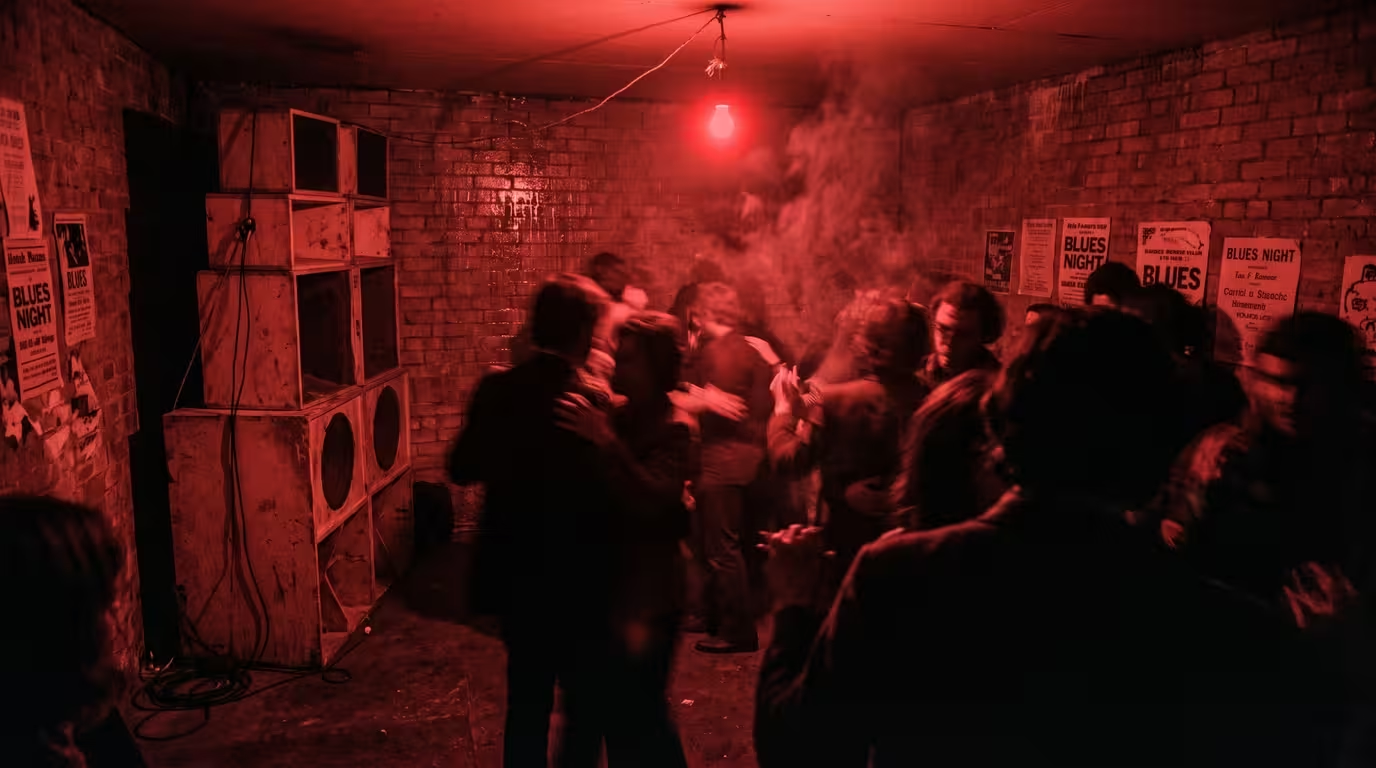
When the Empire Windrush docked at Tilbury on 22 June 1948, it carried 1,027 passengers, including two stowaways, of whom 802 gave their last country of residence as somewhere in the Caribbean, and it gave its name to a generation who arrived in Britain between 1948 and 1971. They came to a country that had invited their labour but too often refused them a welcome: barred from many pubs and clubs, unwelcome on many dancefloors. So, as they had in Kingston, they built their own spaces, the blues dances and shebeens held in front rooms, basements and derelict houses, where an entrance fee covered the rig.
Britain's first Jamaican-style sound system was Duke Vin, built in 1955 by Vincent Forbes, a former selector for Tom the Great Sebastian who had stowed away to England. His great rival, Count Suckle, followed close behind; both were based in Ladbroke Grove. From there the culture spread across Black Britain: Sir Coxsone Outernational, run by Lloyd Coxsone, the mighty roots sound of Jah Shaka, and Saxon Studio International in Lewisham, among many more. It put down roots wherever Caribbean communities settled, from Notting Hill and Brixton in London to Handsworth in Birmingham, Chapeltown in Leeds, Moss Side in Manchester and St Pauls in Bristol.
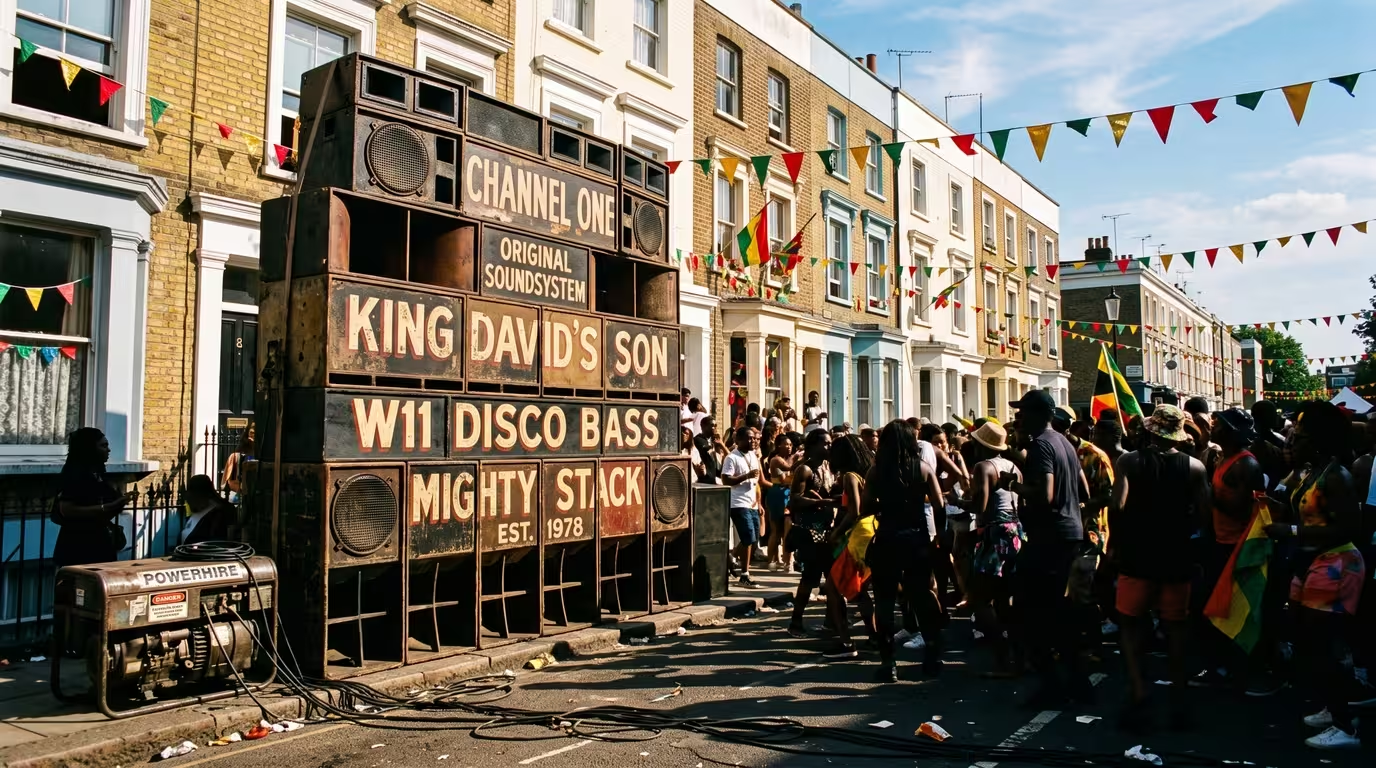
In 1973, the culture went public. Leslie Teacher Palmer, then directing the Notting Hill Carnival, invited static sound systems to become a formal part of the event, a move that helped grow the carnival dramatically and made those towering speaker stacks one of its defining features. Duke Vin's was among the first sounds to play.
British Mutations
Once rooted, the sound system template began generating new British music. A distinctive UK dub and roots scene emerged around Jah Shaka's spiritual, bass-heavy dances and, from 1979, Adrian Sherwood's On-U Sound label, which carried dub's techniques into the wider electronic underground. Lovers rock, reggae's tender, romantic strain, was invented in mid-1970s London by young Black Britons, a genre that gave voice to a generation caught between Jamaica and Britain.
The most far-reaching mutation came from the microphone. At Saxon Studio International, MCs including Peter King, Papa Levi, Tippa Irie and Smiley Culture pioneered a rapid-fire fast-chat style delivered in a mix of Jamaican patois and London slang. Smiley Culture broke through with Police Officer, which peaked at number 12 on the UK singles chart after first charting in November 1984, and the much-loved Cockney Translation, records that told stories about Black British life in a British voice. That fast-chat lineage fed directly into jungle, UK garage, grime and drill.
The deeper inheritance is structural. The bass-first priority, the dubplate as a badge of exclusivity, the MC on the mic, the clash as competition, the pirate-radio and word-of-mouth network: all of it passed from the reggae sound systems into hardcore, jungle, drum and bass, dubstep and every UK bass genre since. Jungle even borrowed Kingston's vocabulary, since the rewind comes straight from sound-clash culture. In Bristol, the Wild Bunch sound system, which grew into Massive Attack, and the production duo Smith & Mighty carried the same DNA into what became trip-hop. The dubstep pioneers of Digital Mystikz explicitly described their approach as sound system thinking.
Heritage and the Living Culture
Sound system culture is now recognised as heritage without losing its pulse. In 2024 the British Library staged Beyond the Bassline, which ran from 26 April to 26 August, was curated by Dr Aleema Gray, and was billed as the first major exhibition to document the 500-year musical journey of African and Caribbean people in Britain, with sound systems at its heart. In 2026 the new V&A East Museum opened with The Music is Black: A British Story, tracing genres from lovers rock to jungle, grime and drum and bass. Meanwhile dozens of static systems still line the streets each August at Notting Hill Carnival, and a thriving UK dub scene continues to build custom rigs and cut fresh plates.
You can hear the culture's core lessons in how club music is still made and played today: build for bass, carry something exclusive that nobody else has, and read the room. That instinct, for the weapon nobody else in the dance is holding, is why exclusive, unreleased tracks still carry such weight. The sound system may be the single most important piece of infrastructure in the history of British popular music: not a genre, but the institution that made the genres possible.
Key takeaways
• A sound system is a mobile institution of rig, crew, selector, MC and exclusive records, born in 1940s Kingston to serve people locked out of radios and clubs.
• The sound clash and the one-off dubplate made exclusivity the central value; the drying-up of US R&B imports pushed operators to record their own music, birthing ska, rocksteady and reggae.
• Dub, through King Tubby and Lee Perry, and toasting, through U-Roy, grew directly out of sound system needs and reshaped global music.
• The Windrush generation rebuilt the culture in Britain from 1955 onward, in blues dances and, from 1973, at Notting Hill Carnival.
• The bass-first, dubplate-driven, clash-oriented template seeded lovers rock, jungle, UK garage, dubstep and grime, the whole UK bass tradition.
