Most dance records grab you in the first eight bars. Progressive house does the opposite. It waits. A kick settles into a groove, a pad drifts in, a bassline starts to roll, and over the next several minutes the track adds and subtracts layers until you suddenly realise you have been taken somewhere. That patience, the long build, the slow reveal, the sense of a journey rather than a hook, is the genre's whole identity. It is also the reason progressive house could survive two completely different lives: one in the shadows of 1990s British clubs, and one in the floodlights of the 2010s festival circuit.
Blog
The Long Build of Progressive House
How a patient, journey-style club sound from the 1990s UK underground became the roar of festival mainstages.
What Progressive Actually Means
Progressive house is a subgenre of house music built on gradual, evolving structure. Where classic house tends to introduce its elements early and loop them, progressive house develops deliberately, layering synths, shifting frequencies and stacking tension across extended arrangements before any real release. The four-on-the-floor pulse stays steady, usually somewhere between 120 and 130 BPM, with the modern festival strain settling around 128. As the standard reference overview puts it, intensity comes from the regular addition and subtraction of layers of sound, with phrases of four, eight or sixteen bars that each introduce a new melody or rhythm.
The toolkit is consistent across eras: lush, atmospheric pads; rolling, dub-influenced basslines; melodic and emotional content; and arrangements long enough to breathe. The word progressive itself, borrowed loosely from progressive rock, points at that forward-moving, continuously building shape. It is music designed less around a single drop than around architecture, and that makes it as much a DJ's craft as a producer's.
Born in the British Underground
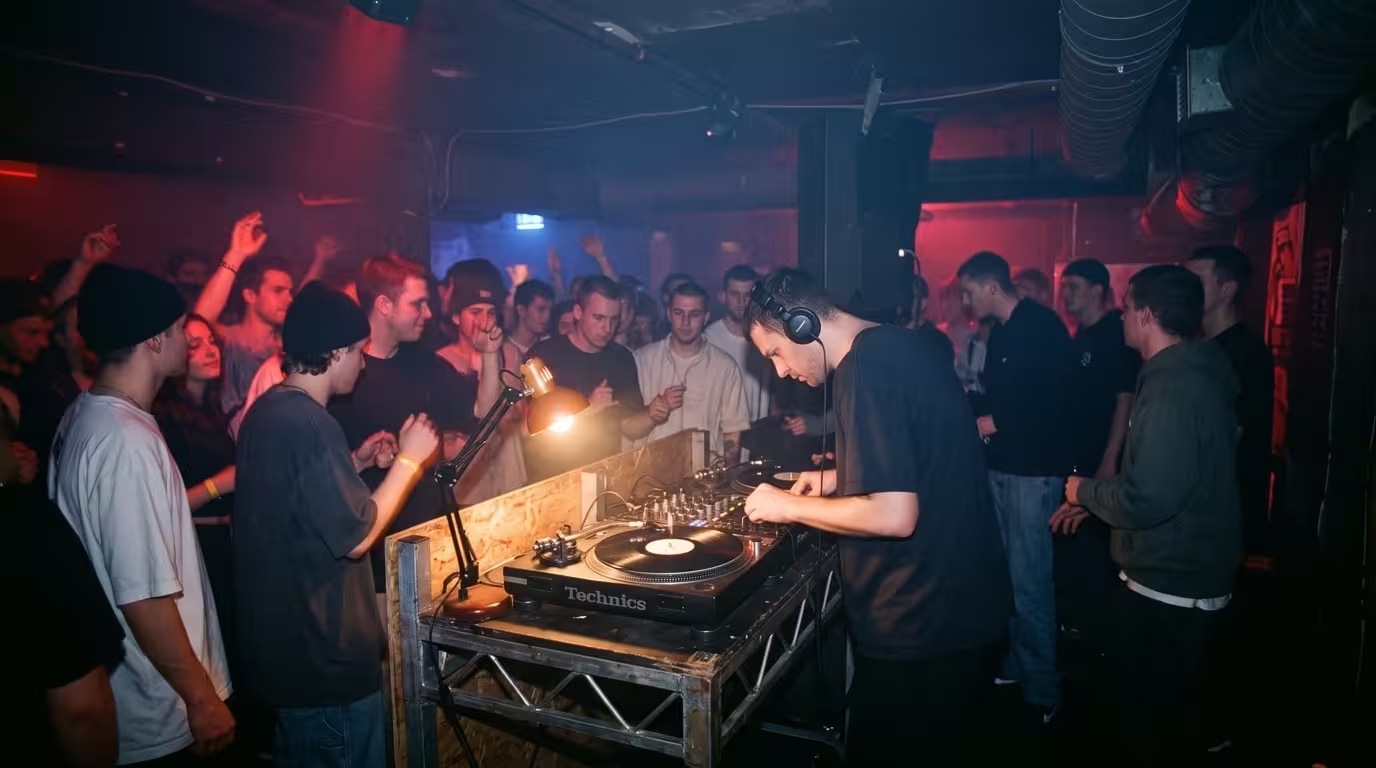
The roots run to the early-1990s UK rave and club scene. British DJs had spent years spinning imported American house and European sounds; progressive house was the moment the UK grew its own. Leftfield's 1990 single Not Forgotten, released on Outer Rhythm, is widely cited as a blueprint: deep, dubby, atmospheric house that did not fit garage, techno or piano house. In fact, the term itself was reportedly coined to describe Leftfield's fusion of house with dub and reggae. The London label Guerilla Records, set up by William Orbit and Dick O'Dell, became the scene's hub.
The name is generally credited to the Mixmag journalist Dom Phillips, who in a June 1992 article titled Trance Mission described a new breed of hard but tuneful, banging but thoughtful, uplifting and trance-y British house, at home with the trendier Balearic crowd yet just as capable of entrancing a rave. Progressive house, he wrote, is what we will call it: simple, funky, driving, and something that could only be British. The label stuck, even if, by Phillips' own account, it was partly a way to make a fresh sound easier to talk about and market.
If the records lit the fuse, the DJs built the cathedral. Sasha and John Digweed, who came together at the Renaissance club night, became synonymous with the long, seamless, journey-style set. Their 1994 triple-CD Renaissance: The Mix Collection helped turn the mix album into an art form, and 1996's Northern Exposure pushed further still. As the Recording Academy notes, it was conceived as two journeys, discs that straddled home listening and dance-floor reverie long before taking the listener on a journey became a cliche. Their late-1990s residency at New York's Twilo did the same for American clubland.
The Connoisseur Years
Through the late 1990s and 2000s, progressive house blurred into neighbouring sounds: progressive trance, progressive breaks, the broader progressive club aesthetic. The mix series spread it worldwide; Global Underground, launched in 1996, turned touring DJs like Sasha, Digweed, Nick Warren and Dave Seaman into globe-trotting brand names with city-themed compilations.
Digweed deepened the project with Bedrock, his duo and label alongside Nick Muir. Their 1999 track Heaven Scent launched Bedrock Records and captured the spirit of their monthly night at Heaven in London, an end-of-the-night record built to make a packed room roar. This was progressive house as a connoisseur's pursuit: deep, hypnotic, atmospheric and proudly underground. It even drew a backlash by the early 2000s, with originators like Dave Seaman admitting the sound had grown pompous, po-faced and full of its own self-importance before it mutated again.
The Festival Transformation
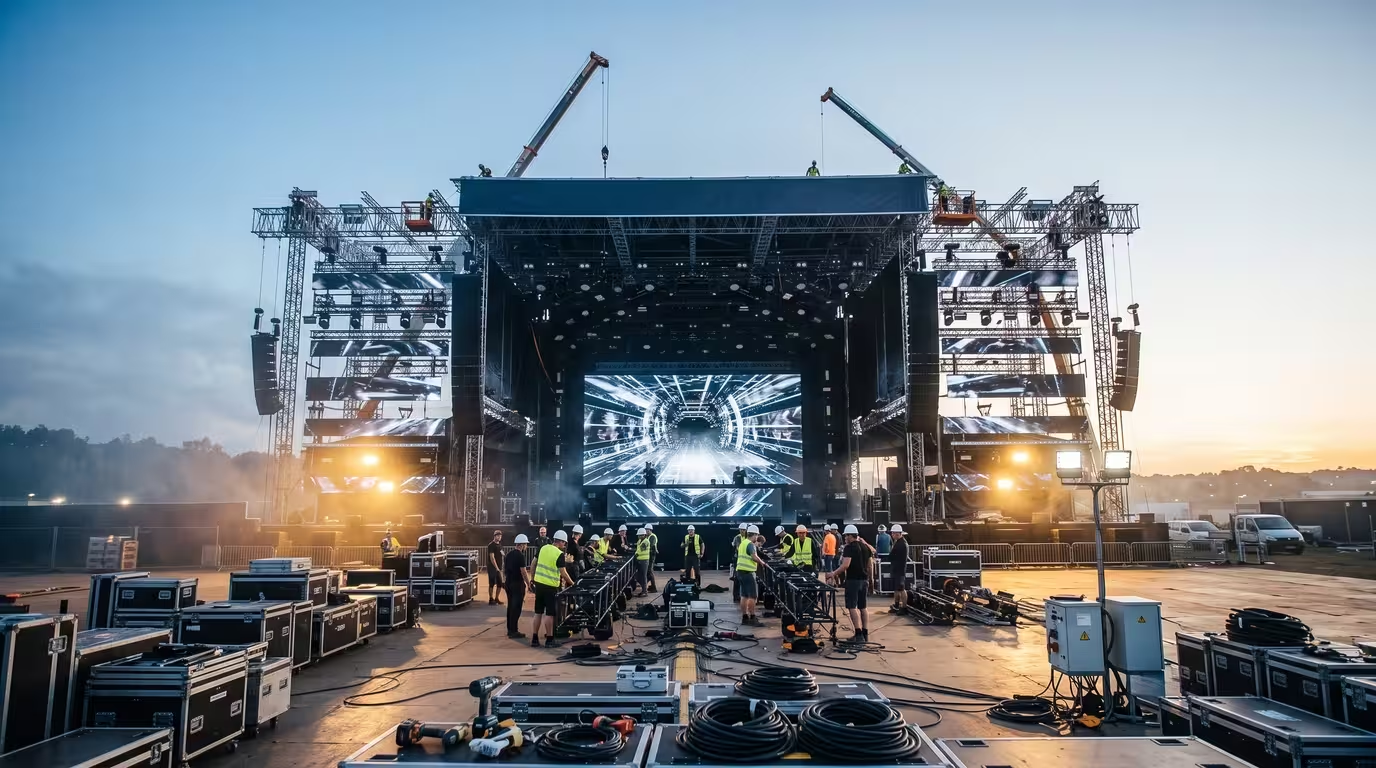
Then the word changed meaning. In the late 2000s and through the 2010s, progressive house came to describe something far bigger and more anthemic, the emotional, build-and-drop sound that became one of the defining noises of the global EDM boom. The DNA was the same, tension, melody and the long climb, but it was rebuilt for mainstages, fireworks and mass sing-alongs.
deadmau5 was pivotal. Joel Zimmerman's melodic, instrumental style, exemplified by the slow-burning Strobe (2009) and the vocal crossover Ghosts n Stuff with Rob Swire, modernised the progressive build for a new generation, most of his tracks sitting at 128 BPM. The Swede Eric Prydz, recording as Pryda, perfected the epic build: released in August 2008 on Data Records, Pjanoo topped the UK Dance Chart for ten non-consecutive weeks and peaked at number two on the UK Singles Chart, while Opus (2015) became a slow-rising live legend. His EPIC and HOLO shows pioneered hologram-driven spectacle.
The most commercially explosive strain was Swedish. Swedish House Mafia, made up of Axwell, Steve Angello and Sebastian Ingrosso, fused progressive builds with pop songwriting and arena-scale sound design. One (2010) and Save the World (2011) set the template; Don't You Worry Child (2012), featuring John Martin, debuted at UK number one with 135,000 first-week copies, finished as the year's 13th best-selling UK single at 632,000 copies, and peaked at number six on the Billboard Hot 100 in early 2013, earning a Grammy nomination for Best Dance Recording.
Swedish House Mafia ft. John Martin - Don't You Worry Child
Avicii's Levels, released in October 2011 and built around an Etta James sample, premiered at Ultra Music Festival in Miami in March 2011 and went on to top the US Dance Club Songs chart, one of the first true crossover anthems of the American EDM mainstreaming. Zedd brought a classically trained ear to the style: his debut album Clarity (2012) yielded a title track, featuring Foxes, that won the Grammy for Best Dance Recording at the 56th Grammy Awards in January 2014. Around them swirled Alesso, Calvin Harris, Porter Robinson, and the progressive-trance euphoria of Above & Beyond, whose Anjunabeats album Group Therapy (2011) spawned a world tour and a long-running radio show. Festivals supplied the amplifier: Ultra, EDC and Tomorrowland turned anthemic progressive house into a worldwide phenomenon between roughly 2010 and 2014.
It is worth being fair about the naming. The festival progressive house of the 2010s is a different animal from the patient 1990s journey sound, a genre-tag evolution not unlike what happened to other styles. Both are legitimate; they simply emphasise different halves of the same idea.
The Legacy, and Its Two Faces
Progressive house never really left, it split. The original journey strain keeps going through Sasha, Digweed and a still-active Bedrock, plus a global underground network of deep, melodic DJs. Its emotional, build-driven DNA also flows directly into the melodic house and techno wave of the late 2010s and 2020s. Labels like Anjunadeep, launched as the deeper sister of Anjunabeats, and artists such as Lane 8, Yotto, Tinlicker and Ben Bohmer carry the patient, emotional, layered torch forward, often under the melodic house banner but unmistakably descended from progressive house.
That is the through-line. Whether whispered across an eight-hour club set or detonated over a festival crowd, progressive house is the music of the long build, of patience rewarded, layers stacked, and a payoff earned over time. For producers and DJs who care about emotional arc and craft rather than instant gratification, it remains one of the most rewarding shapes in dance music to study and to make.
Key takeaways
• Progressive house is defined by gradual, layered, journey-style builds, typically 120 to 130 BPM and often 128 in its festival form.
• It emerged in the early-1990s UK underground; the name is credited to Mixmag's Dom Phillips in 1992.
• Sasha and John Digweed, Renaissance, Northern Exposure and Bedrock made it a DJ's long-form art.
• In the 2010s it was reborn as a festival-mainstage sound via deadmau5, Eric Prydz, Swedish House Mafia, Avicii and Zedd.
• Its emotional, build-driven DNA lives on in today's melodic house through labels like Anjunadeep and artists like Lane 8 and Ben Bohmer.
