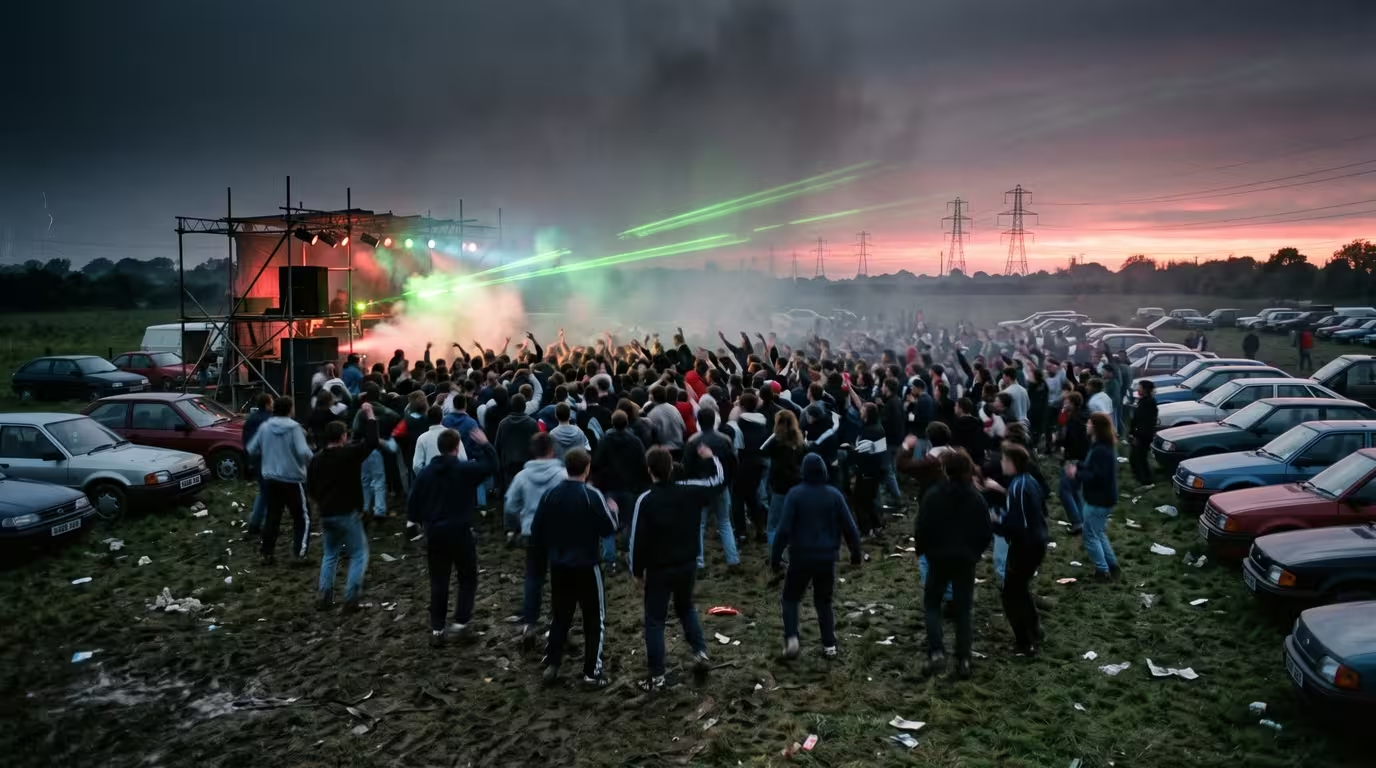
Picture a disused aircraft hangar in Berkshire in the small hours of a June morning in 1989: thousands of young people, a wall of squelching electronic bass, dry ice and lasers, and a car park stretching back down the lanes toward the M25. A year earlier the same energy had been packed into a 300-capacity basement gym in south London. This was the Second Summer of Love, the moment acid house and ecstasy collided and changed what British youth culture looked like for a generation.
Blog
The Second Summer of Love
How acid house and ecstasy turned British youth culture inside out across 1988 and 1989.
What the Second Summer of Love Actually Was
The Second Summer of Love is the name given to Britain's acid house explosion, when house music and the drug MDMA fuelled a mass movement of clubs, warehouse parties and open-air raves. Sources differ on the exact dating: some fix it on the summer of 1988, others on 1989, and many treat it as both. It borrowed its name from the hippie Summer of Love of 1967, and its emblem became the yellow smiley face, cheap, cheerful and instantly readable on a flyer.
The scale was genuinely enormous, drawing hundreds of thousands of people, and it cut across the usual British dividing lines. On dancefloors fuelled by ecstasy, football rivals, soul boys, students and shop workers mixed in a way that unsettled the country's normal tribal geography. It was, by common consent, the biggest shift in British youth culture since punk.
The Ibiza Spark
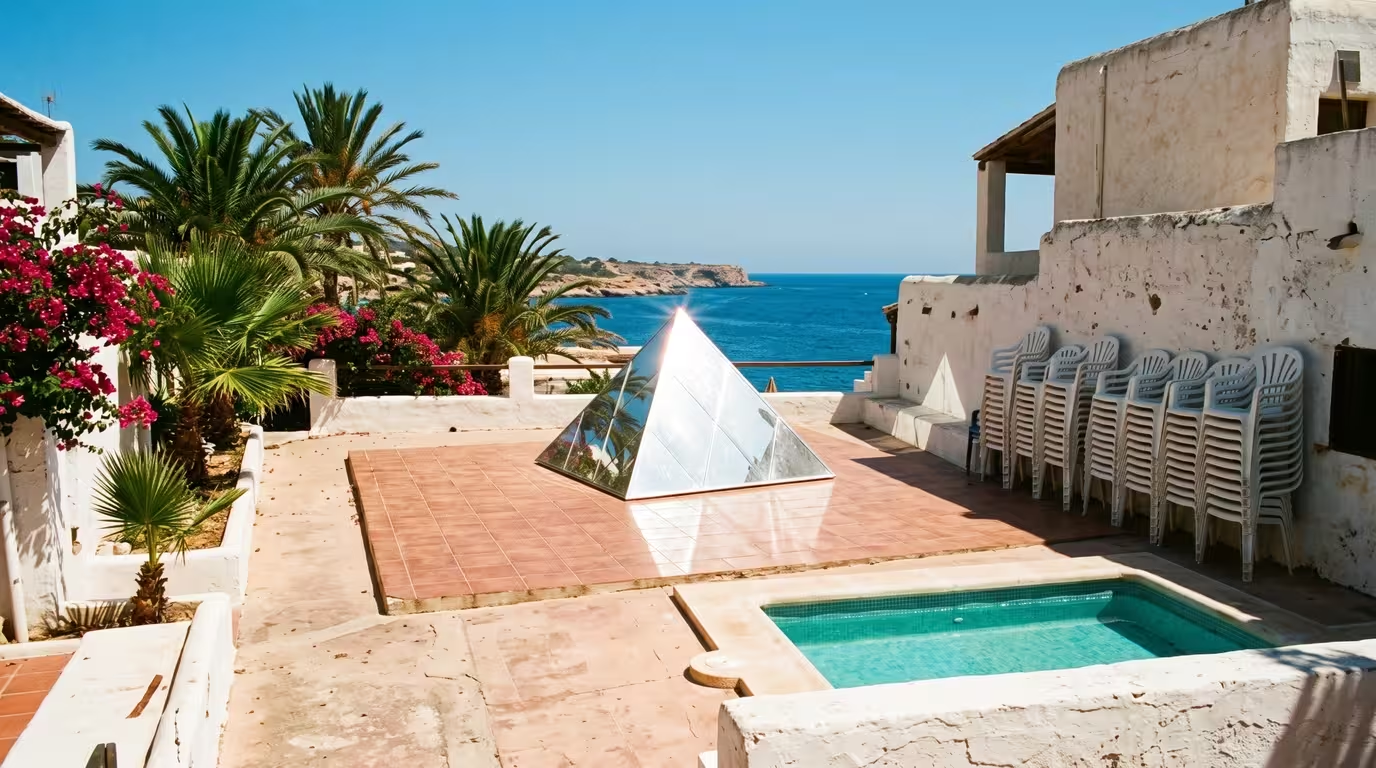
The origin story is now legend. In the summer of 1987, four London DJs, Paul Oakenfold, Danny Rampling, Nicky Holloway and Johnny Walker, spent a week in Ibiza, the trip pegged to Oakenfold's birthday. They ended up at Amnesia, then an open-air club, where the Argentine resident DJ Alfredo Fiorito played a wildly eclectic set: Chicago house next to pop, rock, reggae and European oddities, all bound together by the empathic rush of MDMA. The mix became known as Balearic. As Holloway later put it, on ecstasy it all made sense. They came home determined to recreate it.
London Goes Underground
Rampling and his wife Jenni moved first, opening Shoom in November 1987 in a basement fitness centre on Southwark Street: 300 capacity, strawberry-scented smoke, strobes and a fierce sense of intimacy. Its flyers adopted the smiley, and the club became the blueprint for what came next.
The others followed fast. Oakenfold launched Future in the back room of the gay superclub Heaven, then opened Spectrum in the main room on Monday nights on 11 April 1988; the opening reportedly drew only 124 people to a 2,500-capacity room before it exploded into a phenomenon. Holloway brought acid house to the West End with The Trip at the Astoria in June 1988, an intense night that pulled in up to 3,000 people. Harder and grubbier was RIP at Clink Street near London Bridge, also from June 1988, where a tougher, more stripped-back house sound played to a mixed crowd in a labyrinthine warehouse. Nightlife's old rules, from dress codes and velvet ropes to champagne, gave way to sweat, hugs, dungarees and bottled water. The template spread across the country, most famously to Manchester and the Hacienda.
The Music: A 303 and a Sampler
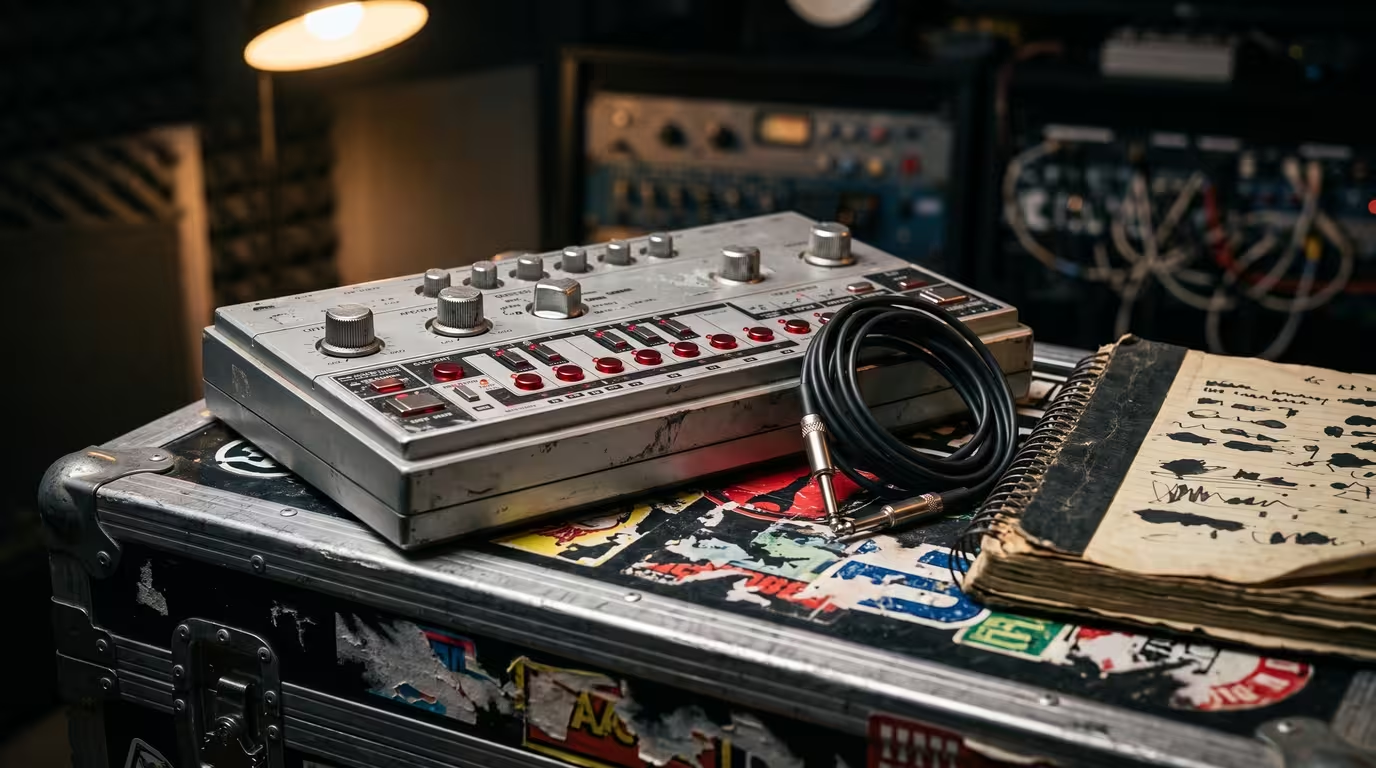
The signature sound was the acid squelch of the Roland TB-303 bass synthesizer, its filter twisted in real time until it screamed. The first record to weaponise it was Chicago's Phuture with Acid Tracks (1987), and imported American house records were the lifeblood of the early clubs.
Then Britain started making its own, and the charts were invaded. MARRS's Pump Up the Volume had already hit number one in October 1987. In 1988 came Bomb the Bass's Beat Dis, which debuted at number five on 20 February 1988 and peaked at number two, held off the top by Kylie Minogue's I Should Be So Lucky; its centre label famously featured a smiley lifted from Watchmen, and that usage is credited as the origin of the smiley as a symbol for acid house. S'Express's Theme from S'Express went to number one that April. Coldcut's Doctorin' the House reached number six, and D Mob's We Call It Acieed hit number three. Manchester answered with A Guy Called Gerald's eerie Voodoo Ray, which reached number 12 and was the best-selling independent single of 1989, and 808 State's Pacific State, which reached number 10. Cheap samplers and drum machines meant anyone with ideas could make a record, and the DJ, not the band, became the central figure.
A Guy Called Gerald - Voodoo Ray
From Warehouses to the Orbital
As police pressure grew in central London, the parties moved out, first to warehouses, then to enormous illegal gatherings in fields and hangars around the M25 orbital motorway. Promoters like Sunrise, Energy, Biology, Genesis and World Dance ran a cat-and-mouse game with the authorities: telephone voicebank lines, last-minute meeting points, and long convoys of cars snaking down country lanes toward a secret site. The most notorious was Sunrise's A Midsummer Night's Dream at White Waltham airfield on 24 June 1989, reportedly attended by around 11,000 people, the event The Sun dubbed Ecstasy Airport. It was run by the promoter Tony Colston-Hayter, who later evaded a conviction for staging an unlicensed party by arguing that Sunrise was a private members' event. For a few hours at a time, these were temporary autonomous zones, self-governing and euphoric before the sun came up.
Moral Panic and the Crackdown
The tabloids could not resist. In October 1988 The Sun briefly tried to cash in, offering readers cut-price smiley T-shirts, before abruptly reversing into condemnation days later with an anti-ecstasy front page. The panic had a human cost that deserves to be handled soberly. Among the earliest ecstasy-related deaths widely reported at the time was that of Janet Mayes, 21, who died on 28 October 1988 after taking two ecstasy tablets at an acid house party at the Jolly Boatman pub in Hampton Court; her death was splashed across the front pages in the language of moral panic.
The state responded on two fronts. Police set up the Pay Party Unit, nicknamed the Acid House Squad, in 1989 under Chief Superintendent Ken Tappenden, coordinating a national crackdown from a base in Kent. Then came legislation. The Entertainments (Increased Penalties) Act 1990, sponsored by the Conservative MP Graham Bright and known as the Acid House Bill, raised the penalty for staging an unlicensed party to a 20,000-pound fine and up to six months in prison. Four years later, the Criminal Justice and Public Order Act 1994 went further, its Section 63 notoriously defining the targeted music as sounds wholly or predominantly characterised by the emission of a succession of repetitive beats.
The Legacy
The clampdown did not kill dance music, it professionalised it. As the free-party era was squeezed, the energy poured into licensed superclubs: Ministry of Sound opened on 21 September 1991, and Cream followed at Nation in Liverpool in October 1992, with Renaissance emerging around the same time. Within a few years dance music was Britain's dominant youth culture and the foundation of a modern club and festival economy. Its DNA runs through every British dance genre that followed, from jungle to garage and grime, and its influence reached into fashion, football culture and the long-running argument about drug policy.
Perhaps its quietest revolution was in how music got made. The Second Summer of Love was the moment the producer and the DJ replaced the band as the engine of youth music, and the DIY, sampler-driven ethos it unleashed still underpins how dance records are built today. That is the enduring shape of it: a couple of summers when British youth culture reorganised itself around a beat, and never quite changed back.
Key takeaways
• The Second Summer of Love was Britain's 1988 and 1989 acid house explosion; sources date it to one year, the other, or both.
• It began with a 1987 Ibiza trip and moved through London clubs like Shoom, Spectrum and The Trip to illegal orbital raves.
• Acid house records stormed the UK charts and made the DJ-producer, not the band, the central figure.
• A tabloid moral panic and police crackdown led to the 1990 Acid House Bill and the 1994 repetitive-beats law.
• The scene professionalised into the superclub era and left dance music as Britain's dominant youth culture.
