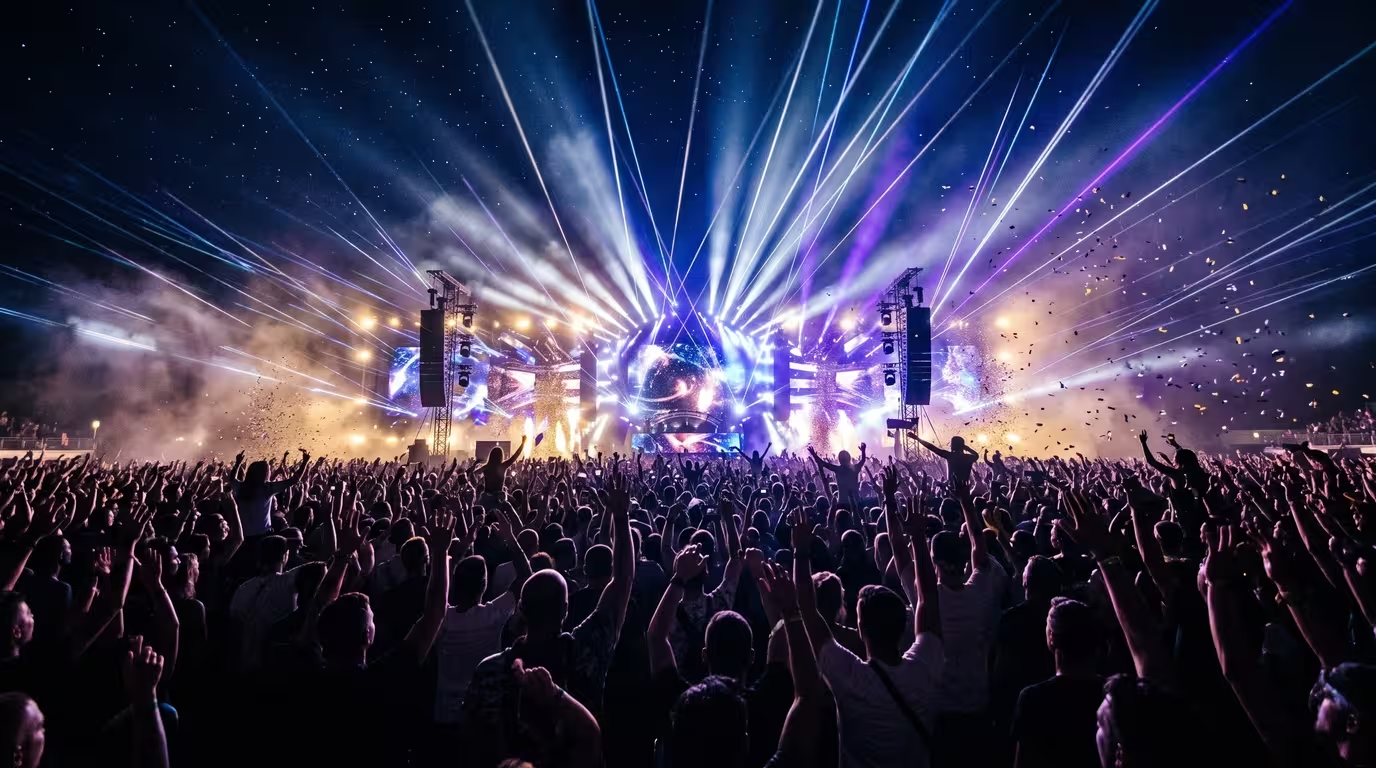
There is a moment, at any good trance night, when the drums drop away. The kick vanishes, a melody rises, tension stretches for thirty seconds that feel like minutes, and then the beat crashes back and ten thousand hands go up at once. That moment is the whole story of trance: a genre built not on groove but on emotion, melody and the promise of euphoric release. This is how a hypnotic German club sound became electronic music's most unashamedly emotional tradition.
Blog
Trance: From Goa to Global Festivals
How a hypnotic German club sound became electronic music's great euphoric tradition, and conquered the world.
What Trance Actually Is
Trance is a form of electronic dance music defined by hypnotic repetition, soaring melody and an emotional arc engineered for catharsis. Most tracks sit somewhere between roughly 125 and 150 BPM, with classic trance often around 135 to 142 and modern uplifting trance around 138 to 140, over a driving four-on-the-floor kick, offbeat open hi-hats and a rolling sixteenth-note bassline.
But tempo is not the point. The signatures that make trance trance are architectural and emotional:
• Long, sweeping builds and extended breakdowns that strip the track back to melody.
• The famous breakdown-and-drop payoff, with tension wound tight and then released.
• Soaring arpeggiated or supersaw leads, often built on the Roland JP-8000.
• Lush pads, atmospheric layering and ethereal or vocal hooks.
• An unembarrassed emphasis on uplift and the hands-in-the-air moment.
The name says it all. The genre is designed to induce a trance state through repetition and gradual escalation, with melody and feeling doing the work that rhythm does in house or techno.
Born in Germany, Dreaming in Goa
Trance emerged in the early 1990s from the techno and EBM scene in Frankfurt, Germany, then spread fast across Europe. Frankfurt was the crucible, with clubs like Omen and Dorian Gray, and a young DJ named Sven Vath who launched the Eye Q label in 1991 and its harder sibling Harthouse the year after. Both became bastions of the early sound.
The foundational records came in a rush. The German duo Dance 2 Trance cut We Came in Peace in 1990; the self-titled 1990 single The Age of Love, reworked in Jam & Spoon's epochal 1992 Watch Out for Stella remix, is one of the most widely cited early trance records. Jam & Spoon, Rolf Ellmer and Markus Loffel, built the melodic blueprint, while in Berlin the MFS label, run by the English expat Mark Reeder, nurtured a young East Berliner named Paul van Dyk alongside Cosmic Baby.
At the same time, a parallel psychedelic branch was taking shape thousands of miles away, on the beaches of Goa in India, where travelling DJs forged a hypnotic, otherworldly strain of the sound. The British DJ Paul Oakenfold carried it to a mass audience with his 1994 Goa Mix for BBC Radio 1's Essential Mix. Goa, and the psytrance it evolved into, is a rich story in its own right, but it is best understood here as one important strand feeding trance's early evolution, one that would loop back into the festival mainstream decades later.
The Euphoric Turn and the Golden Age
Through the mid-to-late 1990s, trance grew more melodic, more emotional, more anthemic. Paul van Dyk's For an Angel, first released on MFS in 1994 and reborn as a 1998 remix, became a definitive anthem; DJ Mag calls it trance's answer to house's Move Your Body. The Italian producer Robert Miles took the tender dream trance of Children (1995) global, an almost entirely instrumental hit that peaked at number 21 on the Billboard Hot 100 in July 1996 and, as Billboard recounts, sold in the millions across Europe, held off the UK number one spot only by Oasis.
Then the floodgates opened. ATB's 9 PM (Till I Come), released in Germany in 1998, went on to top the UK Singles Chart in mid-1999, the first trance record to do so. Ferry Corsten's Out of the Blue, as System F, hit the UK top 20 in 1999, and his Gouryella project with Tiesto minted anthem after anthem. Finland's Darude turned a stark, looping riff into Sandstorm, which reached number three in the UK and became the world's best-selling 12-inch single of 2000. Above them all rose two Dutchmen. Tiesto's remix of Delerium's Silence, an unlikely epic that Resident Advisor credits with accelerating him to superstardom, defined the era; he was voted the world's number one DJ by DJ Mag readers in 2002, 2003 and 2004, and in 2004 became the first DJ to perform live at an Olympic opening ceremony, in Athens. Armin van Buuren launched his A State of Trance radio show on 1 June 2001, a broadcast that would become a genre institution.
This was trance as a mass phenomenon. The UK superclubs, from Gatecrasher in Sheffield with its neon Crasher kids to Cream in Liverpool and Godskitchen, and the terraces of Ibiza, turned melodic trance into a weekend religion around 1999 to 2004. Vocal trance boomed; the DJ Mag Top 100 became a two-man race. In London, the trio Above & Beyond formed in 2000 and founded the Anjunabeats label the same year, named, tellingly, after Anjuna beach in Goa.
Robert Miles - Children
The Backlash and the Dip
Every boom breeds a backlash, and trance's arrived in the mid-2000s. As the sound saturated the charts, the word cheesy attached itself to commercial and vocal trance, and tastemakers turned away. UK superclub attendance was already sliding by 2003; electro house arrived with slower tempos and a cooler pose, and the mainstream drifted toward it and, later, big-room EDM. Trance is dead became a recurring headline.
It was not true, but it was not nonsense either. Some stars evolved out of the genre, with Tiesto steadily moving toward a leaner house and EDM sound, while the mainstream spotlight moved on. What actually happened is that trance retreated to its faithful: the radio shows, the dedicated labels, and a global community that never stopped showing up.
The Modern Era and the Global Stage
Trance today is smaller in the charts but arguably deeper in devotion. A State of Trance has run past 1,200 weekly episodes and, per its official site, is broadcast to an estimated 40 million listeners across more than 80 countries, spawning full-scale ASOT festival editions worldwide since 2007. Above & Beyond's Anjunabeats and its Group Therapy radio built one of dance music's most emotional communities, with the push-the-button ritual, the ABGT arena shows and the self-described Anjuna family.
The live map is genuinely global. Insomniac launched Dreamstate, the first dedicated all-trance festival brand in the US, in 2015; Transmission has filled Prague's O2 Arena since 2006 and toured to Bangkok, Sydney and beyond; the Netherlands' Luminosity keeps the classic sound burning. Veterans like Ferry Corsten, Aly & Fila and Cosmic Gate headline alongside the psytrance-crossover duo Vini Vici, whose collaboration with Armin van Buuren, Great Spirit, closed the circle back to trance's psychedelic Goa roots on the world's biggest stages.
And there is a genuine revival underway. In a feature published on 14 February 2023, the Pitchfork writer Philip Sherburne declared that trance was back and that it was no joke, pointing to a post-pandemic hunger for euphoria and a younger generation with none of the old prejudices. Trance textures, from supersaw leads to rave arpeggios and breakdown drama, have been resurfacing in mainstream pop and dance, and the genre's own festivals have rarely looked healthier.
Why It Endures
Trance conquered the world for the same reason it still resonates: it offers something most dance music only gestures at. It is unafraid to be emotional. The long build and the breakdown turn a room full of strangers into a single held breath; the drop turns that breath into a shout. Underneath the euphoria sits real songcraft, with melody, harmony and an arc that has a beginning and a payoff, which is exactly why the build-breakdown-euphoria craft remains one of the most demanding and rewarding things a producer can attempt.
Born in early-90s Germany alongside a parallel Goa dream, refined into an uplifting art form that ruled the superclubs, bruised by a backlash and reborn through a fiercely loyal global community, trance has proven to be electronic music's great melodic tradition. The arpeggio is still climbing. The drop is still coming. And the hands still go up.
Key takeaways
• Trance is dance music's most emotional, melody-driven genre, defined by long builds, breakdowns and a euphoric drop, typically around 135 to 142 BPM.
• It was born in early-1990s Frankfurt and Berlin, with a parallel psychedelic branch emerging in Goa, India.
• Its golden age, roughly 1999 to 2004, produced global anthems and superstar DJs like Tiesto and Armin van Buuren.
• A mid-2000s backlash pushed trance off the charts but not out of existence.
• Today it thrives through A State of Trance, Anjunabeats, Dreamstate, Transmission and a devoted worldwide trance family.
