When the Berlin Wall fell on 9 November 1989, it left behind a seam of emptiness running through the middle of the city, a corridor of no-man's-land, cleared lots and ownerless buildings where the death strip had been. Into that vacuum came a music made across the Atlantic in another crumbling industrial city. This is the story of Tresor: the club that turned an abandoned bank vault into the European home of Detroit techno, and in doing so bound two post-industrial cities together.
Blog
Tresor and the Berlin-Detroit Axis
How a derelict bank vault in reunified Berlin became the European home of Detroit techno.
A City With a Hole in the Middle
For a few extraordinary years after 1989, central Berlin was a place without clear ownership. In the former East, the collapse of the state left whole districts in legal limbo, with power stations, warehouses, bunkers and apartment blocks carrying unclear title and almost no enforcement. Squatters, artists and party promoters simply moved in. Nomadic raves appeared in a grocery store or a vacant vault for one night, then vanished. In November 2003, mayor Klaus Wowereit would sum up the city in a phrase that stuck: Berlin was arm, aber sexy, poor but sexy.
The politics of it were charged. East and West Berliners were dancing together in spaces that, months earlier, would have gotten them shot for trespassing. Techno arrived without lyrics, without a flag, without a past in either Germany, the perfect blank soundtrack for a city trying to become one thing again. The emptiness was not a backdrop; it was the raw material.
The Vault
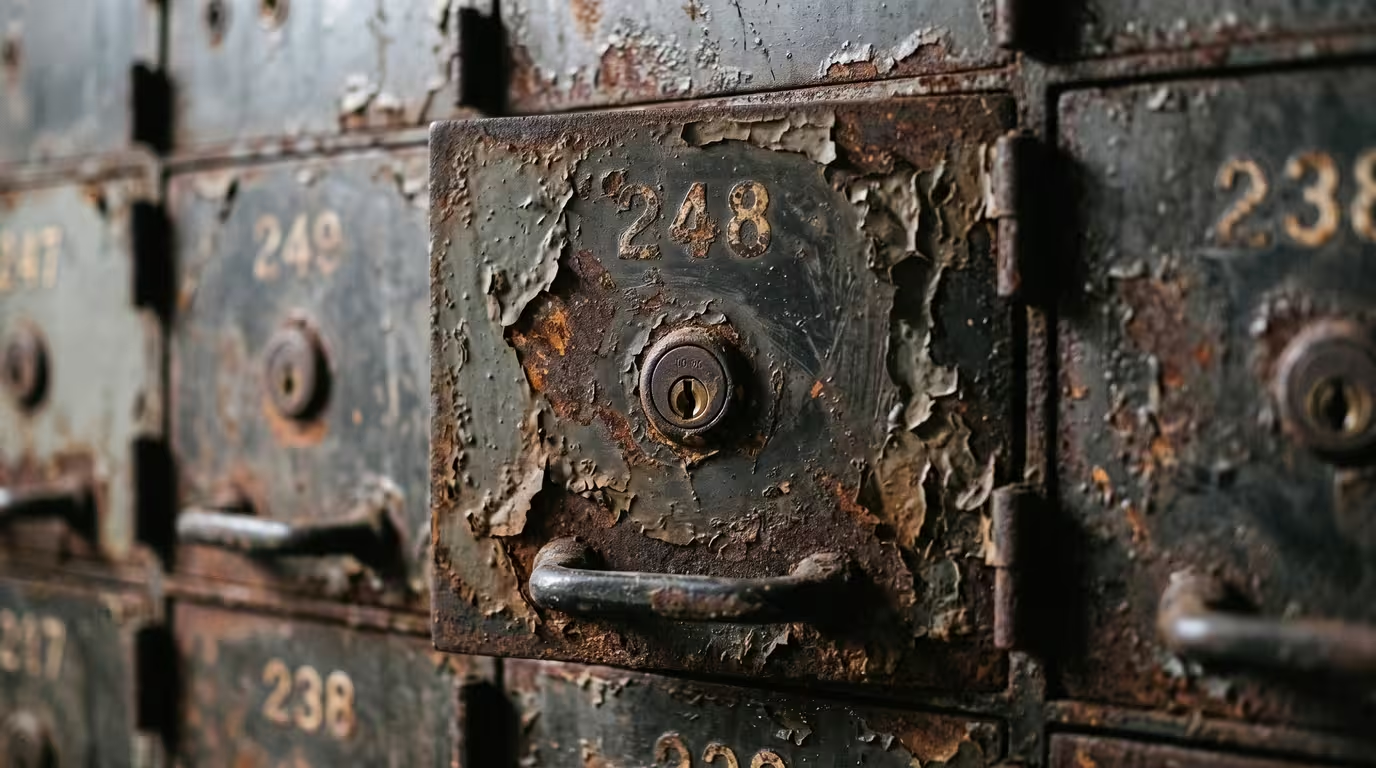
The building above was a ghost. The Wertheim department store on Leipziger Strasse, designed by architect Alfred Messel and opened in 1897, had once been among the largest and most celebrated department stores in Europe. It was owned by the Jewish Wertheim family; under the Nazis it was boycotted from 1934 and, by 1937, Aryanized, forcibly stripped from its owners, who were expropriated and driven out. The store was destroyed in the Second World War, and the ruins ended up marooned in the border zone near Potsdamer Platz. But deep beneath the rubble, the bank strongroom survived, its walls still lined with the steel safe-deposit boxes where Berliners had once stored their valuables.
Dimitri Hegemann, a Westphalian who had come to Berlin in the 1970s and run the experimental Berlin Atonal festival from 1982 and the acid-house club UFO from 1988, found the vault while exploring the derelict land between the two former halves of the city. UFO, Berlin's first acid-house club, had closed in 1990. The vault was damp, dark and powerless. It was like opening a pyramid, Hegemann later recalled. Tresor, German for safe or vault, opened there on 13 March 1991, with Hegemann and colleagues including Carola Stoiber and the old UFO crew behind it.
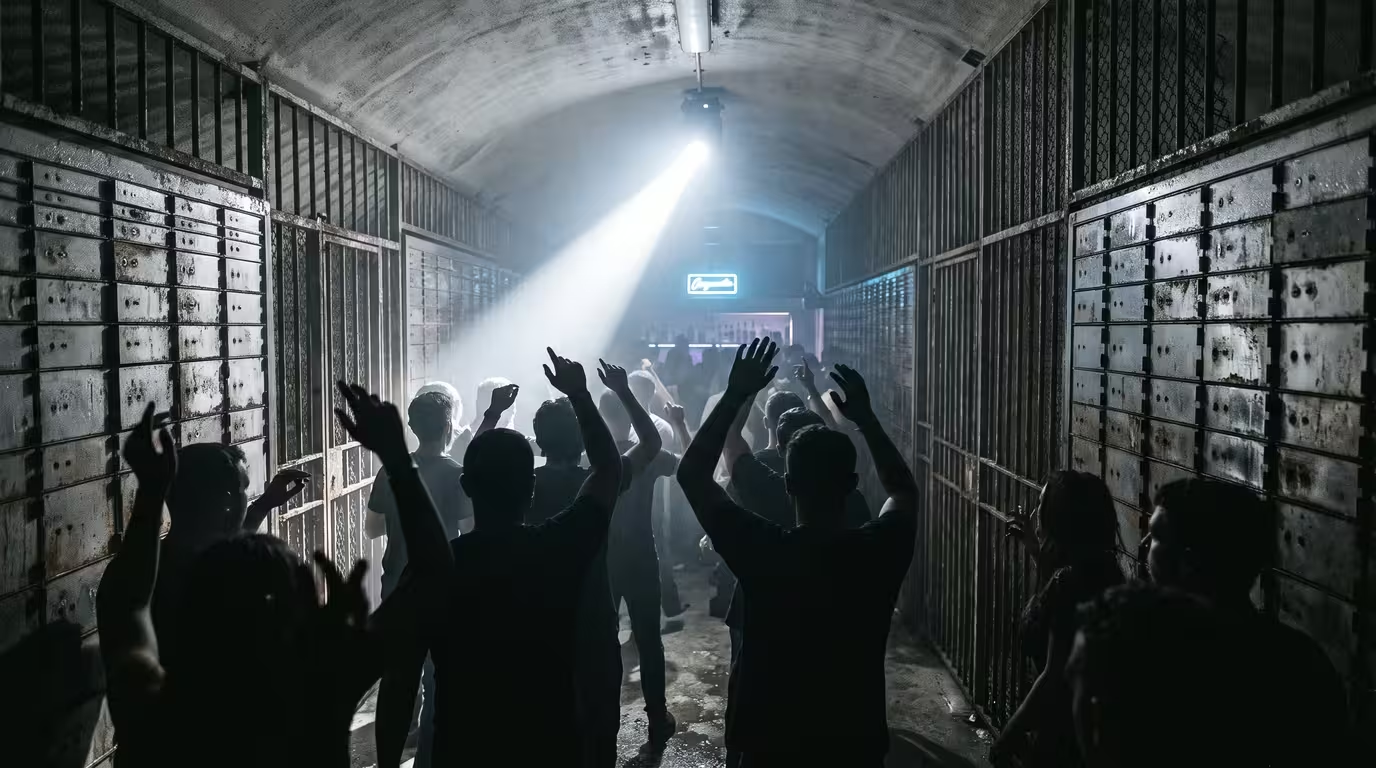
The room did the rest. Low concrete ceilings, iron bars, the rusted safe boxes still bolted to the walls, no decoration, fog, strobes, and a heat so intense it became legend. There was no need to build an aesthetic; the vault was the aesthetic, and it demanded a hard, stripped, metallic music to match.
The Detroit Connection
What made Tresor more than a good room in the right place was who it invited to fill it. In Detroit, another de-industrialised city, a Black electronic music built on drum machines and futurism had been developing since the mid-1980s, the work of the Belleville Three, Juan Atkins, Derrick May and Kevin Saunderson, and, by the end of the decade, the militant collective Underground Resistance, founded by Mad Mike Banks and Jeff Mills. At home, American clubs largely ignored them. Hegemann and Stoiber, hearing parallels between the two broke, changing cities, believed Berlin would be uniquely receptive.
The connection was almost accidental. Hegemann's Interfisch label had signed the industrial project Final Cut, which featured Jeff Mills; the relationship deepened when Stoiber met Mills and Banks around 1991. Hegemann's pitch to Banks was direct: kids from the East and the West were so happy that the wall was open now, but the city needed their music. They came.
The record label, Tresor Records, was founded in October 1991, and its DNA was Detroit from the first catalogue number. TRESOR 1 was the self-titled X-101 record, X-101 being an Underground Resistance alias of Jeff Mills, Mike Banks and Robert Hood, licensed from Detroit and pressed for Europe. It was followed by X-102 and X-103. Blake Baxter's Dream Sequence (1992) became one of the first Detroit albums recorded for the label, made around Underground Resistance's first European tour. Over the years the roster read like a Detroit hall of fame: Jeff Mills' Waveform Transmission series, Robert Hood, Eddie Flashin' Fowlkes, Juan Atkins, Drexciya, and later K-Hand, Terrence Dixon and Scan 7.
Then there were the collaborations that literally spelled out the axis. Berlin's Moritz von Oswald and Thomas Fehlmann worked as 2MB, short for 2 Men in Berlin, and, adding a Detroit guest, became 3MB. 3MB feat. Magic Juan Atkins appeared in 1992; another edition brought in Eddie Fowlkes. The reciprocity was real: Berlin gave Detroit's artists a paying European audience and a stage when home would not, and Detroit gave Berlin a musical identity and lineage it could not have invented alone.
3MB - Die Kosmischen Kuriere

The Tresor Sound
Out of the vault came a template. Where Detroit techno could be dreamy and soulful, the Tresor version, shaped by that hard concrete room and a mostly European producer base, was harder, rawer and more functional: stripped drums, heavy bass, few vocals, built for a dark basement rather than a radio. By the mid-1990s the label had expanded well beyond the Berlin-Detroit corridor to British and European artists like Surgeon, James Ruskin, Joey Beltram and Cristian Vogel, but the founding aesthetic held. The catalogue is still running decades on; Tresor marked its 30th year with a sprawling anniversary compilation that critics at The Quietus treated as a serious document of the genre.
Closure and Rebirth
Berlin's recovery eventually turned against the club. As Potsdamer Platz became prime real estate, the land was sold to developers, and Tresor played its last night on Leipziger Strasse on 16 April 2005. The farewell ran as a two-week series called The Final Cut, tied to the label's compilation Vol. 13, It's Not Over; the finale was a Richie Hawtin and Ricardo Villalobos back-to-back that ran from Saturday deep into the following week. A banner on the wall read It's not over.
It wasn't. After a two-year exile, Tresor reopened on 24 May 2007 inside the disused Kraftwerk Berlin, the decommissioned Heizkraftwerk Berlin-Mitte on Koepenicker Strasse, a vast concrete power plant built in the 1960s alongside the Wall. The new home traded the claustrophobia of the vault for cathedral scale: the Globus floor upstairs for house and experimental sound, a long tunnel descending to the main Tresor room, and the smaller OHM club and cavernous main hall used for art, exhibitions and festivals. In 2013 the experimental festival Berlin Atonal, Hegemann's own 1982 creation, was revived at Kraftwerk under new direction, closing a thirty-year loop.
Tresor Today and the Legacy
Tresor is now one of the most storied techno institutions on earth, and its founder has become an evangelist for club culture as urban policy. In 2012 Hegemann launched the Detroit-Berlin Connection, running conferences and floating plans to repurpose Detroit's abandoned industrial spaces, the Fisher Body 21 plant and the Packard plant, the way Berlin used its own ruins. In any empty building, he has said, he sees an opportunity.
The wider context has caught up with the idea that this was always culture, not just partying. On 6 September 2016 the Berlin-Brandenburg fiscal court ruled that club nights at Berghain counted as concerts for tax purposes, cutting the VAT rate from 19 to 7 percent, taxed like high culture rather than entertainment. And in 2024, after a campaign by the non-profit Rave the Planet, Germany added Technokultur in Berlin to its national inventory of intangible cultural heritage, formally recognising what the ravers in the vault had built.
The Detroit-Berlin axis endures partly as myth and partly as fact, but its lesson is concrete: techno crossed the Atlantic through direct artist-to-artist relationships and a small record label, not through any industry machine. Tresor is the proof, the club that took a strongroom built to keep the world out and turned it into a bridge between two cities the world had written off.
Key takeaways
• Tresor opened on 13 March 1991 in the surviving bank vault of the bombed-out Wertheim department store, in the empty border zone of newly reunified Berlin.
• Its label, founded in October 1991, was Detroit from the start: TRESOR 1 was X-101, an Underground Resistance alias of Jeff Mills, Mike Banks and Robert Hood.
• Berlin gave Detroit's ignored techno pioneers a European audience; Detroit gave Berlin a musical identity, the reciprocity that defines the Berlin-Detroit axis.
• The club closed on Leipziger Strasse on 16 April 2005 and reopened in 2007 in the Kraftwerk power plant, where it still runs.
• Berlin techno's 2016 tax ruling and 2024 heritage listing confirm, belatedly, what the vault always was: culture.
