If you have ever wondered why one track feels euphoric and another feels menacing even at the same tempo, the answer usually starts with the scale. A scale is the small palette of notes a track draws from, and the pattern inside that palette is what sets the emotional tone before a single chord or drum hits. This guide is for producers (and curious DJs) who already grasp the basics of keys and want to go deeper into the scales and modes that actually show up in techno, house, trance, dnb and beyond — and the feelings they create.
What a Scale Actually Is
A scale is an ordered set of pitches within an octave, defined by a specific pattern of intervals — the distances between each note. The note the scale is built on and resolves to is the tonic (or root); it is the home note that everything else relates to. As Ableton's Learning Music puts it, you can think of a scale as something like an artist's palette of paint — a subset of all available notes, chosen because of how they relate to each other, each with a distinct sound and emotional association.
There are 12 notes in Western music (every white and black key inside an octave, the chromatic set). A scale picks a handful of those — usually seven, sometimes five — and the order of the gaps between them is what gives each scale its character. This article focuses on those gaps and the moods they create. For the foundations of keys, relative major/minor and the basics of how keys work, see our companion Musical Keys for DJs article; here we go a level deeper into scale and mode construction.
Whole Steps and Half Steps
Two terms unlock everything. A half step (or semitone) is the smallest distance between two notes — one key to the very next key, black or white. A whole step (or tone) equals two half steps. Every scale is just a recipe of these two intervals. Write "W" for whole and "H" for half, and you can build any scale from any starting note simply by following its pattern.
The Major Scale: Bright and Uplifting
The major scale follows the pattern W‑W‑H‑W‑W‑W‑H. Starting on C, that gives you C‑D‑E‑F‑G‑A‑B — all the white keys, the one major scale with no sharps or flats. Most listeners hear major as bright, happy, stable and uplifting, and that association is remarkably consistent: reviewing the research, Hunter, Schellenberg and Schimmack (building on Kastner and Crowder's 1990 study) report that subjects consistently sorted major-key pieces into the happy category and minor-key pieces into the sad one, regardless of musical training, intelligence or talent.
In electronic music, major keys and the major scale tend to show up where the goal is euphoria and openness: uplifting and festival trance, big-room and mainstage EDM, happy hardcore, and some house and disco-flavoured material. Because the basics of major versus minor are covered in the Musical Keys article, the key point for scale-craft here is the feel: pure major can sound almost too sweet for darker club genres, which is exactly why most electronic producers spend most of their time in minor and modal territory instead.
The Minor Scales: The Workhorse of Electronic Music
If there is one tonal home for electronic music, it is minor. As Hello Music Theory notes, the natural minor (Aeolian) is the second most popular mode after Ionian, and almost any time you hear a piece of music in a minor key, you are hearing the Aeolian mode. There are three flavours of the minor scale worth knowing.
Natural Minor (Aeolian)
The natural minor scale uses the pattern W‑H‑W‑W‑H‑W‑W. Starting on A, that is A‑B‑C‑D‑E‑F‑G — again all white keys, which is why A minor is the relative minor of C major (same notes, different home base). Ableton's Learning Music notes that most people hear minor scales as sad or dark, and that emotional weight is exactly why it dominates electronic production.
Natural minor (also called the Aeolian mode) is the default for techno, house, trance, drum and bass and dubstep. In Attack Magazine's Understanding Modes feature, Oliver Curry observes that dance music is very rarely written in a major key, and that the Aeolian mode — which forms the natural minor scale — is probably the most commonly used mode in dance music. It gives that classic driving, slightly melancholic undertone that sits perfectly under a four-on-the-floor kick.
Harmonic Minor
Take natural minor and raise the seventh note by a half step and you get harmonic minor. In A, that is A‑B‑C‑D‑E‑F‑G♯ — the only change from natural minor is G becoming G♯. That raised seventh creates a strong leading-tone pull back to the root, and the large gap it opens between the sixth and seventh degrees (an augmented second) gives the scale a dramatic, tense, Eastern or classical-sounding flavour. It is a go-to for dramatic, dark and neoclassical-leaning electronic tracks and for adding tension in breakdowns.
Melodic Minor
The melodic minor raises both the sixth and seventh degrees on the way up (A‑B‑C‑D‑E‑F♯‑G♯ ascending), traditionally reverting to natural minor on the way down. The raised sixth smooths out the awkward jump of harmonic minor, producing a jazzier, more sophisticated sound — its ascending form is even nicknamed the jazz minor. It is less common in club music but useful for smoother, more harmonically adventurous melodic work.
Here is a quick reference for the three minor flavours, all built on A:
| Minor scale | Notes (on A) | Character |
|---|---|---|
| Natural minor | A B C D E F G | Dark, sad, the club default |
| Harmonic minor | A B C D E F G♯ | Dramatic, tense, exotic |
| Melodic minor | A B C D E F♯ G♯ (asc.) | Smoother, jazzier |

Modes: The Secret Palette
Modes are where electronic producers find their most distinctive colours. The idea sounds complicated but is simple: take the seven notes of a major scale and start (and resolve) on a different note. Each starting point produces a new scale — a mode — with the same notes but a completely different pattern of gaps, and therefore a different mood. Spin the C major scale through its seven starting points and you get the seven modes: Ionian (the major scale itself), Dorian, Phrygian, Lydian, Mixolydian, Aeolian (the natural minor scale) and Locrian.
A useful way to organise them is from brightest to darkest, which music-theory resources like Open Music Theory describe by counting how many notes are raised or lowered relative to the others: Lydian, Ionian, Mixolydian, Dorian, Aeolian, Phrygian, Locrian. The three with a major third (Lydian, Ionian, Mixolydian) sound brighter; the four with a minor third (Dorian, Aeolian, Phrygian, Locrian) sound darker. Below are the ones that matter most for electronic music.
Dorian: Cool, Groovy, Hopeful-but-Dark
Dorian is a minor mode — but with one twist. Its pattern is W‑H‑W‑W‑W‑H‑W, which is the same as natural minor except the sixth degree is raised (a natural/major sixth instead of a minor sixth). D Dorian (the white keys from D) is D‑E‑F‑G‑A‑B‑C. That raised sixth brightens the otherwise sad minor sound, giving Dorian a cool, sophisticated, funky and hopeful-but-dark character. It is hugely popular in house, deep house, techno and drum and bass — its smooth, flowing quality works beautifully for continuous, evolving melodic and bass patterns where you want a minor feel that does not sound purely sad.
Phrygian: Menacing and Exotic
Phrygian is natural minor with the second degree lowered. The pattern is H‑W‑W‑W‑H‑W‑W, and E Phrygian (white keys from E) is E‑F‑G‑A‑B‑C‑D. That flat second sitting right above the root creates immediate tension and an exotic, Spanish or Middle-Eastern colour. Phrygian is dark, tense and aggressive — the natural home for dark and hard techno, hardstyle, dubstep, industrial and psytrance intros. Analysing Kryptic Minds' dubstep cut "Organic," whose opening flute solo sits in G Phrygian, Oliver Curry of Attack Magazine writes that the Phrygian mode gives the intro its Eastern sound and sets the tone for the track's dark, minor and almost sinister quality.
Phrygian Dominant: Full Middle-Eastern Flavour
A close cousin worth knowing is Phrygian dominant, the fifth mode of the harmonic minor scale. Taking A harmonic minor and starting on its fifth note (E) gives E‑F‑G♯‑A‑B‑C‑D. It is like Phrygian but with a major third instead of a minor third, which combined with the flat second produces a very exotic, Middle-Eastern, Spanish-gypsy or flamenco sound (it is also called the Phrygian dominant or Freygish scale). Psytrance, ethnic-flavoured and darker melodic styles lean on it for intense leads and arpeggios.
Lydian: Dreamy and Floaty
Lydian is the major scale with a raised fourth. The pattern is W‑W‑W‑H‑W‑W‑H, and F Lydian (white keys from F) is F‑G‑A‑B‑C‑D‑E. That single sharpened note gives Lydian a dreamy, floating, magical, almost ethereal quality — brighter and more wondrous than plain major. It is a favourite for ambient, melodic and uplifting passages, pads and cinematic breakdowns where you want a sense of wonder or weightlessness.
Mixolydian: Groovy and Bluesy
Mixolydian is the major scale with a flat seventh. The pattern is W‑W‑H‑W‑W‑H‑W, and G Mixolydian (white keys from G) is G‑A‑B‑C‑D‑E‑F. It keeps the brightness of a major third but the flat seventh adds a bluesy, funky, dominant edge — slightly less sweet than full major. It suits funk-influenced and groove-driven house, nu-disco and anything wanting a relaxed, soulful lift.
Locrian: Unstable, Rarely a Home Base
Locrian (pattern H‑W‑W‑H‑W‑W‑W, white keys from B: B‑C‑D‑E‑F‑G‑A) has both a flat second and a flat fifth, which makes its root chord diminished and deeply unstable. It is the darkest, most dissonant mode and is almost never used as a track's main tonal home — but it can be effective for fleeting tension or experimental, unsettling moments.
The table below sums up the most-used modes by feel.
| Mode | Formula vs parent scale | Mood |
|---|---|---|
| Lydian | Major with raised 4th | Dreamy, floaty, magical |
| Ionian (major) | The major scale | Bright, happy, stable |
| Mixolydian | Major with flat 7th | Groovy, bluesy, funky |
| Dorian | Minor with raised 6th | Cool, jazzy, hopeful-but-dark |
| Aeolian (natural minor) | The minor scale | Dark, sad, the club default |
| Phrygian | Minor with flat 2nd | Menacing, tense, exotic |
| Locrian | Minor with flat 2nd and flat 5th | Unstable, dissonant |
Other Scales Worth Your Time
Beyond the seven-note family, a few other scales earn their place in an electronic producer's toolkit.
Pentatonic scales are five-note scales that are famously safe — there are no strong dissonances, so it is hard to hit a wrong note. Minor pentatonic drops the second and sixth from natural minor (A minor pentatonic = A‑C‑D‑E‑G); major pentatonic drops the fourth and seventh from major (C major pentatonic = C‑D‑E‑G‑A). They share the same relationship as their parent scales — A minor pentatonic and C major pentatonic contain the same five notes. Because they are so forgiving, pentatonics are perfect for quick hooks, leads, riffs and topline melodies, and they are an ideal starting point for producers new to melody-writing.
The blues scale is the minor pentatonic with one extra note — the flat fifth, or blue note. A blues scale = A‑C‑D‑E♭‑E‑G. That added note is a passing spice that adds grit and vocal character; treat it as a connector rather than a note you rest on.
For colour and tension there are also symmetric scales: the whole tone scale (all whole steps, six notes, dreamy and unmoored with no tonal centre), the chromatic scale (all 12 notes, used to embellish and add motion rather than as a key), and the diminished scale (alternating whole and half steps, tense and unstable) — all handy for FX risers, transitions and unsettling moments. Finally, exotic scales such as the Hungarian minor (also called double harmonic minor: C‑D‑E♭‑F♯‑G‑A♭‑B) bring a dark, dramatic, Eastern-European or Middle-Eastern flavour prized in psytrance and world-influenced electronic music.
How Scales Create Mood — and How to Choose One
The takeaway is that scale choice is mood choice. Major is bright; minor is dark and serious, which is why it dominates electronic music. Within minor, modes add nuance: Dorian is groovier and more hopeful, Phrygian is menacing and exotic, Lydian is dreamy, Mixolydian is funky. None of these associations are absolute laws — production, tempo, sound design and arrangement all shape the final feeling, and a minor-key track with bright synths and high energy can still feel euphoric. Treat moods as strong tendencies, not rules.
In practice, work backwards from the vibe and genre you are chasing. Building dark, driving techno? Start in natural minor or Phrygian. Writing a deep-house roller that should feel cool and sophisticated? Try Dorian. Going for an ethereal melodic breakdown? Lydian. Want something exotic for a psytrance lead? Phrygian dominant or Hungarian minor.
Putting Scales to Work in Your DAW
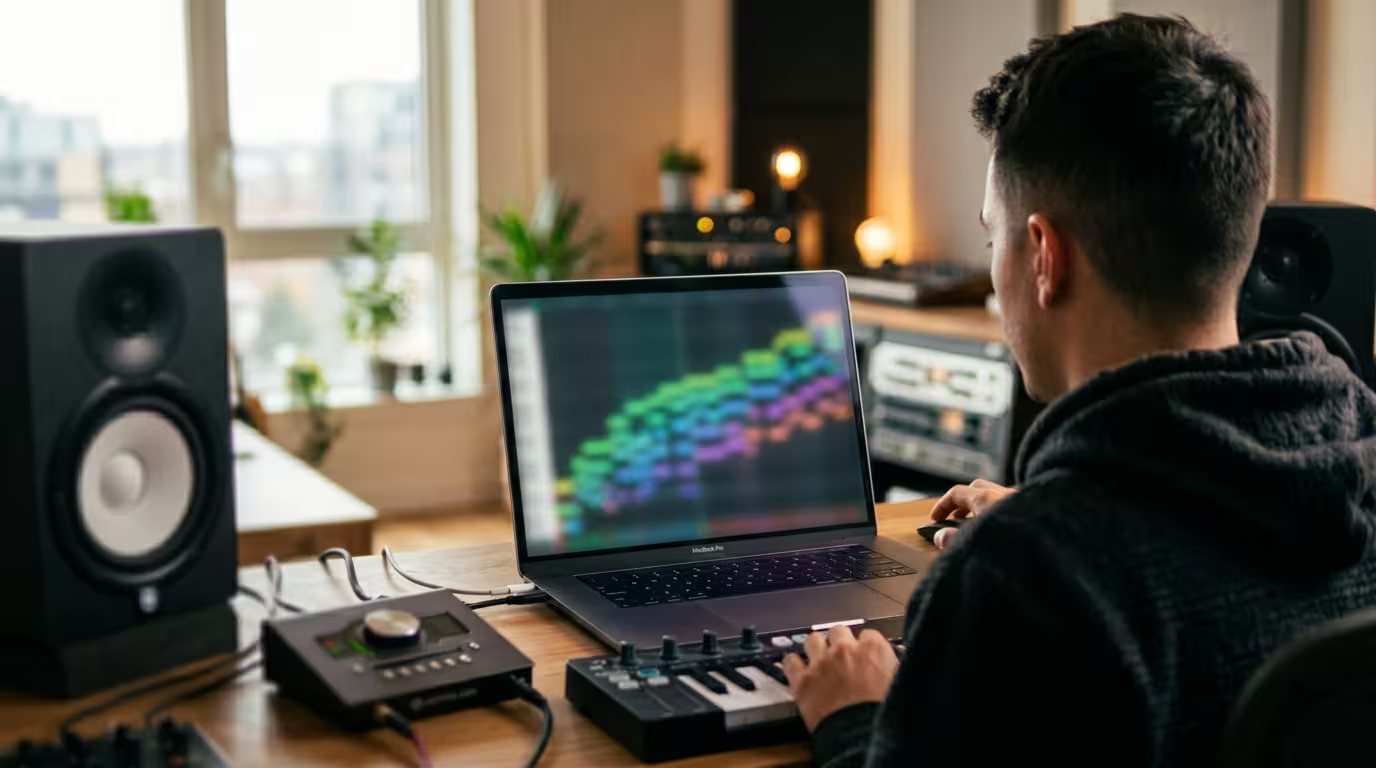
The practical payoff is huge because modern tools do the hard part for you. Most DAWs and many synths and sequencers have scale-quantize or scale-highlight features. In FL Studio, the piano roll's scale highlighting (under the Helpers menu) shades the in-key notes so you can see exactly which pitches belong to your chosen scale. Ableton Live's Scale device forces incoming MIDI into the scale of your choosing, so you can improvise freely and stay in key no matter what you play — Ableton's Theory Hacks classroom project (Lesson 2, The Scale Device, authored by NYU music-education fellow Ethan Hein) even has students set the Scale device to C Phrygian dominant and write a short melody with it. Hardware like Ableton's Push and Native Instruments' Maschine offer an in-key or scale mode that folds the pads so only in-scale notes are available, or lights up the ones that fit.
The workflow is straightforward: pick a root note and a scale, switch on your DAW's scale lock or highlighting, then build melodies, basslines and arpeggios using only those notes. Staying inside one scale keeps everything harmonically coherent, and it is the fastest way to write melodies that sound intentional rather than random. Tools like musictheory.net are great for drilling the patterns by ear away from the DAW.
What This Means for DJs
For DJs, scales mostly matter conceptually rather than operationally — the practical mixing-in-key system is covered in our Camelot Wheel and Harmonic Mixing article. But understanding scales deepens your ear for why tracks feel the way they do: a brooding Phrygian techno cut and a hopeful Dorian house groove will sit differently in a set even at the same key and tempo. Knowing that minor and Phrygian skew dark while Lydian and major skew bright helps you read a record's emotional intent and place it where it belongs in your arc — using mood, not just BPM and key, as a selection tool.
Key takeaways
• A scale is a pattern of whole and half steps around a root note; that pattern sets the mood before anything else.
• Minor (Aeolian) is the workhorse of electronic music; harmonic minor adds drama, melodic minor adds smoothness.
• Modes are the major scale started on different notes: Dorian (groovy), Phrygian (menacing), Lydian (dreamy), Mixolydian (funky), Locrian (unstable).
• Pentatonic and blues scales are safe, beginner-friendly choices for hooks and leads; exotic and symmetric scales add tension and flavour.
• Use your DAW's scale-lock or highlight features (Ableton Scale device, FL Studio highlighting, Push/Maschine in-key) to stay in key and write faster.
• Choose your scale to fit the vibe — and remember moods are strong tendencies, not hard rules.
Ready-made, exclusive EDM tracks with full rights — released as your own.
