Ghost production is the music-industry practice in which one producer — the ghost producer — creates a track that is released or performed under another artist's or DJ's name, usually with the real creator uncredited in public. It is the electronic-music cousin of ghostwriting in books, speeches, and pop songwriting: the work is real, the arrangement is consensual and contractual, and only the public credit is rearranged. This article is the foundational explainer for our Releasing and Ghost Production category — what ghost production is, how it works, why it exists, where it came from, and the genuine debate it provokes.
Defining ghost production
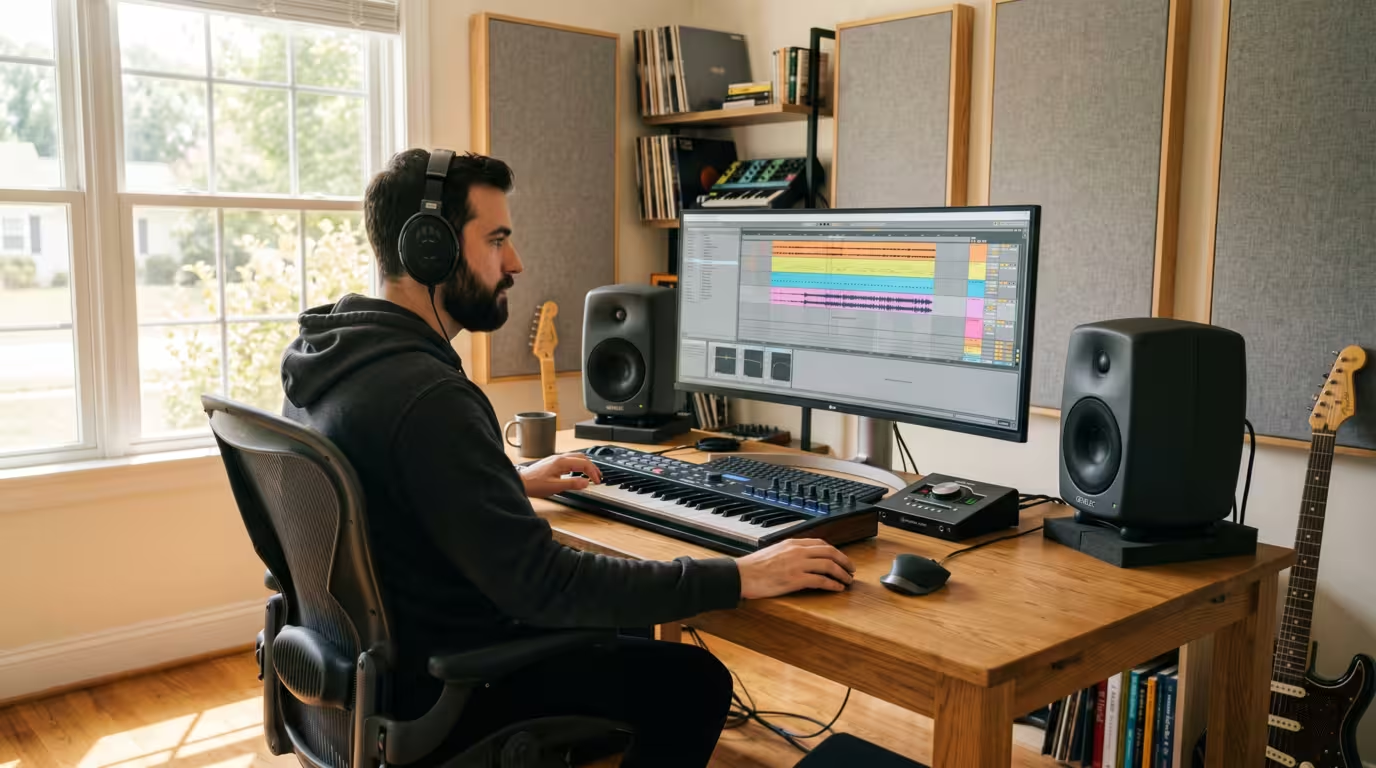
A ghost producer is a professional music producer who composes, arranges, and produces music for someone else, then steps out of the public picture. The front artist (often a touring DJ or established act) releases that music under their own name and is publicly treated as its creator. In exchange, the ghost producer is paid and typically agrees — frequently through a non-disclosure agreement — to remain anonymous and to transfer the rights.
The analogy to ghostwriting is exact rather than loose. As Wikipedia's entry notes, composers have hired ghostwriters for centuries, and a pop-music ghostwriter writes lyrics and a melody in the style of the credited musician. Ghost production simply moves that long-standing arrangement into the world of the DAW, the synth, and the club track.
It is worth separating two things people often conflate. Ghost production is about production and authorship credit — who actually made the record. It is not the same as performance deception, where someone mimes to another person's voice on stage. We return to that distinction below.
How ghost production works: the main models
In practice, ghost production isn't one thing — it sits on a spectrum from a fully commissioned track to lightly uncredited help. Three broad models cover most of it.
| Model | How it works |
|---|---|
| Bespoke / commissioned | The artist briefs a producer on style, references, and mood; the producer builds a custom track to order, with revisions until it fits. |
| Ready-made / off-the-shelf | Producers make finished tracks and sell them, often exclusively (one buyer gets full rights and releases it as their own) or sometimes non-exclusively. |
| Uncredited collaboration | A co-producer or studio engineer contributes substantially but is left off the public credits, shading the line between ghosting and teamwork. |
In the bespoke model, the transaction begins with a brief: the artist describes the sound they want and supplies reference tracks, and the producer composes, arranges, mixes, and often masters a track tailored to them. In the ready-made model — the basis of online marketplaces — producers create tracks speculatively and sell them, usually with full rights transferred to a single exclusive buyer who then releases the track as their own.
The third model is the blurriest. A great deal of music is made by teams, and when a co-producer or engineer goes uncredited, the result resembles ghost production even if everyone in the room would call it collaboration. As one experienced producer told DJ Mag, there is a subtle difference between buying a finished track that already ticks the right stylistic boxes and hiring someone's services to help bring your own ideas to life. That spectrum is why the term gets argued over so much.
The mechanics of the rights transfer — exclusive versus non-exclusive licences, copyright, publishing, and royalties — deserve their own treatment. We cover them in separate articles on ghost-producer contracts and on exclusive vs non-exclusive tracks; here, the key point is simply that the transfer is handled by agreement.
The exchange: what changes hands
At its core, ghost production is a trade. The ghost producer delivers a finished track — often with stems, MIDI, and mastered and unmastered versions — and gives up public credit, usually along with the rights. In return they receive payment, and the front artist receives a release-ready record they can put out and perform as their own.
Compensation varies widely. Most commonly a ghost producer takes a one-time flat fee — effectively a buyout of the creative work — and forgoes future royalties. Less commonly, the deal includes royalties or credit. Billboard reported in 2015 that ghost producing can be lucrative, earning anywhere from around $1,000 to $20,000 per track for A-list DJs.
The anonymous producer interviewed by UKF in 2015 described how the choice between fee and royalties is itself a calculation — weighing, say, a tiny advance now against the chance of large royalties later, versus a big advance now and no royalties at all. He also explained that the structure depends on the client: for a top-tier artist whose name guarantees a chart placing he negotiates royalties and credit, while for a DJ who simply needs releases to secure bookings he is happy to take a modest flat fee and hand the track over outright. The detail of how these deals are structured belongs to our contracts and royalties articles.
Why ghost production exists
Ghost production persists because it solves real problems on both sides of the transaction. The demand comes from the structure of the modern music business itself.
For artists and DJs, the pressures are practical:
• Relentless release demand. Staying relevant means putting out a steady stream of singles, remixes, and edits, and festival sets benefit from fresh exclusives.
• Touring time. Headliners spend much of the year on the road, leaving little studio time. As Billboard noted, intense touring schedules keep big acts out of the studio.
• Performing isn't producing. Being a brilliant DJ, curator, and performer is a different skill from sound design, arrangement, mixing, and mastering.
• Brand and sound. Artists want consistent, on-brand records, and may commission tracks that fit an established identity.
For producers, the appeal is just as concrete: income from a skill that may not yet have a public audience, a way into the industry, portfolio-building, and — for many — the freedom to make music without the grind of being a public artist. The most-cited example is Dutch producer Maarten Vorwerk, widely acknowledged as a ghost producer for acts including DVBBS and Dimitri Vegas & Like Mike, who said in a 2015 Wonderland In Rave interview that he simply loves being in the studio and creating, that it is who he is and what he does, and the best way for him to express himself. Some producers simply don't want the stage; the UKF interviewee pushed back on the idea that he had sold out, insisting he was never after fame or fortune — his love is in the studio, and that is what he gets paid to do.

A long tradition, not a new trick
Ghost production feels scandalous to some EDM fans, but uncredited creative labor is woven through the entire history of music and entertainment. Ghostwriting in popular song is so common that, as Billboard has documented, hit records across the genres have long been written by people other than the famous voice singing them — Frank Sinatra, Elvis Presley, and many others performed songs penned by professional songwriters. The Motown machine of the 1960s ran on behind-the-scenes writers; film and television scoring has its own well-worn history of credited composers who relied on uncredited ghostwriters and orchestrators.
In dance music specifically, working with studio engineers and collaborators is older than the controversy. DJ Mag points out that producers have been working with studio collaborators and engineers for decades, citing relationships such as drum & bass icon Goldie's long partnership with engineer Rob Playford. Vice's Thump put it bluntly: ghostwriting and ghost-producing have been part of dance music since its inception.
What changed in the 2010s was visibility. The practice became a loud public talking point in 2015, when, on May 29, Grammy-nominated producer Mat Zo (Matan Zohar) tweeted that electronic music had rotten teeth that needed pulling, casting himself as a nerd standing up to the jock who had stolen the nerd's homework, and naming Tiësto, Diplo, and Markus Schulz. That episode — and the Billboard coverage in its feature asking whether it was time for EDM's ghost producers to step out from behind the curtain — dragged ghost production from open secret to open debate.
A different case: Milli Vanilli
It's tempting to file Milli Vanilli under ghost production, but it belongs in a different folder. The Munich duo, assembled by producer Frank Farian in 1988, didn't sing on their own records — session vocalists including Brad Howell, John Davis, and Charles Shaw did — while Fab Morvan and Rob Pilatus danced and lip-synced. When the truth emerged, their 1990 Best New Artist Grammy was revoked, the only time that has happened. That was performance deception: the public face wasn't performing the vocals at all. Ghost production concerns who produced a recording, not whether the credited performer is faking a live performance. The two are related cousins in the family of credit-doesn't-match-reality, but they are not the same thing.
Scale and acceptance
How common is ghost production? Precise figures are impossible — anonymity is the entire point — so prevalence is best understood through what industry figures say rather than invented statistics. The consistent message from inside the scene is that it is widespread and broadly normalized, even as it remains contested.
Several well-documented, acknowledged cases anchor the picture. Leaked contracts reported by Your EDM in December 2016 showed that KSHMR (Niles Hollowell-Dhar) ghost-produced for Borgeous: KSHMR received 50 percent from Spinnin' Records' purchase of the "They Don't Know Us" master plus a further 25 percent via his company Deep Dish Inc — a 75 percent total — while a contract amendment had him agree to waive his credit on any masters. Afrojack has openly said he co-produced David Guetta's "Titanium" but declined a credit at the time; Billboard reported in March 2025 that he later called that the biggest mistake of his career, and he is now credited as a writer and co-producer alongside Guetta and Giorgio Tuinfort. Martin Garrix has described being signed to Spinnin' Records after the label discovered he had ghost-produced a track that became a hit — an example of ghosting as a career on-ramp.
Attitudes among working DJs lean toward acceptance. When DJ Mag asked its Top 100 DJs what they thought of DJs who use ghost producers, 34 declined to answer; of the 66 who did, 67 percent expressed support. David Guetta's framing is representative of the team defense: he argues it is entirely fine to work as a team, with everyone credited and paid, much like being in a band. Others draw a line at honesty rather than at help itself — as Hardwell put it, if you're not producing your own tracks you should just be honest and admit you're a good DJ who got help in the studio.
A note of caution belongs here: many specific claims that a given artist uses a ghost producer are rumor or speculation, and some named artists, such as Martin Garrix, have explicitly denied using ghost producers for their own releases. Responsible discussion sticks to what is acknowledged or documented and treats the rest as unproven.
The ethics and transparency debate
This is the heart of the matter, and it is genuinely two-sided. People of good faith disagree, and the disagreement usually turns on transparency rather than on whether collaboration itself is acceptable.
The case for ghost production is straightforward. It is a legal, consensual, contractual service — a form of collaboration and outsourcing no different in kind from a pop star working with a songwriting team or a film director hiring a screenwriter. The front artist is often a genuine curator, performer, and brand who shapes creative direction, manages vocal sessions, and brings the music to audiences live. Producers enter these deals knowingly and get paid — sometimes very well — for doing what they love without the burden of public life. And since much of music is already collaborative, critics single out EDM only because it carries an unusually strong myth of the lone bedroom genius.
The criticisms are equally real. The core concern is deception: if an artist presents themselves as the sole creator of music they didn't make, fans who value that authorship may feel cheated. As Billboard observed, DJs are famous for their beats, so learning that a track leans on another producer's work can leave a listener feeling cheated. There is the lack of public credit for the person who actually made the work; the secrecy enforced by NDAs; and the worry, voiced by Billboard's sources, that young or inexperienced producers can be exploited — a talented kid who looks up to you is unlikely to say no or push for higher rates. Producer Figure captured the purist objection memorably, comparing ghost-producing to discovering that the Mona Lisa was painted by numbers.
Much of the friction dissolves around the idea of disclosure. Many critics have no problem with help that is acknowledged — the objection is to hidden authorship combined with claims of sole creation. As commentators including Anonymous Tracks have argued, full disclosure should be practiced by artists, DJs, producers and labels alike, so that credit really does land where it is due. Some artists have moved toward crediting collaborators more openly. Where one lands on the ethics tends to depend on how much weight one gives the auteur ideal versus the reality that records are usually made by teams. This article presents those positions; it does not adjudicate them.
Is ghost production legal?
Yes. Ghost production is a legitimate commercial arrangement. When a producer voluntarily agrees, by contract, to be paid and to transfer credit and rights, there is nothing illegal about the front artist then releasing the music as their own. It is not fraud when it is consensual and contractual; the disputes that do arise — such as the Billboard-reported conflict between Alok and Sevenn over credit — tend to be about messy credit, ownership, or unpaid splits, not about the concept itself.
This is a general description, not legal advice, and the specifics — rights assignment, publishing, confidentiality, and royalties — are exactly what a proper contract should nail down. Our dedicated articles on contracts and rights go into that detail.
Ghost production vs related practices
Because the term gets stretched, it helps to distinguish ghost production from neighboring concepts.
| Term | What it is |
|---|---|
| Ghost production | A producer makes a track released under another's name, usually uncredited, by agreement. |
| Ghostwriting | The same idea applied to songwriting — lyrics and melody written for a credited performer. |
| Uncredited co-production | Genuine collaboration where one contributor is simply left off the public credits. |
| Credited producer | A normal producer who is openly named on the release; no "ghost" at all. |
Two further distinctions matter. Sampling and remixing involve reworking existing, identifiable recordings — a different legal and creative act from commissioning an original track. And Milli Vanilli-style lip-syncing is performance deception, not a question of who produced the recording. Ghost production is specifically about the authorship of an original production being privately reassigned.
Where this article fits
This piece is the definitional cornerstone of our Releasing and Ghost Production category. It deliberately stays broad. For the deeper dives, see our companion articles on becoming a ghost producer, buying ghost-produced tracks, ghost-producer contracts and rights, royalties and publishing, exclusive vs non-exclusive tracks, and the wider mechanics of releasing music through distribution and record labels.
Key takeaways
• Ghost production is when a producer makes a track released under another artist's name, usually uncredited, by paid agreement — the EDM equivalent of ghostwriting.
• It comes in three broad models: bespoke commissioned tracks, ready-made tracks sold (often exclusively), and uncredited co-production.
• It exists because of relentless release pressure, touring schedules, and the fact that performing and producing are different skills.
• It is long-established, legal, and contractual — and distinct from Milli Vanilli-style lip-sync deception.
• The ethics debate is real and two-sided, and it turns mostly on transparency and disclosure rather than on collaboration itself.
Ready-made, exclusive EDM tracks with full rights — released as your own.
