Some artists build a career. Richard D. James built a myth, and then made music strange and beautiful enough to justify it. For more than thirty years the Cornish producer known as Aphex Twin has moved between serene ambient and violent, glitching breakbeat, hoarding music by the hundreds of tracks while feeding journalists a steady diet of half-truths. Sorting the documented from the invented is part of the pleasure, and the records, remarkably, still sound like they arrived from somewhere the rest of us have not reached yet.
Blog
Aphex Twin and the Sound of Genius
How a reclusive Cornish maverick turned bedroom experiments into some of electronic music's defining records.
From Limerick to the Cornish Coast
Richard David James was born on 18 August 1971 in Limerick, Ireland, to Welsh parents, and raised in Lanner, a village in Cornwall, where he attended Redruth School. The isolation suited him; he has spoken of liking that the county felt cut off from the rest of the world. By the late 1980s he was DJing at free parties and clubs around south-west England, including alternating weeks at the Bowgie Inn near Newquay.
It was there, in 1989, that he met Grant Wilson-Claridge, who realised the young DJ was spinning tapes of his own music. In 1991 the pair founded Rephlex Records, the label that coined the term braindance, a deliberately silly counter-label for the experimental electronic music they loved. That same year James released his debut EP, Analogue Bubblebath, on Mighty Force Records. His early rave weapon Digeridoo, released on the Belgian label R&S in early 1992, reached number 55 on the UK Singles Chart that May. He later said he wanted a track that would really kill everybody off so they could not dance.

The Albums That Rewrote the Rules
The record that changed everything was Selected Ambient Works 85-92, released on 9 November 1992 through Apollo, a subsidiary of R&S. Its warm, melancholy techno reputedly drew on tracks recorded to cassette as far back as 1985, when James was in his early teens, a claim that is part of the album's legend as much as its history. Two decades on, Fact magazine named it the greatest album of the 1990s. It remains a touchstone.
Its 1994 follow-up on Warp, Selected Ambient Works Volume II, went further out: a largely beatless double album of untitled pieces denoted by cryptic pie-chart symbols. James told The Wire the tracks were inspired by lucid dreams and synaesthesia, an assertion to file alongside his tank stories. Initially divisive, it was later reassessed by Pitchfork with a perfect score.
Then he turned aggressive. ...I Care Because You Do (1995) fused abrasive rhythms with symphonic sweep, and its cover carried the first of his grinning self-portraits. The Richard D. James Album (1996), composed on a Macintosh, distilled the frenetic, chopped-up style dubbed drill'n'bass: impossibly fast programmed drums draped in lush strings. Two singles then made him briefly, improbably famous. Come to Daddy (1997) and Windowlicker (1999) were paired with grotesque, unforgettable videos directed by Chris Cunningham, who mapped James's grinning face onto children and bikini-clad dancers. The Windowlicker clip was nominated for a Brit Award for Best British Video.
His last album for over a decade was Drukqs (2001), a sprawling double set alternating brutal programmed drums with delicate prepared-piano miniatures like Avril 14th, recorded on a computer-controlled Disklavier. The widely repeated account, which James himself has told, is that he rushed it out after leaving an MP3 player loaded with unreleased tracks on a plane and deciding a leak was inevitable.
Aphex Twin - Come to Daddy

The Disappearance and the Return
After Drukqs came a long public silence under the Aphex Twin name, broken by the Analord series of 2004 and 2005, eleven analogue-heavy vinyl EPs mostly released as AFX on Rephlex. Then, in 2014, the return: Syro, announced by a chartreuse blimp bearing his logo floating over London, with the tracklist first posted to a page reachable only through the Tor dark-web browser, plus stencilled logos around New York. It worked. Syro reached number eight in the UK and number 11 on the US Billboard 200, and won the Grammy for Best Dance/Electronic Album in 2015. James, characteristically, did not attend.
He has stayed busy on his own terms since: the Computer Controlled Acoustic Instruments pt2 EP (2015), the Cheetah EP (2016), the Collapse EP (2018) and the Blackbox Life Recorder 21f / In a Room7 F760 EP (2023). In 2015 he also began anonymously uploading unreleased tracks to a SoundCloud account, user18081971, the numbers spelling his birthdate, posting 269 tracks over several months. He said he did it partly so his family would not be left to manage the archive after his death.
The Sound and the Craft
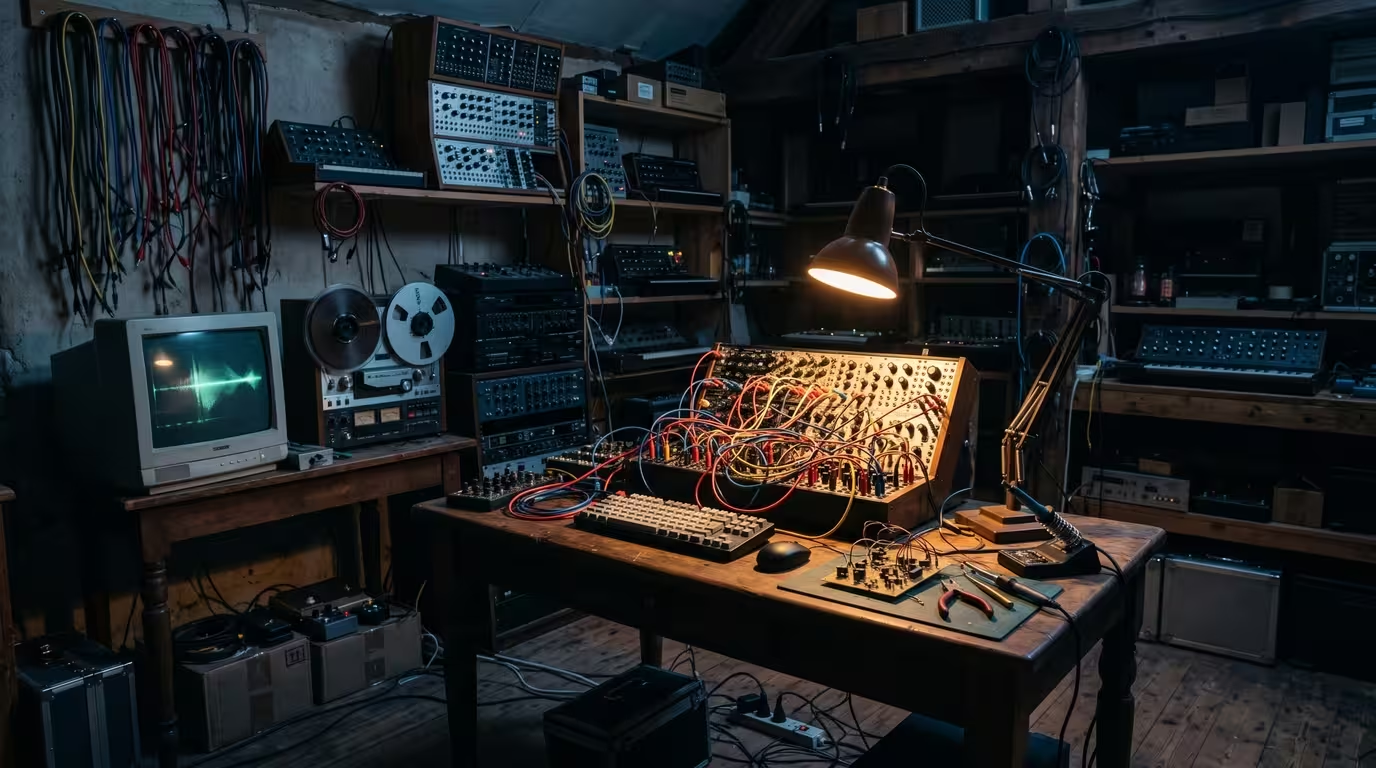
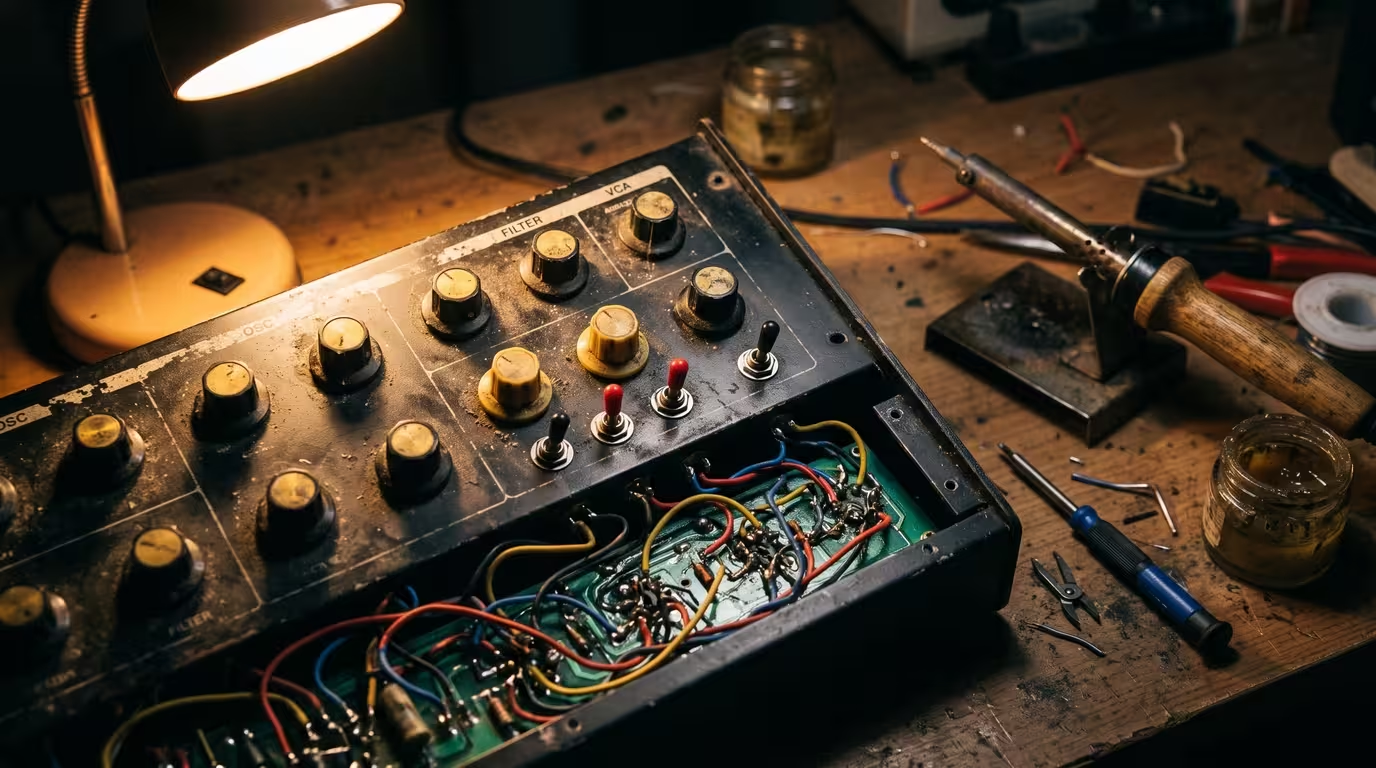
What makes his music unmistakable is the collision at its heart: hyper-detailed, almost violent drum programming set against disarmingly tender melody. He can be serene and savage within the same track. Much of that comes from a genuine obsession with tools. In a 1993 interview James described hand-building his own filters, oscillators, a sampler and a sequencer, and heavily modifying gear like the Korg MS-20 and Roland SH-101, professing to hate the idea of using other people's equipment. Drukqs used a modified Yamaha Disklavier alongside solenoid-based drum mechanisms he built himself. Decades later he pushed Korg to include microtuning on its Monologue synth. This is the through-line: a producer who treats the machine not as an instrument to play but as a world to live inside.
The Mythology and the Persona
The music would be enough. But James wrapped it in an unreliable, wind-up persona that became inseparable from the work. Over the years he has claimed to own a tank, in reality a Daimler Ferret armoured scout car, to sleep barely at all, to compose while lucid dreaming, to have lived in a converted bank vault in south London, and to have priced up a decommissioned submarine. A BBC documentary presented by John Doran, The Cult of Aphex Twin, framed him neatly as a product of the Cornish myth-making tradition. The grinning-face logo, the amorphous A designed by Paul Nicholson in 1991, became a piece of visual shorthand as recognisable as any in electronic music, and his rare live shows, played at punishing volume and paired with visuals by the artist Weirdcore, still trade in that same unsettling humour.
Crucially, the myths are best enjoyed as myths. James is one of the most inventive and influential figures in contemporary electronic music, and the persona is a smokescreen he clearly delights in operating.
Why It Still Sounds Ahead of Its Time
James also gave his name to a genre and then rejected it. Told his work was intelligent dance music, he scoffed in a 1997 interview that the term basically declared one kind of music intelligent and everything else stupid, hence his preference for the joke word braindance. Yet the influence is undeniable. Thom Yorke, who gorged on Warp releases while steering Radiohead toward the electronics of Kid A, has called him one of his biggest modern influences; Frank Ocean listed Aphex Twin's aisatsana [102] among his favourite songs in the zine released alongside Blonde; and his fingerprints are on everything from breakcore to hyperpop.
More than the myths, the enduring lesson of Aphex Twin is the one most useful to any producer: a bottomless curiosity about sound and a refusal to repeat a formula. He made bedroom experimentalism feel like the highest form of the art. The tank may or may not be real. The records, decades on, still sound like the future.
Key takeaways
• Richard D. James, born on 18 August 1971 in Limerick and raised in Cornwall, is among the most inventive figures in electronic music.
• Selected Ambient Works 85-92 (1992) and its 1994 sequel reshaped ambient; the Richard D. James Album defined drill'n'bass.
• His 2014 comeback Syro, promoted by a blimp and a dark-web page, won a 2015 Grammy.
• He built and modified much of his own gear, and treats the machine as a world to inhabit.
• The tall tales, from the tank and the bank vault to the submarine and lucid-dream composing, are self-built legend, best enjoyed as part of the story.
