Some bands write songs. Kraftwerk built a language. Before the drum machine was a cliche, before the producer was a star, four fastidious men from Dusseldorf decided that the machine could be a bandmate and the studio an instrument, and in doing so they quietly authored the operating system for modern music. Trace almost any electronic record back far enough and you arrive at the same cool, gleaming source.
Blog
Kraftwerk: The Blueprint for Electronic Music
How four art students in Dusseldorf drew the map that electro, hip-hop, techno and synth-pop still follow.
From Krautrock to the Man-Machine
Kraftwerk was formed in Dusseldorf in 1970 by Ralf Hutter and Florian Schneider, who had met around 1968 while studying at the city's Robert Schumann Conservatory. Their early records were restless, improvisatory affairs, long exploratory jams closer to the experimental German scene the British press had jokingly dubbed krautrock than to the crisp pop they would later perfect. That scene mattered: alongside Can, Neu!, Cluster, Faust and Tangerine Dream, Kraftwerk belonged to a generation of young Germans hunting for a cultural identity that answered neither to the Nazi past nor to imported Anglo-American rock. Tellingly, the guitarist Michael Rother and the drummer Klaus Dinger briefly passed through Kraftwerk before leaving in 1971 to form Neu! and refine the hypnotic motorik pulse.
Hutter and Schneider ran everything from their own Kling Klang Studio, the Dusseldorf workshop where every Kraftwerk album was conceived. The classic quartet took shape as Wolfgang Flur joined on electronic percussion in 1973 and Karl Bartos came aboard in 1975. Where their peers looked outward, Kraftwerk leaned into their Germanness, singing in German and celebrating the autobahn and the European railway, as a deliberate, faintly ironic statement of renewal.
The Classic Run of Albums
The turning point arrived in 1974 with Autobahn. Its 22-minute title track, a shimmering electronic road trip complete with the whoosh of passing traffic, was edited to 3:27 for single release and became an unlikely international hit, reaching number 25 on the US Billboard Hot 100 and number 11 in the UK, while the album climbed high on both countries' charts. After three purely experimental records, Kraftwerk had found melody, concept and an audience at once.
What followed is one of the great runs in modern music:
• Radio-Activity (1975), their first fully electronic album, a bilingual concept record built on the pun between radioactive decay and radio broadcast.
• Trans-Europe Express (1977), for many their masterpiece, whose iron-rhythm title track simulates the clack of wheels on rails and name-checks David Bowie and Iggy Pop.
• The Man-Machine (1978), with its stark red-and-black cover, lettered by Karl Klefisch in homage to the Russian constructivist El Lissitzky, and the eternal singles The Robots and The Model.
• Computer World (1981), an eerily prescient meditation on data, networks and surveillance, home to Numbers and Computer Love.
Kraftwerk's commercial peak in Britain came almost by accident. Computer Love was released with The Model on the flip side and stalled; when DJs flipped it, the reissued double A-side reached number one on the UK Singles Chart in early 1982, several years after The Model was first recorded. Later came the 1983 Tour de France single, the long-delayed Electric Cafe (1986, later restored to its intended title Techno Pop), and eventually Tour de France Soundtracks in 2003.
Homemade Machines, Human Hands
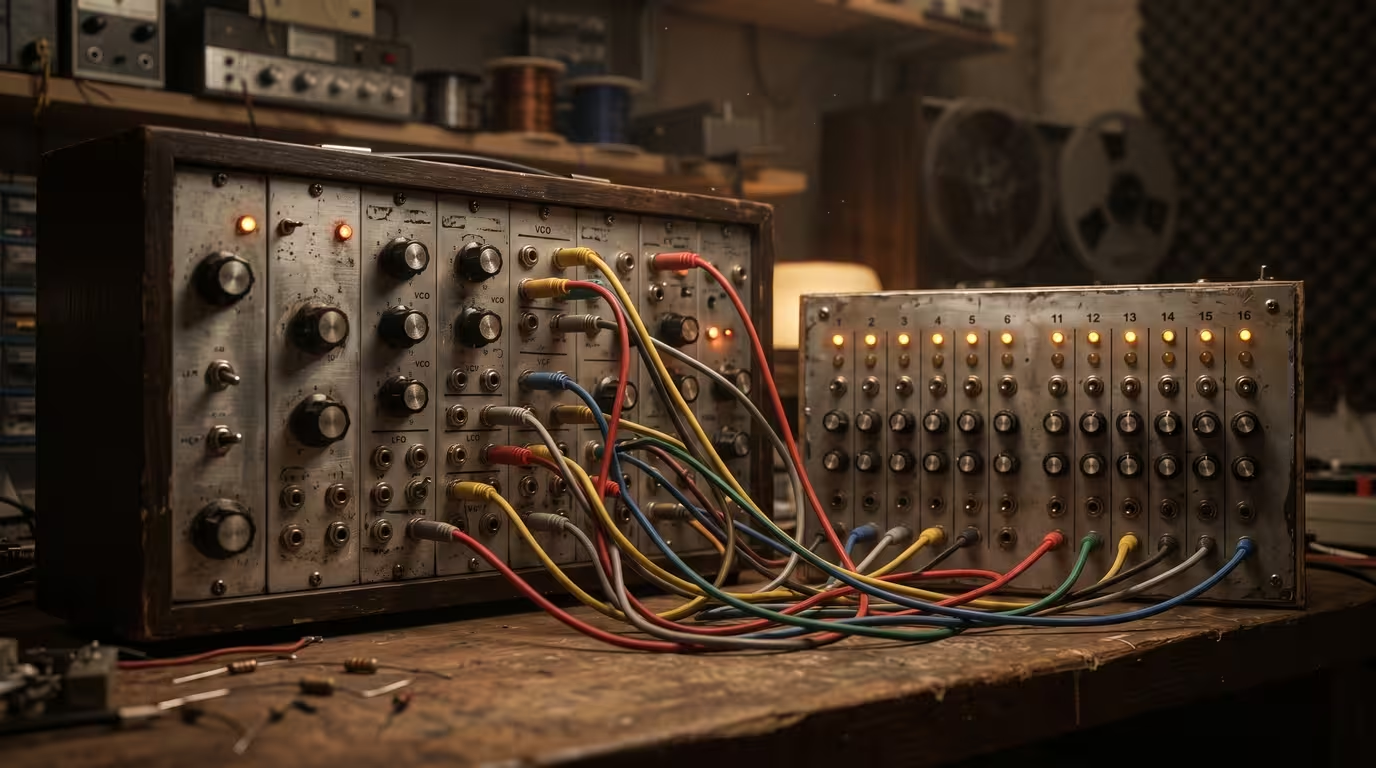
Kraftwerk's sound was inseparable from their gear. Autobahn leaned on a Minimoog, an ARP Odyssey and an EMS Synthi, but the group increasingly built or modified their own instruments: homemade electronic drum pads that Hutter and Schneider patented, a custom Synthanorma sequencer commissioned from a Bonn workshop, and vocoders and speech synthesizers that turned the human voice into something chrome-plated. Fact magazine has catalogued how much of this kit was bespoke, hardware no one else owned. The point was philosophical as much as technical: as Hutter liked to say, they played the machines, and sometimes the machines played them.
The Idea: Anti-Stars in Matching Suits
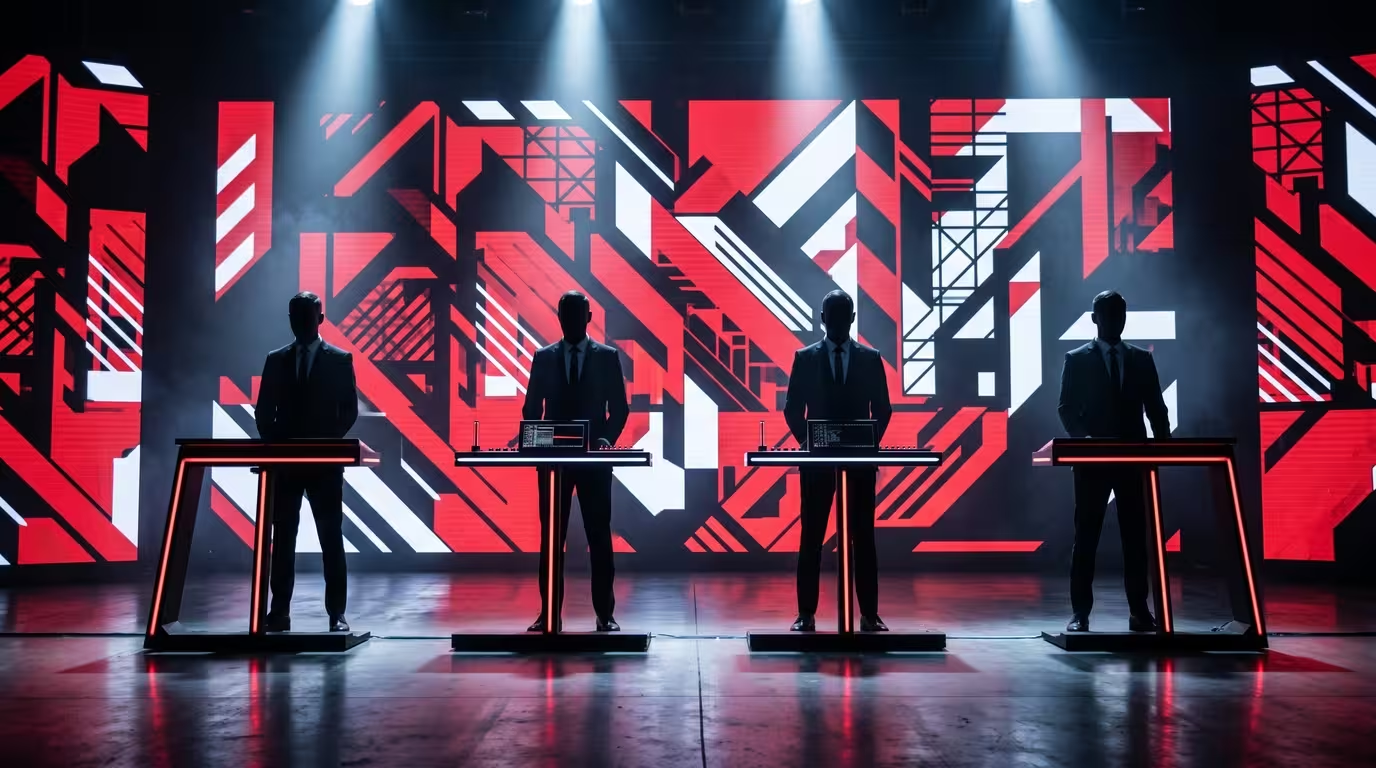
Just as radical was the concept. Kraftwerk presented themselves as four impassive figures in identical suits, at times replaced onstage by robot mannequins built in their likeness, a deliberate rejection of rock-star ego drawn from their art-school world and the clean geometry of the Bauhaus and constructivism. They guarded their image obsessively, granted few interviews, and famously sent robots to some press events. Over time the art world claimed them: in 2012 New York's Museum of Modern Art staged Kraftwerk - Retrospective 1 2 3 4 5 6 7 8, eight consecutive nights of the band performing one album per evening in 3-D, a run that later travelled to the Tate Modern and beyond.
Kraftwerk - The Robots

The Influence: The Heart of the Matter
Here is where Kraftwerk's reach becomes almost hard to overstate. They are widely regarded as the godfathers of electronic pop music, and their machine-funk crossed the Atlantic and detonated.
In hip-hop and electro, the pivotal moment came in 1982, when Afrika Bambaataa & Soulsonic Force's Planet Rock interpolated the melody of Trans-Europe Express over a beat modelled on Numbers. The record, as Sound on Sound has documented in detail, with its producers admitting they realised they might get sued by Kraftwerk, helped invent electro and became foundational to early hip-hop; the borrowings led to an out-of-court settlement with the Tommy Boy Records head Tom Silverman. Their icy grooves found some of their most devoted audiences among Black listeners in New York and Detroit.
In Detroit techno, the reverence was total. Juan Atkins, Derrick May and Kevin Saunderson, the Belleville Three, fused Kraftwerk's European precision with American funk. May's much-quoted description of the new sound, from the liner notes of the 1988 compilation Techno! The New Dance Sound of Detroit, imagined George Clinton and Kraftwerk stuck in an elevator with only a sequencer to keep them company. Atkins's group Cybotron drew the line straight from Dusseldorf to the Motor City.
In synth-pop and new wave, Kraftwerk were the ur-text. Bowie named the instrumental V-2 Schneider on his 1977 album Heroes after Florian Schneider; Depeche Mode, New Order, OMD, the Human League and Gary Numan all built on the template. And in house, techno and the whole edifice of modern dance music, the deeper inheritance is structural: the sequenced groove, the drum machine, the synthesized bassline and the idea of the producer as a studio-based auteur all descend from what Kraftwerk formalised.
Their status as one of the most-sampled acts also made them a landmark in copyright law. In the German Metall auf Metall case, the producer Moses Pelham looped a roughly two-second rhythm from Kraftwerk's 1977 track, played about 5 percent slower, into a 1997 Sabrina Setlur single, triggering litigation running since 1999 through the Hamburg courts, Germany's Federal Court of Justice, its Constitutional Court and the Court of Justice of the European Union twice. In April 2026 the CJEU handed down a sampler-friendly interpretation of the pastiche exception, holding that it is enough for the pastiche nature to be recognisable to someone familiar with the original, but it did not end the dispute: the case was sent back to Germany's federal courts for a final decision and remains open.
The Later Years and the Legacy
Kraftwerk's pace slowed as the members drifted apart: Flur left in 1987 and Bartos in 1990. Schneider departed in 2008 after four decades, leaving Hutter to steer the group; Schneider died of cancer on 21 April 2020, aged 73, a loss mourned across the musical world. Hutter has kept Kraftwerk touring their catalogue as an immersive 3-D live show, and the honours have accumulated: a Grammy Lifetime Achievement Award in 2014, and induction into the Rock and Roll Hall of Fame in 2021 in the Early Influence category.
There is a neat lesson in all this for anyone making electronic music today. Kraftwerk essentially invented the modern producer's toolkit and mindset, from the looping groove to the machine as bandmate and the studio as the real instrument, and studying how they did it remains genuinely instructive. A group of art students in Dusseldorf sat down at their homemade consoles and drew a map. More than half a century later, nearly all electronic music is still travelling the roads they laid.
Key takeaways
• Kraftwerk, formed in Dusseldorf in 1970 by Ralf Hutter and Florian Schneider, are widely regarded as the godfathers of electronic music.
• Their classic run, from Autobahn and Radio-Activity to Trans-Europe Express, The Man-Machine and Computer World, turned experimental krautrock into fully electronic pop.
• The man-machine aesthetic paired homemade instruments with a deliberate anti-rock-star image later embraced by museums like MoMA.
• Their influence runs through electro, hip-hop, Detroit techno, synth-pop and essentially all modern dance music.
• Florian Schneider died in 2020; Ralf Hutter continues to lead Kraftwerk as acknowledged ancestors of the genre.
