Some records rearrange the furniture. A few knock the walls down. In the spring of 1982, a twelve-inch single called Planet Rock did the second thing, welding a German synthesizer melody to a Bronx block-party sensibility over the metronomic pulse of a new drum machine, and in the process naming a sound the world had not quite heard before. That sound was electro, and its DNA is still audible every time an 808 kick rattles a car trunk.
Blog
Electro and the Planet Rock Moment
How Kraftwerk's machine music collided with Bronx hip-hop to spark a genre that still runs through everything.
What Electro Actually Is
Electro, often called electro-funk, is a style of electronic dance music that emerged in the early 1980s, roughly between 1981 and 1983. It is built around the Roland TR-808 drum machine, whose programmed, syncopated patterns replaced the live drummer of funk with something colder, tighter and unmistakably machine-made. Over those beats sit synthesized basslines, spare melodic stabs, and vocals pushed through a vocoder or talkbox into a robotic deadpan.
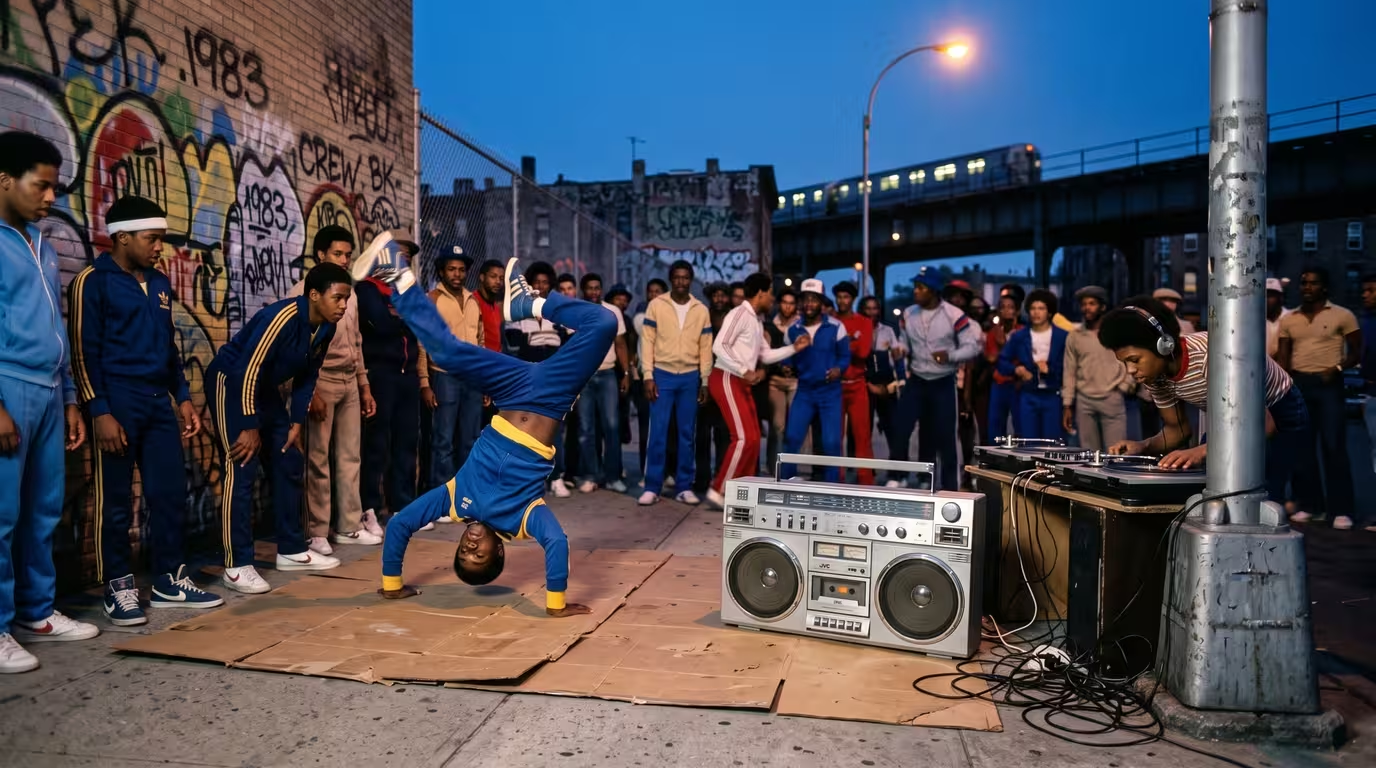
The aesthetic is the message. Where disco chased warmth and boogie leaned on lead vocals, electro leaned into the machine, with sci-fi themes, futuristic imagery and a man-machine fascination borrowed wholesale from European electronic pop. Crucially, electro was body music. Its syncopated, breakbeat-style rhythms, dry, funky and mechanical rather than the four-on-the-floor thump of house, made it the soundtrack of breakdancing. B-boys and b-girls needed hard, angular, robotic rhythms to pop and lock to, and electro delivered.
The Ingredients
No single genius invented electro; it was a collision of scenes and machines.
• Kraftwerk, the German quartet from Dusseldorf, loomed over everything. Their albums Trans-Europe Express (1977), The Man-Machine (1978) and Computer World (1981) fused European electronic minimalism with a robotic precision that, improbably, landed hard with Black audiences in New York and Detroit. Trans-Europe Express became a staple at Afrika Bambaataa's Bronx River parties, and Numbers, from Computer World, charted on the R&B side.
• The funk lineage ran underneath it all, from George Clinton's Parliament-Funkadelic Afrofuturism to the electronic funk of Zapp and Roger Troutman, whose talkbox turned the human voice into a synthesizer.
• Yellow Magic Orchestra, the Japanese synth-pop pioneers, were early adopters of the machine aesthetic and among the first acts to use the TR-808 on record.
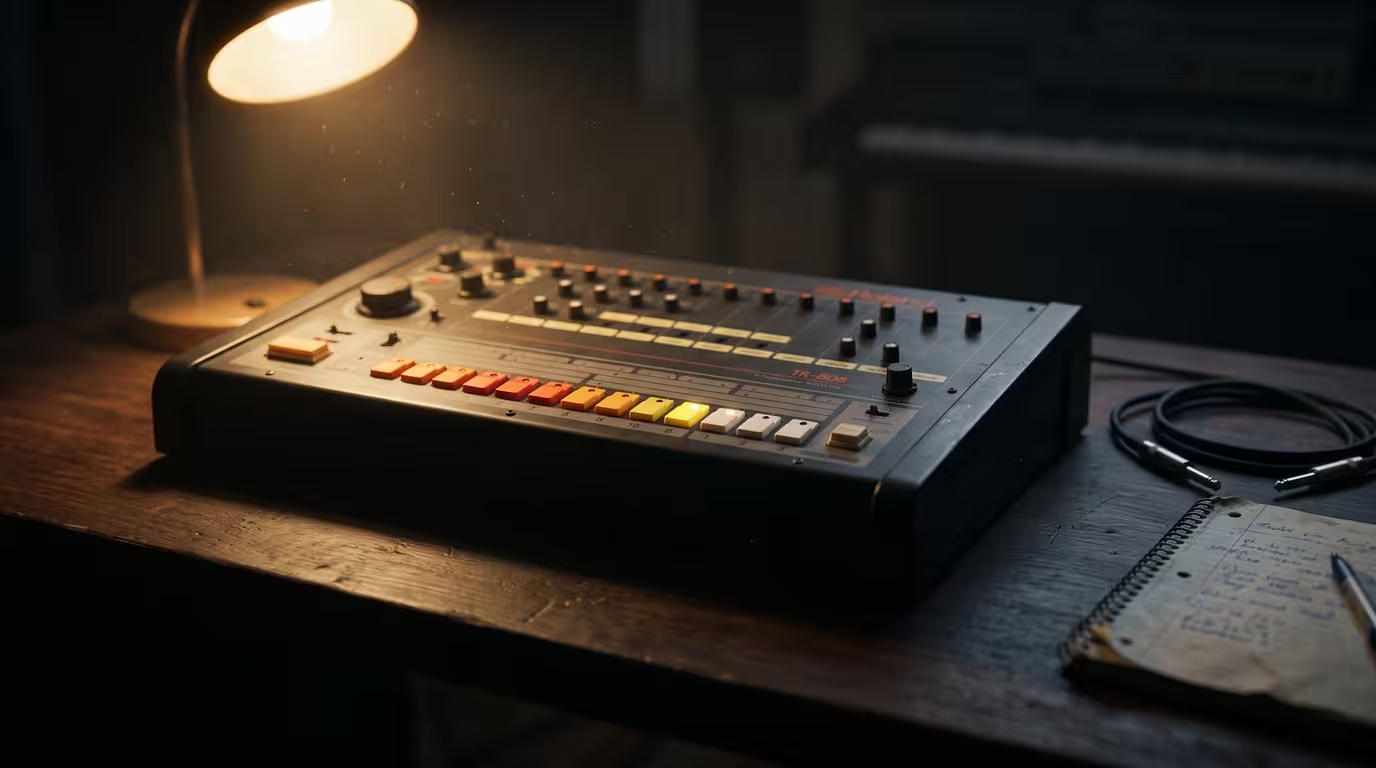
• And the machines themselves arrived cheap and programmable. The TR-808, released in 1980, was a commercial flop at first, its sounds deemed thin and unrealistic, but that synthetic character became its superpower. Roland built approximately 12,000 units before discontinuing it in 1983, after which secondhand boxes landed in the right hands at the right price.
Bambaataa, a DJ with an encyclopedic and famously eclectic record collection, was the connective tissue. He would drop Kraftwerk, Gary Numan and Yellow Magic Orchestra for crowds that just wanted to dance, proving that the machine music and the block party belonged together.
The Planet Rock Moment
The synthesis crystallised on one record. Planet Rock, credited to Afrika Bambaataa & the Soulsonic Force, was released on Tommy Boy Records in 1982 and produced by Arthur Baker with the keyboardist John Robie. Tommy Boy's Tom Silverman recalled the idea in a 1988 Keyboard interview, saying he thought it would be a great idea to use those rhythms and that kind of sound on a black record, so he and Bambaataa went into the studio. The goal was a record in the spirit of Kraftwerk, but funky, and built for the floor.
They did it by interpolating the melody of Trans-Europe Express with a drum pattern modelled on Numbers, recreated in the studio rather than sampled, all laid over a TR-808. Robert Palmer of The New York Times called it perhaps the most influential black pop record of 1982. It peaked at number four on Billboard's R&B chart and number 48 on the Hot 100, earned a US gold certification, and effectively launched electro as a named genre, spawning, by Baker's own account, a hundred imitators almost overnight.
Because the Kraftwerk elements were replayed without prior clearance, the record drew the Germans' anger and a settlement followed. Baker later described the resolution bluntly, recalling that Kraftwerk went to Tommy Boy and that Silverman gave them a dollar a record, while raising the single's list price to cover it, so that, in Baker's telling, the buyers effectively paid Kraftwerk. Exact totals and dates beyond that are not reliably documented, so it is best understood as a negotiated settlement rather than a precise figure.
A word on Bambaataa the person. He was a pivotal DJ and the founder of the Universal Zulu Nation, but from 2016 he faced serious public allegations of sexual abuse of minors, which he denied. The fairest telling credits the record and its creators, Baker, Robie and the Soulsonic Force, rather than lionising the man.
Afrika Bambaataa & The Soulsonic Force - Planet Rock

The Explosion, 1982 to 1985
Once the template existed, electro detonated across the country and then the world.
In New York, the floodgates opened: Man Parrish's Hip Hop, Be Bop (Don't Stop) in 1982, Hashim's Al-Naafiysh (The Soul) in 1983, Newcleus's Jam On It in 1984, Twilight 22's Electric Kingdom, plus Warp 9, the Jonzun Crew and Planet Patrol, much of it flowing through the Tommy Boy, Streetwise and allied label ecosystem, with Arthur Baker's fingerprints everywhere.
The crossover moment came from an unexpected direction. In 1983, the jazz pianist Herbie Hancock released Rockit, produced by Bill Laswell and Michael Beinhorn and propelled by Grandmixer DXT's turntable scratching, a performance that gave hip-hop its first Grammy trophy. Its uncanny Godley and Creme video, full of twitching robotic mannequins, went into heavy rotation on MTV; Rockit won the Grammy for Best R&B Instrumental Performance and took five awards at the inaugural 1984 MTV Video Music Awards, more than any other artist that night.
On the West Coast, electro mutated into something faster and sleeker. Egyptian Lover with Egypt, Egypt, the Unknown DJ, Arabian Prince and the World Class Wreckin' Cru, whose members included a young Dr. Dre, turned the 808 into the engine of the Los Angeles party scene, a sound that fed directly into later West Coast rap.
In Detroit, the story turned generational. Cybotron, made up of Juan Atkins and Richard 3070 Davis, released Cosmic Cars and then Clear, fusing Kraftwerk's precision with Parliament's cosmic funk and Alvin Toffler's futurism. Atkins soon left to record as Model 500 and founded Metroplex Records; Detroit electro fed straight into the birth of techno.
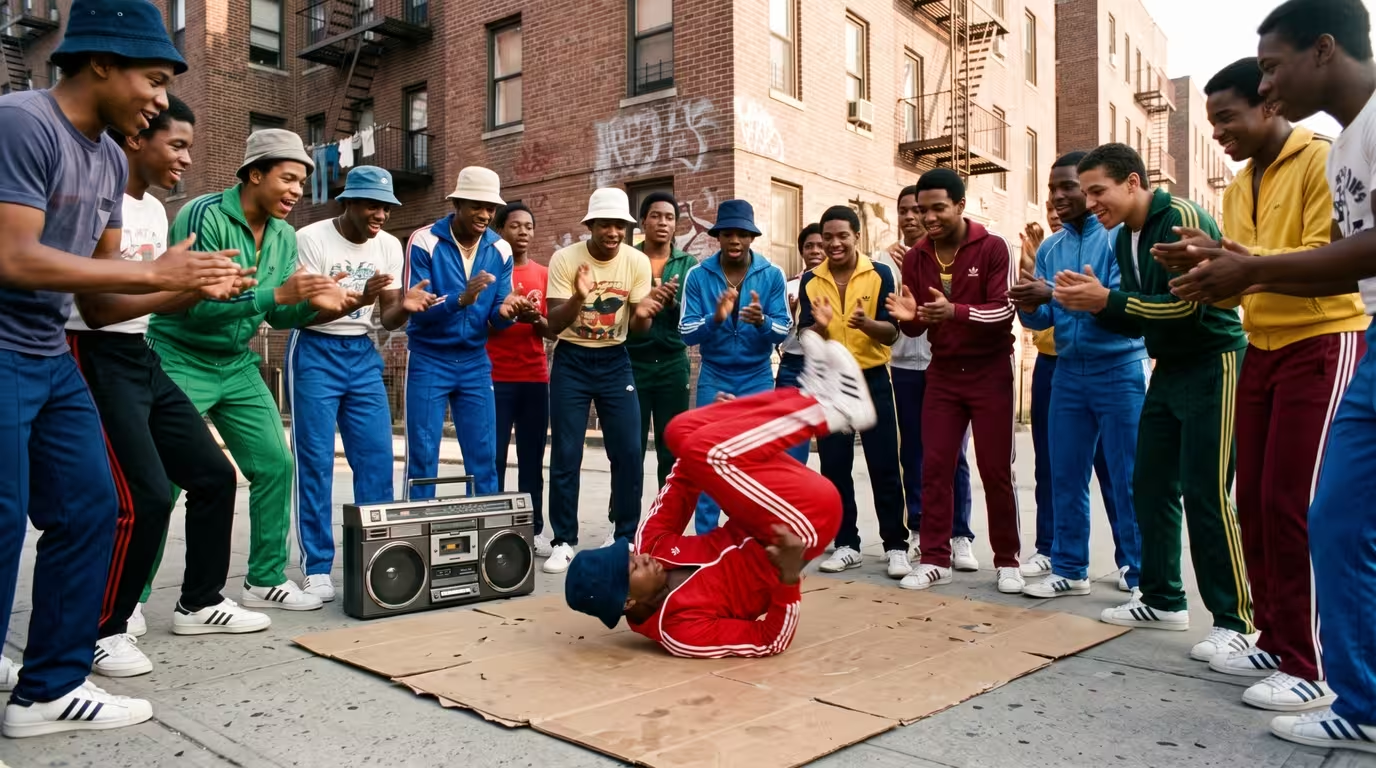
Abroad, Britain caught the bug through Morgan Khan's Street Sounds Electro compilation series, whose mixed LPs and cassettes became breakdance essentials up and down the country. And the movies did the rest: Wild Style (1983), Beat Street (1984), with a soundtrack partly overseen by Arthur Baker, and Breakin' (1984), which even featured Kraftwerk's Tour de France, carried electro and b-boy culture around the globe.
Decline, and a Very Long Afterlife
By the mid-to-late 1980s, electro faded from the mainstream. Hip-hop moved toward sampling and harder, rock-inflected beats, while house and techno rose. But electro never really died; it just went underground and seeded everything.
Its 808 template became the backbone of Miami bass, where producers like Amos Larkins II and groups like 2 Live Crew stretched the 808 kick into that trunk-rattling sub-bass. It fed freestyle. In Detroit, its aesthetic ran through techno's first wave and resurfaced with Drexciya, the enigmatic duo of James Stinson and Gerald Donald, whose Afrofuturist mythology of an underwater civilisation descended from enslaved Africans thrown overboard remains one of electronic music's great conceptual achievements. Underground Resistance, Dopplereffekt and Anthony Rother kept the flame, and a distinct electro revival flourished in the late 1990s.
More recently, a new generation of DJs and producers, among them Helena Hauff and Detroit's DJ Stingray, alongside veterans like Egyptian Lover, has pushed electro back into the spotlight of the underground club scene, its syncopated funk a pointed alternative to four-to-the-floor techno.
One note on terminology: the word electro was later borrowed for the mid-2000s electro house sound of Justice, blog house and deadmau5, a distinct, four-on-the-floor genre that shares little beyond the name. When people who love the 808 breakbeat say electro, they mean the robot-funk.
Why It Matters
Electro is one of the great hinge moments in music history, the point where Black American funk and hip-hop culture fused with European electronic machine music, and the seam is still visible in almost everything that followed. It gave techno its blueprint, gave hip-hop production the 808, and gave dance music a futurist, Afrofuturist imagination that treated machines not as a threat but as instruments of escape.
The machine-funk craft at its core, an 808, a synth, a vocoder and an idea about the future, remains one of the foundational skills in a producer's world. Nearly half a century on, the robot still has the funk.
Key takeaways
• Electro, or electro-funk, is the early-1980s, 808-driven, robotic, sci-fi-tinged dance genre, not the 2000s electro house.
• It was born when Kraftwerk's machine music met Bronx block-party hip-hop, crystallised by Planet Rock in 1982.
• Planet Rock interpolated Kraftwerk's Trans-Europe Express and Numbers over a TR-808; credit belongs to Arthur Baker, John Robie and the Soulsonic Force.
• Electro soundtracked breakdancing and spread worldwide via films and the UK's Street Sounds series.
• Its DNA seeded Detroit techno, Miami bass and freestyle, and lives on through Drexciya and a continuing electro revival.
