Almost every track that moves a dancefloor is built on a short loop of chords that repeats, hypnotically, for minutes at a time. Understanding those chords — how they are built, which ones belong together, and why a particular sequence feels euphoric, dark or bittersweet — is one of the biggest upgrades a new producer can make. This article focuses specifically on chords and chord progressions. For the underlying ideas of keys and scales, see our companion articles on Musical Keys for DJs and Scales for Electronic Music, and for mixing in key see the Camelot Wheel and Harmonic Mixing guide.
What a Chord Actually Is
A chord is simply three or more notes played at the same time. The basic building block in dance music — and most Western music — is the triad, a three-note chord made of a root, a third and a fifth. You build a triad by stacking thirds: start on a note, skip one, land on the next, skip again, land on the next.
The interval between the root and the third decides the chord's whole personality. A major triad is a root plus a major third (4 semitones) plus a perfect fifth (7 semitones) — for example C–E–G — and it sounds bright and stable. A minor triad keeps the same perfect fifth but lowers the third to a minor third (3 semitones) — for example A–C–E — and it sounds darker, sadder, more introspective. That single semitone of difference in the third is the most emotionally loaded note in the chord. Two other triad types appear occasionally: the diminished triad (minor third plus a diminished fifth, e.g. B–D–F) sounds tense and unstable, and the augmented triad (major third plus an augmented fifth) sounds uneasy and mysterious.
Chords come from scales. If you take the notes of a scale and stack thirds on each one, you generate a family of chords that all sound good together — which is exactly what gives a track its harmonic glue.
The Chords Hiding in Your Key
Every major and minor key contains seven notes, and building a triad on each note gives you seven diatonic (within the key) chords. Producers write these with Roman numerals, where the number is the scale degree the chord is built on and the case shows the quality: uppercase for major, lowercase for minor, and a small circle (°) for diminished. The huge advantage is that the pattern is identical in every key, so once you learn it you can transpose instantly.
In a major key the qualities always run I, ii, iii, IV, V, vi, vii°. Here are the chords in C major.
| Roman numeral | Chord in C major | Quality |
|---|---|---|
| I | C (C–E–G) | major |
| ii | Dm (D–F–A) | minor |
| iii | Em (E–G–B) | minor |
| IV | F (F–A–C) | major |
| V | G (G–B–D) | major |
| vi | Am (A–C–E) | minor |
| vii° | Bdim (B–D–F) | diminished |
In a natural minor key the pattern shifts to i, ii°, III, iv, v, VI, VII. Here it is in A minor — which is the relative minor of C major and therefore uses exactly the same seven notes and the same seven chords, just renumbered from a different home base.
| Roman numeral | Chord in A minor | Quality |
|---|---|---|
| i | Am (A–C–E) | minor |
| ii° | Bdim (B–D–F) | diminished |
| III | C (C–E–G) | major |
| iv | Dm (D–F–A) | minor |
| v | Em (E–G–B) | minor |
| VI | F (F–A–C) | major |
| VII | G (G–B–D) | major |
That relative-key relationship is worth burning into memory, because it explains why so many dance tracks feel both uplifting and melancholy at once — they are using the same chords, just leaning on a minor or major center.
Sevenths, Ninths and the Lush Dance Sound
Triads are the foundation, but the warm, jazzy, emotional sound of deep house, soulful house, lo-fi and future bass comes from adding more notes. Stack one more third on top of a triad and you get a seventh chord, a four-note chord. The three you will use most:
• Major seventh (maj7): a major triad plus a major seventh — Cmaj7 = C–E–G–B. Dreamy, warm, sophisticated.
• Minor seventh (m7): a minor triad plus a minor seventh — Am7 = A–C–E–G. Smooth and mellow; the backbone of soulful and deep house.
• Dominant seventh (7): a major triad plus a minor seventh — G7 = G–B–D–F. Tense and bluesy; it contains a tritone that strongly wants to resolve.
Stack yet another third and you reach ninth chords: Cmaj9 (C–E–G–B–D), Am9 (A–C–E–G–B), and the dominant C9 (C–E–G–B♭–D). These extended chords are what producers call the secret sauce — they sound rich and lush, which is why deep house leans so heavily on minor and major 7ths and 9ths. Attack Magazine's tutorial on deep house chords puts it plainly: a trademark of deep house is its jazz-influenced minor and major 7 chords, which give tracks a strong, chord-led feel. There are also suspended chords — sus chords — where the third is replaced by the second (sus2: C–D–G) or fourth (sus4: C–F–G). With no third, a sus chord is neither major nor minor; it sounds open and unresolved, ideal for intros and build-ups before it resolves into a full chord.
A useful workflow: write your progression as plain triads first, then experiment with adding 7ths, 9ths and suspensions to taste.
The Progressions That Power the Dancefloor
A chord progression is just a succession of chords in a particular order, and as Wikipedia's chord progression entry notes, they are the foundation on which melody and rhythm are built. Most dance music loops a four-chord progression endlessly. Here are the workhorses, written in Roman numerals with a concrete realization and the mood most listeners associate with them. Treat the moods as widely-recognized tendencies, not laws — arrangement, tempo and sound design change everything.
| Progression | Example | Typical mood |
|---|---|---|
| I–V–vi–IV | C–G–Am–F | Uplifting, anthemic, familiar |
| vi–IV–I–V | Am–F–C–G | Emotional, bittersweet |
| i–VI–III–VII | Am–F–C–G | Epic, euphoric (minor) |
| i–VII–VI–VII | Am–G–F–G | Driving, hypnotic |
| ii–V–I | Dm–G–C | Jazzy, resolved |
| i–iv–VII | Am–Dm–G | Dark, rolling |
The first two rows are the same four chords in different rotations — the famous axis, or four-chord, progression that powers a huge share of pop and EDM. Its ubiquity is so well known that the Australian comedy trio The Axis of Awesome built a Four Chords medley stringing dozens of pop hits over a single I–V–vi–IV loop; the routine went viral after BBC Radio 1 airplay and its two main videos had passed 100 million combined YouTube views by May 2020. The vi–IV–I–V rotation has its own name too: Boston Globe columnist Marc Hirsh dubbed it the "sensitive female chord progression" after noticing it in Joan Osborne's "One of Us" and across late-1990s Lilith Fair performers. Crucially, look at rows two and three: vi–IV–I–V in C major (Am–F–C–G) is the identical set of chords to i–VI–III–VII in A minor. The only thing that changes is which chord feels like home. This is why the epic minor progression and the bittersweet pop progression are really two sides of the same coin. Avicii's "Wake Me Up," for instance, sits in B minor and loops Bm–G–D–A — a textbook i–VI–III–VII — which read from its relative major (D) is simply a rotation of that same four-chord axis.
Genre Tendencies
• Deep and soulful house borrow directly from jazz: the ii–V–I turnaround (Dm7–G7–Cmaj7 in C) and 7th/9th voicings give it that smooth, sophisticated feel.
• Trance and progressive house favour emotional minor progressions like i–VI–III–VII for their epic, hands-in-the-air builds, often arpeggiated and layered with supersaws.
• Techno and minimal frequently sit on a single chord, a two-chord vamp, or modal riffs with almost no harmonic movement — the interest comes from rhythm, timbre and filter automation rather than chord changes.
• Future bass uses lush major chords with extensions — a staple is I–iii–vi–IV (C–Em–Am–F) voiced as big detuned 7th and 9th supersaw stacks.
• Lo-fi leans on jazzy 7ths and 9ths for its hazy, nostalgic warmth.
Because the chords loop, dance music is uniquely forgiving: you can build an entire track on three or four chords as long as the groove and sound design carry it.
How Progressions Create Emotion
The emotional pull of a progression comes largely from tension and resolution. Some chords feel stable (home), others feel like they are leaning somewhere. The strongest pull in tonal music is from the V chord (the dominant) back to the I (the tonic) — the V is restless and wants to resolve home, a movement formalized as the authentic cadence. Adding a seventh to the V (V7) sharpens that pull because of the tritone inside it. Minor chords and minor-key progressions read as more melancholic and introspective; major as brighter and more optimistic.
In a dance arrangement, these forces map onto structure. A breakdown often strips back to a pad playing the bare progression, building emotional tension; the drop then releases it with the full chord stack, bass and drums hitting together. Many of the most hypnotic tracks deliberately avoid a strong resolution — a loop like i–VII–VI–VII never truly lands, which is exactly what gives it that endless, trance-like momentum perfect for long DJ blends. Producers also create lifts by borrowing chords from outside the key or by modulating up a key in the final drop for a burst of extra energy.
Inversions and Voicing
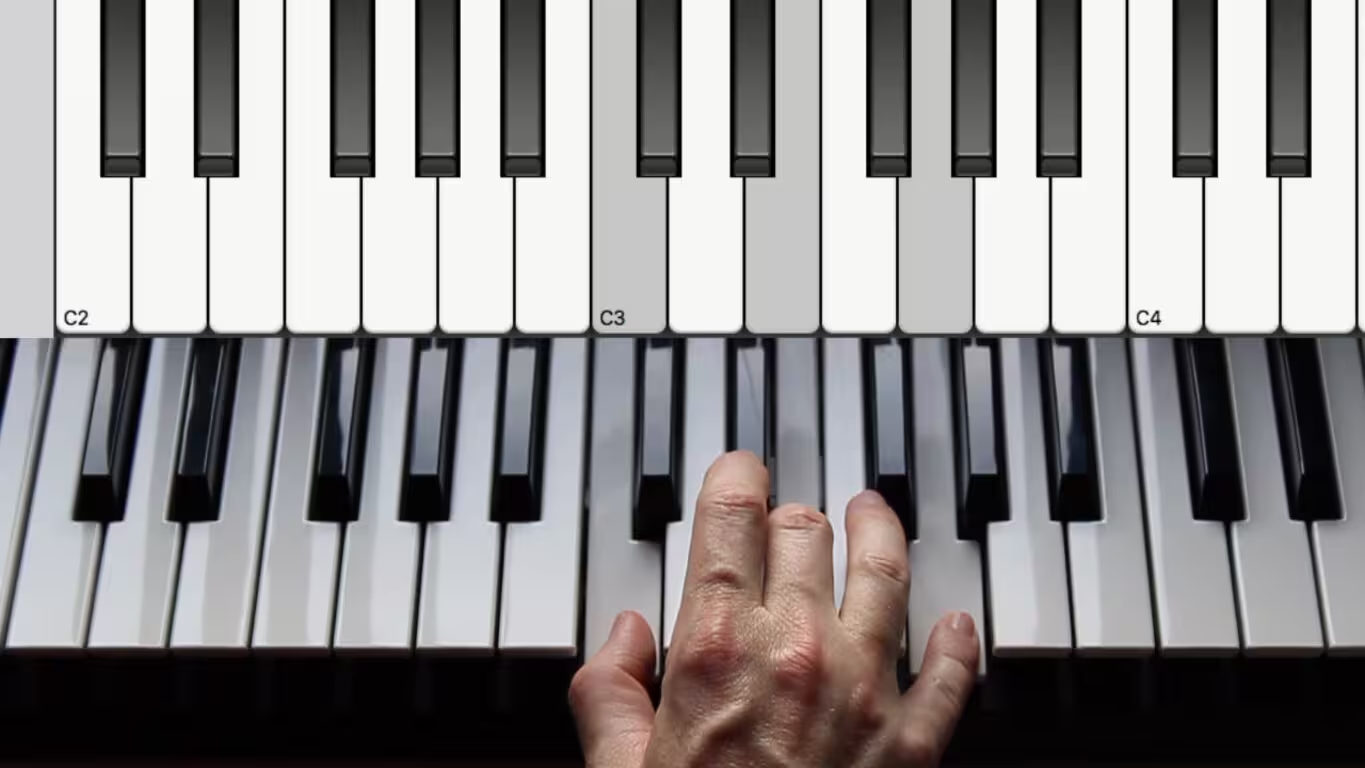
The same chord can be played with its notes in different vertical orders — these are inversions. C major is C–E–G in root position, E–G–C in first inversion, G–C–E in second inversion: same three notes, different lowest note and different feel. Spreading a chord's notes across octaves (an open voicing) sounds wide and lush; clustering them sounds tight and punchy.
Producers invert chords mainly for smoother movement, a practice called voice leading: you keep notes common to two chords in the same place and move the others by the smallest possible step. For example, moving from C major to F major in root position is a big jump, but voicing F as C–F–A keeps C on the bottom and barely moves the other notes. Smooth voice leading is a large part of what separates polished, professional-sounding chords from blocky ones.
Putting It to Work in Your DAW
You do not need to be a keyboard virtuoso to use any of this. A practical path:
1. Pick a key and stay diatonic. Start with the seven chords in your major or minor key and you literally cannot play a wrong chord.
2. Loop a four-chord progression from the table above and let it repeat for several bars before judging it.
3. Add 7ths and 9ths for lushness, then try a sus chord or an inversion to smooth the transitions.
4. Stack a simple melody on top using notes from the same scale.
5. Match the progression to the energy you want — bright major for festival euphoria, minor for late-night depth.
Modern DAWs make this almost effortless. Ableton Live's Chord MIDI effect turns a single note into a full chord, and its Scale device snaps everything to a chosen key; FL Studio's piano-roll chord and stamp tools insert ready-made shapes; and dedicated tools and arpeggiators (including Captain Chords-style plugins) generate progressions and break chords into moving patterns. Ableton's free, browser-based Learning Music course is an excellent hands-on primer, and Hooktheory maintains what it calls the internet's largest collection of songs broken down by music theory — tens of thousands of crowd-sourced analyses that reveal the actual progressions behind real records.
For DJs, the payoff is mostly in understanding and selection. Knowing why a track feels euphoric or dark — and recognizing the progression underneath — helps you match not just the key but the harmonic feeling when planning mashups and transitions, which is where harmonic mixing (covered in the Camelot Wheel and Harmonic Mixing article) and chord knowledge meet.
Key takeaways
• A chord is three-plus notes together; major triads (root + 4 + 7 semitones) sound bright, minor triads (root + 3 + 7) sound dark.
• Each key has seven diatonic chords; in major they run I ii iii IV V vi vii°, in natural minor i ii° III iv v VI VII.
• 7th and 9th chords create the lush, jazzy sound of deep house, future bass and lo-fi.
• The axis progressions I–V–vi–IV / vi–IV–I–V and the minor i–VI–III–VII are the same chords in different rotations — learn them first.
• Emotion comes from tension and resolution (V wants to go home) and from looping; arrangement and voice leading do the rest.
Ready-made, exclusive EDM tracks with full rights — released as your own.
