A Performing Rights Organization (PRO) is one of the most important — and most misunderstood — pieces of the music-income puzzle. Plenty of producers join one, assume they're now collecting royalties, and quietly leave money sitting uncollected for years. This guide explains what a PRO actually is and does, the major PROs by territory, how to affiliate and register your works, and — crucially — the other collection bodies you need alongside a PRO to capture everything your music earns. It builds on our companion article How Music Royalties Work, which defines the royalty types; here we focus on the organizations and the practical how-to of collection.
This article is general educational information, not financial or legal advice. PROs, rates, fees, eligibility rules and the way royalties are split vary by country and change over time. Always confirm the current details directly with the relevant organizations and consult a qualified professional for your own situation.
What a PRO is and does
A Performing Rights Organization licenses the public-performance right in musical compositions to the businesses that use music — radio and TV stations, clubs and venues, streaming services, shops, gyms, restaurants and more — usually through a blanket license that covers the PRO's entire catalog at once. The PRO collects the license fees, tracks where and when works are performed, and distributes the money as performance royalties to its affiliated songwriters and publishers.
The reason PROs exist is simple: it is impossible for an individual songwriter to license and invoice every venue, station and platform that might play their music. As SESAC puts it, businesses get a consolidated, clearinghouse-style way to clear the rights, while the copyright owner gets a body that ensures users are licensed and pays out accordingly. ASCAP traces this all the way back to 1914, founded so that songwriters no longer had to individually license and collect payment for each performance.
Two points matter for the rest of this guide. First, a PRO deals only with the composition (the song — the melody, chords and lyrics), not the sound recording. (For the two-copyrights foundation, see Copyright Basics for Producers.) Second, performance royalties are split into a writer's share and a publisher's share — typically 50/50. Your PRO pays the writer's share directly to you; the publisher's share only reaches you if a publisher, a publishing administrator, or your own publishing entity is set up to collect it. For a full recap of what performance royalties are versus mechanical, master and sync royalties, see How Music Royalties Work.

The major PROs by territory
Most countries have one main PRO; the United States is unusual in having four. As a songwriter you generally affiliate with one PRO in your home territory, and it collects worldwide on your behalf through reciprocal agreements with foreign societies — the global network coordinated through CISAC. CISAC's 227 member societies collected a record €13.1 billion in 2023; as Director General Gadi Oron noted in the CISAC Global Collections Report 2024, collections on behalf of creators reached a new all-time high of €13.1 billion, a 7.6% increase. When your track is played in Germany, GEMA collects locally and passes the money to your home PRO.
In the US, ASCAP and BMI are the two large organizations open to essentially anyone, while SESAC and Global Music Rights (GMR) are invitation-only, for-profit boutiques. ASCAP remains a not-for-profit owned and governed by its members. BMI announced in October 2022 that it would move from a not-for-profit to a for-profit model, and was acquired by an investor group led by New Mountain Capital in a deal that closed on February 8, 2024 — New Mountain's own announcement confirmed it had completed the acquisition of Broadcast Music, Inc., with former shareholders allocating $100 million of proceeds to affiliates.
A non-exhaustive map of major composition PROs/societies:
| Territory | PRO / society |
|---|---|
| United States | ASCAP, BMI, SESAC, GMR |
| United Kingdom | PRS for Music |
| Canada | SOCAN |
| Australia / New Zealand | APRA AMCOS |
| Germany | GEMA |
| France | SACEM |
| Japan | JASRAC |
A practical wrinkle: in many countries the same body collects both performance and mechanical royalties on the composition. France's SACEM, Germany's GEMA and Japan's JASRAC operate this way as combined societies. In the UK, PRS for Music handles performance while its sister society MCPS handles mechanicals — you can join both together. US PROs, by contrast, collect performance only, which is why American producers need a separate mechanical collector (more below).
How to choose
You can generally only be affiliated with one PRO for performance rights at a time, so the choice matters. Factors to weigh include eligibility (SESAC and GMR are invite-only), cost, payout frequency and speed, transparency, and member services. We do not recommend one as best — compare them against your own needs and check the current details on each organization's site.
How to affiliate (join a PRO)
Joining is straightforward, but note that only you, the writer, can affiliate — a publisher or admin cannot do it for you. You apply on your home PRO's website as a writer, and you can usually also set up a publisher entity so you can collect the publisher's share too. (With ASCAP, for example, an independent songwriter must set up an ASCAP publishing company to collect the publisher's share; otherwise that 50% can go uncollected.)
Fees vary and change, so treat any figure as current-but-subject-to-change and verify before you join. As of 2026, ASCAP states that joining is free for writers and free when joining as a writer and publisher at the same time (a $50 one-time fee applies to publisher-only membership). BMI's official site states songwriter membership is free, with one-time publisher-affiliation fees of $175 for an individual, $250 for a corporation/LLC and $500 for a partnership, though some industry sources have reported a one-time writer fee being introduced after its for-profit switch — another reason to check current rates directly. In the UK, PRS for Music charges a one-time writer joining fee of around £100 (with a discounted rate for under-25s), and MCPS membership is separate. In Canada, SOCAN is free for writers with a one-time publisher fee. Most PROs also require an exclusivity period — you commit to one society and can switch only at set intervals.
Registering your works — the step that gets you paid
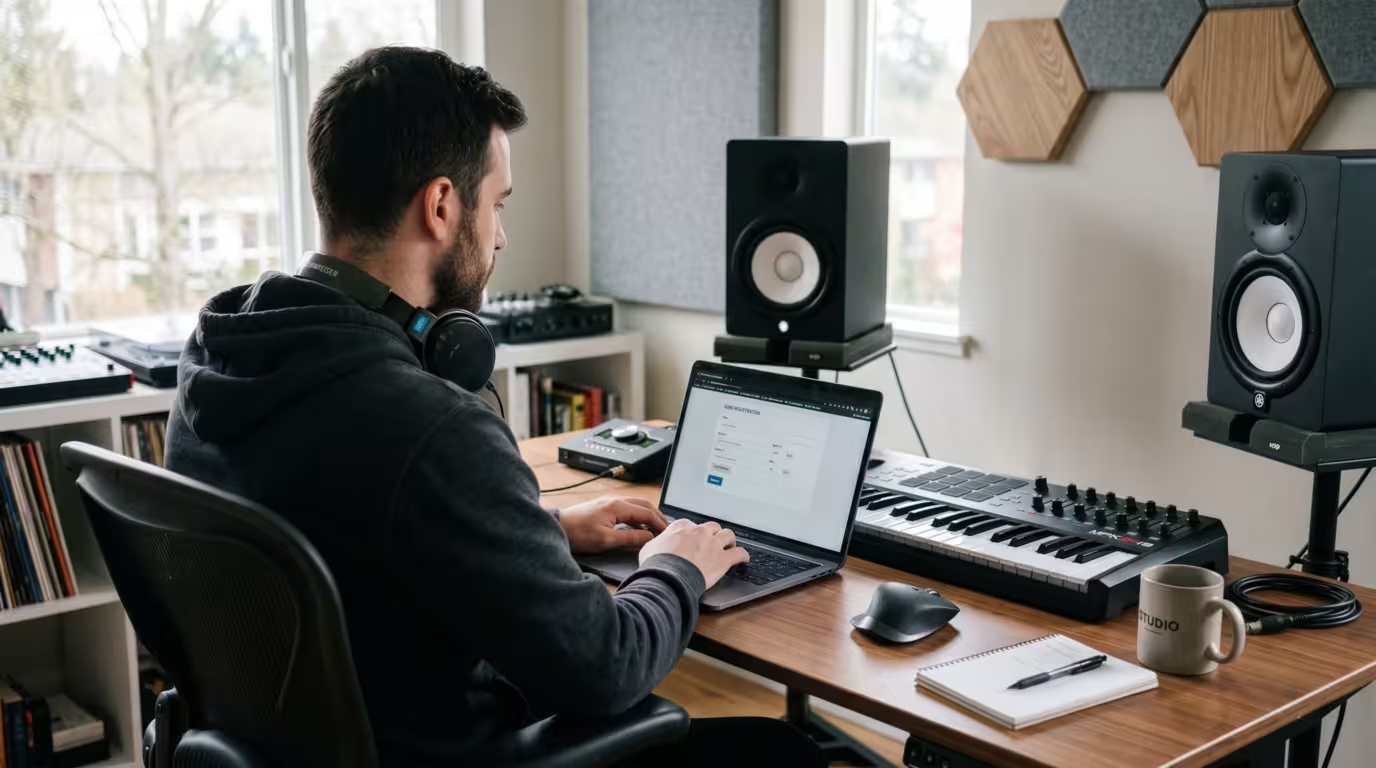
Here is the single most important point in this entire guide: joining a PRO is not the same as collecting royalties. You must separately register each work — every song or track — with the PRO, listing the title, all writers, their IPI/CAE numbers, the publisher details and the ownership splits. The PRO uses that data to match performances to you and pay you. Unregistered works generate uncollected royalties.
Co-writers each register their own split, and if collaborators are with different PROs, each must register the work with their own society. Get the splits agreed in writing (a split sheet) at the point of creation so they total exactly 100%, and keep your metadata clean and consistent — ASCAP recommends registering works accurately, ideally before they are uploaded online anywhere. Bad or missing metadata is one of the biggest reasons money ends up in an unmatched pool that is eventually redistributed to other rights holders.
What PROs collect — and what they don't
A PRO is one piece of the puzzle, not the whole thing. This is the section that clears up the most expensive misconception in independent music: that joining a PRO collects everything. It does not.
PROs collect composition public-performance royalties only. In the US specifically, they do not collect:
| Income type | Who collects it instead |
|---|---|
| Mechanical royalties (composition) | The MLC (US streaming) and/or a publisher/admin |
| Master / sound-recording royalties | Your distributor or label |
| Neighbouring / digital-recording rights | SoundExchange (US), PPL (UK) and similar |
| Sync placements | Negotiated directly or via a publisher |
Mechanical royalties are owed when a composition is reproduced — including every interactive stream. In the US these are collected by The MLC, not your PRO. The master side — the actual recording — is an entirely separate copyright that PROs never touch; that income comes through your distributor or label, and (for non-interactive digital radio) through SoundExchange. Because a single Spotify stream generates a performance royalty (PRO), a mechanical royalty (The MLC) and a master royalty (distributor) simultaneously, relying on a PRO alone means collecting only a fraction of what you're owed.
The full collection ecosystem
To collect everything, a producer assembles a stack of registrations. The system is fragmented by design, and each body covers a different slice:
| Body | What it collects |
|---|---|
| Your PRO | Composition public-performance royalties |
| The MLC (US) / mechanical society | Mechanical royalties on the composition |
| Distributor | Master / recording royalties from streaming & sales |
| SoundExchange (US) / PPL (UK) | Digital sound-recording (neighbouring) royalties |
| Publisher / publishing admin (optional) | Ties the composition side together globally |
The MLC (the Mechanical Licensing Collective) was created by the US Music Modernization Act and began operating in 2021; it administers the blanket mechanical license for US interactive streaming, and registration is free — it is funded by the digital services, not by songwriters. It only covers US mechanicals, so international mechanicals need a foreign society or an admin.
SoundExchange is the US body designated to collect digital sound-recording performance royalties from non-interactive services like SiriusXM, Pandora's radio mode and internet radio. It pays the recording side under a statutory formula: 45 percent of performance royalties go directly to the featured artists on a recording, 5 percent to a fund for non-featured artists, and the remaining 50 percent to the owner of the sound recording — and registration is free. In the UK, PPL plays the equivalent neighbouring-rights role for recordings. Your distributor handles getting your release onto streaming platforms and collecting the master royalties — we cover that side in a future releasing/distribution article.
Publishers and publishing administrators
The composition side is the most fragmented, and this is where a publishing administrator can help. An admin — services such as Songtrust, Sentric or TuneCore Publishing — registers your works with collection societies worldwide and collects the publisher's share plus mechanicals globally, in exchange for a percentage commission (commonly around 15 to 20%) and sometimes a small setup fee. Crucially, an admin does not take ownership of your copyright; you keep 100% of your rights and creative control.
That distinguishes an admin from a traditional publisher, which typically takes an ownership stake in your compositions (often 50% of the publishing, sometimes in perpetuity) in return for advances, sync pitching, creative development and full administration. Note that even with an admin, only you can affiliate with your PRO — the admin works alongside it, registering works and chasing the international and mechanical income a lone PRO affiliation tends to leave on the table. Whether the commission is worth it depends on your catalog size and how international your plays are.
How DJs and producers actually get paid
Putting it together, a proactive setup for an independent electronic producer looks roughly like this:
• Affiliate with your home PRO as a writer, and set up your publishing entity (or use an admin) so you collect both the writer's and publisher's shares.
• Register every work with accurate titles, writers, splits and metadata — before release where possible.
• Register with a mechanical collector — The MLC in the US (free), and/or use a publishing admin for global mechanicals.
• Use a distributor for your releases so you collect the master/recording royalties.
• Register recordings with SoundExchange (or your country's neighbouring-rights body, e.g. PPL) if they get digital or satellite-radio play.
• Report your DJ setlists to the PRO where allowed. This is especially relevant — and especially neglected — in dance music. PRS for Music lets members report live performances and DJ sets, but participation is sparse: as PRS dance-music relationship manager Ash Howard told DJ Mag, at a 2018 Creamfields event the setlist collectors approached around 230 individual DJs, most of whom were unresponsive, and only 10 setlists were ultimately provided to PRS. Tracks must be registered for setlist reporting to pay out.
• Keep everything registered and metadata clean, and stay proactive — nobody chases this money for you automatically.
The scale of what goes uncaptured is real: the Association for Electronic Music (AFEM) projected in 2016, as reported by Billboard, that dance music producers were missing out on an estimated $120 million in royalties from live performances. Much of that gap comes down to unreported setlists and unregistered works.
Royalty collection and ghost production
For a ghost-production marketplace audience, one question decides everything: who owns the track after the deal, because that's who registers and collects.
In a typical flat-fee buyout — the standard ghost-production model — the producer sells the track outright and transfers all rights to the buyer. The buyer becomes the owner and is the one who registers the work with their PRO and collects the royalties; the ghost producer, having sold it, does not register or collect on that track. In a royalty or hybrid deal, the producer may retain a share and would register their retained writer/publisher split accordingly.
The essential, recurring lesson: who registers the work and collects the royalties must be spelled out in the contract. A buyer who wants the royalties needs to actually own the composition and then register it with their PRO and mechanical collector. For the rights mechanics behind these deals, see Ghost Production Contracts and Rights and Buying Ready-Made Tracks; for how the royalty types split, see How Music Royalties Work.
Common mistakes and tips
The recurring, avoidable mistakes:
• Joining a PRO but never registering works — the classic. No registration, no royalties.
• Assuming a PRO collects everything — it collects composition performance only; you'll miss mechanicals, master and neighbouring royalties.
• Skipping a mechanical collector (e.g. not signing up with The MLC) — leaving US streaming mechanicals unclaimed.
• Not using a distributor — no master royalties at all.
• Not registering with SoundExchange — US digital-performance recording royalties left on the table.
• Inaccurate splits or metadata, or being affiliated with the wrong (or no) PRO for your territory.
• Not reporting DJ setlists.
• In ghost production, confusion over who registers and collects.
The tips are the mirror image: affiliate and register your works; set up your publishing share; add a mechanical collector, a distributor and SoundExchange/neighbouring body; consider a publishing admin if you release internationally; keep metadata and splits accurate; be proactive; and settle who-collects in writing whenever a track changes hands.
Key takeaways
• A PRO licenses the public-performance right in compositions, collects the fees, and pays them out as performance royalties — but that is only one slice of your income.
• Joining is not collecting: you must register every work, with accurate splits and metadata, or the money goes uncollected.
• US PROs don't collect mechanicals, master royalties, neighbouring rights or sync — you need The MLC, a distributor, SoundExchange/PPL and possibly a publisher/admin too.
• You generally affiliate with one home PRO, which collects worldwide via reciprocal agreements; combined societies abroad (SACEM, GEMA) may handle mechanicals too.
• In a ghost-production buyout, the buyer/owner registers and collects — put who-collects in the contract.
• This is general educational information, not legal or financial advice; rules, fees and rates vary by country and change, so confirm with the organizations and a professional.
Ready-made, exclusive EDM tracks with full rights — released as your own.
