Some records ask for your attention. Dub techno asks you to disappear into it. It is techno heard through fog, a steady machine pulse wrapped in echo, reverb and hiss until the beat seems to arrive from the far end of a flooded warehouse. It was born when two lineages collided in one strange, half-empty city, and the people who codified it did so almost anonymously, letting the music speak while they stayed offstage.

Blog
Dub Techno and the Berlin Blueprint
How Jamaican echo met Detroit's machine pulse in a post-Wall city, and Basic Channel wrote the template.
What Dub Techno Actually Is
Dub techno is a hybrid. It takes techno's steady four-on-the-floor pulse and minimal, repetitive structures and runs them through the production philosophy of Jamaican dub: heavy delay and echo, cavernous reverb, dropouts, filtering and, above all, a sense of space. The mixing desk stops being a neutral tool and becomes an instrument in its own right.
The signature elements are easy to recognise once you know them:
• A muffled, delayed chord stab, the famous dub chord, that decays and blurs across bars.
• Deep sub-bass and a soft, rounded kick rather than a hard slam.
• Crackle, hiss and analog noise treated as musical texture, not error.
• Extremely slow evolution over long tracks, with minimal or no melody.
• A hypnotic, immersive, submerged quality, the reason people reach for words like oceanic and underwater.
The tempo usually sits somewhere around 120 to 130 BPM, slow and steady. The whole aesthetic favours atmosphere, depth and texture over drama. Where a lot of club music pushes toward a climax, dub techno rewards patience: it breathes, it decays, and it evolves so gradually you barely notice the room changing around you. Reviewing the Basic Channel catalogue, Pitchfork described how the forceful kicks of their early tracks had softened, slowed and been submerged in the murk, a neat summary of the whole genre's centre of gravity.
Two Rivers: Kingston and Detroit
The first river runs through Kingston. In the late 1960s and early 1970s, Jamaican engineers turned the recording studio into a compositional space. King Tubby, an electronics and sound engineer working from a small studio in the Waterhouse district, is widely credited with turning dub into an art form, stripping vocals from reggae tracks, boosting drums and bass, and playing the mixing desk with echo, reverb and radical dropouts. He is often cited as an originator of the remix itself. Lee Scratch Perry, working from his Black Ark studio, pushed the same ideas toward the surreal. Their collaboration on Blackboard Jungle Dub (1973) is frequently named as one of the first full-length dub albums.
The second river runs through Detroit. In the 1980s, the Belleville Three, Juan Atkins, Derrick May and Kevin Saunderson, fused funk and European electronics like Kraftwerk into a futuristic machine music. Atkins, recording as Model 500 on his Metroplex label, set the template: insistent drum-machine rhythms, spare melody, science-fiction cool.
The two rivers met in Berlin. After the Wall fell in 1989, the reunified city was full of buildings nobody clearly owned, and a generation moved into the empty factories, power stations and bank vaults. Tresor opened in March 1991 in the safe-deposit vault of the former Wertheim department store, and built a direct bridge to Detroit; its label, founded that October, released Jeff Mills, Robert Hood and the Underground Resistance orbit in Europe. E-Werk followed in a former power plant. Cheap space, no curfew and a city improvising its own future made the perfect crucible.
Basic Channel: The Blueprint
Into that scene stepped Moritz von Oswald and Mark Ernestus. Von Oswald was a trained percussionist who had played in the last incarnation of the Neue Deutsche Welle band Palais Schaumburg, then moved into electronic music with Thomas Fehlmann as 2MB and 3MB, working as an in-house producer around Tresor. Ernestus had founded the record shop Hard Wax in 1989. Together, in 1993, they founded Basic Channel.
Their records fused Detroit's pulse with dub's space and became the defining template for a whole genre. Between 1993 and 1994 the label released its first nine 12-inch singles under a rotating cast of aliases, so that the catalogue numbers, not the names, told you who made them. The debut came under the name Cyrus with Enforcement in 1993, followed by tracks that became touchstones: Phylyps Trak (1993), Quadrant's Q1.1 (1993), and the run of Quadrant Dub, Octagon and Radiance in 1994. The CD compilation BCD gathered edits of the vinyl in 1995. Their aliases multiplied, from Maurizio and Round Two to Quadrant, Cyrus and Phylyps, until the discography felt like a machine running its own programme.
The look matched the sound. The sleeves were near-featureless, the label art a greyscale, lock-like design with cryptic lettering that grew more distorted and unreadable with each release. Von Oswald and Ernestus gave almost no interviews; as The Quietus recounts, in an early 1995 feature with The Wire's Biba Kopf the pair gave only their first names and asked that the interview not be taped. The music was designed to be divorced from its creators, an automaton pursuing its own goals.
Crucially, the Detroit link was not just spiritual. Von Oswald had remodelled a track by Atkins' Infiniti alias, Think Quick, into a spare, reverb-drenched production that reads almost like a Basic Channel manifesto, and the duo's early records were cut in Detroit. The respect flowed both ways across the Berlin-Detroit axis.
The Ecosystem: Hard Wax, Dubplates and the Sister Labels
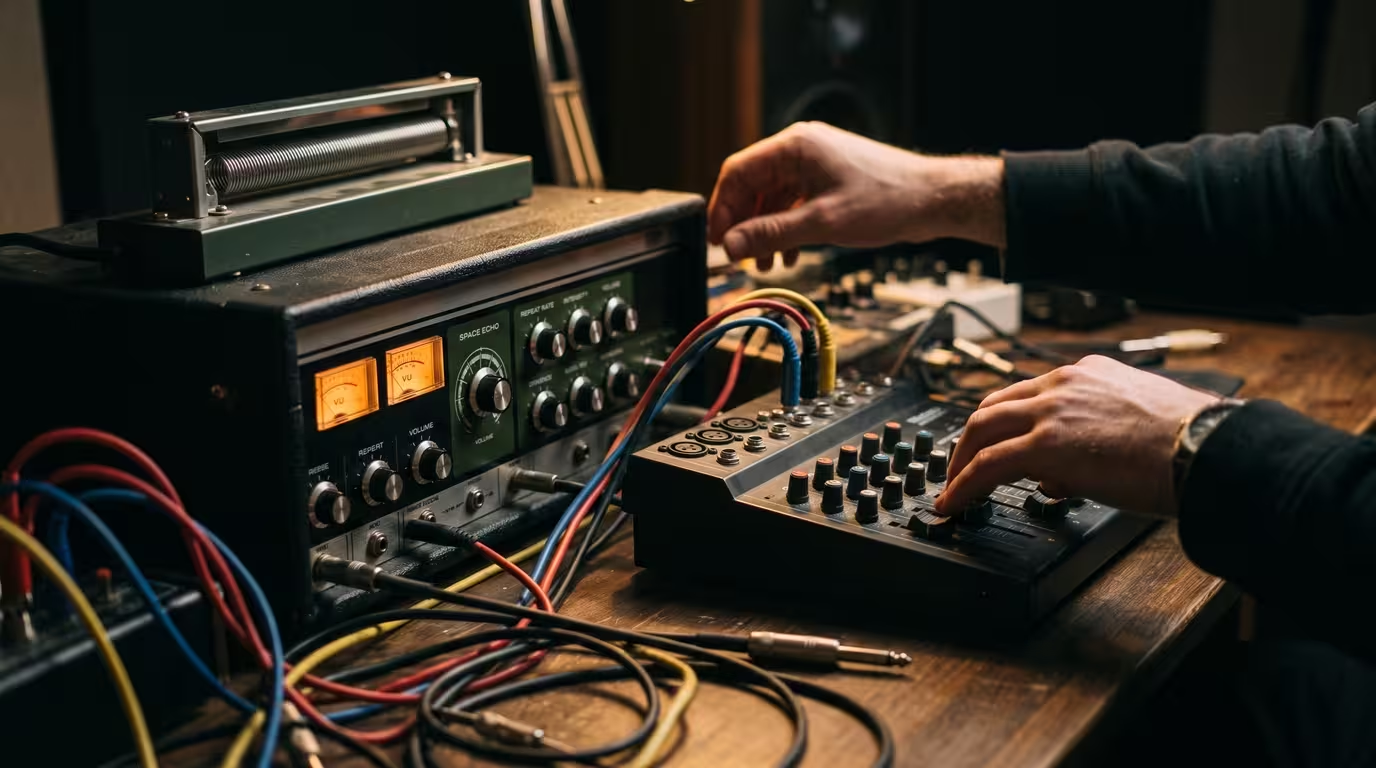
What made Basic Channel unusual was not only the music; it was that they built an entire self-contained infrastructure around it. Ernestus's shop Hard Wax became the distribution hub and the physical heart of the Berlin sound, a site of near-silent pilgrimage that also functioned as an incubator for new artists. In 1995 the duo founded Dubplates & Mastering, their own mastering and vinyl-cutting studio, because, as Ernestus told Electronic Beats, the creative importance of the vinyl cut was barely recognised in Germany at the time and was commonly seen as an engineer's job. It went on to become one of the most respected cutting houses in the world.
Then came the sister labels. Chain Reaction, founded in 1995, extended the sound to an extended family of artists with a numbered, coded catalogue aesthetic. Its roster reads like a canon: Porter Ricks (Thomas Koner and Andy Mellwig), whose Biokinetics was the label's first release in 1996 and remains a genre landmark; Vainqueur (Rene Lowe); Substance; Fluxion; the Finnish producer Vladislav Delay; and Monolake. That last name matters beyond dub techno: Monolake was founded by Robert Henke and Gerhard Behles, who went on to co-found Ableton, the company behind Live, launched in 2001 and now one of the most widely used pieces of music software on the planet.
Later, von Oswald and Ernestus followed dub back to its source. As Rhythm & Sound, beginning in 1996, they made more faithful, bass-heavy takes on Jamaican dub, working with vocalists including Paul St. Hilaire (formerly Tikiman), Cornell Campbell, Willi Williams and the Chosen Brothers, released on Burial Mix and later reissuing classic reggae through Basic Replay. The coldness of digital dub gained a human, spiritual warmth.
Moritz von Oswald on Dub, Remixing and Inspiration
The Philosophy and the Craft
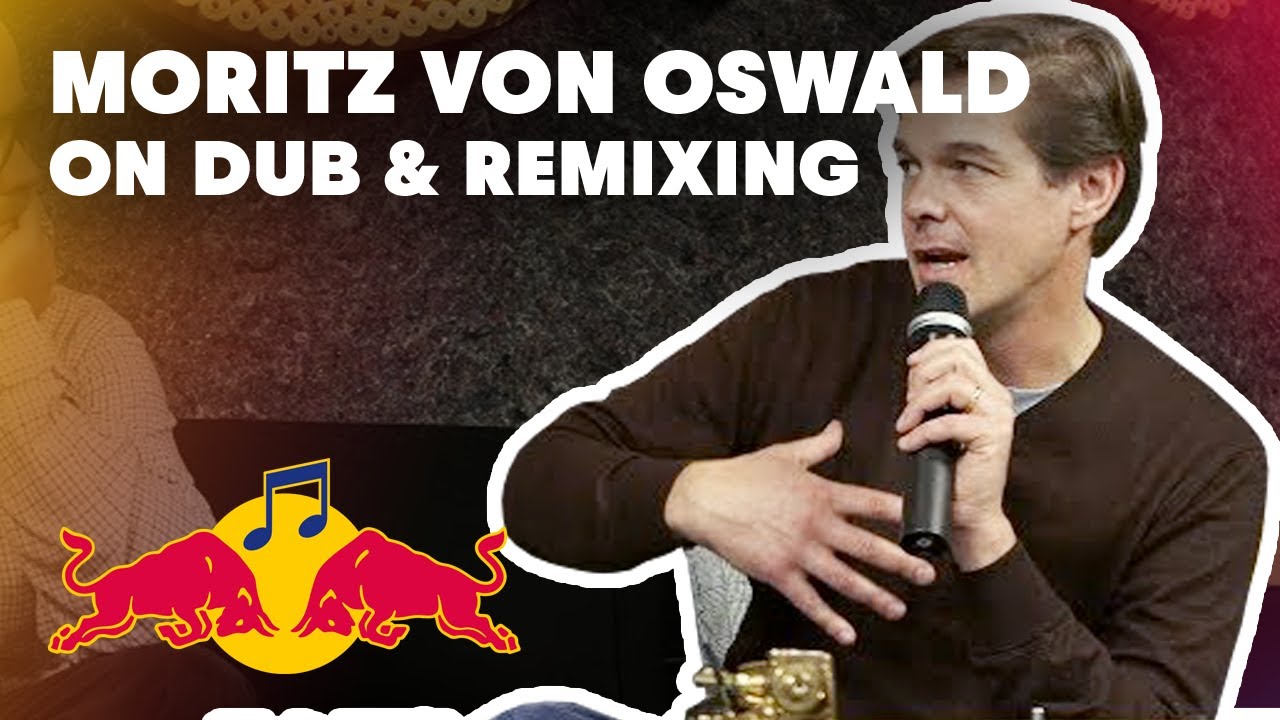
Ask Moritz von Oswald how you stop a track full of delays from collapsing into mush and his answer is two words: live mixing. In a 2008 Red Bull Music Academy lecture he described building patterns that are not rigidly defined but constantly shift against each other, keeping the music in a suspended state, not moving, just held like a Polaroid. He praised old analog tape echoes because their sound is so rich and more alive, while admitting the duo's tools changed constantly over the years.
That is the dub inheritance in a sentence: the studio as an instrument, mixed by hand in real time. Just as important is what they refused to remove. In a rare 2003 profile for The Wire, the pair described their approach as working very slowly and listening very closely, treating a track as a weave in which every element locks together, so that killing the hum or the crackle would unravel the whole thing. Hiss and hum that would be anathema to most producers were left in, because they held the music together. The anonymity was part of the same ethos: names and faces did not matter, only the sound. This is music that rewards deep listening and long DJ sets, because the drama is in the detail.
The Spread and the Legacy
Dub techno never stormed the charts, but it seeped everywhere. In Germany, Pole (Stefan Betke) took a broken Waldorf 4-Pole filter, a gift that fell on the floor and started to crackle, and built his 1, 2 and 3 albums between 1998 and 2000 around its random hiss, laying a trail that dubstep producers and countless others would follow. Later the sound globalised: in the United States, Rod Modell (Deepchord) and Stephen Hitchell reconnected it to Detroit's lineage, most famously on The Coldest Season, released in August 2007 on Modern Love, recorded with vintage analog gear and named the 49th best album of the decade by Resident Advisor. Labels like Echocord and Modern Love, and artists like Yagya, Intrusion, Fluxion, Deadbeat and Brendon Moeller, kept refining the form, while Monolake evolved a high-fidelity strain of its own.
The founders moved on too. Von Oswald has since led the Moritz von Oswald Trio and collaborated with figures ranging from Carl Craig to the late Afrobeat drummer Tony Allen. Ernestus followed the polyrhythms back to Africa, forming Mark Ernestus' Ndagga Rhythm Force with Senegalese sabar musicians. Basic Channel's own catalogue, meanwhile, has stayed quietly in print for three decades: repressed, revered, and still sounding like the future.
Why It Matters
Dub techno is one of electronic music's quietly radical ideas: proof that subtraction, space and texture can hit harder than any drop. It shaped a city's identity and a global underground, and it did so through an ethos of anonymity, patience and craft as distinctive as the sound itself. For a producer, there is a lesson buried in the hiss: delay, reverb, restraint and the shaping of noise are not decoration added at the end. They can be the composition. That is a discipline worth studying, and dub techno remains its deepest textbook.
Key takeaways
• Dub techno fuses Detroit techno's machine pulse with Jamaican dub's echo, reverb and space, codified in early-1990s Berlin.
• Moritz von Oswald and Mark Ernestus founded Basic Channel in 1993 and wrote the blueprint.
• They built a whole ecosystem: Hard Wax, Dubplates & Mastering, Chain Reaction and Rhythm & Sound.
• The philosophy, with the mixing desk as an instrument, live mixing, hiss and imperfection as material and faces hidden, is as influential as the records.
• The sound still thrives worldwide, from Pole and Deepchord to a generation of bedroom producers.
