Turn the tempo up to 160 beats per minute, strip a track down to a single chopped voice, a tumbling kick and a booming sub, and point the whole thing at a pair of feet moving faster than the eye can follow. That is footwork: a Chicago music so bound to a Chicago dance that you cannot really explain one without the other. It is one of the last great regional innovations in American dance music, and for a sound built in gyms and basements on the South and West Sides, it travelled remarkably far.
Blog
Footwork and Chicago's Fastest Dance
How a 160 BPM battle music from Chicago's South and West Sides rewired the rhythm of global electronic music.
The Dance Came First
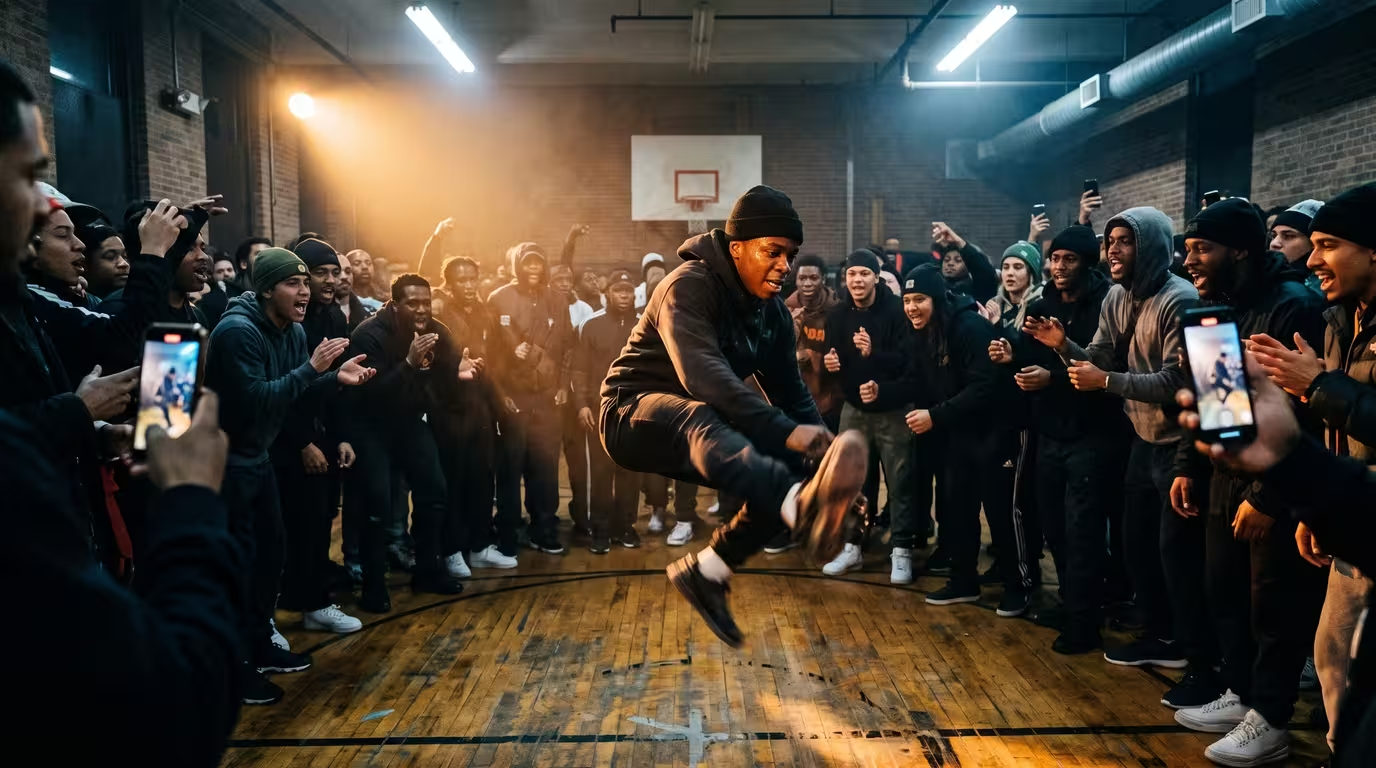
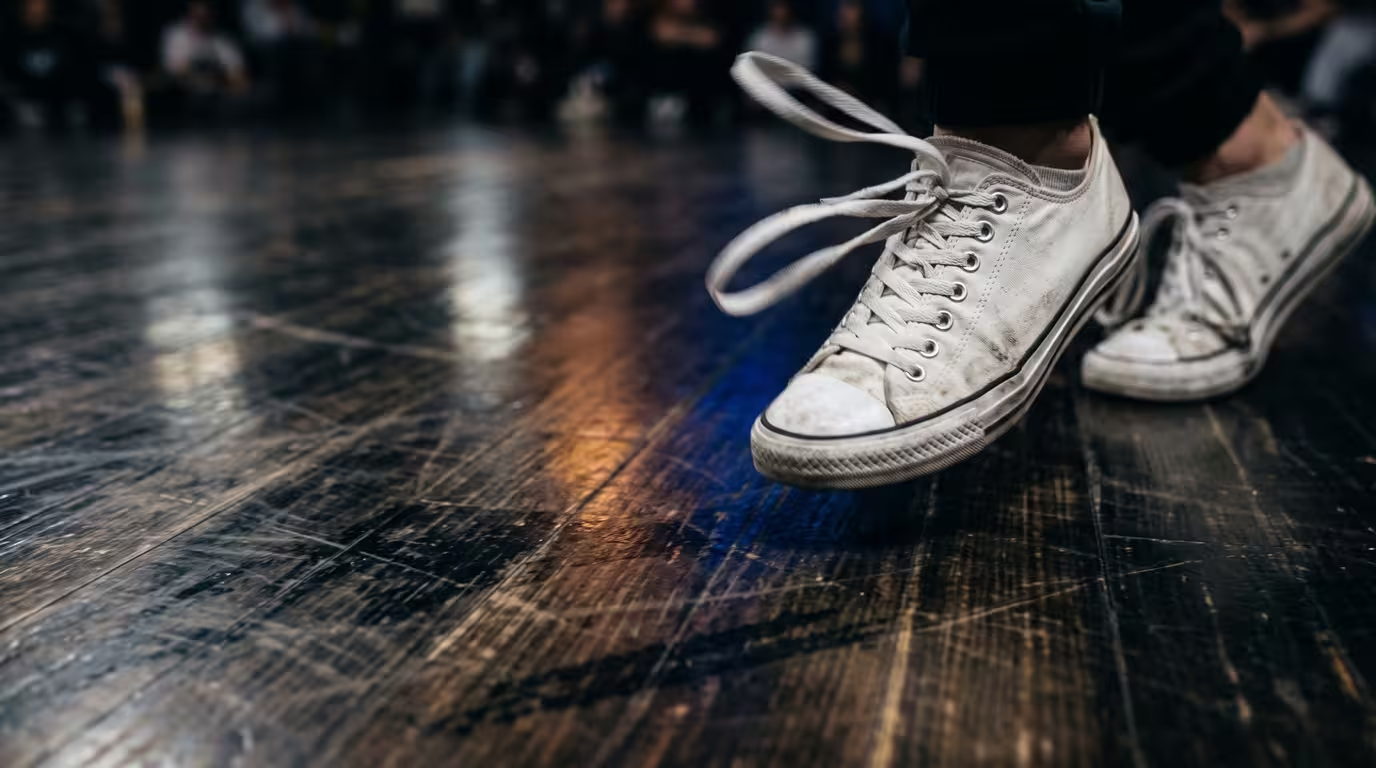
Before footwork was a genre you could stream, it was a thing bodies did. The dance grew out of Chicago's house culture in the 1980s, coalescing into a distinct, hyper-fast style by the early 1990s, danced and drilled at roughly 160 BPM. It is defined by dazzling speed at ground level: rapid shuffles, slides, kicks and ankle-twisting spins, the upper body loose while the feet fire off patterns too quick to count.
Its natural habitat is the battle. Two dancers, or two crews, face off inside a ring of onlookers, the circle, and take turns going in, trying to out-speed, out-invent and out-nerve each other while the crowd judges in real time. This is combative, athletic, improvisational art, passed down in person through clubs, house parties and after-school practice. The crucial point, repeated by everyone who has lived it, is that the music exists to serve the dance. As the South Side dancer Chief Manny told Vice, the music was for the dance. Producers build tracks as weapons for the circle, and dancers bring those tracks to life.
From Chicago House to Ghetto House to Juke
Footwork sits at the end of a clear Chicago lineage. It begins with house music itself, born between roughly 1977 and 1982 at the Warehouse, the West Loop club where Frankie Knuckles became the resident DJ and, eventually, gave the music its name. House was warm, disco-descended, four-on-the-floor.
By the mid-1990s a rawer local mutation took hold: ghetto house, sometimes called booty house. Stripped to a pounding 808 and 909 kick, minimal, fast and often sexually explicit, it was pioneered by producers like DJ Deeon, DJ Funk and DJ Milton and released on Ray Barney's Dance Mania, the label Jacob Arnold, writing for Resident Advisor in 2013, dubbed ghetto house's Motown. Dance Mania ran through the 1990s, ceasing its original run around 2000, and was built on cheap gear and street-level distribution: cassettes sold on corners, white-label 12-inches.
The next acceleration was juke. The term was coined by the DJs Puncho and Gant-Man in the late 1990s, via Dance Mania-scene tracks such as Juke It in 1997, describing music tied to a faster, more frenetic dance; Gant-Man has recounted hearing girls at a high-school party say the party was juking. Then came footwork proper: the more abstract, rhythmically dense, roughly 160 BPM strain built specifically for the battle. In practice the words overlap and get used interchangeably; even Planet Mu's Mike Paradinas once observed that footwork is footwork, but juke can refer to footwork and ghetto house. Detroit had its own related strain, ghettotech, championed by DJ Godfather and DJ Assault, whose high-BPM, loop-driven DJ tools fed the same regional bloodstream.
The Sound: Minimal and Overwhelming at Once
Footwork is a paradox, skeletal and dense in the same breath. Strip away everything and you find a template, well described by Planet Mu as hyper-rhythmic, abstract dance music pitched around 160 BPM, made of cut-up samples twisted into repetitive rhythms and shapes, over offbeat, syncopated drum-machine patterns and pumping sub-bass lines.
The rhythmic language is what stuns musicians. Instead of house's steady four-on-the-floor, footwork runs on triplets, rattling double-time hi-hats and clave-like patterns, with kicks and claps scattered off the grid. Bass arrives as booming, often distorted 808-style sub. Vocals are typically a single phrase looped and diced into stuttering fragments until the words dissolve into pure rhythm. Because the tracks are built for battle, producers plant deliberate traps: sudden switch-ups, halftime drops and dramatic, war-trumpet flourishes designed to trip a dancer or dare them to keep up.
That 160 BPM is also why footwork found such a natural ally in the UK. It sits right beside jungle and drum and bass tempos, which typically run around 160 to 170, and can be felt either at full speed or as a halftime 80 BPM lope. When footwork broke internationally around 2010, producers like Om Unit, as Philip D Kick, along with Machinedrum and Addison Groove, began fusing its drum programming with jungle breaks, birthing a whole footwork-jungle hybrid on the 160 and 80 axis.
The Pioneers and the Crew
The single track most often cited as the first true footwork record is Baby Come On, made in 1997 by Kavain Space, better known as RP Boo, who came up as a dancer in the crew House-O-Matics and, in his own words, took what he did as a dancer and turned it into a style of music. He is widely credited, alongside DJ Clent and DJ Rashad, as a founder of the sound.
If RP Boo is the originator, DJ Rashad (Rashad Harden) became footwork's greatest ambassador. He and DJ Spinn (Morris Harper) founded the crew that became footwork's central collective, first the Ghettoteknitianz in the mid-2000s, renamed Teklife in 2011, partly to shed the limiting word ghetto. The crew has since grown into a worldwide network of DJs, producers and dancers, including DJ Earl, DJ Taye, DJ Manny and the West Side veteran Traxman, whose crate-digging soul flips, heard across his Da Mind of Traxman albums on Planet Mu, show how deep the genre's roots in funk and house run.
Meet The Era: A Chicago Footwork Documentary

Escaping Chicago
For over a decade, footwork lived almost entirely in Chicago, spread mostly by battle tapes and grainy online clips. Its year zero abroad came on 6 December 2010, when Planet Mu, the English label run by Mike Paradinas, released Bangs & Works Vol. 1: A Chicago Footwork Compilation, a 25-track survey featuring RP Boo, DJ Rashad, DJ Spinn, Traxman, DJ Roc, DJ Nate and more. NPR gave it a First Listen, noting that this art culture, spanning hundreds of DJs and thousands of dancers, had been incubating in obscurity for more than a decade on the South and West Sides of Chicago.
From there it accelerated. Rashad signed to Kode9's Hyperdub and, in October 2013, released Double Cup, the sole album issued in his lifetime and now regarded as a pivotal footwork record, drawing house, hip-hop, R&B, acid and jungle into its 808 turbine. Scenes bloomed abroad, most substantially in Japan, where DJ Fulltono's Osaka label Booty Tune had actually been releasing footwork since 2008, making Japan, by the label's own account, one of the earliest footwork territories anywhere, alongside Detroit's Juke Trax and Chicago's Bang Da Box. Tokyo later hosted Battle Train Tokyo, the country's first footwork dance tournament.
Legacy: Carried Forward
On 26 April 2014, Rashad was found dead in Chicago at the age of 34; toxicological tests by the Cook County Medical Examiner's office found he died of an accidental intoxication involving heroin, cocaine and alprazolam. It was a devastating loss for a scene that had finally reached the world. Teklife chose to carry it on, launching Teklife Records in 2015 with Rashad's unreleased music and continuing to tour and release globally.
Footwork's influence has since spread well beyond the circle. Its most striking artistic offshoot is Jlin (Jerrilynn Patton) from Gary, Indiana, who emerged via Bangs & Works Vol. 2 and then pushed footwork's rhythms into fully composed, experimental territory on Dark Energy (2015) and Black Origami (2017), both on Planet Mu. She has since collaborated with Bjork, Philip Glass and Kronos Quartet, and her composition Perspective, written for Third Coast Percussion, was named a finalist for the 2023 Pulitzer Prize in Music, an extraordinary journey for a rhythmic language born in Chicago battle circles. Meanwhile crews like The Era, co-founded in 2014 on the South Side and documented by the filmmaker Wills Glasspiegel, keep insisting on the human truth of it: this is Black Chicago dance, do-it-yourself and community-made, not manufactured by any institution.
For a producer, footwork is also one of the most instructive things you can study: its triplet programming, its use of space and its surgical sample-chopping demand a rhythmic literacy most electronic music never approaches. But its deepest lesson is cultural. Footwork remains inseparable from the people and the circles that made it. The music is the weapon; the dancer is the point.
Key takeaways
• Footwork is a Chicago electronic genre at roughly 160 BPM, built as functional battle music for an equally fast dance, and the dance came first.
• Its lineage runs from Chicago house to ghetto house on Dance Mania, then juke, then footwork, with a related Detroit cousin in ghettotech.
• The sound is triplet-driven, sub-heavy and sample-chopped, minimal and overwhelming at once, and tempo-adjacent to jungle and drum and bass.
• RP Boo's Baby Come On (1997) is widely cited as the first footwork track; DJ Rashad and Teklife became its global ambassadors.
• Planet Mu's Bangs & Works Vol. 1 (2010) and Rashad's Double Cup (2013) broke it worldwide; after Rashad's death in 2014, Teklife and artists like Jlin carried it forward.
