There is a straight line running through almost every dance floor on earth, and it leads back to one man behind a pair of turntables in a converted factory on the west side of Chicago. Frankie Knuckles did not invent dancing, or disco, or the drum machine. What he did was rarer: he took the records nobody wanted any more, rebuilt them for the people in front of him, and in the process gave a whole genre both its sound and its name. They called him the godfather of house, and the title, for once, was earned.
Blog
Frankie Knuckles, the Godfather of House
How a Bronx-born DJ turned a Chicago warehouse into the birthplace of a global sound.
From the Bronx to the Underground
He was born Francis Warren Nicholls Jr. on 18 January 1955, in the Bronx. As a teenager he fell in with a kid who would become his lifelong friend and fellow legend, Larry Levan, and together the pair went looking for the city's after-hours underground. They found it in the rooms that were quietly rewriting nightlife: David Mancuso's invitation-only Loft, and Nicky Siano's the Gallery, where the two teenagers earned their first club jobs blowing up balloons, laying out the buffet and, as the story is fondly retold, spiking the punch. Siano let them hang in the booth and watch him work; it was, effectively, their school.
While studying at Manhattan's Fashion Institute of Technology, Knuckles began to DJ in earnest, playing soul, disco and R&B at the Continental Baths, the opulent gay bathhouse where Levan had spun before him. This was the raw material of everything that followed: Philadelphia soul, gospel fervour, the four-on-the-floor pulse of disco, and the communal, largely Black and gay club culture that treated the dance floor as sanctuary. As Rolling Stone noted in its obituary, he was steeped in that world long before he ever set foot in Chicago.
The Warehouse and the Naming of a Genre
In 1977, an old friend from the New York scene, Robert Williams, was opening a members-only club in Chicago and needed a resident DJ. Levan, the first choice, turned it down. Knuckles took it, and moved to the Midwest.
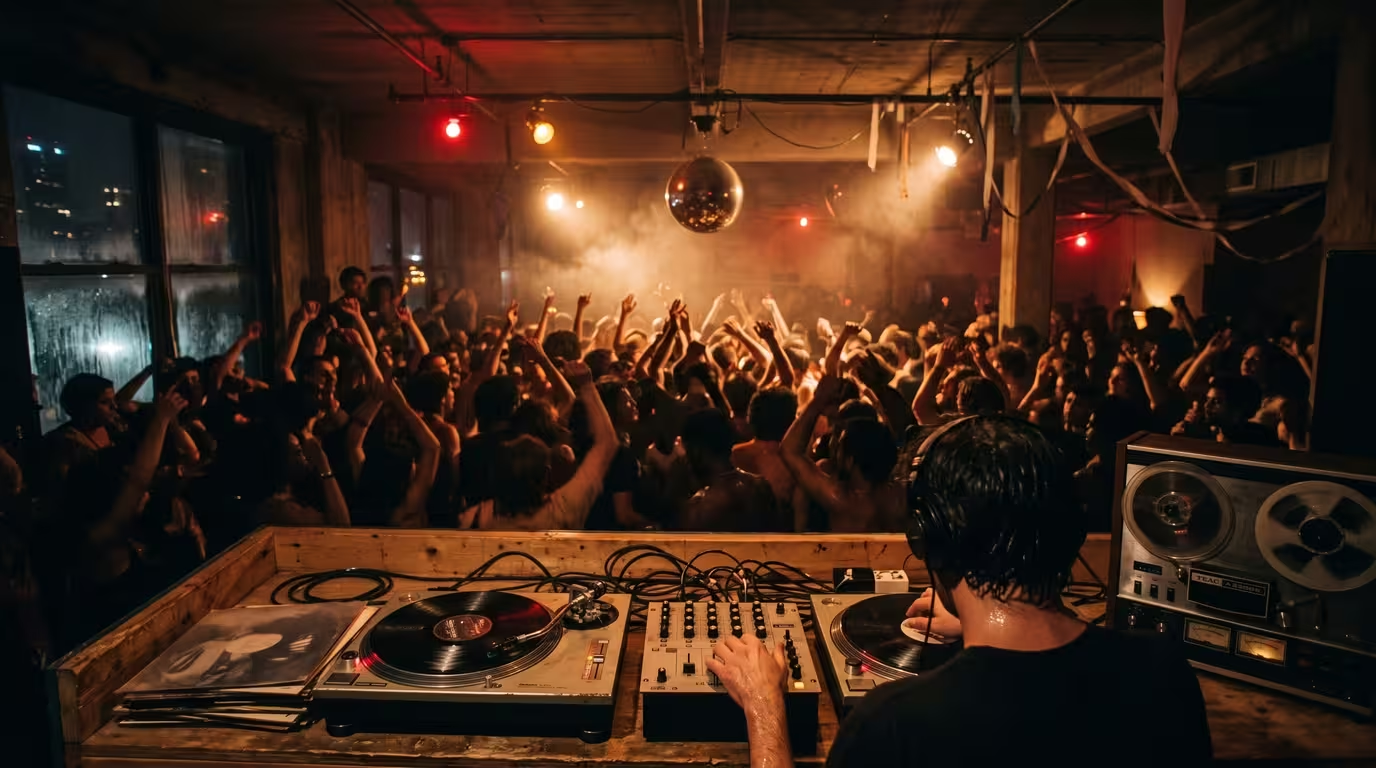
The Warehouse sat in a narrow brick building at 206 South Jefferson Street. It ran all night, an alcohol-free juice bar that could keep going long after the licensed rooms closed, with Knuckles often keeping the party moving until eight in the morning for a crowd that was predominantly Black and gay. He came to describe the feeling in frankly spiritual terms, likening it to church: get three thousand different personalities in a room, he said, and at the peak the whole room becomes one. Dancers who were shut out of most of the city found a home there.
The naming is now folklore, and it is worth telling as the widely accepted account rather than gospel. As the sets at the Warehouse grew famous, Chicago record stores, and the shop Importes Etc. is usually credited, began flagging the tracks Knuckles played as heard at the Warehouse, a phrase that patrons shortened to house. Knuckles himself told the story of driving past a tavern with a sign reading that they played house music, and asking a friend what that meant, only to be told it was the music he played at his own club. However the contraction happened, everyone agrees where the word came from: the House.
Disco's Revenge, Built on Tape and a Drum Machine
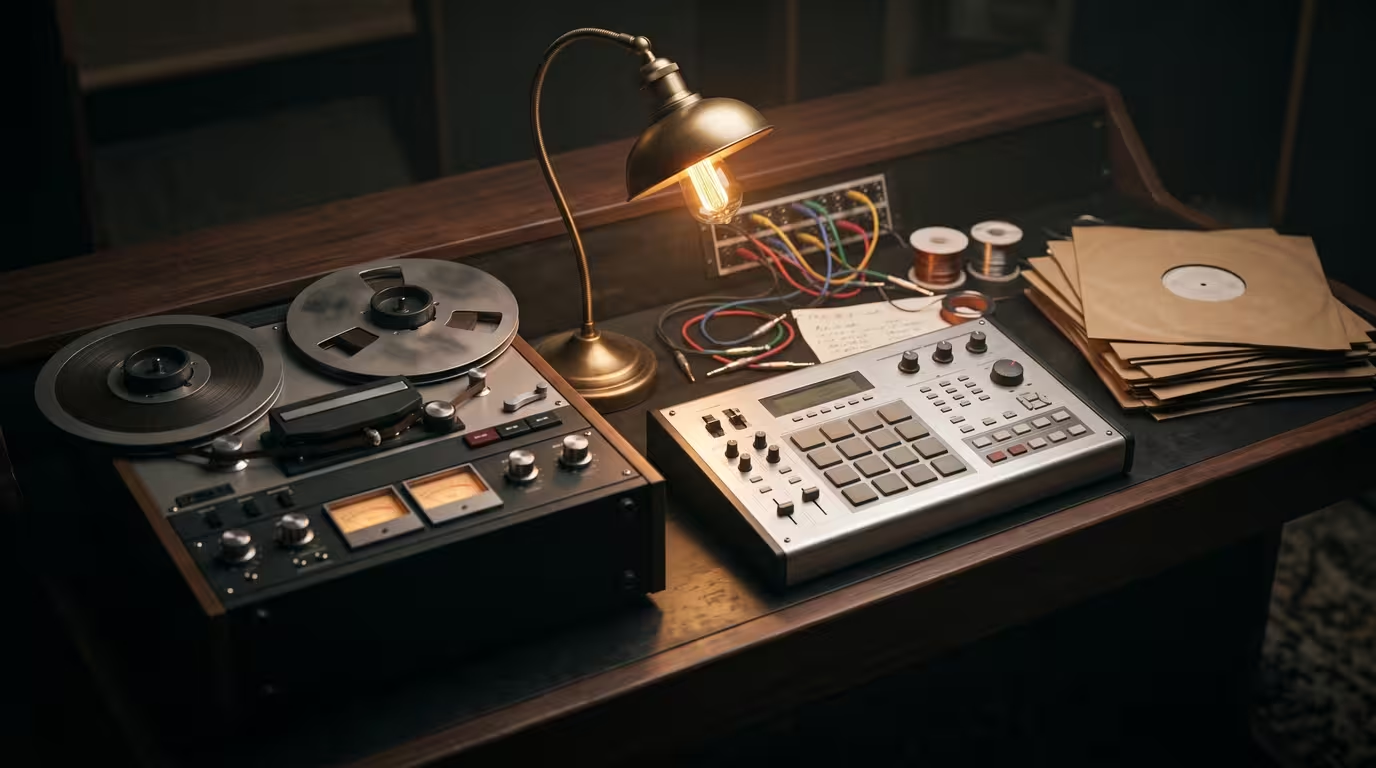
The genius was in the craft. After the anti-disco backlash of 1979, when Chicago's own Disco Demolition Night torched a crate of records at a baseball stadium, the supply of new dance music dried up. Knuckles simply made his own. He began re-editing existing tracks on reel-to-reel tape, extending intros and breaks, toughening and stretching records so they served the floor rather than the radio. Around 1983 he added a Roland TR-909 drum machine, which, in the most-repeated version of the tale, he acquired from a young Detroit visionary named Derrick May. He would wire it under the records, tuning the kick down until the bottom end could be felt more than heard.
That combination, a familiar disco or soul record re-cut and driven by an insistent machine pulse, is the DNA of house. Knuckles, with characteristic wit, called the whole thing disco's revenge. He left the Warehouse in November 1982 to open his own club, the Power Plant, carrying the sound and the congregation with him. You can hear him talk through all of it in his own words in the Red Bull Music Academy lecture he gave in Madrid in 2011.
The Records
When the edits gave way to originals, the results defined the genre. Introduced to a shy, gifted singer named Jamie Principle, Knuckles turned a demo that had circulated on tape for a year into Your Love and Baby Wants to Ride, both eventually released on Chicago's Trax Records in 1987. In 1989 came Tears, credited as Frankie Knuckles presents Satoshi Tomiie and sung by Robert Owens, a soul-drenched landmark on which the twenty-year-old Tomiie built the track and Knuckles acted, in Tomiie's words, as a kind of Quincy Jones figure overseeing the whole.
Then came the crossover. One of the first DJs to sign to a major label, he joined Virgin and released his debut album Beyond the Mix in 1991, home to The Whistle Song, a gently euphoric instrumental that reached number one on Billboard's Hot Dance Club Play chart in the summer of 1991, the first of four US dance chart number ones. In 1988 he had co-founded Def Mix Productions with David Morales and the formidable manager Judy Weinstein, and he became one of the most sought-after remixers in pop. Per Billboard, his Def Classic touch reached records including Mary J. Blige's Everything, Michael Jackson's You Are Not Alone, Chaka Khan's Ain't Nobody, Lisa Stansfield's Change and Inner City's Whatcha Gonna Do With My Lovin', alongside work for Toni Braxton, Whitney Houston, Janet Jackson, Diana Ross and Luther Vandross. In 1997 the work was recognised at the highest level: Knuckles won the inaugural Grammy Award for Remixer of the Year, Non-Classical, becoming the first DJ ever to take home a Grammy.
Frankie Knuckles - The Whistle Song

Honours, Loss and Legacy
By the 2000s he was a global ambassador for a music that had conquered the planet, still touring, still insisting on house's Black and gay origins. In 2004 Chicago named the stretch of Jefferson Street where the Warehouse once stood Frankie Knuckles Way and declared 25 August Frankie Knuckles Day; the state senator who helped push the honour through was a then-little-known politician named Barack Obama.
Frankie Knuckles died in Chicago on 31 March 2014, at the age of 59, from complications related to type II diabetes. The outpouring was immediate and worldwide, a measure of how many careers traced back to his booth. His legacy is now tended by the Frankie Knuckles Foundation, founded by his longtime friend and business partner Frederick Dunson to preserve his work and support the causes he championed, from music in schools to AIDS and diabetes research. As NPR put it, you may not know his name, but if you have danced in the last few decades, you know his sound.
The quiet lesson of his career is that the tools of modern dance music are the ones he improvised at the Warehouse. The edit, the extended intro, the drum machine layered under a familiar record, the long emotional arc of a set built for a specific room of dancers: every DJ and producer working today is, whether they know it or not, still building on the house that Frankie built.
Key takeaways
• Frankie Knuckles (1955 to 2014) was the New York DJ whose Chicago residency gave house music its sound and its name.
• His craft, reel-to-reel edits and a Roland TR-909 layered under disco and soul, turned a dying genre into a new one.
• Key records include Your Love and Baby Wants to Ride with Jamie Principle, Tears, and The Whistle Song.
• He co-founded Def Mix in 1988 and won the first Grammy for Remixer of the Year, Non-Classical, in 1997.
• The music that fills clubs and festivals worldwide still descends directly from his booth at the Warehouse.
