You already know how to beatmatch, EQ and ride a transition. That is the grammar of DJing. Building a set is the storytelling — choosing which tracks to play, in what order, and how to move a room's energy across time. This article is the foundational overview of set programming for the Performance and Sets category: the energy arc, the classic structure, how your time slot changes everything, and how to balance a prepared plan with live instinct.
Mixing Is Grammar, Programming Is Story
It is worth being blunt about a hierarchy that experienced DJs and DJ educators repeat constantly: track selection and sequencing matter more than technical polish. Wikipedia's own entry on the disc jockey splits a DJ's quality into two features — technical skill, and the ability to select the most suitable recordings, also known as reading the crowd. Most working DJs will tell you the second feature wins. Digital DJ Tips puts it plainly: for beginners, mixing from one track to another becomes the only goal, but dancefloors don't care about that — they want the right record for right now, and the mixing comes second.
This is the mental shift that separates a bedroom mixer from a programmer. A clean blend between two wrong records is still a wrong moment. A slightly rough cut into exactly the right track lands every time. Set-building (sometimes called set composition or programming) is the craft of selecting, ordering and connecting tracks so a set develops with clear direction — a journey rather than a shuffle of bangers. The actual mechanics of blending — beatmatching, EQ, phrasing, transition types — are covered in the Mixing Techniques category; here we assume you can do them and focus on what to play and when.
The Energy Arc Is the Heart of It
If you take one idea from this article, take this: a set is shaped by an energy curve, not a flat line. Energy is not loudness or even tempo — it is the combined sense of drive, intensity and momentum a track creates. The widely shared principle, repeated across DJ education from Mixed In Key to DJ TechTools, is that great sets ebb and flow. Mixed In Key's mixing book Beyond Beatmatching describes rhythm as a landscape of peaks and valleys: at the peaks you tell the audience when to get excited; at the valleys you give them a chance to breathe.
Two failure modes flank the ideal. Flat-out from the first beat exhausts a crowd: play ten bangers in a row and they stop feeling like bangers. The opposite — every track at the same medium level — is simply boring, leaving people standing along the walls. The skill is contrast: build tension, release it, give the floor a breather, then build again so the next peak hits harder. As the principle goes, peak moments should feel earned — if everything is a peak, nothing is.
This is exactly the reputation Sasha and John Digweed built. Around their Northern Exposure era their marathon sets often ran up to eight hours and emphasised narrative flow and emotional depth, building arcs over extended durations rather than a parade of anthems. You do not need to play progressive house to borrow the principle: think in terms of where you are taking people and what you are doing to the room, then choose the next track to serve that arc.
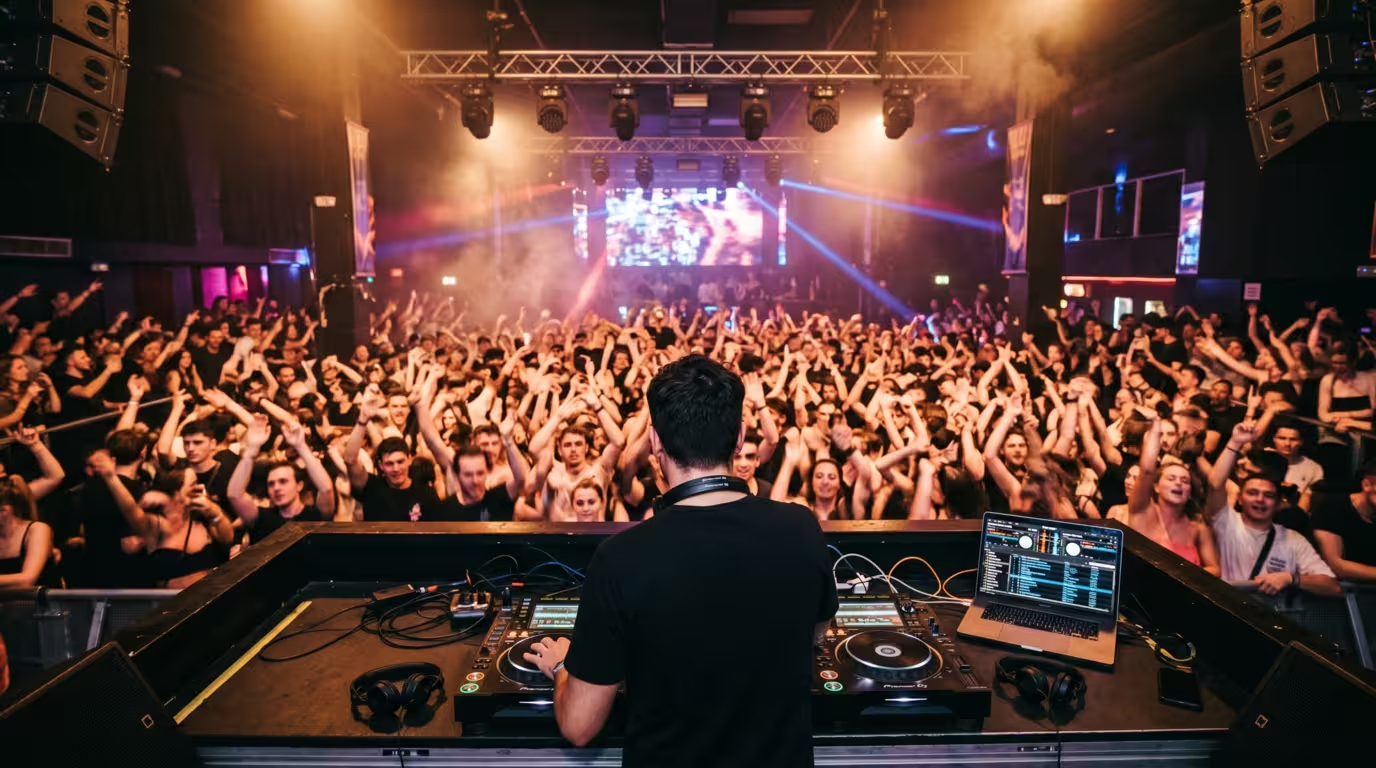
A common shorthand divides sets into a handful of energy shapes. The right one depends on your slot.
| Shape | Energy over time | Best for |
|---|---|---|
| Journey | Build, peak, release | Long sets you control end to end |
| Peak-time | Sustained high | Main-room/festival slots after a warm-up |
| Build / warm-up | Low rising to mid | Opening slots handing over to a headliner |
| Cool-down | High falling to low | Closing and after-hours |
| Steady groove | Narrow band, no big arc | Deep/minimal sessions, background rooms |
The Classic Set Structure
Most multi-DJ nights follow a natural arc: warm-up, build, peak, then comedown. Think of it as the structure of the whole night, with each DJ responsible for one section.
Opening and Warm-Up
The warm-up is the most misunderstood and, many argue, the most important slot. The job is to set a mood and gently draw people in, not to fill the floor. Resident Advisor's classic feature The esoteric art of the opening DJ frames it boldly — that the warm-up DJ deserves perhaps even more credit than the headliner. In it, fabric London resident Craig Richards calls the warm-up a wonderful challenge that, played properly, brings maximum musical fulfilment, while Steve Lawler says the warm-up's job is in fact the hardest and crucial to how the whole night turns out.
The cardinal sin — repeated almost as sacred law across DJ culture — is peaking too early. Don't drop the biggest tracks on a half-empty floor; you leave the headliner nowhere to go and torch the room instead of warming it. Lee Burridge, quoted in the same RA feature, says a great opener leaves the energy at a point where the guest DJ can comfortably continue from. A related rule: never play the headliner's own tracks or remixes — those belong to them. Practically, this slot is a gift: it lets you play deeper, slower, more atmospheric records you would never get away with at peak time. (A dedicated warm-up and opening article in this category will go deeper.)

Building
Once a floor is established, you raise energy gradually — heavier basslines, more rhythmic drive, creeping tempo, richer arrangements. The discipline here is patience: each track should feel like a small step up, not a leap. You are layering energy, not dumping it.
Peak Time
This is the climax — your biggest, highest-energy records, the moment the crowd came for. Even here, restraint pays. Stacking three maximum-intensity tracks back to back dulls their impact; alternate the hardest drops with groovier tracks so the genuine peaks still feel like peaks. Micro-variation — a brief breakdown, a texture change, a vocal — keeps a sustained high feeling alive rather than monotonous.
Closing and Comedown
A good closer brings the room down deliberately — controlled deceleration, not an abrupt stop. This is the place for the memorable last record, the emotional or surprising track people leave humming. Dropping too fast feels jarring; taking too long loses them. (A future closing-sets article will expand on this.)
Your Slot Changes Everything
The single most practical lesson in set-building is that there is no universal structure — there is only the structure that fits your role and your set length. A short peak-time slot, a warm-up, and an open-to-close marathon demand completely different approaches.
| Slot type | Typical length | Approach |
|---|---|---|
| Warm-up / opening | 1–2 hrs | Start low, build to a hand-over; never peak |
| Peak-time / festival | 60–90 min | Get to high energy fast; sustain with variety |
| Open-to-close / marathon | 4–8+ hrs | Full arc; pace yourself; dynamics over hours |
A 60-to-90-minute festival or main-room set is often a near-relentless peak: the floor is already warm and you have little time, so you get to the energy quickly and sustain it. A two-hour-plus slot can ebb and flow more, with room for deep cuts. The open-to-close marathon is the ultimate test of restraint, because you are the warm-up, peak-time and closing DJ all at once. Trance veteran John 00 Fleming, whose extended sets often run to eight hours or more, described in an EDM Identity interview starting with chill-out music and breaks and letting the BPM rise slowly over eight hours, so it feels like listening to eight different DJs in one hit. DJs who play all night repeatedly name the same secret weapon: restraint — you cannot go faster or harder track after track without going up and down. For long sets especially, organise music into opening, primetime and closing pools, and pack roughly twice as much as you think you'll need.
Track Selection and Ordering
If the arc is the skeleton, track selection is the flesh. The goal is not to assemble your favourite songs but to choose records that work together and sequence them so each supports the one before and after it. A useful habit, drawn from set-composition guides, is to think of every track by its role: some are openers, some are bridges that connect genres or moods, some are tension-builders, and some are payoff records — the deep cuts and signature tracks you save for a specific moment. Knowing the role makes ordering easy.
Three working principles recur across the literature:
• Know your music. A deep, well-known library is the foundation. DJ TechTools' guide to organising playlists by energy calls knowing your music the number-one piece of advice, because it is what lets you freestyle confidently and build fluid sets.
• Contrast keeps interest. Experienced DJs deliberately alternate — vocal then instrumental, familiar then obscure, busier then stripped-back — to hold attention without breaking the vibe.
• Place signature tracks for impact. Save your face-melters and emotional standouts for moments that earn them, not the first thirty minutes.
A practical tip many DJs use is the mini-set: pre-rehearsed clusters of two or three tracks you know lock together. You build a set by transitioning between mini-sets rather than agonising over every single track, which takes the panic out of what-next.
BPM and Harmonic Flow as Energy Tools
Tempo is one of your most direct energy levers, but use it gradually. The common technique is BPM creep — nudging tempo up roughly 1 to 2 BPM per transition over several tracks so the audience feels the climb without noticing any single change. Avoid chaotic jumps; if you need a big tempo shift, use a breakdown, a half-time/double-time trick, or a deliberate reset track. Crucially, faster does not always mean higher energy — a stripped-back track at 140 can feel calmer than a driving bassline at 126, so judge energy by feel, not the BPM readout. (The Music Theory category's BPM Ranges by Genre covers tempo bands in detail.)
Harmonic mixing — keeping tracks in compatible musical keys — smooths transitions and gives you another energy dial. Staying in key or moving one step around the Camelot wheel keeps blends seamless; an upward key change (an energy boost) lifts the room, while moving to a darker key pulls it down. Don't let it become a cage, though: a harmonically perfect transition with a 20-BPM gap sounds worse than a small key clash at the right tempo, and a well-timed cut can be exactly the curveball a floor needs. For the full system, see Camelot Wheel and Harmonic Mixing, and Electronic Song Structure for how intros, breakdowns and drops shape your mix points.
Reading the Room and Adapting
A plan is a starting point, not a script. The whole structure above must flex to the actual crowd in front of you. Watch the floor constantly and read the signals: hands up, heads nodding, conversations stopping and phones disappearing mean you're on track; drifting to the bar, checking phones and a thinning floor mean something's off. The counter-intuitive fix when a floor empties is usually not to go harder — it's often that you pushed too hard, so easing back into something groovier rejuvenates the room. Digital DJ Tips recounts watching a respected techno DJ clear a room down to just the bar staff, resolutely ploughing through a set he'd planned regardless of the crowd — the textbook warning against rigidity. We cover the basics here; a dedicated crowd-reading article in this category will go deeper.
Preparation Versus Improvisation
So should you plan the whole set or wing it? The honest, widely shared answer is: neither extreme. The danger of a 100% pre-planned set is rigidity — you can't respond when the room asks for something else. The danger of 100% winging it is a messy, directionless set. Most professionals land in the middle: they prepare material exhaustively but sequence live.
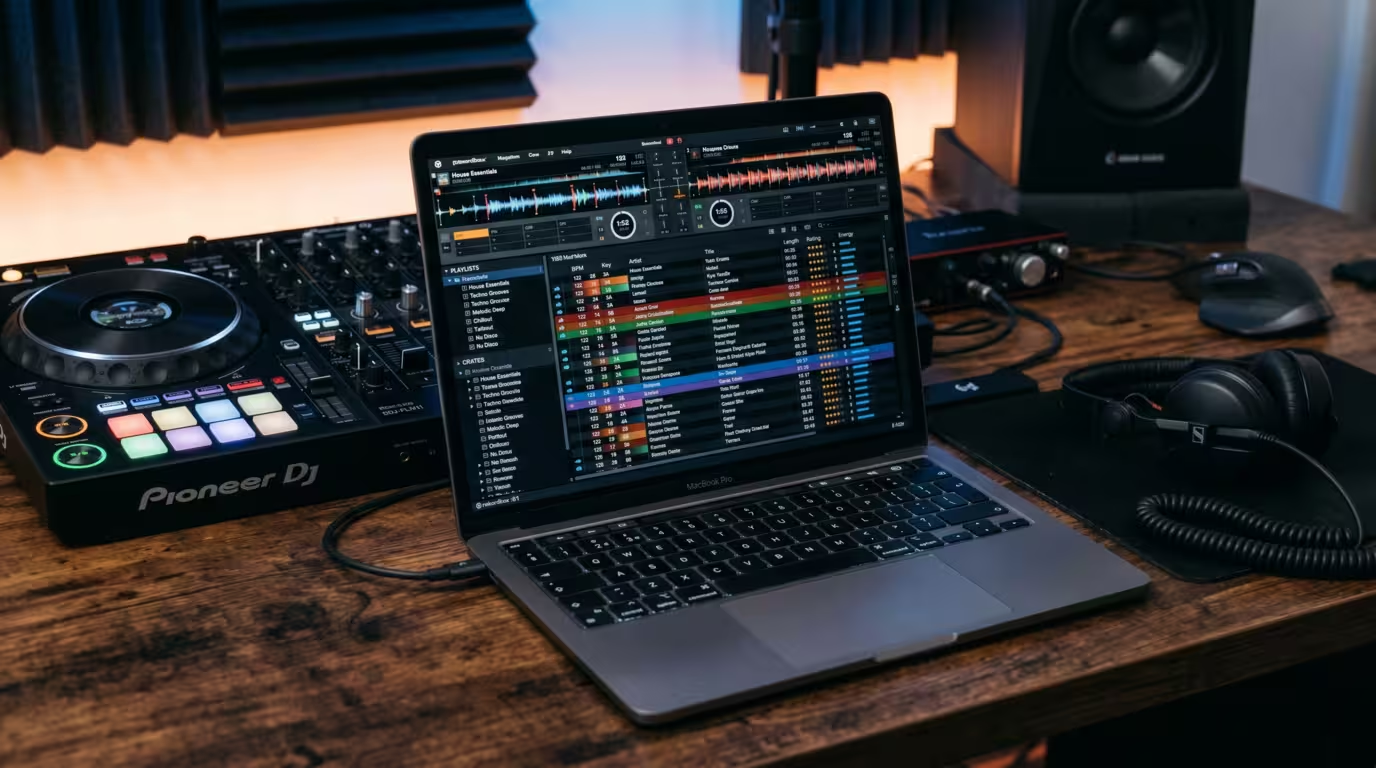
In practice that means building organised crates and playlists (by energy, genre, key and mood), tagging tracks, setting cue points and loops on key records, rehearsing transitions and mini-sets, and maybe sketching a loose arc or a few anchor tracks — then choosing the actual order in the moment by reading the floor. Software like rekordbox, Serato, Traktor and Engine DJ all support this with key/BPM analysis and smart crates. Recording and reviewing your own practice sets is one of the fastest ways to spot pacing problems (see Recording Your DJ Mix).
It's worth acknowledging the genuine range of approaches. Underground and club DJs tend to improvise heavily, treating the night as a live conversation. Some big-stage festival and EDM performances, by contrast, are heavily pre-planned and timed to lighting, pyro and visuals — sometimes to the point of being effectively pre-arranged. Both are valid for their context; just know which context you're in. As John 00 Fleming notes, audiences who come for an improvised journey are buying the twists and turns, while fans of more commercial acts often want the set they can predict.
Practical Tips and Common Mistakes
• Don't blow your load early. Never play your biggest track in the first thirty minutes — you'll have nowhere to go.
• Know your role. Warm-up means warm up. Match your energy to the slot, not your ego.
• Manage energy, don't flatten it. Build, release, breathe, build again. Contrast creates excitement.
• Prepare, then stay flexible. Have organised crates and if-then options, but let the room rewrite the plan.
• Bring more than you need. Pack roughly double your track count to cover every eventuality.
• Don't over-rely on perfect mixing. A well-timed cut can beat a flawless blend if it serves the moment.
• Record and review. Listen back the next day with notes; you'll catch both mistakes and brilliant accidents.
• Tell a story. Aim for a set people remember as a whole, not a list of tracks they remember individually.
Key takeaways
• Programming and track selection matter as much as — many say more than — technical mixing skill.
• Shape a set as an energy arc with peaks, valleys and breathers; never flat-out or flat.
• The classic structure is warm-up → build → peak → close, but your slot and set length dictate the shape.
• Warm-up DJs build anticipation without peaking early or playing the headliner's tracks — a near-sacred rule.
• Move BPM and key gradually as energy tools, and lean on the Camelot and BPM articles for the theory.
• Prepare material thoroughly, then sequence live by reading the room — balance beats both extremes.
Ready-made, exclusive EDM tracks with full rights — released as your own.
