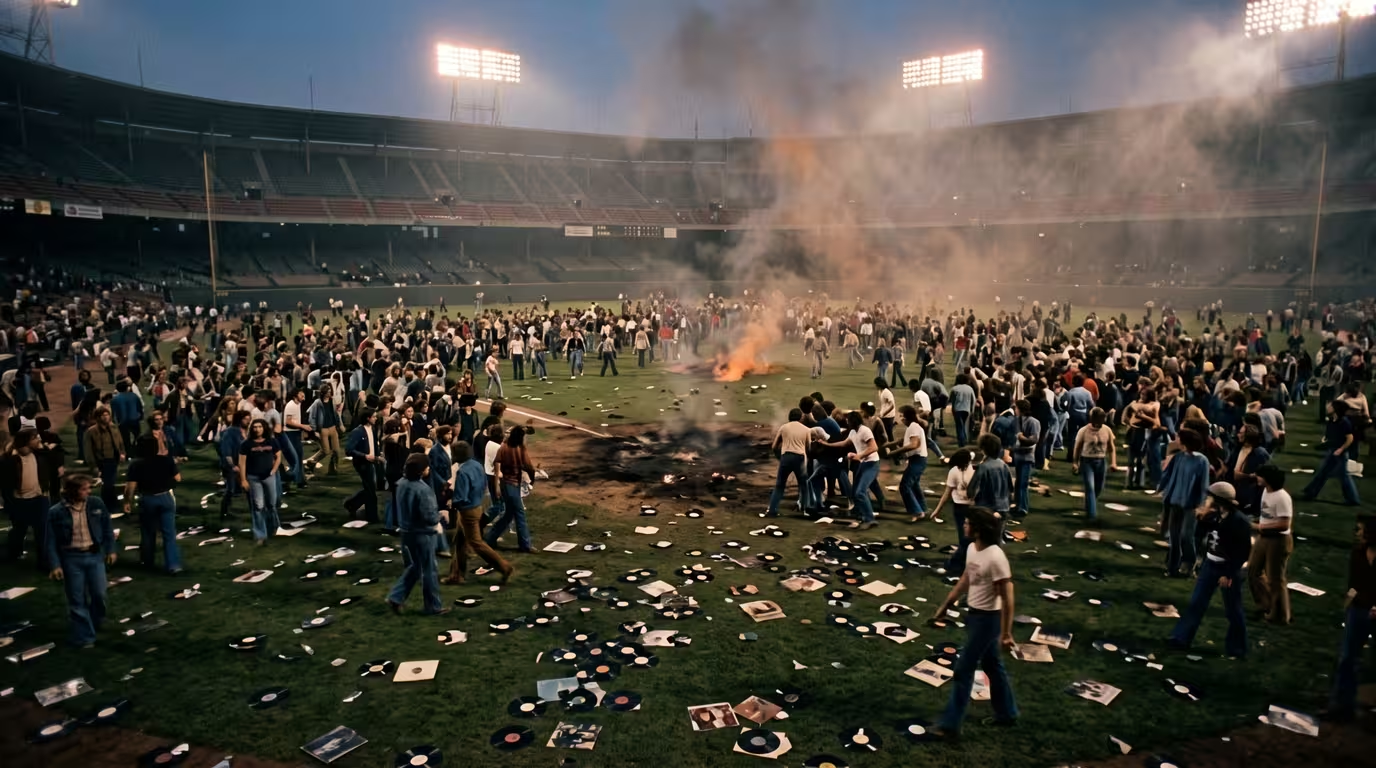
On the night of 12 July 1979, a crate of vinyl exploded in the outfield of a Chicago ballpark, and a generation of rock fans cheered what they believed was the death of disco. They were half right. Disco did die commercially, fast and almost overnight. But the music itself slipped out the back door of the mainstream, returned to the Black, Latino and gay clubs that had invented it, and there quietly mutated into something new. That something was house.
Blog
Disco's Death and the Birth of House
How a 1979 baseball-stadium riot tried to bury dance music, and instead drove it underground into the clubs where house was born.
Disco Was Never Just a Punchline
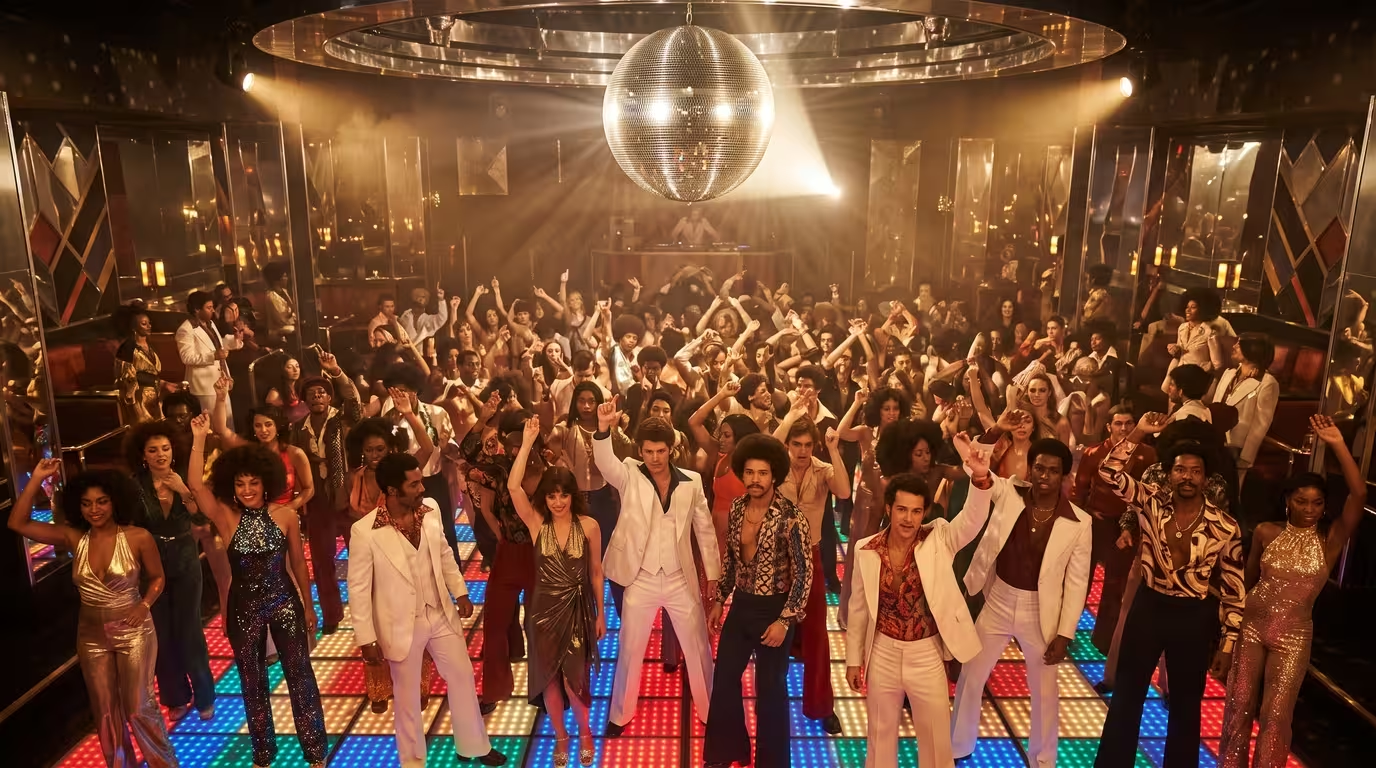
Before it became a wardrobe cliche, disco was underground music made by and for people the mainstream ignored. Its template was set not in a stadium but in a New York apartment: on Valentine's Day 1970, David Mancuso threw a party he called Love Saves the Day at The Loft, his home at 647 Broadway. There was no bar, no velvet rope, no categories, just a great sound system and a mixed crowd of Black, Latino and gay dancers who had nowhere else to be themselves. That ethos, the DJ and the dancefloor as the whole point, is the seed of everything that follows.
The craft grew up around it. The producer Tom Moulton, frustrated by the gaps between songs, spliced reel-to-reel tape into continuous mixes and stretched three-minute singles into extended workouts, inventing the disco break and, by happy accident, the 12-inch single that remains dance music's basic unit of currency. Musically, disco had a signature: a steady four-on-the-floor kick, lush strings and horns, soaring vocals, roughly 110 to 130 beats per minute built for bodies in motion.
Then it went supernova. Studio 54 opened in April 1977; the Saturday Night Fever soundtrack, released that November, topped the Billboard 200 for 24 consecutive weeks and, until Michael Jackson's Thriller, stood as the best-selling album in music history, with over 40 million copies sold worldwide. By 1978 and 1979 disco owned the charts. That total saturation, disco on the radio, disco in commercials, disco everywhere, is exactly what set the backlash in motion.
The Night They Blew Up Disco
The Disco Sucks movement had been building through 1978 and 1979, and its loudest voice was the Chicago shock jock Steve Dahl of WLUP, who had been let go from a rival station when it flipped to an all-disco format. With the White Sox promotions director Mike Veeck, son of the owner Bill Veeck, Dahl cooked up a stunt for a midweek doubleheader against the Detroit Tigers: bring a disco record, get in for 98 cents, and watch the records get blown up between games.
They expected maybe 20,000. According to the official account, attendance was reported at 47,795, with many estimates putting the real figure past 50,000 once thousands more climbed the gates. Dahl detonated the crate in centre field, and the ballpark came apart. Thousands stormed the turf, lit fires and tore up the field; 39 people were arrested, and the White Sox were forced to forfeit the second game, baseball's first forfeit in five years.
The War on Disco
What Was Really Burning
Here is where the story gets uncomfortable, and where honesty matters. The records in those crates were not only Bee Gees singles. Vince Lawrence, a Black teenager working as a Comiskey usher that night and later a founding figure of house, remembers records by Black artists who were not disco at all landing in the pile: Tyrone Davis, Curtis Mayfield, Otis Clay. Chic's Nile Rodgers, watching the footage, famously said it felt to him like a Nazi book-burning.
The scholarly and journalistic consensus is clear-eyed: disco was identified with Black, Latino and gay culture, and the ferocity of the reaction carried unmistakable racial and homophobic undertones, whatever any individual in the crowd intended. Disco had centred exactly the people mainstream America was least comfortable with, and the mob that torched it was overwhelmingly young, white and male.
Dahl has spent decades rejecting that reading. He has written that he is worn out from defending himself as a racist homophobe, insisting the event was neither racist nor anti-gay, just kids taking aim at a musical genre. He frames it as anti-corporate rebellion against disco's overexposure, and it is true that genuine market fatigue was real by 1979. Both things can be true at once: a backlash against commercial saturation that also gave respectable voice, as one history put it, to uglier resentments. The fairest verdict is that the saturation was the pretext and the demographics were the target.
Disco Didn't Die, It Went Home
The commercial collapse was brutal and quick. In the United States, units sold fell 10.4 percent from 1978 to 1979, a value-based sales drop of 11 percent, and the record industry's first major financial setback since the Great Depression. Radio stations dumped disco formats, labels dropped disco acts, and the word itself became toxic, with artists rebranding as dance or boogie. Careers of Black, Latino and gay performers were gutted. Commercially, disco was over.
But music does not take orders from a baseball stadium. It retreated to the underground clubs where it started, and in Chicago it was reborn. In 1977, a New York DJ named Frankie Knuckles, a Loft regular, moved to Chicago to spin at a new club called the Warehouse, opened by Robert Williams at 206 South Jefferson Street for a mostly Black, Latino and gay crowd. As fresh disco records dried up after 1979, Knuckles kept the floor moving by rebuilding what he had, splicing reel-to-reel tape edits and laying a Roland TR-909 drum machine, bought from Detroit's Derrick May, underneath the grooves. Chicago record shops began fielding requests for the stuff they play at the Warehouse. Shortened, that became house.
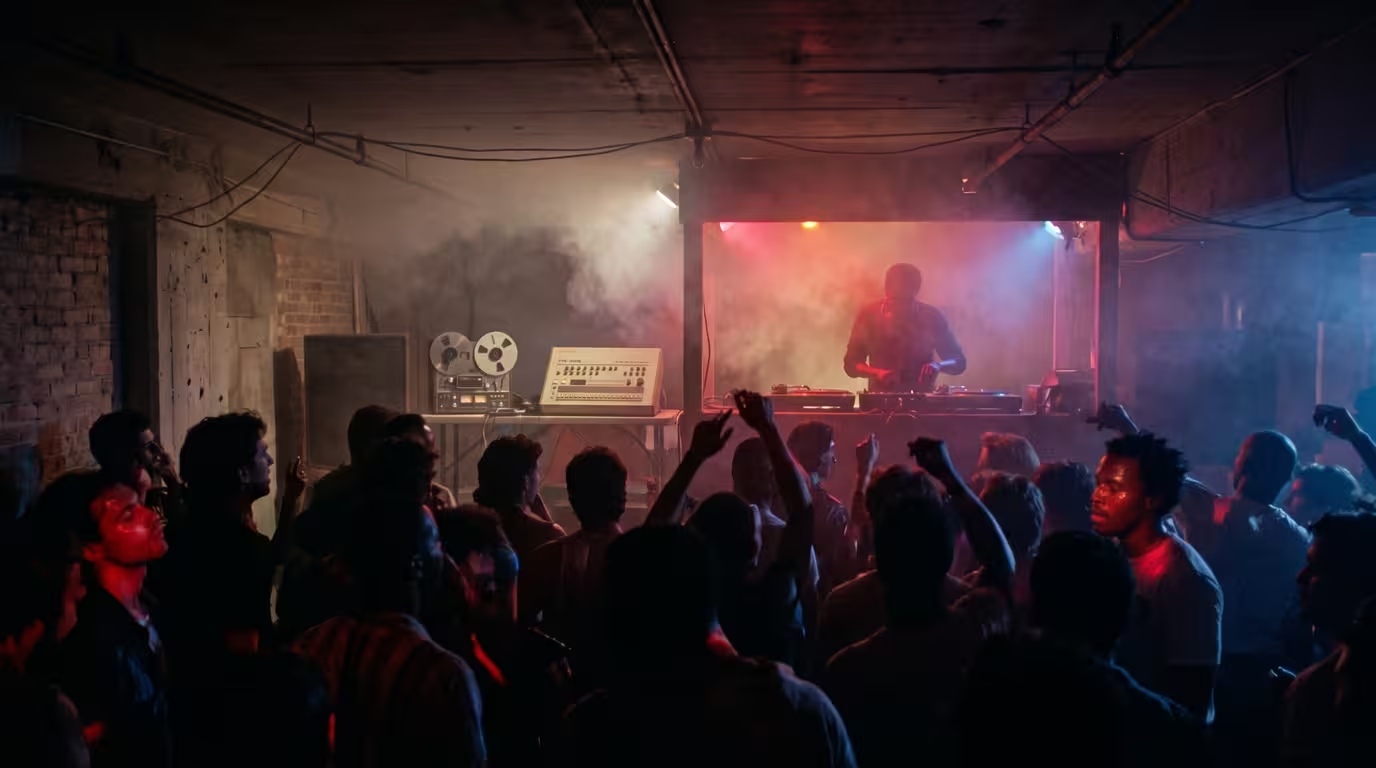
Ron Hardy pushed a rawer, harder version at the Music Box across town. Then the kids started making their own records. Jesse Saunders and Vince Lawrence's On and On (1984) is widely cited, if hotly contested, as the first house record, cut cheaply on drum machines. Larry Sherman's Trax Records and Rocky Jones's DJ International, founded in 1985, became the genre's engines. Marshall Jefferson delivered the euphoric Move Your Body in 1986; Larry Heard, as Mr. Fingers, made Can You Feel It the same year. On 24 January 1987, Steve Silk Hurley's Jack Your Body reached number one on the UK Singles Chart for two weeks, the first house track to top the British charts. And that year Phuture's twelve-minute Acid Tracks, built on the squelch of a Roland TB-303, birthed acid house. House was, quite literally, built from disco's remains: the four-on-the-floor, the loops, the samples, the DJ's edit.
Three Cities, One Lineage
Chicago was not alone. In New York, Larry Levan held court at the Paradise Garage from 1977 to 1987, carrying disco's soulful lineage forward into what became garage. In Detroit, the Belleville Three, Juan Atkins, Derrick May and Kevin Saunderson, fused funk with cold European electronics into techno, starting with Atkins' No UFOs in 1985. All three scenes inherited disco's core idea: the DJ, the dancefloor, the all-night communion.
Then it crossed the Atlantic. By the Second Summer of Love in 1988, Chicago acid house was detonating British youth culture at clubs like Shoom and the Hacienda, fed by DJs returning from Ibiza. The music killed in a Chicago ballpark in 1979 had become the foundation of essentially all modern electronic dance music.
What Actually Died in 1979
The lesson is simple and worth holding onto: disco's death was a commercial event, not a musical one. If anything, the backlash accelerated the transformation by shoving the music back underground, into the exact rooms where innovation happens when no one is watching or cashing in. House and techno are not disco's replacements; they are its direct descendants, carrying the same DNA, and the same reminder of who dance music came from.
That inheritance is still audible every time a producer lays down a four-on-the-floor kick or a DJ reaches for a clean, dancefloor-ready edit. The tools got cheaper and the rooms got bigger, but the craft that started on reel-to-reel tape in a Chicago warehouse is still the job: keep the floor moving. The people who tried to blow that up only sent it somewhere they could not follow.
Key takeaways
• Disco Demolition Night, on 12 July 1979 at Comiskey Park, marked disco's commercial collapse, not its musical end.
• Disco began as underground music of Black, Latino and gay communities; the backlash carried documented racial and homophobic undertones, though Steve Dahl denies any such intent and cites market saturation.
• Driven underground, disco mutated into house at Chicago's Warehouse under Frankie Knuckles, who shaped the sound with tape edits and drum machines.
• Trax, DJ International and records like On and On, Move Your Body, Jack Your Body and Acid Tracks built the genre in the mid-1980s.
• House in Chicago, garage in New York and techno in Detroit all descend directly from disco, and went on to conquer the world.
