Some clubs make money. A rare few make history. The Hacienda did the second while spectacularly failing at the first, a Manchester nightclub that haemorrhaged cash for the best part of fifteen years, was propped up by a pop group's royalties, and in the process helped rewire what a night out in Britain could be. This is the story of how a beautiful, half-empty warehouse became the cathedral of acid house.
Blog
The Hacienda and Madchester's Rise
How a Factory Records folly that bled money for years rewired British nightlife.
A Club With a Catalogue Number
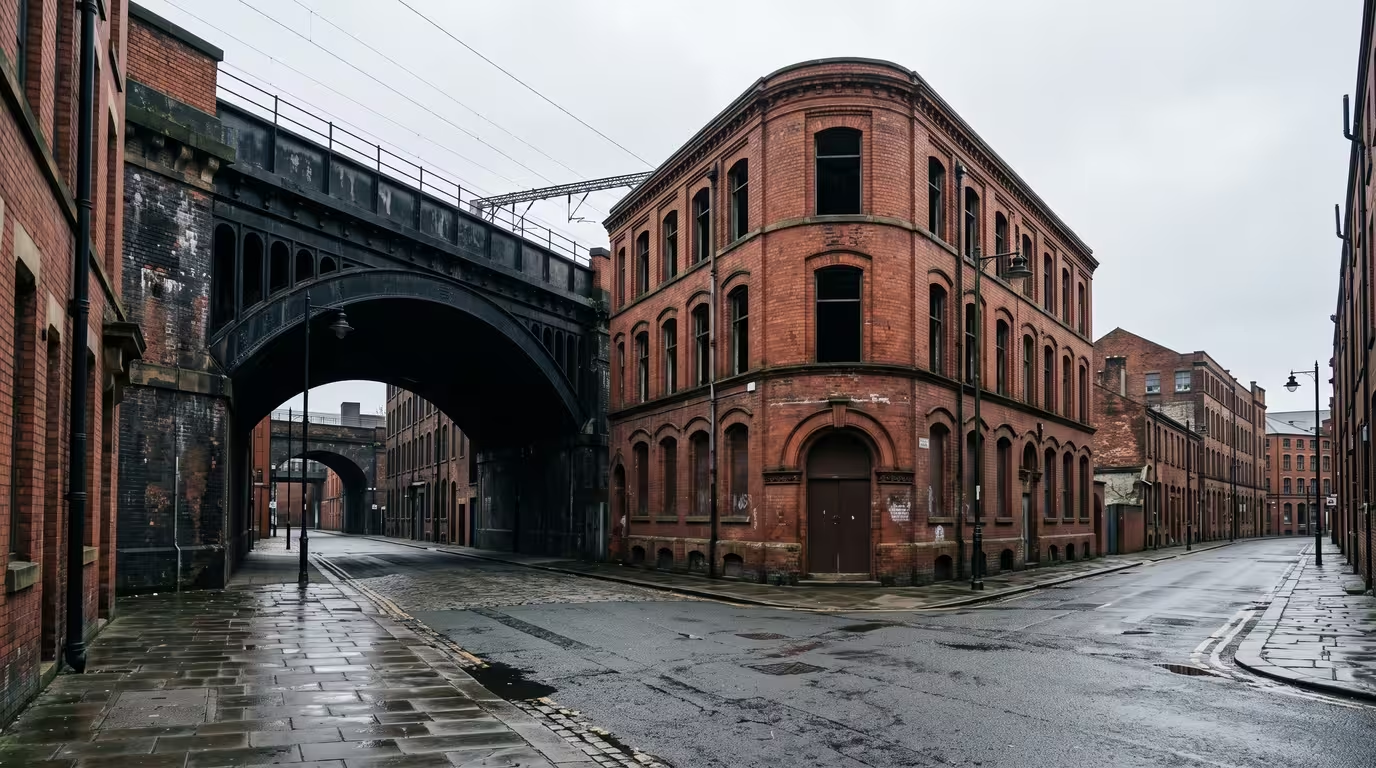
The Hacienda opened on 21 May 1982 in a former yacht builder's shop and warehouse at 11 to 13 Whitworth Street West, a curved red-brick building on the edge of Manchester city centre beside the Rochdale Canal. It was conceived by New Order's manager Rob Gretton and largely financed by the record label Factory Records, the band New Order and the label boss Tony Wilson. In true Factory style it was given its own catalogue number, FAC 51, as if the building itself were just another release alongside the records.
The name came from the Situationists. It was lifted from a line by Ivan Chtcheglov, who wrote in his 1953 text Formulary for a New Urbanism that you will never see the hacienda, that it does not exist, and that the hacienda must be built. The cedilla in the club's name was a Factory in-joke, making the letters look like the number 51.
The Most Beautiful Empty Room in Britain
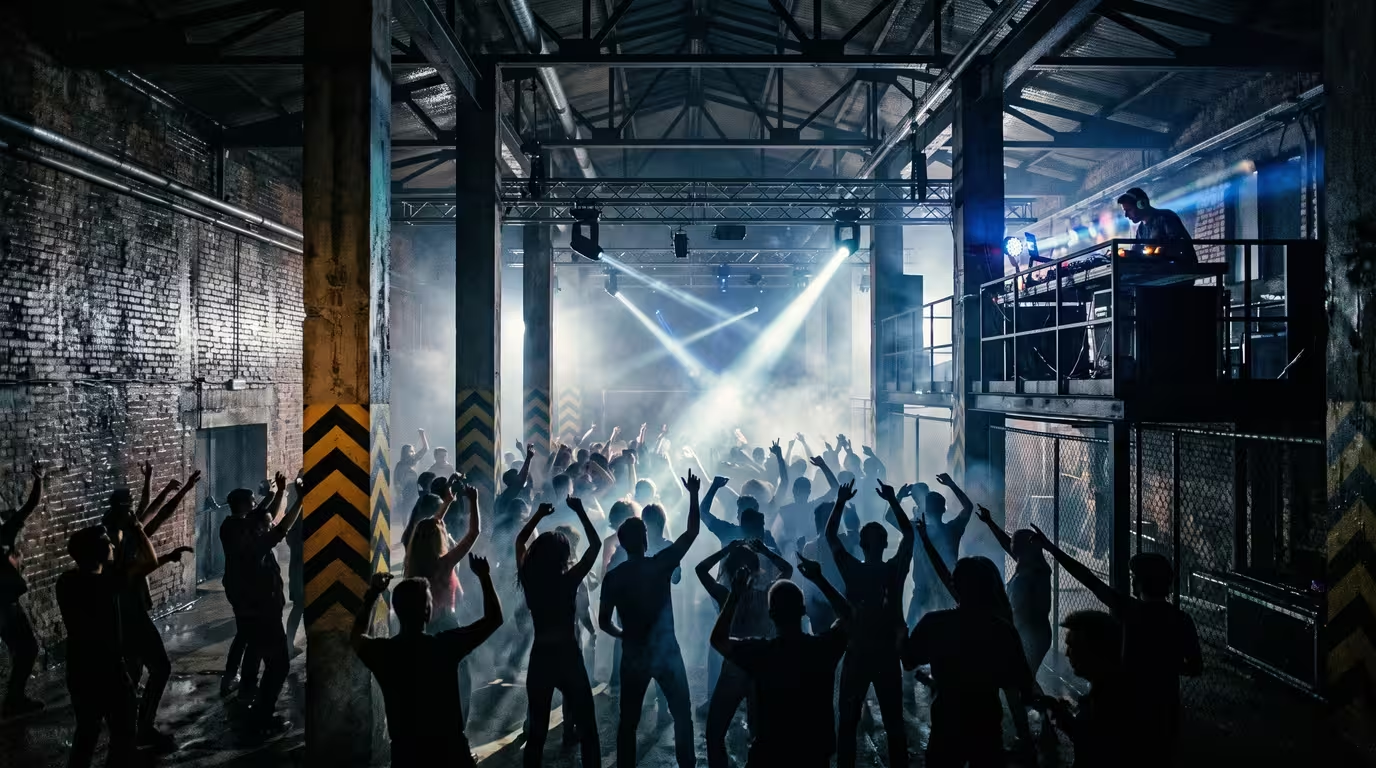
The interior was designed by Ben Kelly, brought in on the recommendation of Factory's graphic designer Peter Saville. Kelly turned the raw, cathedral-like space into something no British club had seen: cool blue and grey tones, steel and exposed structure, neon bar signs and, most famously, black-and-yellow hazard stripes painted on the pillars that ran across the dancefloor, with reflective cat's-eyes and traffic bollards mapping out the edges. Kelly took the visual language of factories and motorways and made it a nightclub. A journalist referred to it as the motorway aesthetic, he later recalled, simply because he had used cat's-eyes and roadside bollards in the scheme. The design became one of the most influential club interiors ever made, echoing decades later in fashion, including Virgil Abloh's stripes for Off-White.
There was one problem: it was a magnificent room that nobody quite knew what to do with. Cavernous and cold, it was built like a live venue at the exact moment live venues were fading, and for years it was famously empty. As Graeme Park later put it, in the years before it all kicked off the Hacienda was always half empty.
Legendary Gigs to a Quarter-Full Room
The early Hacienda ran as a live venue, and its bookings now read like a canon. The Smiths played there in 1983. In 1985 Einsturzende Neubauten notoriously attacked a supporting pillar with a pneumatic drill mid-set. And on 27 January 1984, a barely-known Madonna made her first UK television appearance there, performing Holiday for Channel 4's The Tube with the resident DJ Greg Wilson, who had brought electro and proper mixing to a weekly Hacienda night in 1983, cutting it up live. It was a spectacular roster performed, too often, to a near-empty floor.
New Order's success, above all their 1983 hit Blue Monday, quietly subsidised the whole enterprise. Roughly 341,000 pounds was reportedly spent before the doors even opened, and by Peter Hook's account in his memoir the club owed New Order around two million pounds by 1985. Exactly how much vanished in total is still disputed; the co-founder Alan Erasmus and Hook have both cited a figure of around six million, while Hook has written that the club was about 18 million in debt by the time it closed, adding that because of sloppy account keeping it is hard to know precisely.
The Transformation: House, Ecstasy and Nude
Everything changed with house music. From 1986 the Hacienda became one of the first British clubs to play house consistently, and Mike Pickering's Friday night Nude, which he launched with Little Martin Prendergast playing early Chicago and Detroit records, turned the club's fortunes. Nude went, in Mixmag's words, from making a consistent loss to being full every night of the week by early 1987. In 1987 Graeme Park joined Pickering behind the decks, and the Pickering and Park partnership became the sound of the room. Thursdays belonged to Dave Haslam, whose eclectic Temperance night, launched in May 1986, became a magnet for Madchester's indie-dance crowd; he would DJ at the club over 450 times.
Then came the summer that detonated it. In July 1988 Pickering and Jon DaSilva launched Hot, an Ibiza-inspired night with palm trees, ice-pops and a 20-foot portable swimming pool installed on the floor. It landed just as ecstasy and the Second Summer of Love arrived in the north. The whole feeling of clubbing changed; DaSilva called it year zero for acid house in Manchester. Local records became anthems, from A Guy Called Gerald's Voodoo Ray to 808 State's Pacific State, as the club's DJs championed them week after week.
808 State - Pacific State

Madchester
Out of this fusion of indie guitars and dance beats came Madchester, a scene as much as a sound, blending psychedelia, baggy fashion and acid house. Its bands were the Stone Roses, Happy Mondays, Inspiral Carpets, the Charlatans, James and 808 State, and the Hacienda was its living room. The term was popularised by Happy Mondays' 1989 EP Madchester Rave On, and Manchester's confidence turned global. The Second Summer of Love had a northern capital, and it was FAC 51.
The Dark Side
Success brought predators. As ecstasy took over, alcohol sales collapsed, since clubbers drank water rather than beer, and the drug economy drew gangs to the doors. The city that the press had celebrated as Madchester was soon rechristened Gunchester. In January 1991 a member of the security team was threatened with a machine gun, and the club voluntarily closed that year while its owners talked to police; Tony Wilson read a statement to the dancefloor saying they were sick and tired of dealing with instances of personal violence. It reopened with heavier security, but the mood had curdled.
The scene's human cost was already clear. On 14 July 1989, 16-year-old Clare Leighton, from Cannock in Staffordshire, collapsed after taking an ecstasy tablet at the club and died 36 hours later from a rare reaction. She is widely remembered as one of the first ecstasy-related deaths in Britain, a young life that should not be lost in the mythology.
The Collapse
The Hacienda never solved the basic maths: a club that does not sell drinks does not pay its bills. Factory Records itself went bankrupt in 1992, and the club's debts spiralled. It lost its entertainments licence in June 1997; the final night, a club night called Freak with Dave Haslam and Elliot Eastwick, was 28 June 1997, with Spiritualized playing the last live show a fortnight earlier. The building stood empty, was briefly overtaken by free parties, and in November 2000 its fixtures and fittings, right down to the dancefloor planks and the DJ booth, were sold off across 69 lots in a charity auction. It was demolished in 2002 and replaced by an apartment block that kept the Hacienda name, licensed from Peter Hook, under the tin-eared strapline that now the party was over, you could come home.
Why It Still Matters
Commercially, the Hacienda was a disaster. Culturally, it changed everything. It introduced house music to a mass British audience, helped ignite rave culture, and made Manchester a global music city. It set the template for the superclub era that followed, from Liverpool's Cream to London's Ministry of Sound, and reframed the nightclub as a cultural project rather than a business. Its afterlife is everywhere: in Ben Kelly's much-imitated design, named in 2019 to Historic England's A History of England in 100 Places as one of ten music and literature sites chosen by the novelist Monica Ali, alongside Abbey Road Studios and the 100 Club; in Michael Winterbottom's 2002 film 24 Hour Party People; in Peter Hook's memoir The Hacienda: How Not to Run a Club; and in Hacienda Classical, the orchestral show that Graeme Park and Mike Pickering debuted at Manchester's Bridgewater Hall in 2016.
If the Hacienda left a lesson for anyone building a scene today, it is an inconvenient one: the rooms that change music are usually run by people playing records nobody has asked for yet. FAC 51 lost a fortune doing exactly that, and rewired British nightlife in the bargain.
Key takeaways
• The Hacienda, catalogued as FAC 51, opened on 21 May 1982, funded by Factory Records and New Order, in a former yacht warehouse on Whitworth Street West.
• Ben Kelly's industrial design, with its hazard stripes, bollards and cat's-eyes, became one of the most influential club interiors ever built.
• After years of losses, house music, ecstasy and the Nude and Hot nights transformed it into the crucible of acid house and Madchester.
• Gang violence, a drug economy and Clare Leighton's death in 1989 darkened its later years; Factory went bankrupt in 1992 and the club closed on 28 June 1997.
• Demolished in 2002, it lives on through its design legacy, 24 Hour Party People, Peter Hook's book and Hacienda Classical.
