A back-to-back (B2B) set is one of the most exciting and exposing things you can do behind the decks: two (or more) DJs sharing a single set, trading off track by track or in blocks, building one performance together. It rewards listening, generosity and chemistry, and punishes ego. If you already mix confidently on your own, this guide explains exactly how B2B works — the formats, the mechanics, the musical conversation, and the unwritten rules — so your first time sharing a booth goes well.
What a B2B set actually is
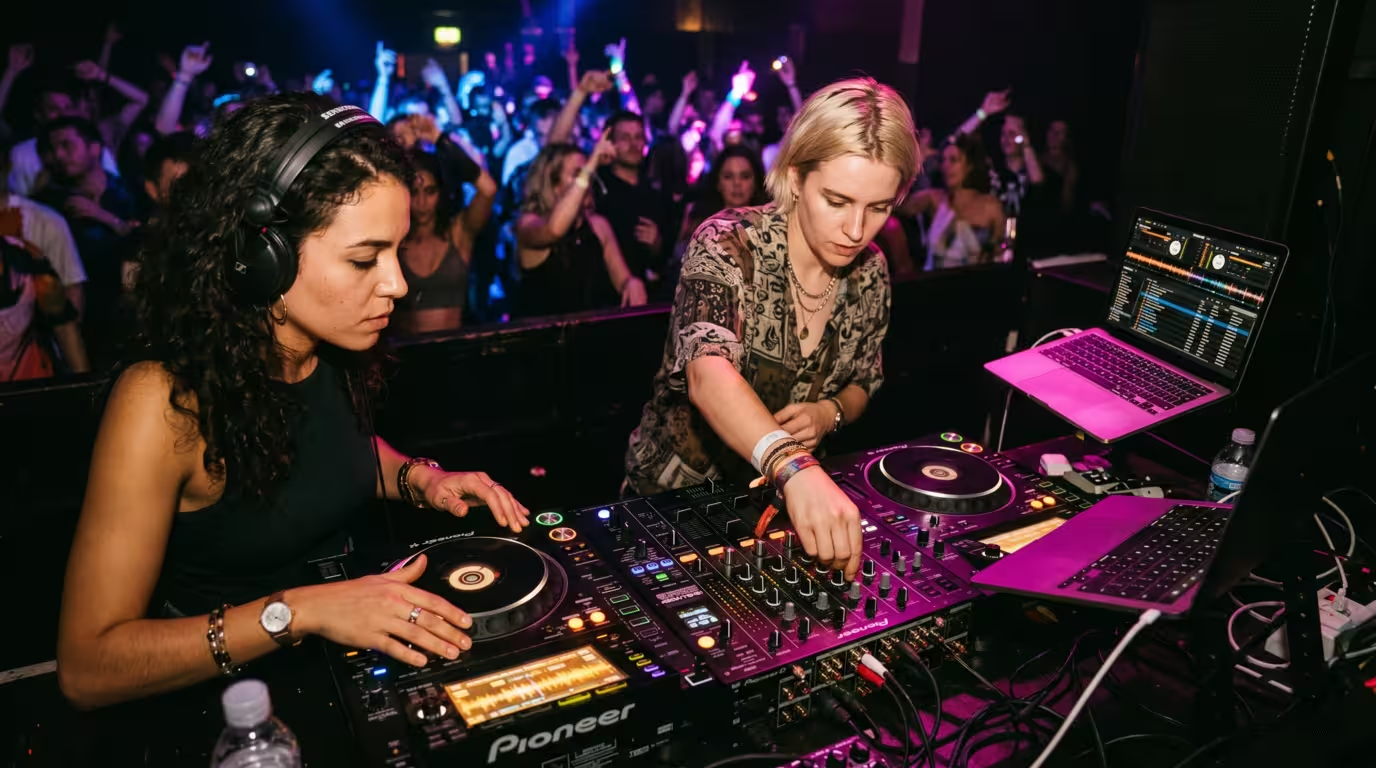
B2B is shorthand for back-to-back, and in DJ culture it means two or more DJs performing one set together, alternating who plays. It is not two separate sets played one after the other — that common-English sense of back-to-back is exactly what the DJ term does not mean. On a line-up you'll see it written as DJ A b2b DJ B (occasionally styled vs.), and it signals a single, shared, collaborative performance in which the artists take turns selecting and mixing within the same time slot.
The acronym scales with the number of players: two DJs is a b2b, three is a b3b (back-to-back-to-back), four is a b4b, and so on. Two DJs is by far the most common configuration, with three or more reserved for special or surprise moments.
The name itself is a piece of history. In the vinyl era, while one DJ mixed, the other would turn to the record bins behind the booth to dig for the next record — leaving the two literally back-to-back. As several writers have noted, given that today's DJs stand shoulder to shoulder, side-to-side would be the more literal description, but the original term stuck.
Why DJs play back-to-back
The appeal of B2B is, above all, the dialogue. Where a solo set is one person's vision, a back-to-back is a real-time conversation: one DJ plays a record, the other answers it, and the set is shaped by two sensibilities pushing and responding to each other. The producer and DJ Jack Adams (Mumdance) — whose 2017 Radio Mumdance run on Rinse FM spanned a 40-episode series of weekly back-to-backs with artists including DJ Storm, Surgeon and Ben UFO — described a back-to-back as being, like any good relationship, fundamentally about communication and empathy with your partner.
That dialogue produces music neither DJ would make alone. Sharing the decks, as Pioneer DJ's guide describes, can unlock something in DJs, leading them to play music they wouldn't normally play, in ways they wouldn't normally play it. Two libraries and two instincts collide, and the unpredictability is the point. There are practical and emotional upsides too: a friend in the booth steadies the nerves, you cover for each other technically, and the shared energy is infectious for a crowd.
Promoters love B2Bs because pairing two names is a marketing event in itself — think of bills built around big head-to-head pairings. It is worth being honest that some B2Bs exist mainly to fit more DJs onto a line-up or to create a poster moment, but the format's real value is creative.
The formats of B2B
There is no single correct way to run a B2B; the structure you choose changes how the set feels. The shorter the turns, the tighter and more conversational the set; the longer the turns, the more each DJ can develop an idea on their own. A widely recommended approach for a long set is to vary the turn length — start with longer blocks to settle in, then shorten them as you warm up, ending one-for-one when you're both locked in.
Here are the main formats and how each one feels.
| Format | How it works | Feel / notes |
|---|---|---|
| Track-for-track (one-for-one) | DJs strictly alternate, one track each | Tightest dialogue; you always mix out of your partner's tune; most demanding |
| Two-for-two (or a few each) | Each plays two or three before swapping | A bit of room to develop an idea while staying collaborative |
| Time blocks | Each plays a chunk (e.g. 15-30 min) before swapping | Most autonomy per DJ; good for easing in or for clashing styles |
| b3b / b4b (3+ DJs) | Three or more rotate, often in blocks | More variety, more coordination; harder to stay coherent |
| Extended / all-night B2B | A long shared set, often varying turn length | Time to find a deep groove together |
Many experienced DJs treat these as starting points rather than rules. As several artists interviewed by Mixmag described, pairs often begin two-for-two and shift to one-for-one once trust builds, looping a track to buy a few extra seconds when needed. The relay is an extreme variant: on 18 April 2019, 182 DJs at Manchester's Joshua Brooks — each given four minutes to mix in their single track — set the Guinness record for the largest B2B relay, beating the 147 fielded by Sydney's Stoney Roads.
How a B2B works mechanically
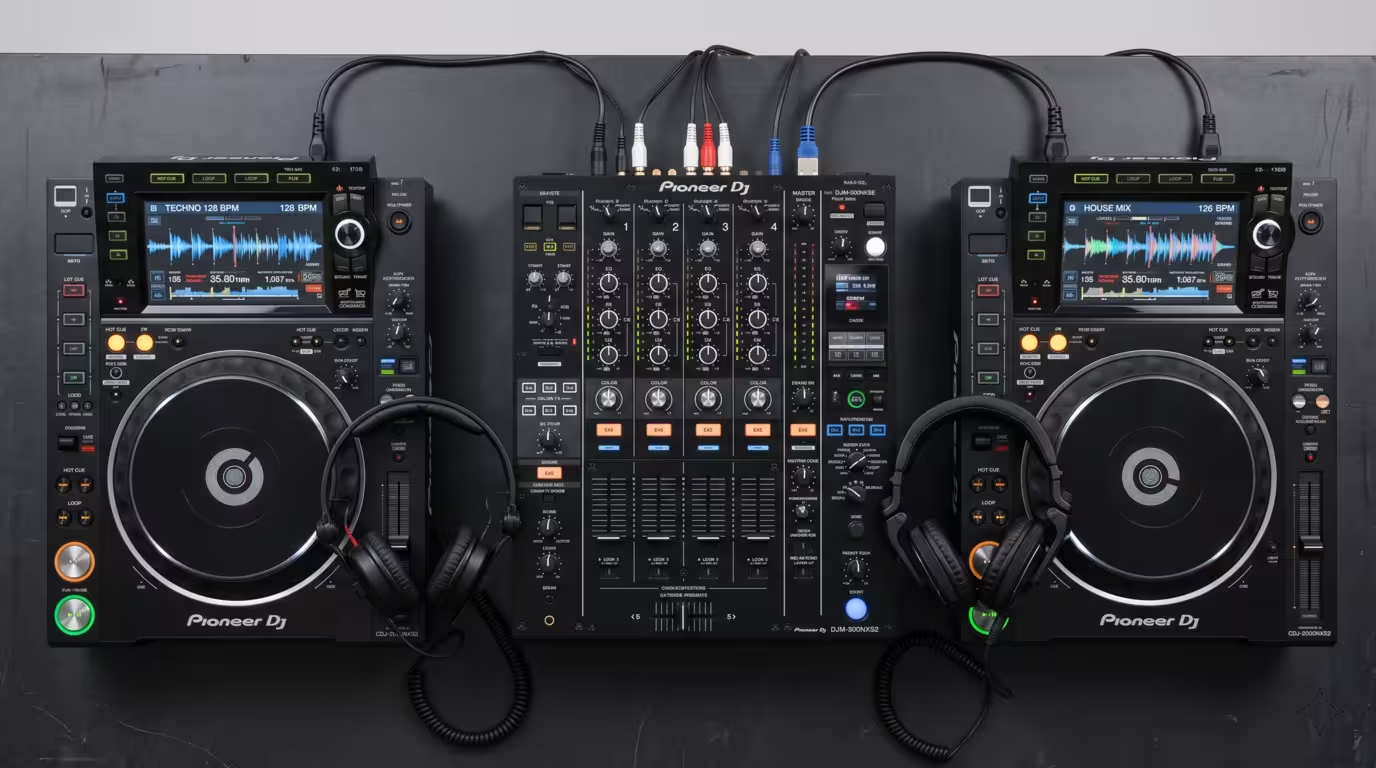
The standard setup is the same gear you already know: two CDJs (or turntables) and a mixer, with each DJ taking a deck and its corresponding channel. For three or more players you typically move to a four-channel mixer and more players so everyone has their own deck and channel.
The core mechanic is simple. While one DJ's track is playing out to the room, the other previews and cues their next track in headphones on the free deck, then mixes it in when it's their turn. By convention, the incoming DJ brings in their own track and handles that transition — in a one-for-one set, as Pioneer DJ notes, you're always mixing out of the other person's track.
The thorny practical question is the mixer. The strong working rule is that each DJ operates their own deck and channel and does not touch the other's uninvited. During the brief overlap of a blend there is unavoidable shared use, which is exactly why communication matters. Two further habits keep it clean. First, leave the mixer neutral when you hand over: as Pioneer DJ's guide advises, before passing control back you should check the cue volume isn't too loud, turn off filters and effects on inactive channels, and reset the EQs to 12 o'clock for good measure. Second, keep your hands off your partner's transition even when it's wobbling — the same guide's blunt advice on whether to fix your partner's mix is simply don't, because being rescued can feel worse than a small stumble.
For headphone cueing, modern club mixers such as the Pioneer DJM-A9 and DJM-V10 (and the Allen & Heath Xone:96) provide separate A/B headphone outputs, so each DJ can plug in their own pair and cue independently — one can beatmatch in the mix while the other previews the next tune. On older single-output mixers, DJs share a pair or a splitter and physically pass the headphones across at the handover. And one hardware warning that haunts CDJ B2Bs: never pull the wrong USB. Mark your stick with a charm or zip-tie and only ever touch your own.
The musical side: playing together
Mechanics aside, a B2B lives or dies on listening. The biggest mistake is playing your solo set with another person standing next to you. Instead of sweating your next selection in isolation, get into what your partner is playing and let it guide your answer — this, as Pioneer DJ puts it, is when a back-to-back set really takes off.
That means staying harmonically and rhythmically aware of a track you didn't choose. Because you don't control the preceding record, mixing in key and at a compatible tempo is even more important than in a solo set; a rhythmically tight blend can still sour if the keys clash. (For the underlying craft, see the Mixing Techniques articles on beatmatching, EQ and phrasing, and the Music Theory pieces on BPM ranges and Camelot/harmonic mixing.)
Crucially, set your partner up rather than box them in. Good B2B players leave the next move open — the producer Special Request describes trying to create multiple options for your partner to build on — and they resist the urge to mix out too early. As Berlin's Mor Elian has observed, the excitement of a B2B tempts people to mix a little too early; letting a track breathe and pointing out a good entry point is far better than snatching it away. The give-and-take of two selectors is the magic, but it must serve one coherent journey, not two competing ones.
Etiquette and communication
If solo booth conduct has unwritten rules (see Booth and Club Etiquette), a B2B is the intense, doubled-up version of them. The whole thing rests on respect and trust, and the etiquette is mostly common sense once you frame it that way.
What to do
• Agree the format up front. Decide who starts, who finishes, roughly how many tracks each, and the genre/tempo lane — ideally before the pressure of the night.
• Communicate constantly. Nods, eye contact and a hand toward the mixer (I'm coming in) do most of the work; agree any signals in advance. Danilo Plessow (Motor City Drum Ensemble) says he relies on constant communication — when is it OK, and where do you want to go.
• Let your partner's track breathe. They played it for the crowd, not as a teaser before your turn.
• Leave the mixer as you found it and keep good vibes in the booth — your shared mood feeds the music.
What not to do
• Don't hog or overstay your turn. Sticking to the agreed format is the cardinal courtesy; as Mumdance says, it's really bad form to hog the decks.
• Don't touch your partner's deck, EQ or playing track uninvited. Mixmag's etiquette guide is direct: there's little reason to touch the EQ when another DJ is getting set to mix in.
• Don't cut their track short to slam yours in — Yung Singh names this as the worst B2B sin.
• Don't try to out-do or upstage your partner. A B2B is collaboration, not competition. As Plessow puts it, it is definitely not the place to be egotistic and show off your records — you need to try to build something together.
The phrase one DJ used sums it up: in a back-to-back, the opposite of ego is duo.
Choosing a partner and preparing
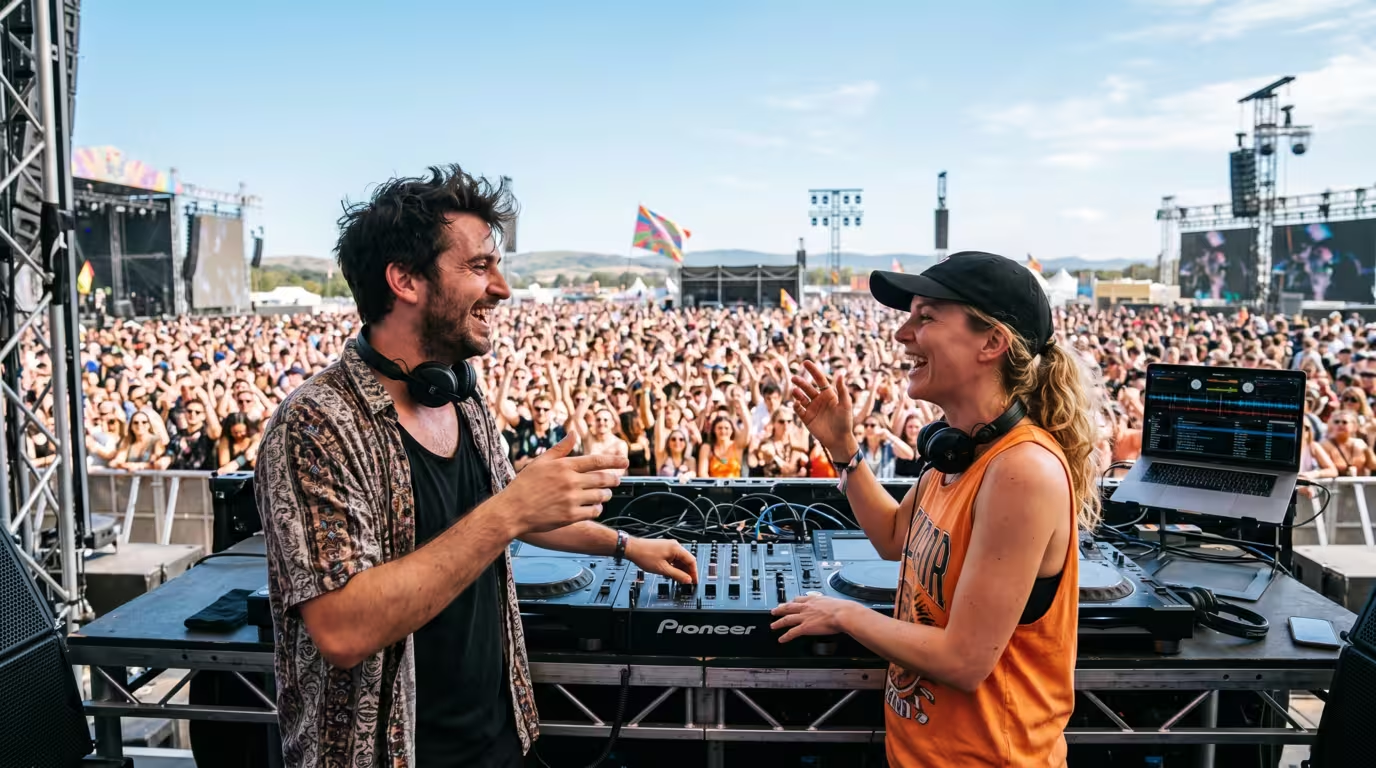
Partner choice is the single biggest factor. The ideal partner shares enough common ground that your records talk to each other, but brings enough difference to make the set surprising. Mixing styles matter as much as taste: as Objekt (TJ Hertz) has noted, pairing a pure long-blender with someone who throws in quick cuts and fader tricks every other transition can sound jarring — contrast can be great, but too much of it feels uneven. If you've never played together, research your partner before you even agree to the gig.
Preparation is mostly about alignment, not a fixed setlist. Talk beforehand about the genre and tempo range, who starts, and how loose or planned you want to be. Many DJs swap tracks in advance — Batu describes building a handful of bedrock tunes as a mission statement for the set even if you never play them. Pack much wider than usual: Red Bull's B2B guide suggests preparing at least 30 tracks per hour, setting aside easy-to-mix music for when you get stuck, because you'll often be mixing faster and into music you didn't pick. Practising together, where possible, builds the near-telepathic shorthand that long-standing pairs rely on. Sort the unglamorous stuff too — fees, gear compatibility and software — early, since money and logistics are common sources of friction.
The challenges of B2B
Be clear-eyed: back-to-backs don't always work, and they can feel flat, forced or awkward. The most common failure is the ego clash — when one DJ ignores what was just played and waits for their turn to drop a pre-planned track, the set becomes two jarring mini-sets with no narrative. Maintaining a single coherent arc with two (or more) visions is genuinely hard, and it gets harder the more DJs you add, which is why b3b and b4b sets lean on blocks and tight coordination.
Other pitfalls are practical: BPM, key and energy mismatches that make transitions awkward; not knowing your partner's tracks, so you can't anticipate; and technical friction when one runs Serato and the other rekordbox USBs, or prefers a rotary mixer to channel faders. None of these are fatal, but each is a reason to communicate more, not less.
A brief note on culture
The back-to-back is a long-established and celebrated part of DJ and club culture, not a recent gimmick. Its roots reach back to vinyl-era necessity and the communal spirit of early DJing, and it became a promoted attraction as superclubs and CDJ technology spread from the 1990s onward. Today, marquee pairings are festival events in their own right: documented examples include Carl Cox b2b Adam Beyer (a celebrated Junction 2 and Resistance pairing), Jamie Jones b2b The Martinez Brothers, and the rarer b3b — Four Tet, Caribou and Jamie xx played back-to-back-to-back at the Grand Palais in Paris in June 2012. Branded series such as Red Bull's Back2Beyond now exist specifically to stage memorable B2B sets, underlining how central the format has become.
How to play a great B2B
Pulling it together, the playbook is short and repeatable:
• Communicate and agree the format before you start; check in during the set.
• Pick the right partner — overlapping but complementary taste, compatible mixing style, mutual respect.
• Listen and complement; don't compete. Answer what your partner played; build one journey.
• Don't hog your turns, and start with blocks or two-for-two before going one-for-one if you're new to it.
• Share the mixer respectfully — work your own deck, leave EQs neutral on the handover, and keep your hands off their transition.
• Read each other and the crowd, leave your partner room to shine, and set them up well.
• Leave the ego at the door and have fun — the joy of B2B is the whole reason it exists.
For the foundations this article builds on, see Building a DJ Set (now an arc shared by two), Reading the Crowd, Booth and Club Etiquette, and the Mixing Techniques and Music Theory guides.
Key takeaways
• A B2B is two or more DJs sharing one set and alternating — not two consecutive solo sets; three is a b3b, four a b4b.
• The classic format is track-for-track, with two-for-two, time blocks and rotations all common; varying turn length works well over a long set.
• Mechanically, the incoming DJ cues on the free deck and mixes their own track in; each DJ works their own channel and leaves the other's gear alone.
• It's a musical conversation, not a contest: listen, complement, leave room, and don't try to upstage your partner.
• Choose a compatible partner, agree the plan up front, communicate throughout, and leave your ego at the door.
Ready-made, exclusive EDM tracks with full rights — released as your own.
