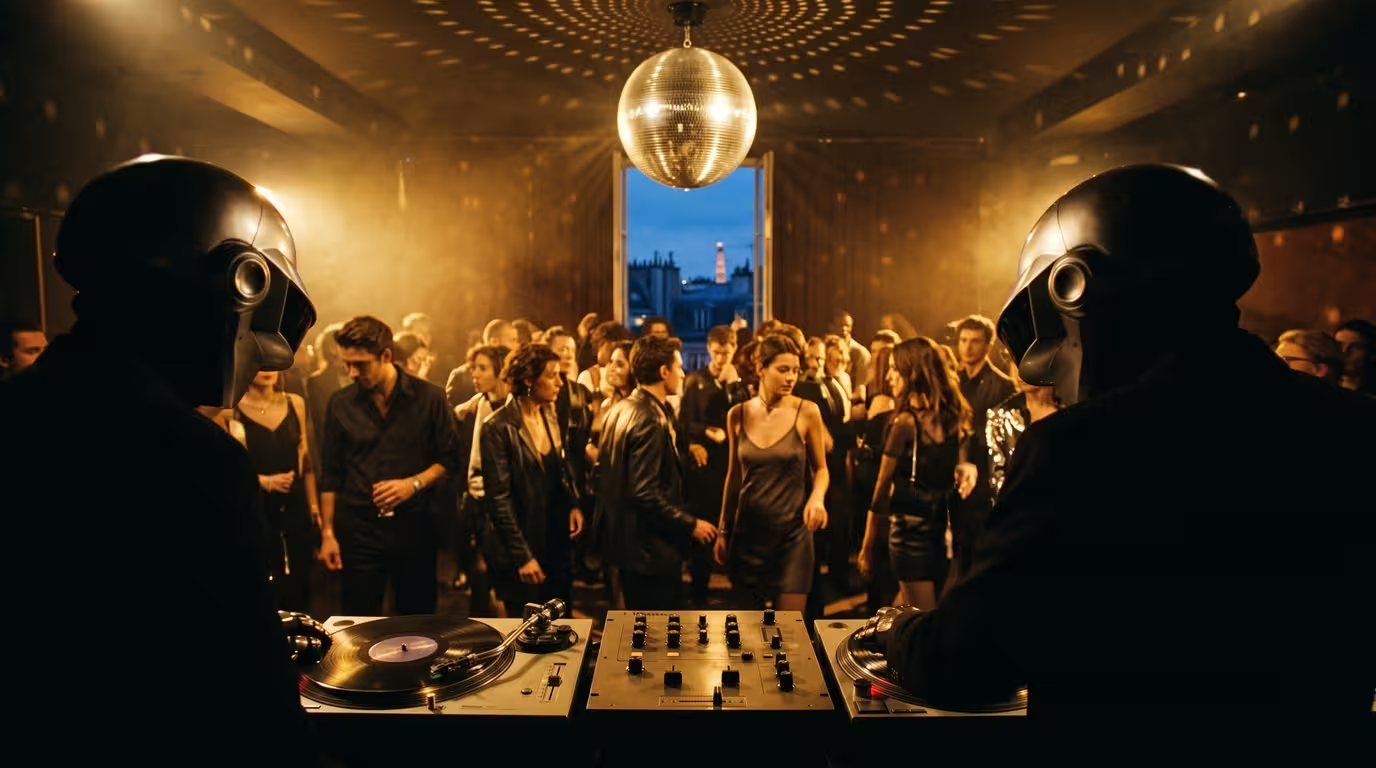
Press play on a French Touch record and the trick reveals itself slowly. A muffled disco loop creeps in, as if heard through a wall; a filter opens, the highs bloom, the bassline starts to strut, and a four-on-the-floor kick lifts the whole thing into the light. That move, taking an old groove and sweeping it into euphoria, is the sound of mid-1990s Paris, and it changed dance music for good.
Blog
French Touch and the House Revolution
How a generation of Paris producers filtered disco into a warm, global house sound, with Daft Punk at its centre.
A City Built on Disco
Long before french house had a name, France had disco in its blood. The Paris-based drummer-producer Cerrone scored international hits with Love in C Minor (1976) and Supernature (1977), the latter selling over eight million copies worldwide, fusing lush orchestration, a pounding kick and synthesised sci-fi drama. Alongside Giorgio Moroder's Euro-disco and the string-laden funk of Chic, this was the lush, danceable European disco that French kids grew up on.
When house and techno arrived from Chicago and Detroit in the late 1980s, carried into Paris clubs like The Palace by DJs such as Laurent Garnier, a generation of record-collecting Parisians found a way to fuse the two. They had grown up on disco, funk and soul; now they had drum machines, cheap samplers and a love of American black music. The result was a genre built on a deceptively simple idea: loop a disco or funk break, sweep a resonant filter across it, drop a kick underneath, and let nostalgia do the rest.
The Touch Gets a Name
The phrase French Touch floated around Paris nightlife for years, appearing on a Fnac Music jacket in 1991 that promised a French touch to house, but it stuck as a genre name after the British journalist Martin James used it in a 1996 Melody Maker review of Etienne de Crecy's Super Discount. The records came first, though. In 1996, Motorbass, de Crecy with Philippe Zdar, released Pansoul, an album of deep, filtered, sample-led house now widely seen as a founding document of the sound.
Super Discount turned the filter-house approach into a concept, and a wave of Parisian producers followed: Zdar went on to form Cassius with Boom Bass, becoming one of the world's most in-demand producers; Bob Sinclar built sun-drenched, disco-sampling house on his Yellow Productions label; Alan Braxe and Fred Falke perfected the melodic, uplifting end of the spectrum. The scene had its clubhouses too: the Respect night, and the labels Roule, run by Thomas Bangalter, and Crydamoure, run by Guy-Manuel de Homem-Christo.
Two Robots From Paris
At the centre stood Daft Punk. Thomas Bangalter and Guy-Manuel de Homem-Christo met at a Paris secondary school and first played together in an indie band called Darlin'. A dismissive Melody Maker review, which wrote the music off as a daft punky thrash, gave them both a punchline and a name. They embraced electronic music, met Scotland's Slam at a rave, and put out early singles on Glasgow's Soma Quality Recordings, including The New Wave and the breakout Da Funk.
Their 1997 debut Homework, released by Virgin, took the filtered house template global. Da Funk and Around the World, the latter built on a hypnotic vocoder hook and a bouncing bass, its title chanted 144 times in the album version and 80 in the radio edit, turned an underground Parisian sound into an MTV and dancefloor phenomenon at once. Daft Punk themselves described Around the World as being like making a Chic record with a talk box.
How the Sound Was Made
French Touch was a producer's genre, defined by technique as much as by taste. The toolkit was cheap and specific: gritty 12-bit samplers like the E-mu SP-1200, Roland's TR-909 drum machine, warm Juno synths, and a humble Alesis 3630 compressor for the pumping sidechain feel. The magic ingredient was the filter sweep, rolling a low-pass filter open across a looped disco break to build tension and release.
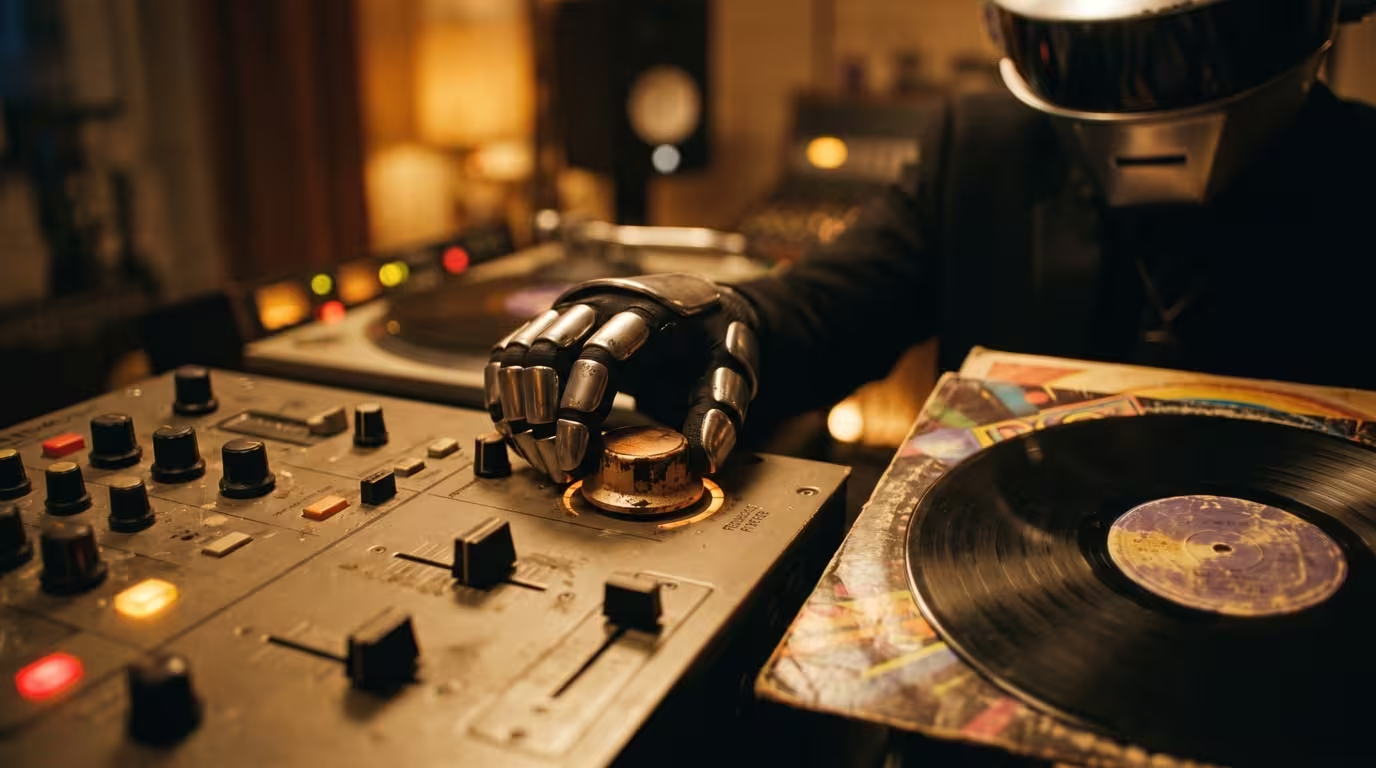
It is the kind of craft that rewards a great ear and a great record collection, knowing exactly which two bars of an old groove will carry a whole track. That sample-smart, groove-first mindset is still the foundation of how exclusive, ready-made dance tracks get built today.
The defining example arrived in 1998. Stardust, Bangalter with Alan Braxe and the singer Benjamin Diamond, built Music Sounds Better with You around a looped guitar riff from Chaka Khan's 1981 track Fate. First released on Roule, it debuted at number two on the UK chart, topped the US dance chart and has sold more than two million copies worldwide. It remains the genre's perfect distillation: warm, hypnotic, melancholy and joyful all at once.
Going Global
By the turn of the millennium, French house was everywhere. Cassius's 1999 and Bob Sinclar's productions filled clubs; in 2000, Modjo's Lady (Hear Me Tonight), built on a sample of Chic's Soup for One, topped the UK chart and became a worldwide hit. The single earned Modjo an entry in the Guinness World Records as the first French group to debut at number one on the UK singles chart.
Then Daft Punk doubled down on disco. Their 2001 album Discovery leaned fully into vocoders, filtered loops and childhood nostalgia. One More Time, with a heavily processed vocal from Romanthony, was built on Eddie Johns's 1979 disco track More Spell on You; Harder, Better, Faster, Stronger flipped Edwin Birdsong's 1979 funk cut Cola Bottle Baby. The album doubled as the soundtrack to the anime film Interstella 5555. With it, the robots defined a certain sound of global dance-pop.
The Second Wave
The next French generation pushed harder. Ed Banger Records, founded by Daft Punk's former manager Pedro Winter (Busy P), became the loud, electro-leaning heir to the scene, with artists like SebastiAn, Mr Oizo, DJ Mehdi, Breakbot and, above all, Justice. Justice's 2007 debut, stylized as a cross, ran synths through guitar distortion for a heavier sound, and its single D.A.N.C.E. became a crossover hit. The album earned a Grammy nomination for Best Electronic/Dance Album; the duo's first Grammy win came in 2009, for their remix of MGMT's Electric Feel.
Daft Punk, meanwhile, reached escape velocity. Their Alive 2006 and 2007 tour, performed from inside a glowing LED pyramid, set a new template for live electronic spectacle, and the live album Alive 2007 won a Grammy. Then came the full circle: 2013's Random Access Memories, which traded samples for live session players, brought in Giorgio Moroder and Chic's Nile Rodgers, and yielded Get Lucky with Pharrell Williams and Rodgers. At the 56th Grammy Awards in January 2014 the project swept five awards: Album of the Year, Record of the Year for Get Lucky, Best Pop Duo/Group Performance, Best Dance/Electronica Album and Best Engineered Album, Non-Classical. Live disco was reborn through the duo that had spent two decades filtering it. Daft Punk announced their split in 2021 with an eight-minute Epilogue video.
Why It Still Matters
French Touch was Paris taking disco, its own rich heritage and America's, and looping, filtering and processing it into a warm, funky, sample-based house sound that conquered the world. Its DNA echoes everywhere now: in the nu-disco lineage, in the filtered-disco revival, in Justice's ongoing career, and in the countless producers who learned that a single well-chosen loop and a slow filter sweep can move a room. Few national scenes in dance music history have been so influential, or so beloved.
Key takeaways
• French house, or French Touch, was built by mid-1990s Paris producers who filtered and looped 1970s and 80s disco and funk into house.
• Daft Punk globalized the sound with Homework (1997) and Discovery (2001); Stardust's 1998 anthem defined the filtered-disco blueprint.
• The technique, a disco loop, a resonant filter sweep and sidechain pump, remains central to dance production.
• Ed Banger and Justice carried a harder, electro evolution into the late 2000s.
• Random Access Memories (2013) brought live disco full circle, sweeping the 2014 Grammys before the duo split in 2021.
