Somewhere on the sand at Anjuna, sometime after midnight in the late 1980s, a DJ leaned over two tape decks and stitched a decade of European electronics into a single, seamless, vocal-free groove that did not stop until sunrise. That sound, hypnotic, Eastern-tinged and built for dancing toward dawn, became Goa trance: the melodic, cosmic, psychedelic music that an Indian beach haven gave the world. This is the story of how it happened.
Blog
Goa Trance and the Beach Party Sound
How a hippie haven on India's coast turned all-night beach rituals into a cosmic, melodic genre that seeded all of psytrance.
Paradise at the End of the Hippie Trail
Goa is a small state on India's west coast, and it sat under Portuguese rule for 451 years, from the conquest of 1510 until Indian forces took it in December 1961, ending Portugal's last foothold on the subcontinent. That long colonial history left it culturally distinct, more relaxed about partying, alcohol and privacy than much of India, and from the late 1960s it became the final stop on the overland hippie trail from Europe.
The first Western freaks, beatniks and travellers drifted into beaches like Anjuna, Vagator and Calangute for the obvious reasons: cheap beachside living, friendly locals, Indian spirituality and, until the mid-1970s, readily available, legal cannabis. Many stayed, or returned season after season, leaving when the monsoon came. The legendary Anjuna flea market grew out of this, where travellers sold their belongings to fund the next leg of the journey.
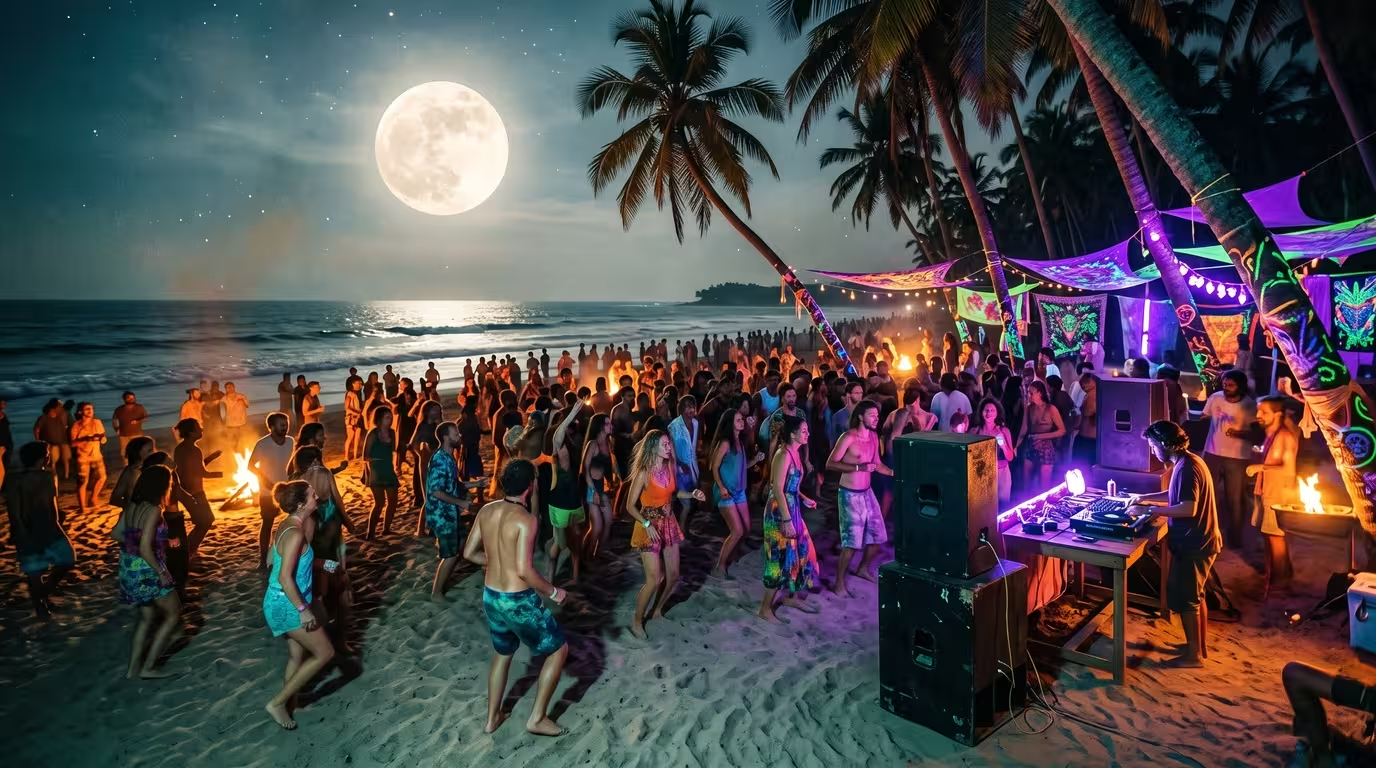
By the mid-1970s, full-moon parties were already a fixture: sound systems hauled by hand to empty beaches, bands jamming all night around bonfires, very few rules. It was a free-spirited, psychedelic, spiritual world, and it was the cultural soil from which the music grew.

From Rock Jams to the Tape-Deck DJs
The soundtrack evolved with the scene. In the 1970s the beaches rang with psychedelic rock, reggae and live jamming. One of the central figures was Goa Gil, born Gilbert Levey in San Rafael, California, who left a collapsing San Francisco scene in 1969, travelled overland, and settled in Goa, where he became a sadhu. By his own account he arrived with a guitar in 1970 and played spiritual songs by the fire before the parties went electronic.
Around the early 1980s, the music turned. Electronics had been creeping in for years; according to a DJ TechTools history of the scene, the very first electronic song played was supposedly a Kraftwerk track back in 1970, brought over on tape by a visitor. As synths and drum machines spread, DJs with tape decks replaced the bands. Crucially, the beach itself shaped the sound: heat, humidity and sand made vinyl impractical, so DJs played from cassette, and the pause-button precision of professional Walkmans let them re-edit as they went. The most influential of these editors was a French DJ known as Laurent, alongside others like Fred Disko and Goa Gil. They took new wave, EBM, new beat, industrial, electro, Hi-NRG and early acid house, cut out the vocals, looped the parts they liked, and welded everything together. As the DJ and writer Dave Mothersole put it in his history of the scene, Laurent took the new electronic music coming out of Europe and America, cut out most of the vocals and the parts he did not like, extended the parts he did, and stitched it all together into one long, constantly morphing psychedelic groove.
This is the key point most newcomers miss: the Goa sound began as a DJ-curated edit aesthetic, not a production genre. The records came from Europe and America; the Goa-ness was in the selection, the surgery and the all-night sequencing. For Goa Gil, the party itself was the point, with dance as active meditation and a way to redefine the ancient tribal ritual for the 21st century. Tracks circulated tape-to-tape, often stripped of any identifying information, in an underground economy with no labels and plenty of secrecy.
Last Hippie Standing: Goa Is a State of Mind

Goa Trance Crystallises as a Genre
By the early 1990s, affordable samplers, synths and sequencers put production in reach of the travellers themselves. Friends who had danced in Goa went home, to London, Tel Aviv and Frankfurt, and began making music specifically for that dancefloor. Around 1993 and 1994, Goa trance crystallised as a distinct production genre, and the name itself came into common use around 1994.
The classic sound is unmistakable. It runs fast, roughly 130 to 150 BPM, over a driving 4/4 kick, with long tracks, often eight to twelve minutes, that build steadily rather than dropping. Over the top swirl layered, arpeggiated synth lines, acid TB-303 squelches, lush leads and Eastern-tinged melodic motifs, drenched in delay and reverb. Producers favoured analog machines like the Roland TB-303, the Juno series and the SH-101, and laced tracks with spoken-word samples, frequently from science-fiction films, touching on drugs, aliens, mysticism and the cosmos. The goal was the same as the old beach parties: a collective, trance-inducing, uplifting journey toward transcendence. That melodic, cosmic warmth is precisely what later distinguished classic Goa trance from the darker, more minimal psytrance that followed.
The Pioneers, the Labels and the Golden Age
If Goa supplied the spirit, a cluster of mostly UK, Israeli, German and Japanese producers supplied the records, and a handful of labels turned a scene into a discography.
• Dragonfly Records, launched by Martin Youth Glover, bassist of Killing Joke, out of his Butterfly Studios in Brixton, is widely regarded as the first dedicated Goa trance label. Its 1993 compilation Project II Trance helped announce the sound, with early tracks from Man With No Name and Hallucinogen.
• TIP Records was founded in 1994 by Raja Ram, Graham Wood and Ian St Paul, growing out of their band The Infinity Project.
• In Israel, Avi Nissim and Lior Perlmutter built Astral Projection and their Trust in Trance label into one of the scene's defining acts.
The artist who best captured the genre's peak was Simon Posford, recording as Hallucinogen. His debut album Twisted, released on 16 October 1995 on Dragonfly, is considered one of the most influential records in the genre; it reached number 27 on the French album chart and has sold over 85,000 copies worldwide. It carried classics like LSD, built on a vocal sample from the BBC documentary The Rise and Fall of LSD, and Gamma Goblins. Around him orbited a constellation of acts: Man With No Name (Martin Freeland), Juno Reactor (Ben Watkins), Total Eclipse, The Infinity Project, Etnica, Pleiadians, Electric Universe and California Sunshine, among others.
Goa trance even brushed the mainstream. On 18 December 1994, Paul Oakenfold, who had spent time at the Goa beach parties, broadcast his two-hour Goa Mix as a BBC Radio 1 Essential Mix, fusing trance with film-score samples; it was voted the best Essential Mix ever by BBC Radio 1 listeners in 2000 and won a Silver Award at the 1997 Sony Radio Awards. Astral Projection's Dancing Galaxy, released on 20 October 1997, became, in the words of AllMusic's John Bush, one of the best-selling trance albums in history. The golden age is generally dated to roughly 1994 to 1997, when the music enjoyed real commercial visibility before the hype cooled.
Into Psytrance, and a Lasting Legacy
By the late 1990s, the music changed. As production tools and the scene globalised, Goa trance evolved into psychedelic trance, or psytrance: cleaner, harder-kicking, more bass-and-rhythm focused, more minimal and less overtly melodic and Eastern. The terms blurred for a while, then Goa came to mean the older, lush, pre-1999 sound while psytrance carried the scene forward into full-on, dark, forest and progressive offshoots. The genre's commercial death was famously, and only half-seriously, declared in the liner notes of a 1997 compilation that listed Goa trance among that year's losses.
Goa itself changed too. As the parties drew busloads of tourists and global attention, commercialisation set in, and noise rules, eventually a 10 p.m. ban on amplified music, and police crackdowns steadily squeezed the beach parties that started it all.
But the cosmic, melodic, psychedelic legacy endures. Goa trance is the parent of all psychedelic electronic music, and its golden-age sound has been kept alive and revived by a neo-Goa movement, with labels like Suntrip reissuing classics and championing the old melodic style. The pioneers are revered, the records still get played, and Goa keeps its mythic status as the birthplace.
It remains a strikingly rich craft, too: layered, hypnotic, transcendent music built from arpeggios, acid lines and patient, eight-minute builds. For anyone who makes electronic music, the original Goa trance sound is a deep well worth drinking from, proof that a few tape decks, a beach and a shared sense of the infinite can turn into a whole genre.
Key takeaways
• Goa trance grew from the hippie and traveller beach-party scene on Goa's coast, especially Anjuna and Vagator, from the late 1960s onward.
• It began as a DJ tape-editing aesthetic in the 1980s, with vocals cut and tracks looped into one all-night groove, before becoming a production genre around 1993 and 1994.
• The classic sound is fast, around 130 to 150 BPM, melodic, layered, arpeggiated, Eastern-tinged and cosmic, built for transcendence on the dancefloor.
• Key labels such as Dragonfly, TIP and Trust in Trance, and artists like Hallucinogen, Astral Projection, Man With No Name and Juno Reactor, defined the golden age of roughly 1994 to 1997.
• By the late 1990s Goa trance evolved into psytrance, but its melodic, psychedelic legacy endures through revivals and its lasting influence.
