Somewhere right now, on a hillside in Hungary or a beach in Bahia, thousands of people are dancing in the dark to a sound that never seems to stop for breath. The kick is relentless, the bassline rolls like a galloping engine, and layers of squelching, swirling synths spiral overhead until the whole field moves as one organism. This is psytrance, or psychedelic trance, electronic music's most self-contained and spiritually inclined tribe, and it has spent three decades building a universe entirely its own.
Blog
The Hypnotic World of Psytrance
Inside the fast, trippy, fiercely devoted global tribe that grew out of a beach party in Goa.
What Psytrance Actually Sounds Like
Psytrance is a subgenre of trance music built for hypnosis. Where mainstream trance leads with euphoric breakdowns, psytrance is faster and more relentless, typically running around 140 to 150 BPM and sometimes faster still. Its engine is a driving, rolling 16th-note bassline locked to a four-on-the-floor kick, a pattern so distinctive that fans simply call it rolling. Over that pulse, producers layer acid squelches, formant sweeps, granular stutters and swirling effects that pan and doppler across the stereo field.
Tracks tend to run long, six to ten minutes, and unfold as a journey rather than a verse-chorus song, with new musical ideas introduced every few bars. There is rarely a single big drop. Instead, the music builds and rolls, peaks and dissolves, designed to carry a dancer through a sustained, immersive, altered state across an entire night. Harmony is sparse and often modal, leaning on minor and Phrygian colours that give psytrance its faintly Eastern, otherworldly flavour. The goal is not a chorus you hum on the way home; it is a trance state on the dancefloor.
Born on the Beaches of Goa
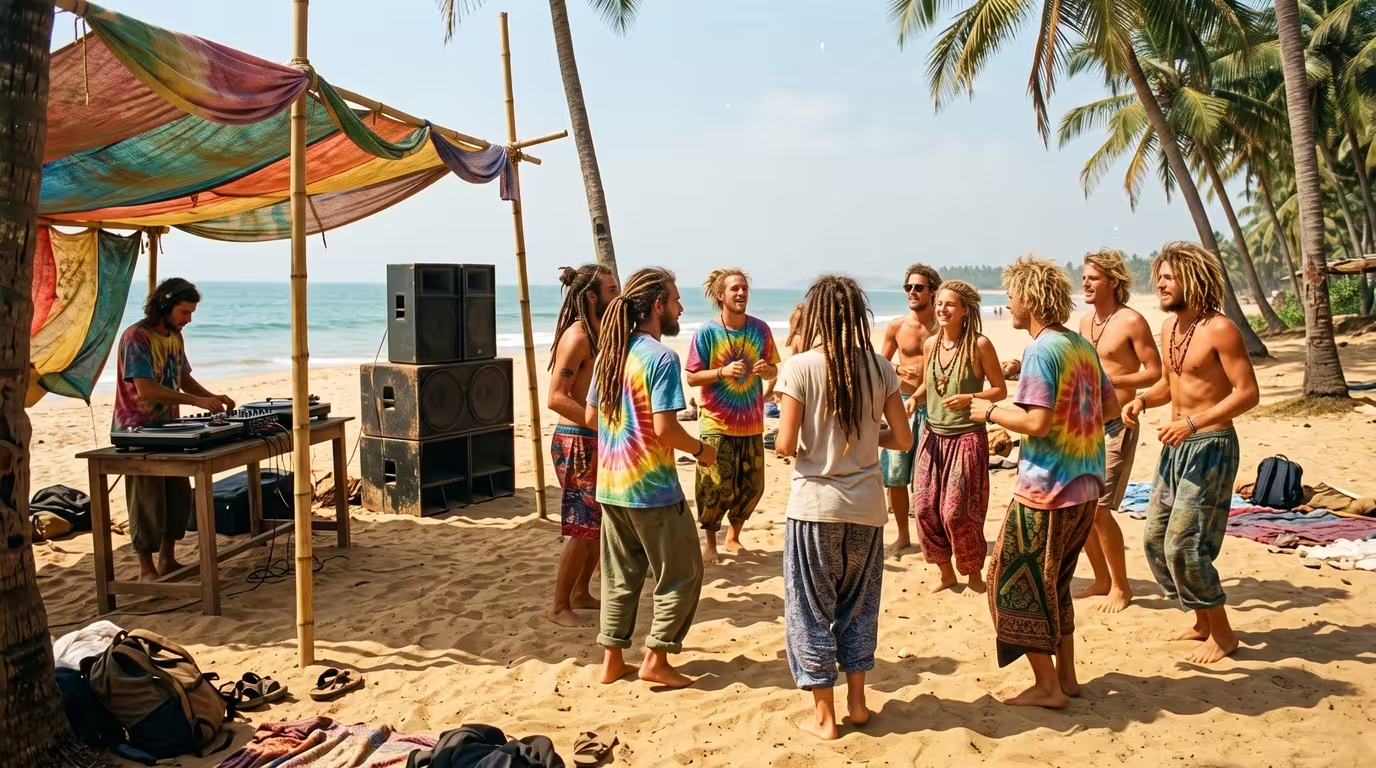
The story starts not in a studio but on the sand. From the late 1960s, the Indian coastal state of Goa, a former Portuguese colony, became a magnet for Western hippies and travellers drawn by cheap living, beaches and Indian spirituality. By the 1980s, the soundtrack to Goa's famous full-moon beach parties was shifting from psychedelic rock to a blend of electronic body music, new beat, industrial, acid house and early techno, mixed for marathon all-night dancing.
The figure most often credited as the scene's godfather is Goa Gil, an American who left San Francisco in 1969, settled in India and became a sadhu before turning to DJing. Gil framed the trance party as an active form of meditation and described his mission as redefining the ancient tribal ritual for the 21st century. DJs in Goa spliced and edited tracks onto DAT tapes to make them longer and more hypnotic, and by the early-to-mid 1990s this had crystallised into Goa trance: melodic, psychedelic, layered, with cosmic and spiritual overtones. The first Goa trance album, Project II Trance, arrived in 1993, and the British DJ Paul Oakenfold helped push the sound to wider audiences in 1994.
From Goa Trance to Psytrance
As European and Israeli backpackers carried the music home, the scene globalised, and the sound mutated. Through the late 1990s, as digital production tools matured, Goa trance grew darker, more bass-and-rhythm-focused and less overtly melodic, and the term psychedelic trance, or psytrance, took over. A constellation of labels codified the genre: Britain's Dragonfly Records and TIP Records were among the earliest, and the English producer Simon Posford, recording as Hallucinogen, released the canonical 1995 album Twisted and founded the influential Twisted Records. His ambient-leaning project Shpongle, with the Australian flautist Raja Ram, became a cult phenomenon all its own.
Crucially, Israel became a psytrance powerhouse, its scene seeded by young people returning from Goa after military service. As Red Bull Music Academy documented, illegal psy parties multiplied in Israel's woods, beaches and deserts through the 1990s. The Tel Aviv duo Astral Projection scored genre-defining hits like Mahadeva and People Can Fly, while Haifa's Infected Mushroom, formed in 1996 by Erez Eisen and Amit Duvdevani, pushed psytrance toward mainstream audiences with 1999's The Gathering and 2000's Classical Mushroom, becoming one of the best-selling acts in Israeli music history.
The Global Tribe and Its Festivals
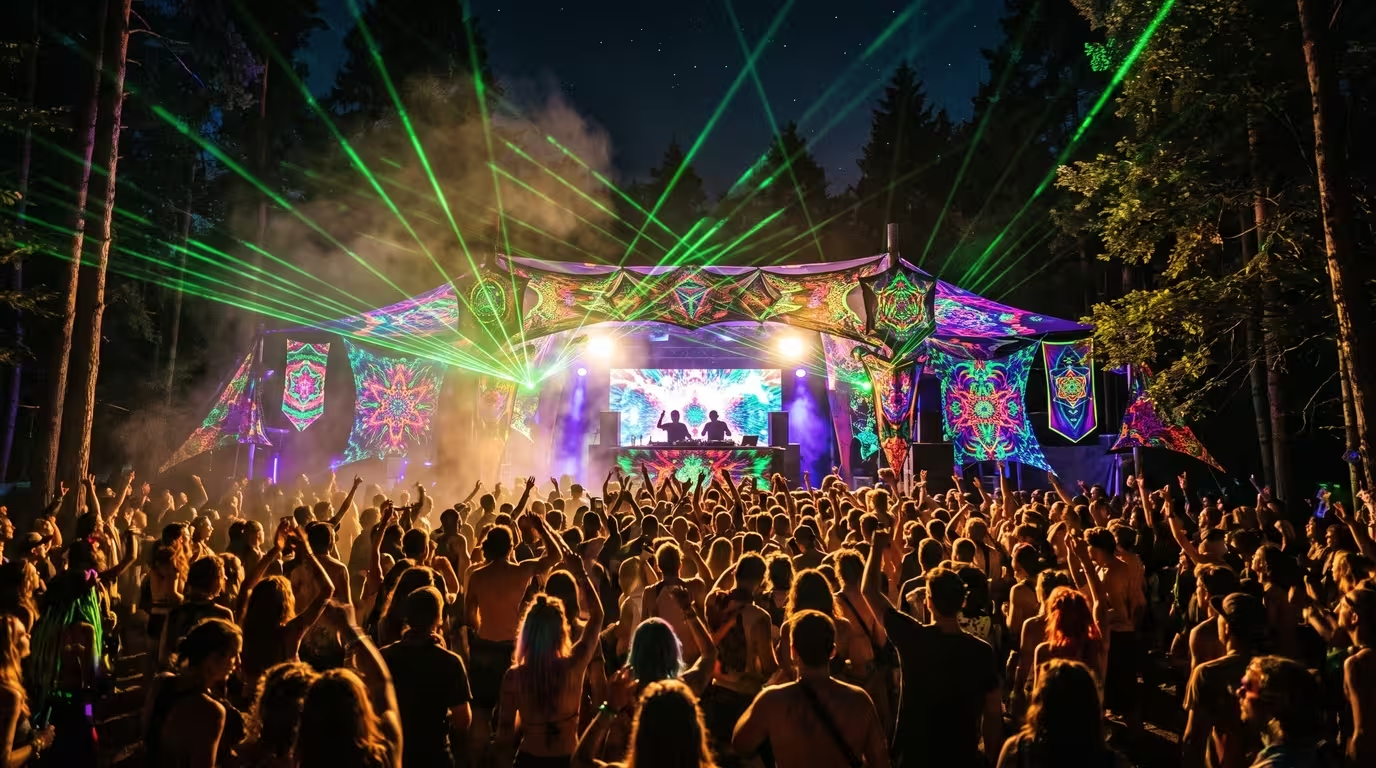
Psytrance's deepest distinction is its culture. More than a sound, it is a worldwide lifestyle descended from Goa's freak community: outdoor, all-night, nature-facing and unapologetically spiritual. The visual world is instantly recognisable, all fluorescent, UV-reactive blacklight art, fractal and sacred-geometry tapestries, and glowing decor that turns a forest clearing into a psychedelic temple.
The scene's beating heart is its open-air festivals. Boom Festival, held biennially in Portugal since 1997 and built around its Dance Temple, is widely regarded as the genre's spiritual home; its 2023 edition drew an official 39,456 attendees plus more than 2,500 staff and volunteers from 169 countries, and it has won A Greener Future's Outstanding Greener Festival Award across eight editions for its sustainability ethos. Hungary's Ozora Festival, which grew out of a 1999 solar-eclipse gathering and became annual in 2004, is one of Europe's largest psytrance events, sleeping a crowd that swells close to 60,000 with under-14s included, and was dubbed the principal hub of psytrance culture in Europe by Trax Magazine. Add Brazil's beachside Universo Paralello, Australia's Rainbow Serpent and Germany's long-running VuuV, and you have a year-round global circuit. Scholars have even described psytrance as a global tribe, a neotribal network of devotees stretching from Israel and Brazil to South Africa, Japan, Mexico, India and across Europe.
Subgenres and the Modern Scene
Psytrance long ago splintered into distinct dialects, and knowing them is half the fun:
• Full-on: the energetic, melodic, festival-friendly mainstream sound.
• Progressive psytrance: slower and groovier, roughly 134 to 140 BPM, hypnotic and hugely popular.
• Dark psy and forest: faster, denser and more atmospheric, often with horror-film textures.
• Hi-tech: blisteringly fast and glitchy, among the most extreme styles.
• Suomisaundi: the wildly experimental Finnish sound born in 1990s Finland.
Modern labels like Denmark's Iboga and the UK's Nano keep the underground stocked, while artists such as Astrix and Ace Ventura headline festivals worldwide. The genre has also had genuine mainstream crossover moments. The Israeli duo Vini Vici were the first psytrance act ever to play the main stages at Tomorrowland and Ultra Music Festival and to perform at Lollapalooza, and their 2016 remix of Hilight Tribe's Free Tibet became the first psytrance track to crack Beatport's overall Top 10. Their collaboration with Armin van Buuren and Hilight Tribe, Great Spirit, released on 12 December 2016, carried the rolling psytrance bassline onto the biggest EDM stages on earth, and went on to be the most played track of Tomorrowland 2017.
Armin van Buuren vs Vini Vici feat. Hilight Tribe - Great Spirit

Why It Endures
Most dance genres ride waves of hype. Psytrance simply keeps rolling, largely indifferent to mainstream trends, sustained by a community that treats it as a way of life rather than a playlist. The reasons for that devotion are baked into the music itself: the hypnotic, transcendent experience; the tight-knit global tribe; the outdoor, nature-and-nighttime ethos; and the psychedelic, spiritual dimension inherited from Goa. For producers and DJs, it is also a fascinating craft to study, since few genres reward this much patience in sound design, arrangement and the slow art of the build. Three decades on from the beaches of Goa, psytrance remains exactly what it always was: a thriving global underground with its own sound, aesthetic, festivals and lifestyle, a self-contained universe still spinning at 145 BPM.
Key takeaways
• Psytrance is fast, typically around 140 to 150 BPM, hypnotic psychedelic trance built on a rolling bassline and layered, trippy sound design.
• It grew out of Goa, India's beach-party scene, evolving from Goa trance into psytrance through the mid-to-late 1990s.
• Israel, the UK and beyond became powerhouses; key names include Hallucinogen and Simon Posford, Astral Projection and Infected Mushroom.
• Its culture is a devoted global tribe defined by outdoor festivals like Boom, Ozora and Universo Paralello, and by UV and fluoro psychedelic art.
• It endures through community, immersion and independence from mainstream trends, electronic music's most self-contained scene.
