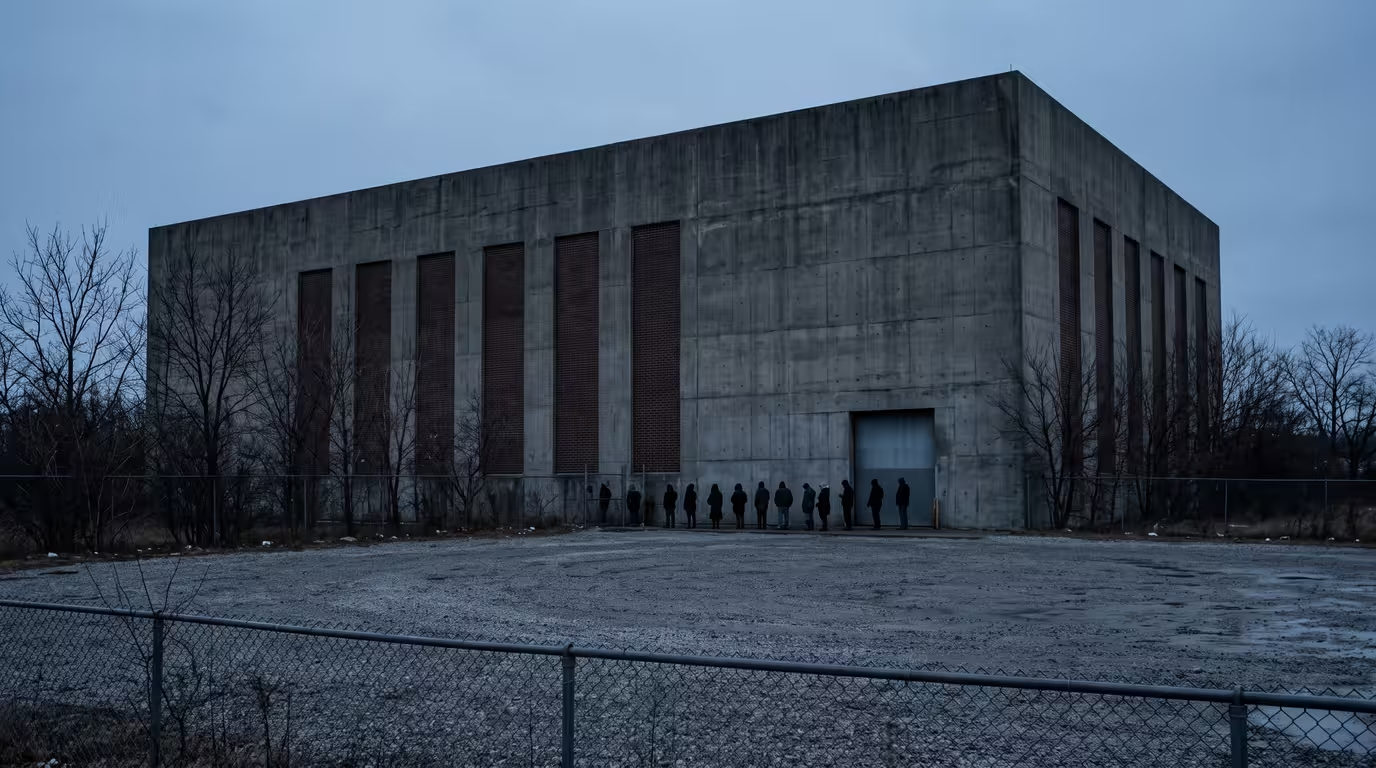
Some clubs sell you a night. Berghain refuses to sell you anything at all: no photos, no promises at the door, no explanation of what happens inside. And that refusal is exactly why the world will not stop talking about it. Housed in a hulking former power plant on the seam between Friedrichshain and Kreuzberg, the Berlin venue has become the most mythologised nightclub on the planet, a concrete cathedral where the music, the architecture and the silence between the beats matter more than anyone's name.
Blog
Inside the Mystique of Berghain
How a derelict East Berlin power plant became the most mythologised techno club on earth.
From Ostgut to a Power Plant
Berghain did not appear from nowhere. Its DNA runs back through the 1990s to Snax, a male-only fetish party that the founders Norbert Thormann and Michael Teufele launched in 1994, and to hardcore techno nights held in a disused railway bunker. In 1998 the pair took over a former railway repair depot near Ostbahnhof and named it Ostgut, a club where hard techno and Berlin's gay scene met on the same dance floor, complete with the darkrooms, mixed crowd and unpoliced freedom that would later define its successor. Ostgut is widely considered to have paved the way for Berghain.
When the city earmarked the site for a large arena, Ostgut closed in early 2003 after a farewell party that regulars still mythologise. Thormann and Teufele found a new home a few hundred metres away: the former Friedrichshain combined heat and power plant, built in 1953 to serve the flagship socialist boulevard then called Stalinallee, and abandoned since the 1980s. Panorama Bar, the house-leaning room upstairs, opened first in October 2004; the vast main techno floor followed that December. The new name fused the two districts the building straddles, Kreuzberg and Friedrichshain, a portmanteau that also happens to mean mountain grove, and that reads as a neat emblem of the club's post-1989 identity.
A Cathedral of Concrete and Steel
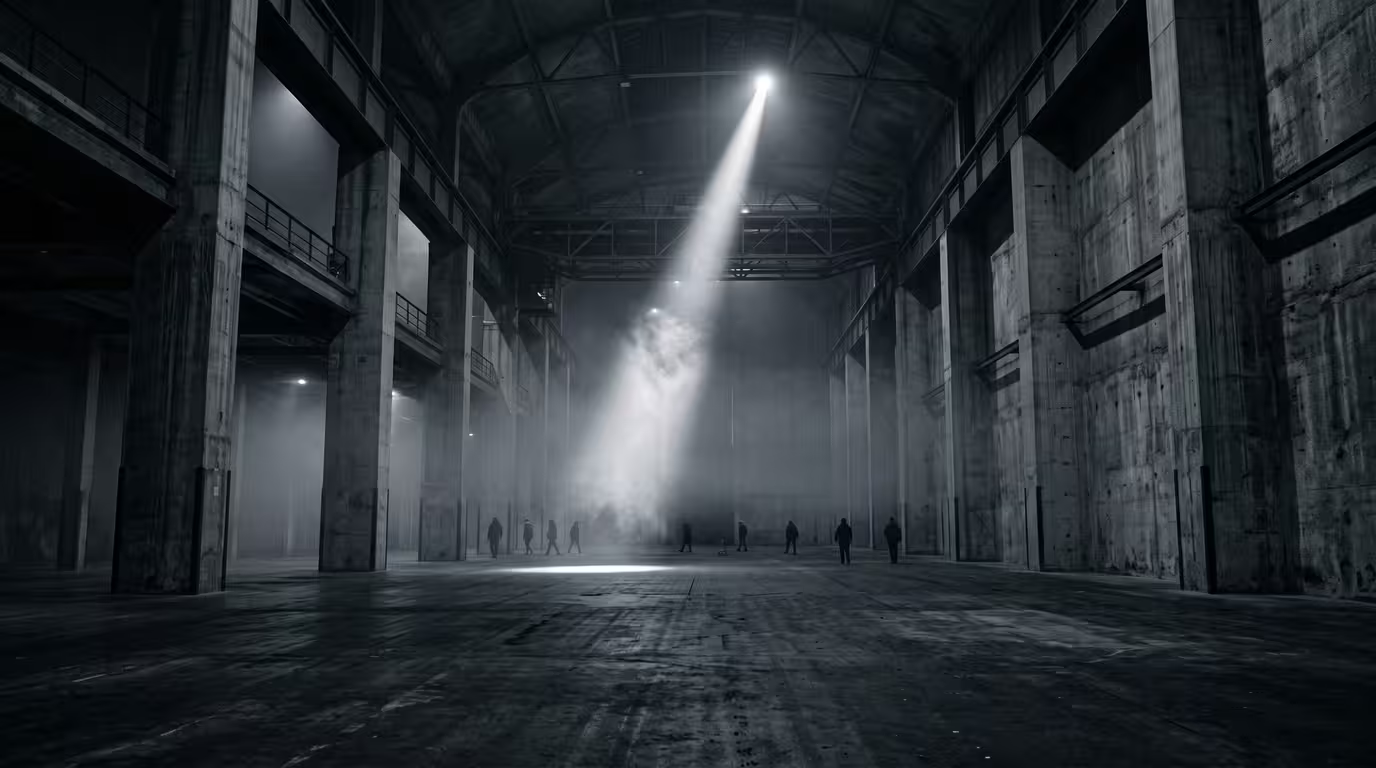
The building is half the argument. The interior was designed by Studio Karhard, the Berlin firm founded in 2003 by the architects Thomas Karsten and Alexandra Erhard, who left the power plant looking like a power plant: raw concrete, exposed steel columns, no decoration to speak of. The main floor, carved from the old turbine hall, rises to ceilings around 18 metres high. Karsten once compared it, to Rolling Stone, to a cathedral of the Middle Ages, and the analogy has stuck, right down to regulars who call a Sunday session mass.
What makes the room feel less like a warehouse and more like a sanctuary is the sound. The original Funktion-One rig, installed in 2005, comprised four Dance Stacks, one Double Infrahorn and two Resolution 2 monitors, and was one of the British firm's largest installs and its first in Berlin; Funktion-One's Tony Andrews travelled to Berlin to tune it against the hall's daunting acoustics. Benedikt Koch of Funktion-One Germany, who installed it, said the system ran at only 10 to 20 percent of its full capacity, because anything more would pin dancers to the floor. In 2023 the club replaced the ageing rig with a new Funktion-One system. The result is a space engineered so that the room, not the DJ, is the star: the booth is recessed, and there is no stage, no VIP and no bottle service. There are also no clocks and no windows on the main floor, and no mirrors in the toilets, small deletions that together dissolve any sense of time. Upstairs, Panorama Bar does the opposite, letting daylight pour through its windows as the sun comes up.
The Door, and the Reasons Behind It
No feature of Berghain is more discussed than its door. Entry is decided, without published criteria, by a small team led by Sven Marquardt, a heavily tattooed photographer who documented East Berlin's punk and bohemian scenes in the 1980s, shooting for the GDR magazine Sibylle, and who has since become the most recognisable gatekeeper in nightlife. The commonly repeated advice, to wear black, arrive in small groups, keep quiet in the queue and know who is playing, circulates endlessly, but every honest account, and Marquardt himself, insists there is no formula. The criteria are opaque by design, and the club's bouncers have at times faced accusations of racism, a criticism worth stating plainly alongside the mythology.
The opacity is not only theatre. The door is a filter that protects what happens inside: a phones-down, unobserved space where a queer-rooted crowd can behave without being watched or uploaded. Which leads to the other famous rule: photography is forbidden, and staff cover every phone camera with a sticker at the entrance. It sounds like exclusivity for its own sake; in practice it is what keeps the room feeling safe enough to be free.
Queer Roots and a Culture of Anonymity
Berghain grew out of gay male nightlife, and it has never disowned that lineage. In its early years the main floor was mostly a space for gay men; today the crowd is more mixed, but the club's values have remained the same: concealment, queerness and excess. There are dedicated darkrooms, a men-only sex club called Lab.oratory in the basement, and a twice-yearly Snax party reserved for gay patrons, a direct thread back to the 1990s. The ethos is anonymity, consent and non-judgment, sustained across sessions long enough that the weekend loses its edges.
Berghain's reputation for hedonism is real and has, at times, turned tragic; German media have reported drug-related emergencies and at least one death after a visitor left the club in 2017, and the venue has drawn political and public-health criticism for its low-intervention stance. It is part of the honest picture, and worth neither glamorising nor pretending away.
Residents, a Label and a Sound That Travelled
If the building gave Berghain its body, its residents gave it a voice. The main-room sound, hard, hypnotic, patient and often stripped to a kick and a shadow of melody, was shaped above all by Ben Klock and Marcel Dettmann, joined over the years by residents including Norman Nodge, Boris, nd_baumecker, Tama Sumo, Steffi, Answer Code Request and Fiedel, with house and disco the register upstairs. In 2005 the owners launched the label Ostgut Ton, which exported that aesthetic worldwide through EPs and its celebrated mix series before it wound down in 2021. The weekly marathon, Klubnacht, still runs from around midnight on Saturday until Monday morning, spread across the main floor, Panorama Bar and the smaller, more experimental Saule, with the Halle, the Garten and Kantine am Berghain rounding out the complex.
There is a genuinely interesting lesson here for anyone who makes electronic music. Records built for this room tend to share a logic: sub-heavy, unhurried, mixed long, engineered to breathe in an 18-metre space rather than to grab a phone speaker. Understanding why a track works in a hall like this is a sharper education in arrangement and low-end than most tutorials.
Recognition, Closure and Myth
Berghain's cultural standing is not only folklore; it is on the record. On 6 September 2016 the Berlin-Brandenburg fiscal court ruled that its weekly club nights count as concerts under German VAT law, taxing entry at the reduced 7 percent rate applied to cultural events rather than the 19 percent for ordinary entertainment. The principle was later upheld by Germany's Federal Fiscal Court, which held that dance-music parties merit the reduced rate so long as the musical performance is the actual purpose of the event from the perspective of an average visitor. More broadly, on 13 March 2024 Techno Culture in Berlin was added to Germany's national inventory of intangible cultural heritage, announced in a joint press release by the Conference of Ministers of Culture, the Federal Government Commissioner for Culture and Media and the German UNESCO Commission, capping a campaign led by the non-profit Rave the Planet.
The club's strangest chapter came during the pandemic. Shuttered in March 2020 like every Berlin venue, Berghain reopened that September not as a club but as a gallery: Studio Berlin, a show mounted with the Boros Foundation that filled the rooms with work by 118 Berlin-based contemporary artists, among them Wolfgang Tillmans, Olafur Eliasson and Tacita Dean, with the no-photos sticker still applied at the door. Dancing resumed in October 2021, nineteen months after the music stopped.
That the same building can be a cathedral, a courtroom exhibit and an art gallery explains both the myth and its critique. As Berlin's tourism boom turned Berghain into a bucket-list stop, the very hype it repels began to corrode what it protects; one commentator's line that Berghain is not a zoo captures a real tension, and enterprising hustlers have even sold tourists dubious guaranteed entry. The exclusivity, the queues, the way the secrecy has been commodified into memes and merchandise, all of it is fair to name. And yet the club endures precisely because it will not explain itself. Strip away the folklore and what remains is disarmingly simple: a former power plant that turns bass into architecture, keeps the cameras off, and lets people disappear into the music. It works because it refuses to tell you why.
Key takeaways
• Berghain opened in 2004 in a 1950s former Friedrichshain power plant, the successor to the queer techno club Ostgut, which ran from 1998 to 2003.
• Its power comes from the building itself: 18-metre concrete ceilings by Studio Karhard and a Funktion-One system run at a fraction of its capacity, with no clocks, windows or photos to break the spell.
• The opaque door run by Sven Marquardt and the strict no-photography rule protect a queer-rooted space of anonymity and freedom.
• Residents like Ben Klock and Marcel Dettmann, and the label Ostgut Ton, carried the hard, hypnotic Berghain sound worldwide.
• A 2016 tax ruling and a 2024 heritage listing confirmed techno's cultural status, even as tourism strains the underground ethos.
