Every track you mix or produce is a stack of frequencies competing for the same finite space between roughly 20 Hz and 20,000 Hz. Knowing where a kick, a bassline, a vocal or a hi-hat actually sits in that spectrum is what separates guessing at EQ knobs from making deliberate, confident moves. This article is a reference to the audio frequency spectrum itself — what frequency is, the named sub-bands from sub-bass to air, what lives in each, how human hearing perceives it all, and why it matters when you're behind the decks or in the DAW.
What Frequency Actually Is
Sound is vibration. When something vibrates — a speaker cone, a guitar string, a column of air — it pushes and pulls the air around it, creating waves of pressure that travel to your ears. Frequency is simply how many of those wave cycles happen per second, and it is measured in hertz (Hz): 1 Hz is one cycle per second, and 1 kHz (kilohertz) is 1,000 cycles per second.
Frequency is the property of sound that most determines pitch. Low frequencies are heard as low-pitched (bass); high frequencies are heard as high-pitched (treble). A bass guitar's lowest string vibrates around 41 Hz; a piercing whistle might be several thousand hertz. Frequency and pitch are closely related but not identical: frequency is the objective, measurable physical quantity in hertz, while pitch is your brain's subjective interpretation of it.
Don't confuse frequency with amplitude. Frequency determines pitch (how high or low); amplitude determines loudness (how quiet or loud), measured in decibels. You can play the same 100 Hz note quietly or loudly — the frequency stays the same while the amplitude changes. For more on managing levels and loudness, see our Gain Staging and LUFS and Loudness Standards articles.
One more relationship worth knowing: wavelength. Sound travels at roughly 343 metres per second in air, so a low 20 Hz wave is about 17 metres long, while a 20,000 Hz wave is only about 1.7 centimetres. This is why bass travels through walls and feels omnidirectional, while high frequencies are directional and easily blocked — and why subwoofers need to be large to move that much air.
The Audible Spectrum: 20 Hz to 20 kHz
The generally accepted range of human hearing is about 20 Hz to 20,000 Hz (20 kHz). Anything below 20 Hz is infrasound — felt as vibration rather than heard as a tone — and anything above 20 kHz is ultrasound, beyond our perception. Many animals hear further: per Wikipedia's hearing-range data, a dog's hearing typically spans roughly 67 Hz to 45 kHz, well above our ceiling.
That 20 kHz ceiling is a youthful ideal, not a lifelong guarantee. The upper limit of hearing declines with age, a process called presbycusis. The tiny hair cells in the cochlea that detect the highest frequencies degrade over time and with noise exposure. In practice, many people can no longer hear above about 16 kHz by their mid-20s, with the ceiling dropping toward 14 kHz by middle age and around 12 kHz or lower for older adults. This is normal and irreversible — and a good reason to protect your hearing, because as a DJ or producer your ears are your most important tool.
How We Actually Perceive Frequency
Here's the concept that trips up most newcomers: human hearing is logarithmic, not linear. We perceive frequency in terms of ratios, not absolute differences in hertz.
The clearest example is the octave — the most fundamental interval in music. One octave is a doubling of frequency. The orchestral tuning note A4 is 440 Hz; the A one octave above is 880 Hz, and the A one octave below is 220 Hz. Keep going and you get a series of A notes at 55, 110, 220, 440 and 880 Hz — each step doubling the last. Notice that the jump in hertz gets bigger as you go up (110 Hz between the first two, 440 Hz between the last two), yet your ear hears each as the same musical step. The ratio of an octave is always 2:1, regardless of where you start.
This is why the bass region occupies only a narrow strip in hertz (say 20 to 250 Hz) yet feels like a huge musical range, while the treble spans many thousands of hertz. The whole audible spectrum covers roughly 10 octaves.
Our sensitivity across the spectrum is also uneven. The human ear is most sensitive between 2 and 5 kHz, which — as the equal-loudness contour literature explains — is largely due to the resonance of the ear canal and the transfer function of the middle-ear ossicles. The roughly 2.5 cm ear canal behaves like a closed tube with a resonant peak near 3,700 Hz, boosting sensitivity right where speech intelligibility and presence live. The flip side, first mapped by Harvey Fletcher and Wilden Munson in their 1933 Journal of the Acoustical Society of America paper (later superseded by the current ISO 226:2003 standard), is that low and very high frequencies need considerably more energy to sound as loud as midrange frequencies — especially at quiet listening levels. This is why a mix's bass balance seems to change as you turn the volume up or down, and why bass elements have to carry more energy to register.
The Frequency Bands, Explained
Audio engineers slice the spectrum into named sub-bands. There is no single official standard — a common scheme uses seven bands (sub-bass, bass, low midrange, midrange, upper midrange, presence, brilliance), while simpler schemes collapse these into low/mid/high. The exact boundaries vary from source to source, so treat every number below as approximate and typical, not absolute. What matters far more than memorising boundaries is understanding the character of each region.
The table below is the centrepiece reference. The Hz figures are commonly cited approximate ranges synthesised from multiple audio-engineering sources (such as Teach Me Audio, iZotope and Sound on Sound), which broadly agree on the bands while differing on exact edges.
| Band | Approx. range | Character |
|---|---|---|
| Sub-bass | 20–60 Hz | Felt more than heard; deep rumble, power, weight |
| Bass | 60–250 Hz | Fullness, warmth, boom; the foundation |
| Low mids | 250–500 Hz | Body and warmth, but mud/boxiness if overdone |
| Midrange | 500 Hz–2 kHz | Core of most instruments and vocals |
| Upper midrange | 2–4 kHz | Presence, attack, intelligibility; harsh if overdone |
| Presence | 4–6 kHz | Clarity, definition, edge |
| Brilliance / air | 6–20 kHz | Sparkle, sheen, air; harmonics and cymbals |
Lows: Sub-Bass and Bass
Sub-bass (≈20 to 60 Hz) is the deepest region — the chest-thumping rumble you feel at a club more than hear. Few instruments reach here naturally; in electronic music it's the home of sub-bass synths, 808s and the lowest kick energy. It carries enormous energy and must be handled carefully: too much overpowers everything, and because of the equal-loudness effect it's hard to judge on small speakers. Bass (≈60 to 250 Hz) is the foundation — the fundamental of basslines and the body/thump of the kick drum. Most bass energy in dance music sits here. Get it right and the track feels full and powerful; overdo it and it turns boomy, cut too much and it sounds thin.
Mids: Where Most of the Music Lives
Low mids (≈250 to 500 Hz) add warmth and body but are the prime suspects for mud and boxiness when crowded. Midrange (≈500 Hz to 2 kHz) is the busiest, most crowded part of almost any mix — the bulk of instruments, synths and vocal fundamentals live here, and the ear pays close attention to it. Upper midrange (≈2 to 4 kHz) is where presence, attack and vocal intelligibility live, and it's the most sensitive part of your hearing — a small boost is very audible, and too much causes listening fatigue and harshness.
Highs: Presence, Brilliance and Air
Presence (≈4 to 6 kHz) governs clarity, definition and edge — it's roughly where home-stereo treble controls are centred. Brilliance or treble (≈6 to 20 kHz) is the top end: hi-hats, cymbals, sibilance and the harmonics that give a mix its sparkle and sheen. The upper part of this band, often called air (around 10 kHz and up), adds openness and polish. Overdo it and you get brittleness, sibilance and hiss; cut too much and the mix sounds dull and lifeless.
What Lives Where in Electronic Music
Knowing the bands is one thing; knowing where your elements sit is what makes the knowledge usable. The figures below are conventional starting points drawn from production sources such as Native Instruments, iZotope and Waves — they vary by sample, sound design and genre, so use them as a map, not a law.
• Kick drum: the body/thump sits roughly 40 to 100 Hz, while the click/beater attack that lets it cut through sits much higher, often 2 to 4 kHz (some engineers go up to 8 kHz).
• Sub-bass / 808: the deep sub energy sits around 30 to 60 Hz; 808 fundamentals typically live in that zone, with added harmonics around 100 to 300 Hz so they remain audible on small speakers.
• Snare/clap: body/fundamental around 150 to 300 Hz, with the snap or crack up in the presence region around 2 to 5 kHz.
• Hi-hats and cymbals: their characteristic sparkle and air live high, roughly 5 to 6 kHz up to 16 to 20 kHz; their low body (300 to 500 Hz) is usually filtered out.
• Vocals: fundamentals roughly 85 to 180 Hz for typical male voices and 165 to 255 Hz for female, with presence and intelligibility around 3 to 5 kHz, sibilance around 5 to 8 kHz, and air above 10 kHz.
• Synth leads vs pads vs bass: synth bass occupies the lows (around 60 to 250 Hz, plus sub below); leads sit mostly in the midrange (roughly 800 Hz to 8 kHz, often boosted near 2 kHz to cut through); pads spread broadly but are usually high-passed so their low end doesn't clutter the bass.
A pattern emerges: the kick and bass both fight for the low end, and the snare's snap and a vocal's presence both want the upper mids. That competition has a name.
Frequency Masking: Why Things Clash
When two sounds occupy the same frequency range at the same time, they compete — and the louder one obscures the other. This is auditory masking (often called frequency masking), and it's the root cause of muddy, cluttered mixes. The classic example is the kick drum and the bassline both piling energy into 60 to 120 Hz: play them at full level together and neither is clear; instead you get a muddy, undefined low end.
The solution, in both production and DJing, is to give each element its own frequency space. Producers carve with EQ, high-pass filtering, sidechaining and arrangement so that competing elements don't occupy the same band at the same moment. The same principle is why DJs perform a bass swap — you never want two basslines blaring at once over a club system, so you trade the low end from one track to the other. (For the actual technique, see our EQ Mixing and Bass Swaps article, and Using Filters When Mixing for high-pass/low-pass moves.)
Why This Matters for DJs and Producers
For DJs, the three EQ knobs on a standard mixer — low, mid, high — map directly onto these frequency regions. The low knob governs the kick and bass region; the mid handles the body, melody and vocals; the high covers hi-hats, cymbals and top-end sparkle. Because the low end carries the most energy and clashes the most, it's the band you'll manage most often when blending — turning the bass down on the outgoing track as you bring up the incoming one. Understanding the spectrum also lets you read a track by ear: when a blend sounds muddy, you know to look low; when it sounds harsh, you look in the upper mids.
DJ software gives you a visual shortcut too. The colour-coded waveforms in tools like Serato and rekordbox map frequency to colour. As Serato's documentation describes it, the display colour-codes the frequency content: red for low-frequency bass, green for mid-frequency sound and blue for high-frequency treble. That lets you literally see where the bass hits and where a breakdown drops the low end before you hear it.
For producers, the spectrum is the canvas for frequency balance: the goal is a full, even distribution of energy where every element has its own space and nothing is overloaded. That means EQ carving to avoid masking, high-pass filtering to clean low-end mud out of elements that don't need it, and keeping the powerful low frequencies — which eat the most headroom — under control so the mix translates on a big club system. A common reference for a balanced mix is a gentle downward slope of energy from the bass to the treble.
Tools: Seeing the Spectrum
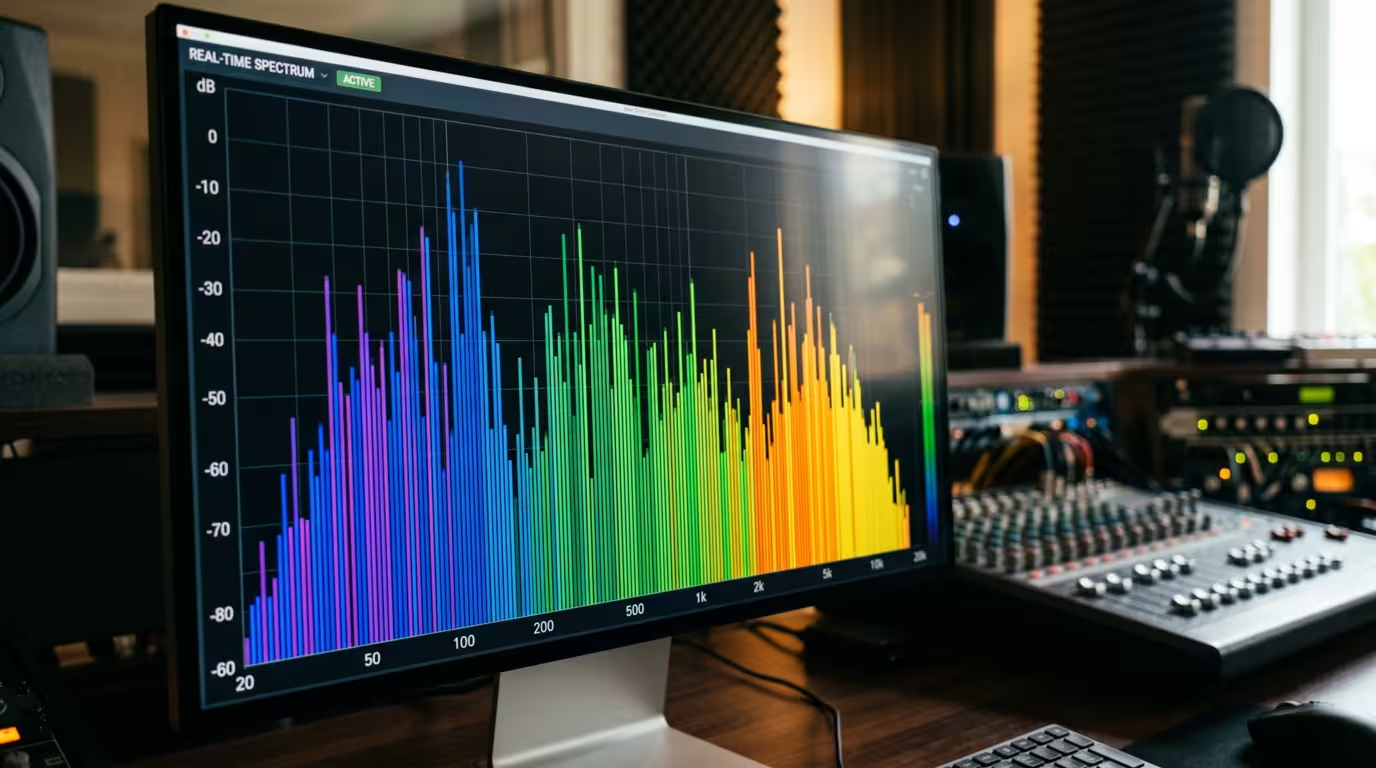
You don't have to rely on your ears alone. A spectrum analyser displays energy across the spectrum in real time, with frequency on the horizontal axis (low on the left, high on the right) and amplitude in decibels on the vertical axis. It lets you see a resonant peak, a muddy build-up around 200 to 400 Hz, or whether your sub energy is present — invaluable for spotting masking and checking balance. Many EQ plugins build an analyser right into their interface so you can see and cut in one view.
That said, the analyser is a guide, not a judge. The trained ear remains the final arbiter — many problems are about how a mix feels rather than how it looks. Use the visuals to confirm and learn, not to mix with your eyes shut to your ears.
Training Your Ear
The spectrum becomes second nature with practice. A few practical ways to internalise it:
• Learn reference points: the deep hum of mains electricity (50 to 60 Hz) is a useful sub/bass anchor; a 1 kHz tone is the classic midrange reference; a kick's fundamental usually lands around 50 to 100 Hz.
• Sweep and listen: boost a narrow EQ band and sweep it across a sound to hear what each region does — this is the single fastest way to map mud, honk, presence and air to actual frequencies.
• Use ear-training tools and reference tracks: compare your mixes to professional tracks you trust to calibrate your sense of balance.
• Mind the equal-loudness trap: check your low end at different volumes, because your perception of bass changes with level. Many engineers judge low frequencies at moderate, consistent monitoring levels.
• Don't over-boost one band: a balanced spectrum almost always sounds better than a scooped or bloated one, and big boosts can push your master into clipping.
Key takeaways
• Frequency is cycles per second, measured in hertz; it determines pitch, while amplitude determines loudness.
• Humans hear roughly 20 Hz to 20 kHz, and the high end declines with age (presbycusis).
• Hearing is logarithmic — an octave is a doubling of frequency — and the ear is most sensitive between 2 and 5 kHz.
• The spectrum splits into approximate bands from sub-bass to air; exact boundaries vary by source.
• Frequency masking is why elements clash; give each its own space with EQ, filtering and bass swaps.
• Use a spectrum analyser and colour-coded waveforms to see the spectrum, but trust your trained ears.
Ready-made, exclusive EDM tracks with full rights — released as your own.
