Some DJs pick records. Jeff Mills builds worlds. For more than forty years the Detroit-born artist known as The Wizard has treated the turntable as a composer's instrument, stacking three or four decks and a drum machine into sets that move at a sprint and read like science fiction. Along the way he took techno somewhere almost no one thought it could go: out of the warehouse and into the museum, the planetarium and the concert hall.
Blog
Jeff Mills, the Wizard of Techno
How a Detroit radio virtuoso turned three turntables and a drum machine into a new kind of art.
The Wizard on Detroit Radio
Jeff Mills was born in Detroit on 18 June 1963, and came up inside one of the richest music ecosystems in America. By the mid-1980s he was a mix-show DJ on Detroit radio, first at WDRQ and then at WJLB, spinning under the name The Wizard. His segments, famously fast and packed with scratching and beat juggling, blended electro, house, new wave, industrial and the nascent techno of Juan Atkins, Derrick May and Kevin Saunderson. As the Detroit Historical Society records it, he played a nonstop mix of techno, house and hip-hop that made him a household name across the city.
The radio show was where his virtuosity was forged. To fit an ever-shrinking slot around abundant new music, Mills learned to move through records at extraordinary speed, an approach that would become his signature. His influence on the city ran deep: a young Eminem later name-checked him on Groundhog Day, from 2013's The Marshall Mathers LP 2, rapping that he had discovered a DJ who was mixing, and that anyone who had not listened to the Wizard had no idea what they were missing.

Underground Resistance and the Masked Years
In 1989 Mills co-founded Underground Resistance with Mad Mike Banks, a former Parliament-Funkadelic bassist; the producer Robert Hood joined soon after. UR was a collective and a label with an attitude: militant, anti-corporate, often appearing masked in balaclavas and combat gear, wiring the aesthetics of early Detroit techno to the economic devastation of the post-industrial city.
The music from those years remains foundational. With Banks and Hood, Mills helped produce a run of uncompromising records, from the sax-laced Nation 2 Nation in 1991 to The Final Frontier and World 2 World in 1992, and, under the alias X-102, the extraordinary concept album Discovers The Rings Of Saturn (1992), released via Berlin's Tresor, on which each track was named for a moon or ring of Saturn. In 1992 Mills left UR to strike out on his own; Hood departed soon after. By Hood's own telling it was an amicable branching-off, driven by Mills' desire to run his own label rather than any feud.
Axis Records and the Track as a Tool
That label was Axis Records, which Mills founded in 1992; some accounts credit Hood as an early co-founder, while Axis itself describes the imprint as Mills' own. It would spawn a family of sub-labels, among them Purpose Maker, Tomorrow, Something In The Sky and 6277, each pushing a leaner, more minimal sound than the techno around it.
The solo catalogue that followed is a cornerstone of the genre. Waveform Transmission Vol. 1, released on Tresor in 1992, is widely regarded by DJ Mag as one of the records, alongside Robert Hood's Minimal Nation, that birthed modern minimal techno: steel-hard, looping and relentless. Then came The Bells (1997), first issued on the Kat Moda EP for Purpose Maker: a two-note bell figure over an overdriven TR-909 kick, running, as Attack Magazine measured it, at 137.52 BPM exactly, the kick distorted by cranking the mixing desk into the red. Attack calls it minimal in arrangement, with never more than a few musical elements happening at a time, yet maximalist in energy. The Purpose Maker label text put it more plainly: probably the most played techno track in history, and the anthem for a sonic generation.
Mills has always framed his music in functional terms. He told Stamp The Wax in 2015 that he had always considered music a tool and nothing more, a device that affects the body and mind so that the listener experiences another conscious state. That philosophy, the track not as a finished song but as a component to be arranged, is the key to understanding what he does behind the decks.
Three Decks and One 909
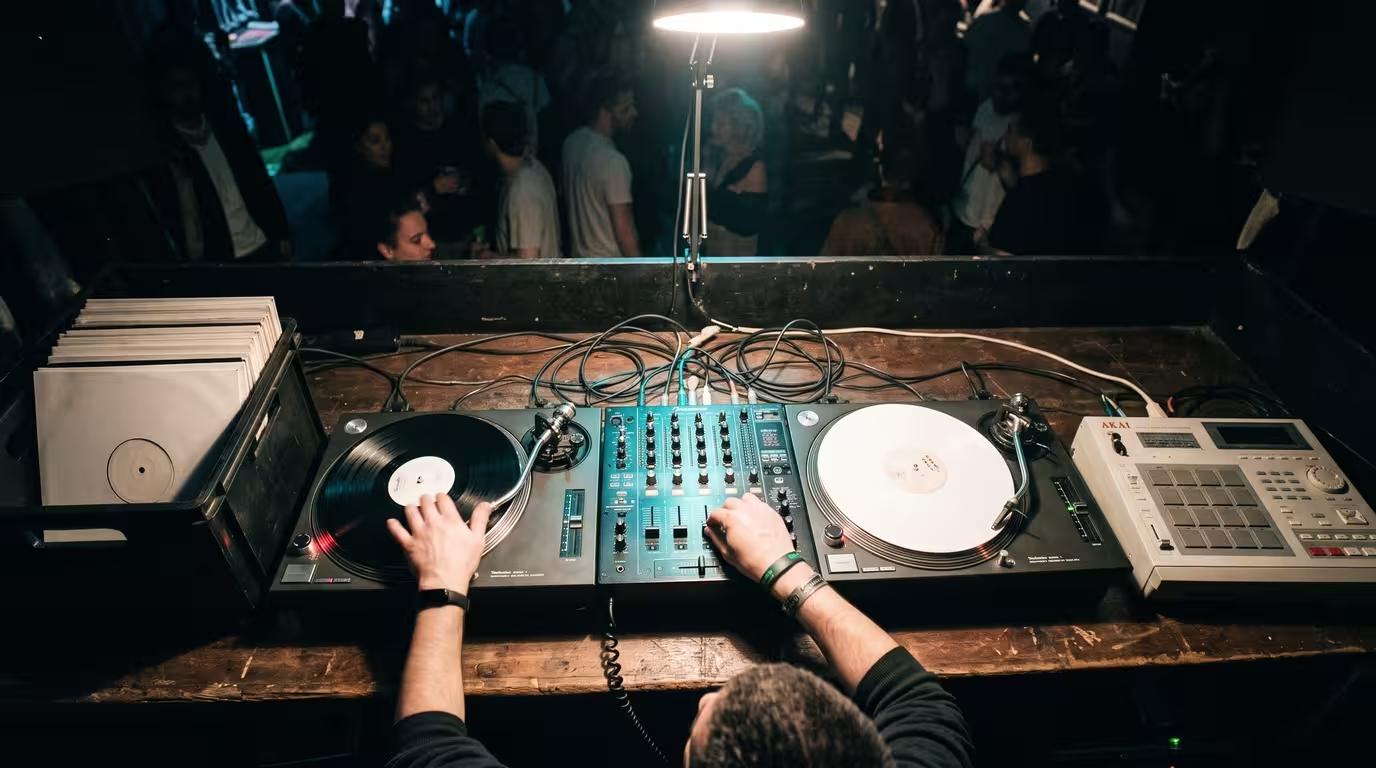
Mills' DJing is the centrepiece of his legend. Where most DJs blend two records, he works with three or four turntables at once, often holding a record on the platter for only a few seconds before snatching it away, and up to seventy records in a single hour. Running through the middle of it is a Roland TR-909 drum machine, played live against the vinyl, a signature practice that led Mixmag to call him the master of the 909. He wields familiar tools deliberately: as he explained in a DJ Mag interview, a record like The Bells will always generate a certain kind of response, so you begin to use it strategically, because you want to make a point.
The definitive document is Live At The Liquid Room in Tokyo, recorded across two nights in October 1995 and released in 1996 as his first commercially available mix. Three decades on it is still cited as one of the most intense and influential DJ mixes ever committed to disc, its raw, restructuring energy a template for a generation. For Mills, the set is a form of storytelling. The more he DJed, he told Stamp The Wax, the better he got at telling stories with music; elsewhere he has described a techno set as a kind of non-verbal narrative, an atmosphere built with the crowd rather than simply played at them.
Jeff Mills on His DJ Style and Early Productions

Techno for the Concert Hall
If the 1990s made Mills a DJ's DJ, the 2000s made him something rarer: an artist who dragged techno into institutions that had never taken it seriously. In 2000 he composed an original electronic score for Fritz Lang's 1927 silent masterpiece Metropolis, released on Axis, a project he has since revisited more than once. He has scored other silent films, including Lang's Woman in the Moon.
Then came the orchestras. In 2005, at the Pont du Gard in southern France, Mills performed Blue Potential with the Montpellier Philharmonic Orchestra, his tracks transcribed for full orchestra by the young composer Thomas Roussel and conducted by Alain Altinoglu, released on CD and DVD and among the first times a techno artist had captured such a collaboration for a wide audience. His fascination with space, science fiction and Afrofuturism runs through everything from his Sleeper Wakes saga to the Mono installation at Barcelona's CCCB, inspired by 2001: A Space Odyssey. In 2015 the Auditorium of the Louvre made him its resident artist for the Duos Ephemeres series, for which he wrote, directed and scored a film shot in the museum's Egyptian galleries.
The Elder Statesman
Mills never stopped working, and he never stopped widening the frame. In 2018 he released Tomorrow Comes The Harvest, a hypnotic collaboration with the late Afrobeat drummer Tony Allen, issued via Blue Note, with the keyboardist Jean-Phi Dary; that partnership with Dary grew into the electro-jazz duo The Paradox, whose album Counter Active arrived on Axis in 2021. France has honoured him twice: he was made a Chevalier de l'Ordre des Arts et des Lettres in 2007 and promoted to Officier in 2017, the insignia presented by the former culture minister Jack Lang.
The through-line is remarkable in its consistency. Jeff Mills is the Detroit radio virtuoso who became a UR co-founder, then a solo auteur, and whose three-deck-and-909 craft and conceptual, space-obsessed body of work carried techno from the club into the gallery. He proved the two things were never in conflict, that a record can be a physical dancefloor weapon and a piece of serious art at the same time. For any DJ or producer, that is the lesson worth stealing: the craft lives in the arrangement of parts, not just the selection of them.
Key takeaways
• Jeff Mills, born in Detroit in 1963, made his name as the radio DJ The Wizard before co-founding Underground Resistance in 1989.
• He founded Axis Records in 1992 and released defining tracks including Waveform Transmission Vol. 1 and The Bells.
• His DJ craft, three or four turntables and a live Roland TR-909, is captured on the landmark 1996 mix Live At The Liquid Room in Tokyo.
• From the 2000 Metropolis score to orchestral works and a Louvre residency, Mills reframed techno as serious conceptual art.
• He treats music as a tool and the set as composition, a way of thinking rather than just a way of playing.
