Every new DJ faces the same first decision: should you buy a DJ controller, a pair of standalone players like Pioneer/AlphaTheta CDJs, or turntables? All three can teach you to mix, but they differ massively in price, portability, and what happens when you eventually play in a club. This guide explains how each option actually works and, more importantly, which one is right for you as a complete beginner. The short version: for most people starting today, a laptop-plus-controller setup is the smartest first purchase — but there are good reasons to choose differently.
The Three Setups at a Glance
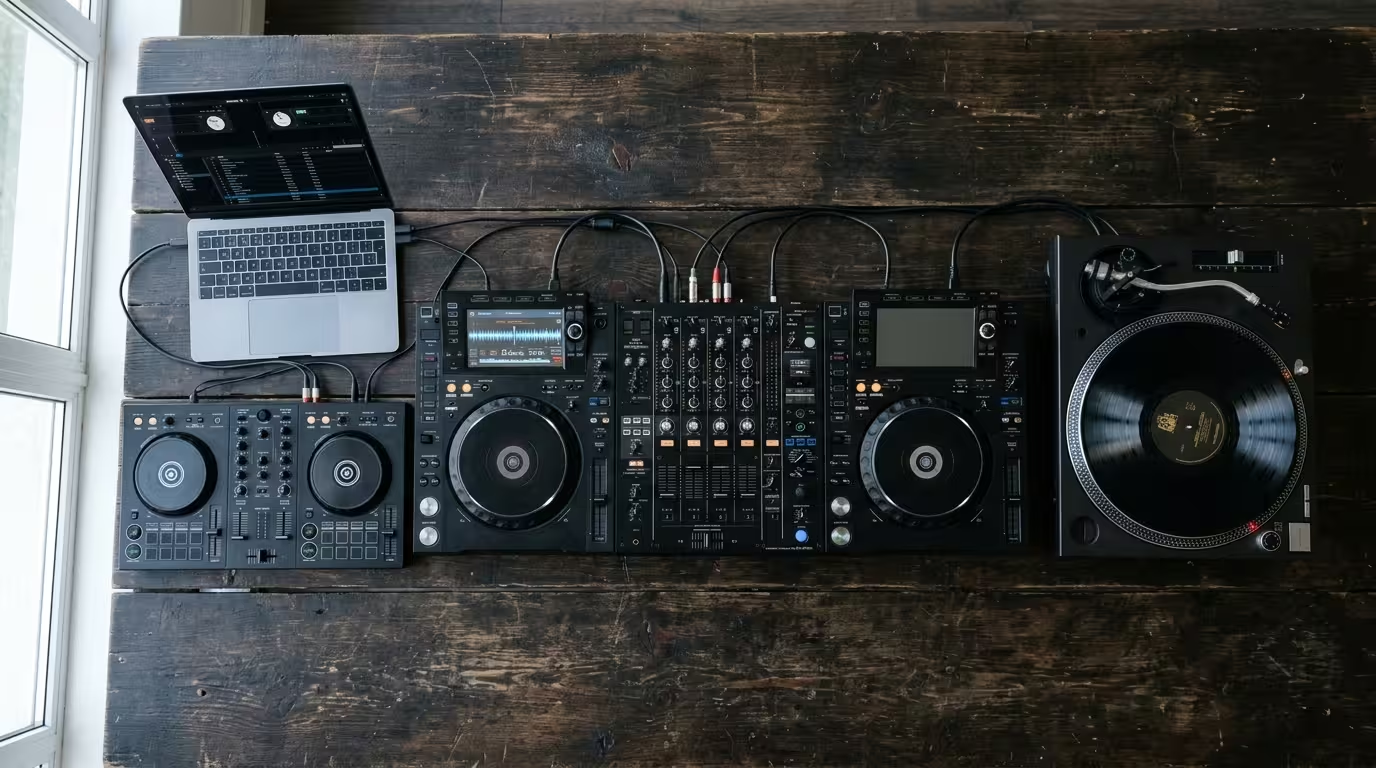
A DJ controller is a single piece of hardware — jog wheels, faders, knobs, and pads — that connects to a laptop, phone, or tablet running DJ software. The computer does the heavy lifting (storing music, analyzing tempo, processing audio); the controller is the tactile interface. Entry models are cheap, light, and beginner-friendly.
CDJs and media players are standalone digital decks. Originally CD players, modern units like the AlphaTheta (Pioneer DJ) CDJ-3000X play music from USB sticks, SD cards, or the cloud, with no laptop required. Two players plus a separate mixer is the configuration installed in nearly every professional club booth worldwide. There is also a hybrid category — standalone all-in-one systems such as the Pioneer DJ XDJ-RX3 — that fuse two players and a mixer into one laptop-free unit.
Turntables play vinyl records. A pair of direct-drive decks plus a mixer is the original DJ setup, dating to the 1970s. Today most turntable DJs also use a digital vinyl system (DVS), which lets a special "timecode" record control digital files on a laptop — giving you the feel of vinyl with the convenience of digital.
How a DJ Controller Works
A controller is the most popular on-ramp for beginners, and for good reason. Because the laptop's software handles analysis and audio, the hardware can be inexpensive and compact. A market-leading starter unit, the Pioneer DJ DDJ-FLX4, retails around $329 in the US, draws power over USB from your computer, and works free with rekordbox, Serato DJ Lite, and other apps. Its layout is deliberately borrowed from professional gear, so the muscle memory you build transfers upward.
Controllers are also forgiving. Features like the DDJ-FLX4's "Smart Fader" can auto-match tempo and key, letting a total beginner produce a passable blend on day one. You can leave assists on while you learn and switch them off as your ears improve — most DJs eventually beatmatch manually using the pitch faders and jog wheels.
The catch: software dependence
The trade-off is reliance on a computer. If your laptop crashes, freezes from a background update, or dies in a cold warehouse, your set stops. Setup also takes longer than a standalone — you're connecting a laptop, launching software, and managing cables. And cheaper controllers have a ceiling: small jog wheels and limited features mean you may outgrow them.
The software itself matters. Serato DJ Lite is free, but it does not support CDJs or club mixers — to use Serato with pro gear you need Serato DJ Pro (a one-time license around $299 or roughly $10/month). rekordbox, the Pioneer DJ ecosystem, has a free tier and is the bridge to club CDJs. Picking your software ecosystem early is wise because it shapes everything downstream.
How CDJs and Standalone Players Work
CDJs are the professional standard. Pioneer released the first CDJ — the top-loading CDJ-500 — in 1994, and the touch-sensitive CDJ-1000 in 2001 introduced "Vinyl Mode," generally accepted as the first CD player that could accurately emulate a vinyl turntable, including scratching. From there the CDJ steadily supplanted turntables as the booth standard; the CDJ-2000NXS2 became the rider staple for clubs and festivals, and the CDJ-3000 line carries that mantle today. Pioneer DJ (now under AlphaTheta) holds at least 70% of the global DJ-equipment market — and in professional environments it is effectively 100% — which is why walking into almost any club means seeing the same gear.
A club setup is two or more players plus a central mixer — historically a Pioneer DJM. These connect via Pro DJ Link, an Ethernet/LAN protocol that lets multiple players share a single USB stick and sync information. The current flagship configuration pairs CDJ-3000 or CDJ-3000X players with a DJM-A9 mixer.
Crucially, modern CDJs no longer need CDs — or a laptop. You prepare music at home in rekordbox (analyzing beat grids, setting cue points, building playlists), export it to a USB drive, and walk into the booth. The newest flagship, the AlphaTheta CDJ-3000X, even adds built-in Wi-Fi, NFC smartphone login, and cloud streaming.
The catch: cost and overkill
The numbers are brutal for a beginner. A single CDJ-3000 runs about $2,549; the CDJ-3000X about $2,999. A full two-player-plus-DJM-A9 rig costs well over $7,000. This is professional infrastructure, not a learning tool, and several gear retailers explicitly warn newcomers against buying it as a first setup.
This is where standalone all-in-one systems shine. The Pioneer DJ XDJ-RX3 packs a club-style two-channel layout, a 10.1-inch touchscreen, and the same rekordbox/USB workflow into one laptop-free unit at a fraction of the price of separate CDJs. It runs around $2,000 — still not cheap, but it gives you the standalone, no-laptop experience and prepares you for real CDJs without four-figure-per-deck pricing.
How Turntables and DVS Work
Turntables are where DJ culture began. The Technics SL-1200, introduced by Matsushita (now Panasonic) in October 1972, used a direct-drive motor — invented by Matsushita engineer Shuichi Obata — that connected the motor directly to the platter instead of using a belt. This produced high torque, near-instant start-up, and the ability to push or pull the record by hand without straining the mechanism. Those traits made it ideal for the scratching and beatmatching that early hip-hop DJs pioneered, and the 1979 SL-1200MK2 cemented it as the world standard. According to Panasonic, more than 3,500,000 SL-1200 units have been sold since 1972.
Records spin at two standard speeds: 33⅓ RPM (used for most 12-inch DJ records and albums) and 45 RPM (singles); the modern SL-1200MK7 adds a switchable 78 RPM and weighs about 9.6 kg per deck.
Digital vinyl systems (DVS)
Buying vinyl for every track is expensive and heavy, so most turntable DJs today use DVS. Instead of music, you play a timecode control record — a special audio signal pressed into the vinyl. The turntable's output runs into a DVS-enabled audio interface, mixer, or controller, which decodes the signal's direction, speed, and needle position, then applies that control to a digital file in software like Serato DJ, Traktor, rekordbox, or Virtual DJ. The result: you scratch, spin, and drop the needle on a real record, but the sound comes from your laptop's library.
The concept dates to N2IT's Final Scratch in 2001, and the modern digital vinyl system is the standard way scratch DJs and vinyl lovers go digital. Serato's "NoiseMap" timecode is widely considered among the most responsive for scratching.
The catch: cost, weight, and difficulty
Turntables have the steepest learning curve — there is no sync button on pure vinyl, so you must beatmatch entirely by ear from day one. They are heavy and not very portable, and a complete two-deck rig is not cheap. Realistic beginner builds run roughly $1,300–$2,000: a pair of entry direct-drive decks (the Pioneer DJ PLX-500 around $449 each, or the Audio-Technica AT-LP140XP around $549 each, both shipping with a cartridge), plus a two-channel mixer like the Pioneer DJ DJM-250MK2 (about $419). Higher-end Reloop RP-7000 MK2 decks (about $680 each, cartridge sold separately) push a build toward $1,900. A pair of flagship Technics SL-1200MK7s alone runs roughly $2,000–$2,400 before a mixer.
Side-by-Side Comparison
If you remember one thing, let it be this: the three setups trade cost and convenience against club-readiness and feel. A controller is the easiest and cheapest way in, standalone players are the working-club standard, and turntables are the hands-on choice for scratching and vinyl. The quick reference below sums up how each suits a beginner, and the table after it lists representative models and current prices.
| Setup | Learning curve | Best suited to |
|---|---|---|
| DJ Controller (+ laptop) | Gentlest — sync and assists | Most beginners; cheap, light, forgiving |
| CDJs / standalone players | Moderate | Committed DJs who want the exact club standard |
| Turntables (vinyl / DVS) | Steepest — beatmatch by ear | Scratching and the tactile vinyl ritual |
| Setup | Representative gear | Approx. US price |
|---|---|---|
| Entry controller | Pioneer DJ DDJ-FLX4 | ~$329 |
| Standalone all-in-one | Pioneer DJ XDJ-RX3 | ~$2,000 |
| Flagship club player (each) | AlphaTheta CDJ-3000X | ~$2,999 |
| Flagship club player (each) | Pioneer DJ CDJ-3000 | ~$2,549 |
| Entry DJ turntable (each) | Pioneer DJ PLX-500 | ~$449 |
| Flagship DJ turntable (each) | Technics SL-1200MK7 | ~$1,000–$1,200 |
The Hybrid Middle Ground
The lines have blurred. Standalone controllers like the XDJ-RX3 give you the laptop-free workflow of CDJs in a controller body. Motorized controllers such as the Rane One add real spinning 7.2-inch platters with adjustable torque, delivering a vinyl-like feel while running Serato — a genuine bridge between the controller and turntable worlds. And DVS means a turntable rig can also play digital files. You are not locked into one philosophy forever.
So Which Should You Buy?
For the overwhelming majority of beginners, start with a controller. It is the cheapest, most portable, most forgiving way to learn whether you actually enjoy DJing before spending serious money. The fundamentals — phrasing, EQ blending, reading energy — transfer to any setup later, and if you stay in the rekordbox ecosystem, the jump to club CDJs is smooth.
Choose standalone players or an all-in-one if you already know you're committed, you specifically want the no-laptop club workflow, and you have the budget. The XDJ-RX3 is the sweet spot here.
Choose turntables if your goal is scratching or turntablism, you love the tactile ritual of vinyl, or you're chasing that specific culture — and you accept the cost, weight, and harder learning curve. Adding DVS later keeps the format practical.
Recommendations
If you're unsure or on a budget: buy a two-channel controller like the DDJ-FLX4 (around $329) and use free software such as rekordbox or Serato DJ Lite. Learn the fundamentals first, and upgrade once you're gigging regularly or your hardware's limits start to frustrate you.
If you're committed and want club skills without a laptop: get a standalone all-in-one like the XDJ-RX3 (around $2,000). It mirrors the CDJ workflow and prepares you directly for booths.
If your end goal is club or festival DJing: stay in the rekordbox ecosystem and practice exporting USBs, so stepping onto real CDJs feels familiar. Do not buy CDJs yourself early — rent studio time on club gear instead.
If you want vinyl or scratching: start with a pair of entry direct-drive decks (PLX-500 or AT-LP140XP) plus a DJM-250MK2, and add a DVS interface when buying records becomes limiting.
Key takeaways
• Controllers are the cheapest, lightest, most beginner-friendly entry point and the right first buy for most people.
• CDJs and standalone players are the professional booth standard but cost far more; an all-in-one like the XDJ-RX3 is the affordable on-ramp.
• Turntables offer the most authentic, tactile experience but are heaviest, priciest to feed, and hardest to learn.
• DVS and motorized controllers blur the categories, so your first choice does not lock you in.
• Pick a software ecosystem (rekordbox or Serato) early, since it shapes your upgrade path.
Ready-made, exclusive EDM tracks with full rights — released as your own.
