A DJ (disc jockey) is a person who selects, sequences and mixes existing recorded music for an audience — in a club, at an event, on the radio, or online. It is one of the most accessible entry points into electronic music, yet the craft runs far deeper than pressing play. This guide defines what a DJ actually is, traces where the term came from, separates DJing from music production, walks through the main types of DJ, and explains what the job involves day to day.
What a DJ Is
At its core, a DJ is a curator and a performer. The encyclopedic definition is simple: a disc jockey plays recorded music for an audience. What turns that into a craft is how the music is chosen and joined together. A DJ reads a room, picks tracks that fit the moment, and blends them so the music flows as one continuous experience rather than a series of separate songs.
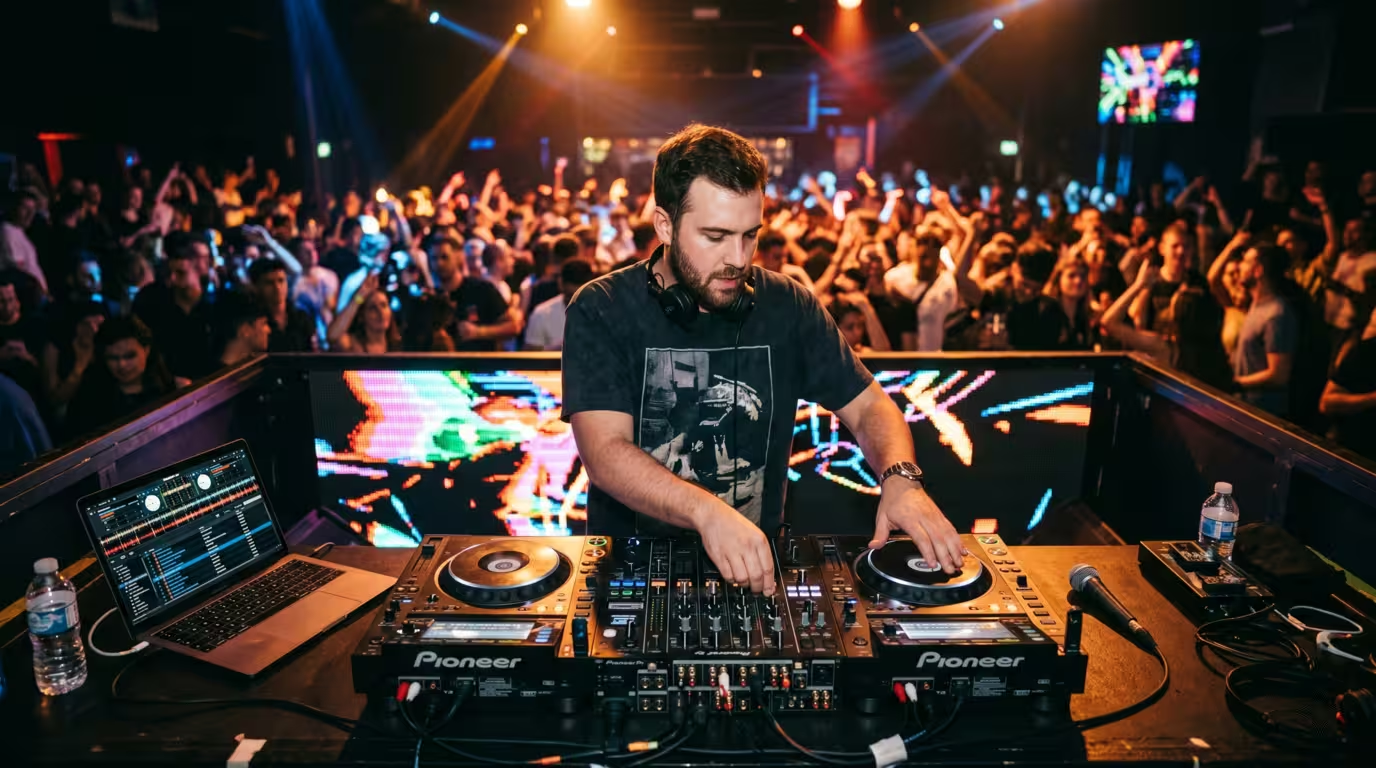
Originally the disc referred to shellac and, later, vinyl records. Today DJ is an all-encompassing term for anyone mixing recorded music from any source — vinyl, CDs, or digital audio files played on media players, a controller, or a laptop. The common thread is that a DJ works with finished recordings made by others (or themselves), combining at least two sources of music at once using equipment that lets them preview and align tracks before the audience hears them.
Where the Term Disc Jockey Comes From
The term disc jockey was coined in 1935 by American radio commentator Walter Winchell to describe the work of radio announcer Martin Block. It combines disc, referring to disc-shaped phonograph records, and jockey, an old term for the operator of a machine. The phrase first appeared in print in a 1941 issue of Variety magazine.
Block earned fame on New York's WNEW by playing records between bulletins about the Lindbergh kidnapping trial, presenting them as though a live band were performing in a studio — a show he called the Make Believe Ballroom. According to Britannica, disc jockey programs went on to become the economic base of many American radio stations after World War II.
The radio DJ came first, and the role evolved dramatically from there. Radio DJs played individual songs and talked between them; the modern club DJ instead creates a seamless, continuous mix. The idea originated in the 1930s but was held back early on by Federal Communications Commission rules requiring frequent identification of recorded music. Even the earliest first-DJ claims predate Winchell's term: a teenager named Ray Newby is widely cited as regularly playing records on a small transmitter in San Jose, California, in 1909, under radio pioneer Charles Doc Herrold.
DJ vs Producer: The Core Distinction
Newcomers to electronic music often confuse DJs with producers, because today many famous artists are both. But the two roles are genuinely different.
A producer creates original recorded music. Working in a studio with a Digital Audio Workstation (DAW) such as Ableton Live, FL Studio or Logic Pro, a producer composes melodies, basslines and drum patterns, designs sounds, arranges them into a finished track, and mixes and masters it for release. The end product is a new song.
A DJ plays and recombines music that already exists. The DJ's raw material is finished tracks, and the creative act happens in real time in front of an audience: choosing what to play next, aligning the beats, blending one record into another, and steering the energy of a room. The end product is a performance, not a recording. The two roles differ in workspace, tools, output and goals.
| Aspect | DJ | Producer |
|---|---|---|
| Main activity | Selects and mixes existing tracks live | Composes and records original music |
| Typical tools | Decks/CDJs, mixer, headphones, controller | DAW software, synths, samplers, monitors |
| End product | A live or recorded set | A finished track for release |
The Producer-DJ Overlap
The overlap matters for your own journey. In dance music, the producer-DJ is now the norm: artists like David Guetta, Martin Garrix and Charlotte de Witte both make their own tracks and perform them live. Original productions are often what lift a DJ beyond their local scene, because original music functions as a calling card that opens up bookings, label relationships and a wider audience. That said, DJing and producing are distinct skill sets — being excellent at one does not make you good at the other, and plenty of respected DJs never produce at all.
One neutral note on the modern industry: because top performers face relentless pressure to keep releasing new music, some commission or buy ready-made tracks from other producers. This practice — known as ghost production — is a normal, legally structured part of the contemporary electronic music business, in which a producer creates a track and transfers the rights to the artist who releases it. It is one of several ways performing DJs source the music they play, alongside record pools, promos and a DJ's own productions.
The Main Types of DJ
DJ covers several distinct jobs that differ in skills, gear, music and goals. Encyclopedic sources group the classic categories as radio, club, mobile and turntablist DJs, but in practice the working world is broader.
• Radio DJ — hosts programmes on a music station, selecting tracks and speaking between them as an on-air personality. The original kind of DJ, still going strong, with figures like BBC Radio presenters shaping tastes for huge audiences.
• Club / nightclub DJ — plays continuous, beatmatched mixes in bars and clubs, usually within one or a few electronic genres such as house, techno or drum and bass, typically using the venue's installed gear.
• Mobile DJ — brings their own sound system, lighting and decks to private events: weddings, corporate functions, birthdays and parties. Mobile DJs often act as Master of Ceremonies and need a broad, multi-decade repertoire.
• Turntablist / scratch DJ — uses turntables and a mixer as instruments, manipulating records through scratching and beat juggling, rooted in hip-hop. The competitive pinnacle is the battle scene.
• Open-format DJ — refuses to be locked into one genre, moving freely between hip-hop, pop, house, Latin and rock, reading the crowd and switching styles on the fly.
• Bedroom DJ — a non-professional hobbyist who mixes at home to learn and have fun. Many professionals start here; not all bedroom DJs want to turn professional.
• Festival / touring DJ — performs large-scale sets at festivals and on world tours, usually as a producer-DJ playing their own anthems. These are the genre's biggest commercial stars.
• Residency DJ — holds a regular, ongoing slot at a specific venue or radio station. Residents learn a room's sound and crowd intimately, and the role offers stability and exposure.
Many DJs wear several of these hats at once — a club resident who also produces, or a mobile DJ who scratches. The categories describe emphasis, not rigid boxes.
What the Job Actually Involves
A polished set is the visible tip of a much larger process. Day to day, DJing breaks down into a few key activities.
Finding and preparing music
Long before a gig, DJs spend hours on music curation — what older DJs call crate digging — hunting down tracks and building an organised library. They then prepare each track in software such as rekordbox, Serato or Traktor: analysing tempo (BPM) and musical key, fixing the beat grid so the software's timing matches the music, and setting cue points that mark intros, breakdowns and drops for instant access during a set. Good preparation is what makes live decisions feel effortless.
Mixing and reading the room
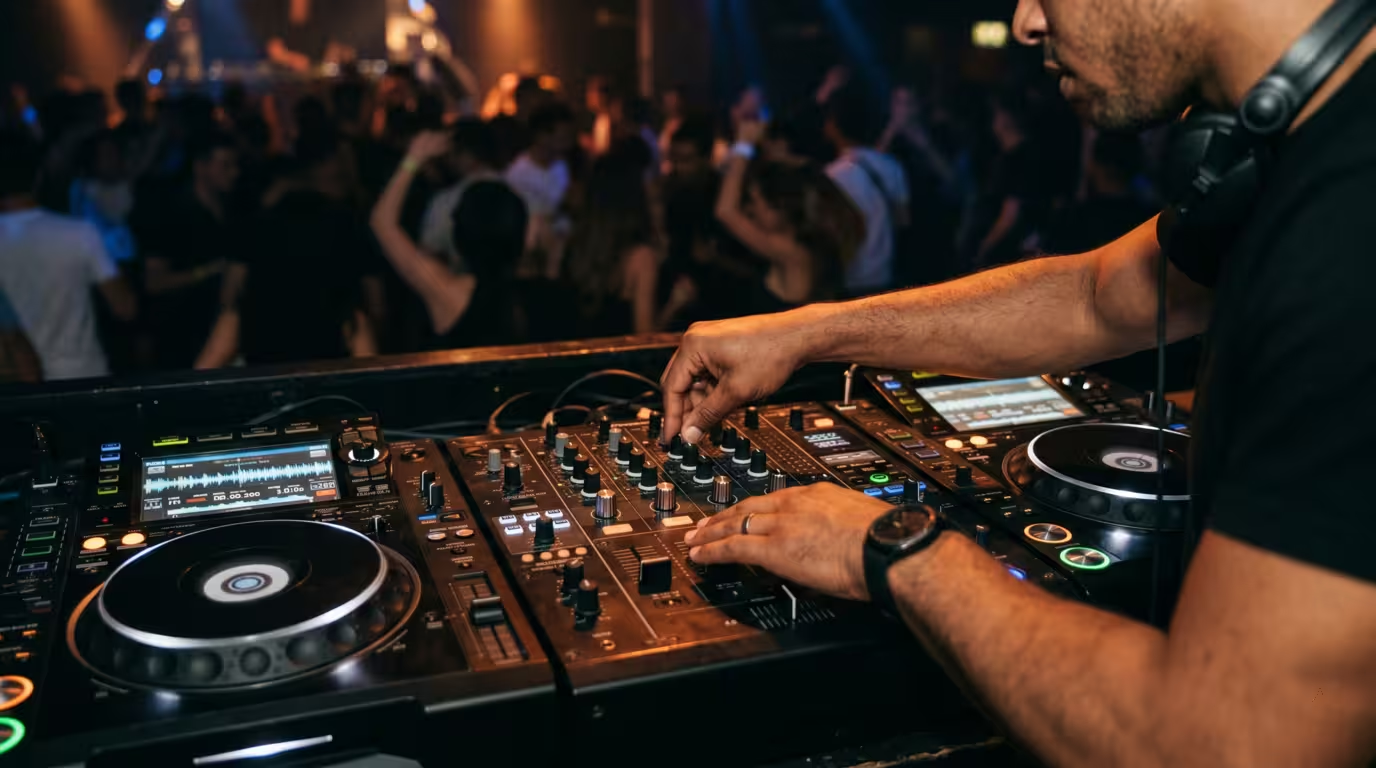
In performance, the DJ beatmatches (aligns the tempos and beats of two tracks so they play in time), then blends them using the mixer's faders and EQ, often masking one track's bass while introducing another's. Phrasing keeps mixes musical: most dance music is built in 8-bar (32-beat) phrases, and skilled DJs transition at phrase boundaries so the structures of both tracks line up. Over a whole set, this becomes set construction — building, sustaining and releasing energy. The DJ does all this while reading the crowd: watching the dance floor, sensing when energy lags, and changing direction to keep people moving. The simplest guide is the floor itself — favor the records that fill it and move on when you see people start to fade.
Equipment and the business side
The standard DJ setup provides at least two music sources plus a way to preview and blend them: turntables, CDJs/media players or a controller; a mixer with a crossfader and EQ; and headphones for cueing the next track. Beyond the booth, working DJs handle a business: getting gigs, promoting themselves on social media, and building a reputation. As one widely cited measure of that career ladder, DJ Mag has run its Top 100 DJs poll since its 100th edition on 21 October 1993, opening it to a public reader vote in 1997 — today billed as the world's biggest music poll and a barometer of the scene's biggest names.
Core Skills That Define DJing
A handful of skills separate a competent DJ from someone simply queuing songs. Each is worth studying in depth, but here is the overview.
| Skill | What it means |
|---|---|
| Beatmatching | Aligning two tracks' tempos and beats so they play in sync |
| Harmonic mixing | Blending tracks in compatible musical keys to avoid clashes |
| EQ blending | Using bass, mid and treble controls to merge tracks cleanly |
| Phrasing | Transitioning at the natural boundaries of musical phrases |
| Track selection | Choosing the right record for the moment |
| Crowd reading | Sensing and steering the audience's energy |
Mixing in Key
Harmonic mixing — also called mixing in key — is often made easier with the Camelot Wheel, a system that turns musical keys into simple codes (like 8A or 8B) so DJs can pick compatible tracks without formal music theory. Modern DJ software detects key automatically, but trusting your ears remains essential.
A Short History of DJing
DJing grew from radio into a performance art over roughly a century.
The radio era began with early experimenters: Ray Newby playing records in 1909, the term disc jockey coined in 1935, and a golden age of Top 40 radio personalities through the mid-twentieth century. Disputed first claims exist for the move to the dance floor: British radio DJ Jimmy Savile is sometimes credited by later writers with running an early DJ dance party in Otley, England, in 1943 and claiming to be the first to use twin turntables — though historians note this is unproven, since twin turntables were illustrated in the BBC Handbook as early as 1929. In Paris, the Whisky à Go-Go is described as the first commercial discothèque, where the impresario Régine claimed to have begun playing on two turntables in 1953 and to be the first club disc jockey. These competing first-DJ stories are best treated as contested folklore rather than settled fact.
The foundations of modern mixing were laid in late-1960s New York, where club DJ Francis Grasso popularised beatmatching at the Sanctuary nightclub, blending records so the beats matched and the music never stopped. Technology kept pace: Technics introduced the SL-1200 direct-drive turntable in October 1972, whose high-torque motor and pitch control made it the de facto standard for DJing and scratching for decades — Technics' own heritage page frames the deck as the spark for DJ culture.
In the 1970s Bronx, hip-hop DJ culture transformed the turntable into an instrument. DJ Kool Herc — widely regarded as the father of hip-hop — isolated the percussive break of funk records and used two copies of the same record to extend it, a technique he called the Merry-Go-Round. Grandmaster Flash built on this with his Quick Mix Theory, pioneering headphone cueing and the precise crossfader cutting that underpins turntablism. This competitive, technical art is celebrated at events such as the DMC World DJ Championships, held since 1985.
Finally came the digital era. Pioneer's CDJ media players — culminating in the industry-standard CDJ-1000 (2001), which convincingly emulated vinyl — moved DJs from records to CDs, then to USB sticks and software. Digital vinyl systems, controllers and laptop software lowered the barrier to entry, and today a beginner can learn on an affordable controller before ever touching a club rig.
Key takeaways
• A DJ selects, sequences and mixes existing recorded music for an audience; a producer creates original tracks in a studio — and many modern artists are both.
• The term disc jockey was coined in 1935 by Walter Winchell to describe radio announcer Martin Block; the role evolved from radio into club performance.
• The main types — radio, club, mobile, turntablist, open-format, bedroom, festival/touring and residency DJs — differ in skills, gear, music and goals.
• Core skills include beatmatching, harmonic mixing, EQ blending, phrasing, track selection and crowd reading.
• DJ culture was shaped by Francis Grasso's beatmatching, the 1972 Technics SL-1200, 1970s Bronx hip-hop pioneers, and the shift to CDJs and digital gear.
Ready-made, exclusive EDM tracks with full rights — released as your own.
