There is a stretch of the Detroit River, less than a mile wide, that turns out to be one of the most consequential borders in electronic music. On the American side sits Detroit, birthplace of techno. On the Canadian side sits Windsor, Ontario, where a teenager named Richie Hawtin spent the late 1980s glued to radio signals drifting across the water. He would go on to cross that river, absorb its new machine music, and then spend three decades bending it into something colder, stranger and more forward-facing than almost anyone else. This is the story of how one obsessive turned a single silver synthesizer into a universe.
Blog
Richie Hawtin and the Plastikman Era
How a border-town kid with one silver box and a philosophy of subtraction reshaped techno twice over.
The Border-Town Kid
Richard Michael Hawtin was born on 4 June 1970 in Banbury, Oxfordshire, England. When he was nine, in 1979, his family emigrated to LaSalle, Ontario, a suburb of Windsor, where his father took a job as a robotics technician at General Motors. It is a detail almost too neat to be true: the man who would fuse music and machines more thoroughly than any of his peers grew up with a father who tinkered with electronics for a living and filled the house with Kraftwerk, Tangerine Dream and other kosmische and early electronic records. His younger brother Matthew became a visual artist and ambient DJ, and would later design Plastikman artwork.
Across the river, Detroit's airwaves were carrying something new. Where his high-school classmates chased rock, Hawtin gravitated to New Order, Depeche Mode and the late-night mix shows of DJs like the Electrifying Mojo and Jeff Mills on stations such as WJLB. As detailed in the extensive reference entry on his career, he began DJing in clubs at 17 and was mentored by Scott Go-Go Gordon at Detroit's Shelter, where his sets mixed house and the harder, second-wave techno then emerging from the city.
Plus 8 and the Second Wave
At the Shelter, Hawtin met John Acquaviva, an established southwestern-Ontario DJ. In 1990 the pair founded Plus 8 Records, naming it after the maximum pitch-adjust setting on their turntables. Alongside Underground Resistance and Carl Craig's Planet E, Plus 8 became a defining force of Detroit techno's second wave, though it operated from Canada. Its early records were faster, harder and more European-facing than much of the first-wave sound, and its roster grew to include Speedy J, Kenny Larkin and Cybersonik.
Hawtin scattered his output across a small army of aliases: F.U.S.E., Circuit Breaker, Concept 1 and Robotman among them, the last cheekily borrowed from his father's day job. Under F.U.S.E. he released his first album, Dimension Intrusion, in 1993, which Warp picked up for its landmark Artificial Intelligence series of electronic listening music, placing the 22-year-old Canadian alongside Aphex Twin and Autechre.
Plastikman: The Silver Box Gospel
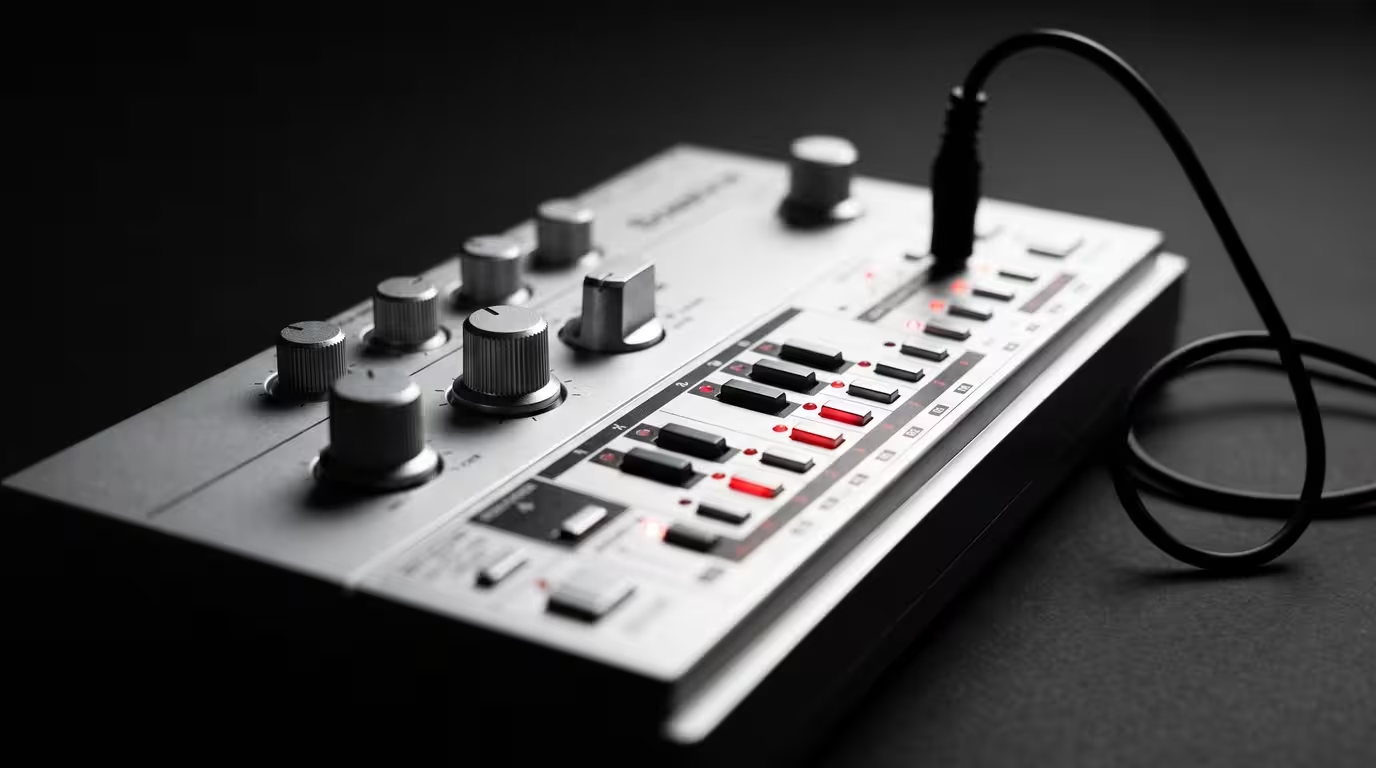
Then came the alias that changed everything. Plastikman debuted in 1993 with the album Sheet One and the still-devastating single Spastik. The aesthetic was total: a wobbling cartoon logo, a k-heavy orthography, and an almost religious devotion to two Roland machines, the TR-909 drum machine and, above all, the TB-303 bass synthesizer, the little silver box whose acid squelch became Hawtin's signature. Plastikman was minimalism as discipline, coaxing enormous tension out of very few elements.
Sheet One is also the source of techno's most famous customs anecdote. Its front inlay was perforated to resemble a sheet of LSD blotter tabs, and the artwork was realistic enough that, according to a 1994 Novamute press release widely retold since, a young man in Texas was arrested and jailed after a police officer spotted the CD on his car seat during a traffic stop. It is a story almost always repeated secondhand, so it is worth flagging as such, but the primary-source press release does exist, and the arrest was real.
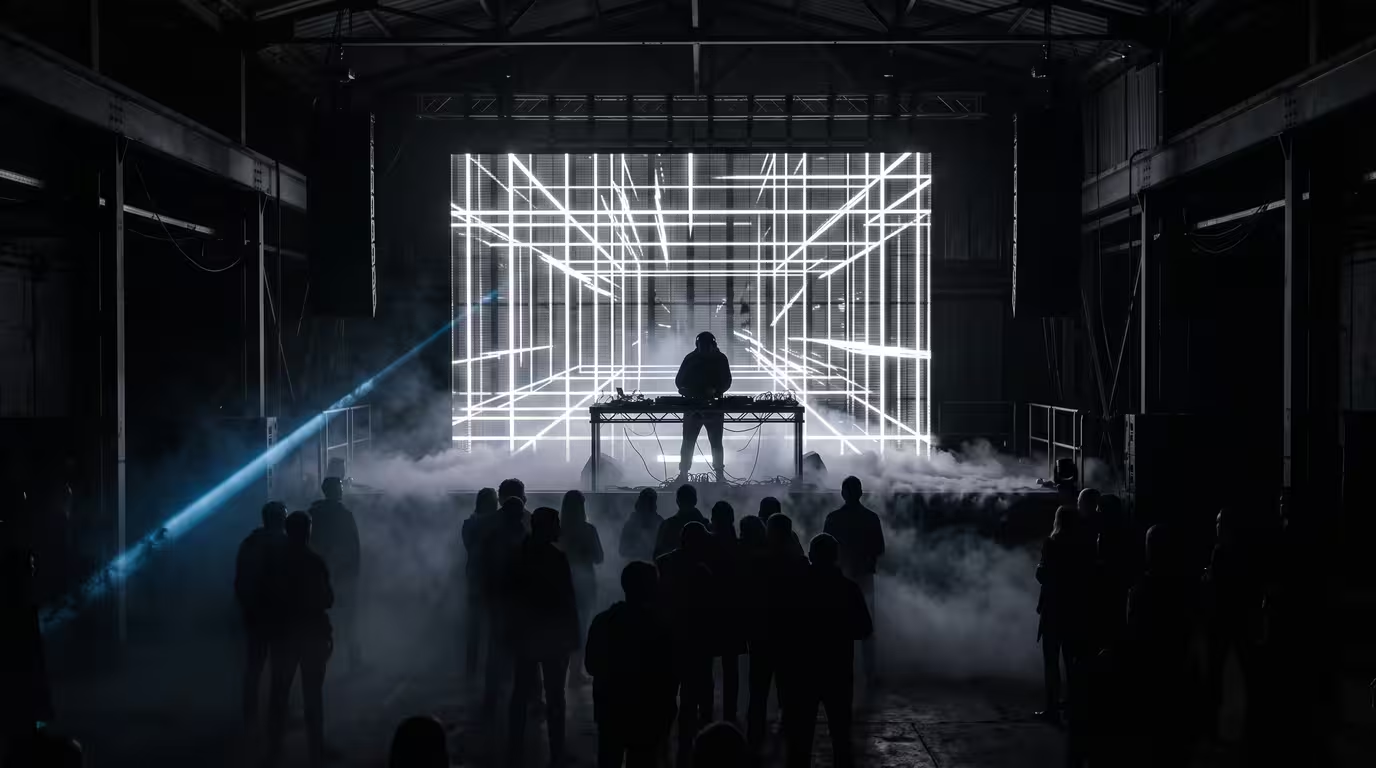
The albums that followed traced an arc from the dancefloor into deep space. Musik arrived in 1994; the Concept 1 run of monthly 12-inches in 1996 pushed reduction to an extreme; and in 1998 came Consumed, a pitch-black, near-ambient record that DJ Mag still calls a minimalist masterwork, comparing its featureless perfection to the monolith in 2001: A Space Odyssey. Closer followed in 2003, its themes of paranoia and claustrophobia making it one of Hawtin's most unsettling works. Live, Plastikman became a striking audiovisual entity, pairing the music with towering LED architecture designed with the visual artist Ali Demirel.
Richie Hawtin on Detroit Techno and Building a Live Show

Minus and the Minimal Decade
In 1998 Hawtin launched a new label, Minus, as Plus 8 was put on hold. Its aesthetic was stark and coded, all cryptic sleeves and a minimise-to-maximise ethos, and over the 2000s it became the defining brand of minimal techno. After a spell in New York in 2002 and 2003, Hawtin relocated to Berlin, following collaborators like Magda into a city whose marathon clubs were the perfect habitat for the loop-driven, hypnotic sound. Minus became one of electronic music's most close-knit collectives, developing artists including Magda, Marc Houle, Troy Pierce, Gaiser, Heartthrob and Barem.
Hawtin's own most influential 2000s work, though, may be a trio of mix albums that quietly rewrote what DJing could be. Decks, EFX & 909 (1999) rebuilt tracks live with turntables, an effects box and a 909. DE9: Closer to the Edit (2001) went further; in his own words, he recorded, sampled, cut and spliced over 100 tracks down into their most basic components, then reassembled them as if solving an audio jigsaw puzzle. Spin named it one of the 20 best albums of 2001, and Resident Advisor later placed it at number 16 on its list of the top 50 mixes of the 2000s. DE9: Transitions (2005) used Ableton Live to layer fragments of many tracks at once; as Resident Advisor's review noted, at times sound sources from as many as seven different tracks are playing simultaneously, prompting the reviewer to ask whether this was a transition from the work of a DJ to that of a composer. Hawtin has said he licensed 550 tracks for the project. It was DJing reimagined as manipulation of fragments rather than the playing of whole records.
Not everyone stayed enchanted. As minimal saturated clubland, it drew a real backlash. As Beatportal's retrospective on the sound recounts, the producer Dan Curtin recalled a Berlin superficiality in which the music's futurism, groove, soul and emotion had atrophied, while another scene figure dismissed the Bar25 era as a cheap sound that quickly became a parody of itself. That is a fair critique to hold alongside the achievements: at its worst, late-2000s minimal did become wallpaper. At its best, in the hands of Hawtin, Ricardo Villalobos and Basic Channel, it remains some of the most quietly radical dance music ever made.
The Technologist
If one thread runs through Hawtin's whole career, it is that he treats new technology as an instrument rather than a threat. He was an early champion of Final Scratch, the pioneering digital-vinyl system developed by the Dutch company N2IT, which he and Acquaviva helped develop and road-test. Around 2001, Final Scratch's timecode-vinyl approach, letting a DJ control digital files with real turntables, was genuinely radical, and it was the direct ancestor of the DVS systems now standard in Serato and Traktor.
He kept going. In 2012 he ran the CNTRL: Beyond EDM tour, an educational trek through North American universities with Loco Dice and Ean Golden. That summer he also launched ENTER., his multi-room residency at Space Ibiza that ran from 2012 to 2015 and folded together music, technology, design and a sake bar; Hawtin, a trained sake sommelier, later built a related sake venture. In 2016 he founded the technology company PLAYdifferently and released the MODEL 1, an all-analog performance mixer co-designed with the former Allen & Heath engineer Andy Rigby-Jones. And his CLOSE live show, premiered at Coachella in 2017, made his hands the star: an improvised hybrid of Ableton, Traktor, modular synth and the Model 1, with cameras abstracting his movements into visuals on a huge screen.
Legacy and the Discipline of Subtraction
Hawtin returned to the Plastikman name in 2010 for a celebrated live revival; the Time Warp show in Mannheim was voted number one in Resident Advisor's readers' poll of the year's top live acts. He revived it again in 2013 for the album EX, recorded in a single session on 16 November 2013 at the Solomon R. Guggenheim Museum in New York for the museum's gala at the invitation of Dior's Raf Simons, a devoted fan who once described listening to Hawtin's music the way others listen to classical music. In recent years he has turned outward; his 2023 From Our Minds tour spotlighted next-generation talent in North American warehouses, reviving the Plus 8 slogan and closing a loop back to Detroit.
His influence is hard to overstate. He helped globalise Detroit's second wave, built two of techno's most important labels, defined the sound and look of an entire minimal decade, and pushed DJ performance from record-selection toward real-time composition. For producers, his real lesson has little to do with any single machine. It is the discipline of subtraction, the confidence to strip a track to almost nothing, paired with the willingness to make a device do something it was never designed to do. That is the border-town kid's quiet legacy: proof that reduction, done with obsession, can be its own kind of maximalism.
Key takeaways
• Richie Hawtin, born in England in 1970 and raised in Windsor, Ontario, absorbed Detroit's second-wave techno across the river and co-founded Plus 8 Records with John Acquaviva in 1990.
• As Plastikman, he built a minimal-acid universe around the Roland TB-303, from Sheet One (1993) to the masterpiece Consumed (1998).
• His Minus label and DE9 mix series defined 2000s minimal techno and reinvented DJing as the manipulation of fragments.
• A lifelong early adopter, he helped develop Final Scratch and later built the PLAYdifferently Model 1 mixer and the CLOSE live show.
• His enduring lesson for producers is the discipline of subtraction, and making machines do what they were never meant to.
