Choosing between rekordbox, Serato DJ and Traktor Pro is less about which software is best and more about where you want to play and what hardware you own. All three are mature, club-capable platforms that can beatgrid, cue, key-detect and now separate stems in real time. The differences that actually matter are ecosystem and workflow — and those differences are sharp enough that the right answer is often dictated by your gear and your local clubs rather than personal taste.
The Three Platforms at a Glance
Each program carries the DNA of a different company and a different scene. Understanding that history explains why each one behaves the way it does today.
rekordbox is made by AlphaTheta, the company formerly known as Pioneer DJ — the manufacturer behind the CDJ players and DJM mixers found in virtually every professional booth. rekordbox began as library-preparation software for exporting analysed tracks to USB sticks, and it remains the gateway to club CDJs. It later grew a full laptop performance mode, so it now does double duty as both prep tool and performance software.
Serato grew out of Serato Scratch Live, the vinyl-emulation system launched in 2004 in an exclusive partnership with Rane. Scratch Live became so dominant among hip-hop, turntablist and open-format DJs that Serato became shorthand for digital vinyl itself. Modern Serato DJ Pro unified that DVS heritage with controller support, and it remains the standard on Rane battle gear and a favourite of scratch and open-format DJs.
Traktor is the oldest of the three, first released by Berlin's Native Instruments in 2000. It pioneered four-deck mixing, sync, Remix Decks and deep effects, and it was central to the controllerism movement and the electronic and techno scene. It was also the first DJ software to support stems, with Traktor Pro 2.9 in August 2015. The current version, Traktor Pro 4, launched on July 17, 2024 with flexible beatgrids, real-time stem separation, a Pattern Player sequencer and an iZotope Ozone Maximizer limiter.

Workflow and Library Management
rekordbox: Prep-First, Dual-Mode
rekordbox is built around two modes: EXPORT mode (for preparing a library and writing it to USB or SD for CDJs) and PERFORMANCE mode (for DJing live from the laptop). You import music, let it analyse BPM, key and waveform, set hot cues and memory cues, build playlists and intelligent playlists, then either play in PERFORMANCE mode or export to a stick. The two-step approach feels slower at first but rewards organised DJs, because the prep you do at home is identical to what appears on the club's CDJs. The default waveform is vertical, which can surprise DJs coming from horizontal layouts.
Serato: Crates and Reliability
Serato's library uses a crate system — you create crates, nest sub-crates, colour-code them and build Smart Crates that auto-populate from rules. The Prepare window lets you analyse tracks, set up to eight cue points and adjust beatgrids before a gig. Serato's reputation is built on rock-solid reliability and an intuitive, horizontal-waveform interface that many DJs find the least fussy of the three to learn.
Traktor: Powerful but Steeper
Traktor uses playlists and folders and is the most text-heavy, least visual library of the three (no album-art thumbnails by default). Its real strength is modularity: each of up to four decks can run in Track, Remix, Stem or Input mode, and the entire interface can be resized and reconfigured. That flexibility makes Traktor the most programmable platform — and the steepest learning curve for beginners.
Hardware Support and the Club Reality
This is the single most important dimension, because the software you pick partly determines where you can play.
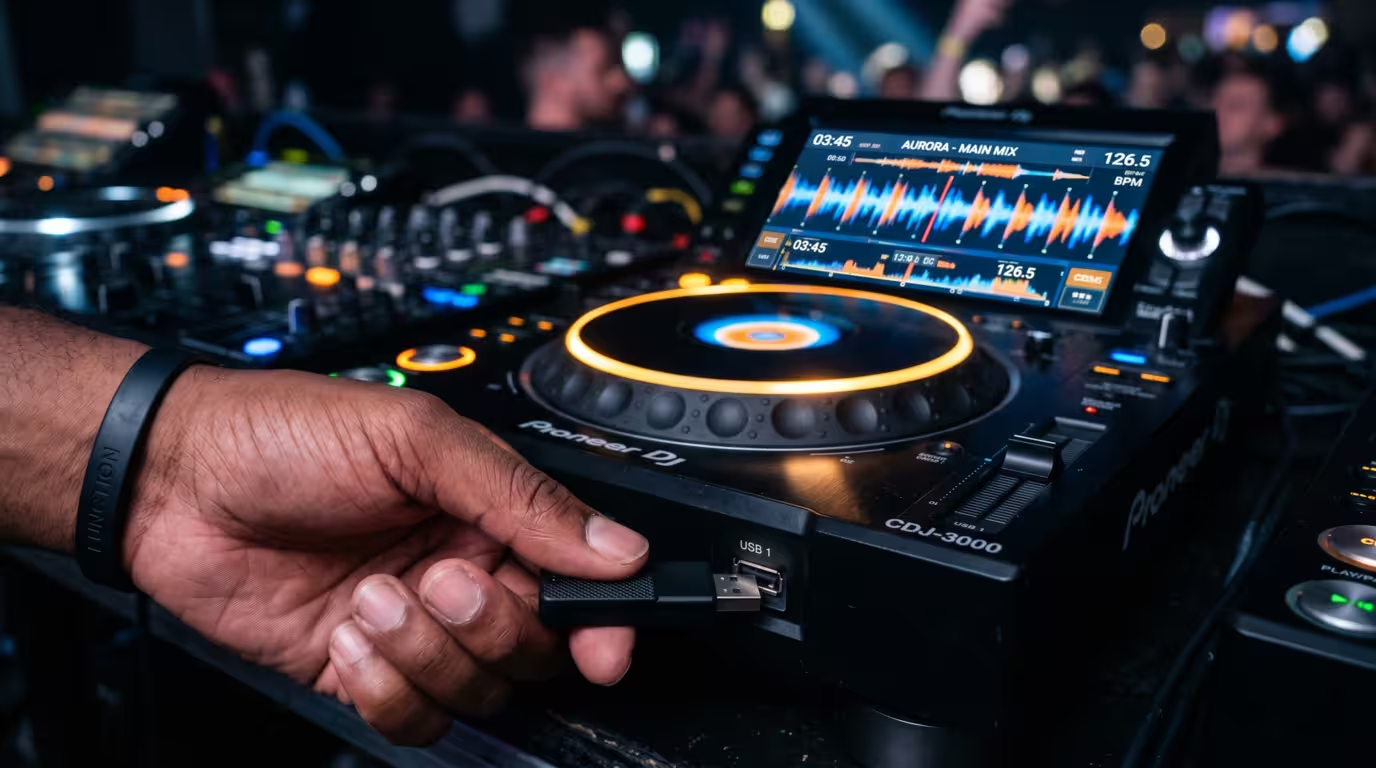
The reality of professional booths is that they overwhelmingly run AlphaTheta/Pioneer CDJs and DJM mixers connected over Pro DJ Link, an Ethernet network protocol. rekordbox is the native path into that world: you export a FAT32-formatted USB stick and walk up to any CDJ with all your cues, loops, grids and playlists intact — no laptop required. That USB-export-to-CDJ workflow is why rekordbox is treated as the de-facto industry standard for club preparation, even by DJs who perform on other software at home.
Serato can also run on club CDJs, but the route is different: you connect the CDJs to your laptop via USB in HID mode, or use a DVS setup (timecode) through a supported mixer such as a Rane or a Serato-ready Pioneer DJM. Serato's great strength is breadth — it officially supports 100-plus pieces of DJ hardware from Pioneer DJ, Rane, Denon DJ, Numark, Roland and others, and it is the built-in standard on Rane's battle mixers like the SEVENTY-TWO and SEVENTY.
Traktor is happiest with Native Instruments' own Traktor Kontrol hardware — the S2, S4, Z1 and Z2 — most of which now ship with Traktor Pro 4 included. Its club and third-party support is the narrowest of the three: Native Instruments dropped Advanced HID support for newer Pioneer CDJs, so walking up to club CDJs with Traktor is far less seamless than with rekordbox or Serato. Traktor DJs in clubs typically bring their own controller or use a DVS or timecode setup, since Traktor Scratch works with any audio interface.
| Software | Club-CDJ access path |
|---|---|
| rekordbox | Native — USB export via Pro DJ Link, no laptop needed |
| Serato | Via USB-HID or DVS/timecode through a supported mixer |
| Traktor | Limited — best via own controller or DVS; narrow CDJ HID support |
| Software | Strongest hardware fit |
|---|---|
| rekordbox | Pioneer/AlphaTheta CDJs, XDJs, DDJ controllers |
| Serato | 100+ controllers/mixers; standard on Rane battle gear |
| Traktor | Traktor Kontrol S2/S4/Z1/Z2; bundled with NI hardware |
Features Compared
Effects and Sound
All three sound excellent on a club system, but their effects have different reputations. Traktor's studio-grade effects — 40-plus FX across four chainable Deck FX slots, plus Mixer FX and Elastique time-stretching — are widely regarded as the deepest and most DAW-like, and Traktor Pro 4 now bundles an iZotope Ozone Maximizer to boost loudness without clipping. Serato's effects are powered by iZotope, with a clean standard set and an expandable bank. rekordbox offers solid beat and colour effects plus the RMX FX taken from Pioneer's Remix Stations on its higher tiers.
Real-Time Stems
All three now offer real-time stem separation, a feature that lets you mute or isolate vocals, drums, bass and instruments live. Serato added Stems as a free base feature in both DJ Pro and DJ Lite. rekordbox's STEMS / Track Separation feature offers a choice of three-stem (vocal, instrumental, drums) or four-stem (adding bass) modes and works on local and streaming tracks. Traktor Pro 4 added high-quality stem separation powered by iZotope's RX technology — but with a key difference: Traktor's stems must be pre-analysed track by track before use, whereas rekordbox and Serato can separate on the fly. Across reviews, all three real-time engines are considered adequate for live use but still short of dedicated offline AI separators on dense productions.
Samplers and Remix Tools
Traktor's Remix Decks (and the new Pattern Player step-sequencer) are the most performance-oriented sample tools of the three and a big reason controllerists favour it. Serato has a 32-slot sampler across four banks; rekordbox has a sampler and sequencer on its paid tiers.
Key Detection, DVS and Streaming
All three detect key and support harmonic mixing, and all three support DVS (digital vinyl) with the right hardware and licence. Streaming is where they diverge: rekordbox and Serato both integrate a wide spread of services, while Traktor is limited to Beatport and Beatsource. Note that Beatsource's catalogue has largely been folded into Beatport as the two services (both owned by Beatport) converge.
| Software | Streaming services |
|---|---|
| rekordbox | Beatport, Beatsource, TIDAL, SoundCloud, Apple Music, Spotify |
| Serato | TIDAL, SoundCloud, Beatport, Beatsource, Apple Music, Spotify (one at a time) |
| Traktor | Beatport and Beatsource only |
Cloud library features also differ. rekordbox offers Cloud Library Sync and CloudDirectPlay via Dropbox on its Creative and Professional tiers, with the Professional plan bundling 5 TB of Dropbox storage. Serato offers its own cloud library backup and sync.
Cost and Licensing
The three platforms use fundamentally different business models, and this often decides the matter for budget-conscious DJs.
rekordbox is subscription-only for its advanced features — there is no perpetual licence, and AlphaTheta's own FAQ confirms there is no option to buy a licence outright. The Free plan ($0) handles library management, USB export and PERFORMANCE mode when you connect a Hardware Unlock device (most current Pioneer controllers). Paid plans, billed monthly on the official plans page, run roughly $12 for Core, $18 for Creative and $36 for Professional, with cheaper annual-equivalent rates of about $10, $15 and $30 per month respectively (Digital DJ Tips pegged the Professional tier at about $30 a month on annual billing).
Serato uses a hybrid model. Serato DJ Lite is genuinely free. Serato DJ Pro is a one-time purchase of $299 or a subscription of $11.99 per month — the monthly rate rose from $9.99 to $11.99 on October 9, 2025 — and the all-inclusive Serato DJ Suite (which adds DVS, Pitch 'n Time, Video, Flip, Play and Serato Studio) is $499 or $14.99 per month. Crucially, supported controllers hardware-unlock Serato DJ Pro for free, so many DJs never pay directly. Serato DJ Pro adds eight hot cues, a 32-slot sampler, set recording, key detection and the DVS option over Lite.
Traktor Pro 4 is a one-time purchase with no subscription — listed at $149 (frequently discounted), with the upgrade from Traktor Pro 3 priced at $74.50. It also ships bundled with most Native Instruments Traktor Kontrol hardware, so many users effectively get it free with a controller, and new buyers receive two free months of Beatport or Beatsource streaming.
| Software | Cost model |
|---|---|
| rekordbox | Free tier + subscription only (~$12–$36/mo); no one-time buy |
| Serato | DJ Lite free; DJ Pro $299 or $11.99/mo; Suite $499 or $14.99/mo |
| Traktor | One-time $149 ($74.50 upgrade); bundled with NI hardware |
Who Should Choose Which
Choose rekordbox if you play, or want to play, on club CDJs and are in the Pioneer/AlphaTheta ecosystem. The USB-export workflow makes it the safest, most future-proof choice for anyone with club-circuit ambitions, and the free tier plus a Hardware Unlock controller covers a lot of ground at no cost.
Choose Serato if you are a hip-hop, open-format or scratch DJ, or if you want the widest possible choice of controllers and mixers. Its reliability, simple crate workflow and Rane integration make it the default for performance-focused and turntablist DJs, and the free Lite tier is a strong entry point.
Choose Traktor if you are an electronic, house or techno DJ who loves deep effects, Remix Decks, the Pattern Player and a modular, controllerist workflow — and you are happy to bring your own Traktor Kontrol hardware rather than relying on club CDJs. The one-time price and hardware bundles are attractive if you dislike subscriptions.
Be pragmatic, though: most working DJs use the software their hardware and their venues dictate. A bedroom producer with a Pioneer DDJ controller and club aspirations should lean rekordbox; a scratch DJ with a Rane mixer should run Serato; a techno head building a custom Kontrol rig will be happiest in Traktor. It is also normal to use more than one over a career, and your library prep largely transfers between them with a little effort.
Key takeaways
• rekordbox is the native path to club CDJs via USB export and Pro DJ Link — the industry-standard prep workflow.
• Serato leads on controller and mixer breadth (100+ devices) and is the standard for hip-hop, open-format and scratch DJs on Rane gear.
• Traktor offers the deepest effects, Remix Decks and modular workflow, but the narrowest club hardware support.
• All three now do real-time stems, key detection and DVS; Traktor's stems must be pre-analysed.
• Cost models differ sharply: rekordbox is subscription-only, Serato is hybrid, Traktor is a one-time buy.
• Let your hardware and your local clubs guide the choice as much as personal preference.
Ready-made, exclusive EDM tracks with full rights — released as your own.
