Spec sheets for DJ controllers are dense, inconsistent between brands, and full of marketing language. This reference article strips that back: first it explains what each spec actually means, then it compares real, current controllers across the entry-level, mid-range and professional tiers in compact data tables. The goal is simple — once you can read a spec sheet, you can compare any two controllers on the numbers that matter to how you actually play.
What a DJ Controller Really Is
A DJ controller is a control surface that sends MIDI or HID commands over USB to DJ software running on a computer or phone; it does not, by itself, mix audio the way a standalone club mixer does. As the Wikipedia entry on DJ controllers explains, a controller sends signals that tell the DJ software how to mix, and most include a built-in sound card so you can preview tracks in headphones before playing them out. That single distinction explains why a $300 controller can mimic the layout of a $5,000 club rig: the heavy audio processing happens in software, and the hardware is the human interface.
Two terms recur throughout this article. A pure controller needs a laptop or phone running software to function. A standalone unit has an onboard computer and can play music straight from a USB drive, SD card or internal disk with no laptop at all — though most standalone units can also act as plain controllers when connected to software.
The Spec Framework: Reading Any Spec Sheet
Channels, Decks and Jog Wheels
Channels and decks are the first numbers to find. Two-channel controllers mix two sources at once; four-channel units mix four, which suits layering, long blends, back-to-back sets and external sources. Note that some two-channel-bodied controllers offer four-deck control in software — the Numark Mixtrack Platinum FX, for example, switches its two physical channels between four software decks rather than giving you four faders.
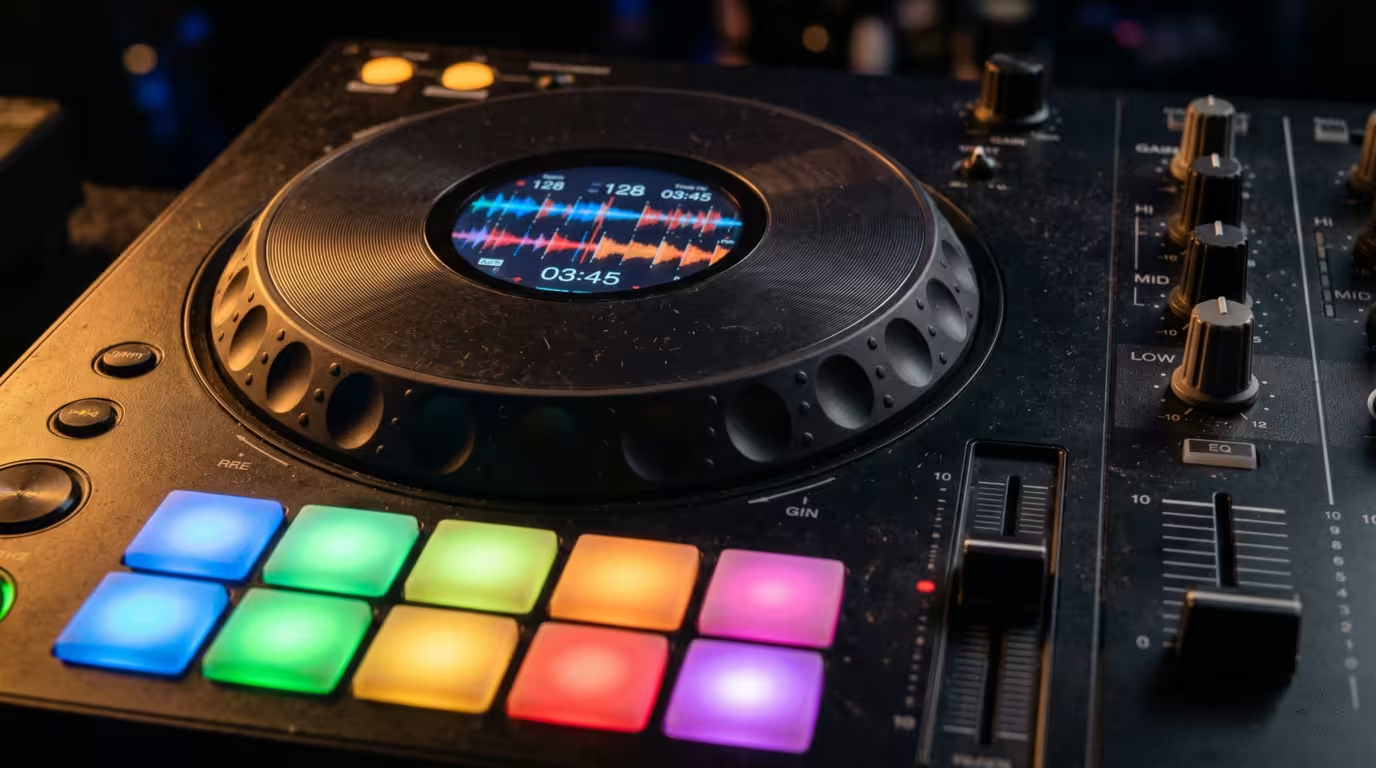
Jog wheels differ in size (quoted in millimetres of diameter) and type. Capacitive-touch mechanical jogs (the most common) sense your finger and are fixed in place. Motorized platters physically spin like a record and are the choice of scratch and turntablist DJs. Bigger is better for scratching: entry battle units like the Pioneer DDJ-REV1 use 154 mm jogs, club-style flagships like the Pioneer DDJ-FLX10 use 206 mm jogs, and motorized units like the Rane One use 7.2-inch (about 183 mm) spinning platters.
Pads, Mixer and Audio Interface
Performance pads are the rubber grid under each deck. Count them per deck (commonly 8), and check whether they are RGB-backlit and how many pad modes (Hot Cue, Loop, Roll, Sampler, Slicer, Pad FX, Beat Jump, Key Shift) they support.
The mixer section covers channel faders, the crossfader, a 3-band EQ per channel and color/filter FX. On higher tiers the crossfader becomes a replaceable, magnetic, contactless design — Pioneer's MAGVEL and Rane's MAG crossfaders are built for the abuse of scratching and the precision of tight cuts.
The built-in audio interface (sound card) is specified by bit depth and sample rate. Entry and mid Pioneer units run 24-bit/44.1 kHz; the Pioneer DDJ-FLX4 supports 16/24-bit at 44.1/48 kHz; the Native Instruments Traktor Kontrol S4 MK3 runs a higher 24-bit/96 kHz interface. What matters more for gigging is whether the interface provides a dedicated headphone cue output separate from the master — every controller here does, but the cheapest units use a single 3.5 mm jack rather than a full 1/4-inch output.
Inputs, Outputs and Connectivity
Outputs determine where you can play. RCA master output is fine for home and small speakers; balanced 1/4-inch TRS or XLR master outputs and a separate booth output are what clubs and PA systems expect. Inputs matter for flexibility: mic inputs for MCs, and phono/line inputs that let you connect turntables or media players. Connectivity covers USB bus power versus an external power supply, USB-C versus the older USB-B, and whether there are two USB ports for laptop-to-laptop handovers. Onboard screens — small color displays in the jog wheels, or a large central touchscreen — reduce how often you look at a laptop, and a central screen is what makes true standalone play practical.
The Three Tiers, Defined
The market sorts cleanly into three price bands. The figures below are approximate current US street prices for new units; several mid-tier classics are now discontinued and sold mainly open-box or used.
| Tier | Approx. USD | What you get |
|---|---|---|
| Entry-level | $150–$330 | 2 channels, plastic build, USB bus power, RCA out, bundled Lite software |
| Mid-range | $600–$1,400 | 4 channels, jog screens or motors, XLR/booth out, external inputs |
| Pro / flagship | $1,500–$3,500 | 4 channels, big jogs, club I/O, stems, often standalone |
Entry-Level Controllers Compared
Entry units are built for learning and bedroom-to-house-party use: 2 physical channels, mostly plastic chassis, USB bus power and a bundled Lite version of software you can later upgrade. The table below lists representative models with verified prices and channel counts.
| Model | Approx. USD | Channels / decks |
|---|---|---|
| AlphaTheta DDJ-FLX2 | $189 | 2 ch / 2 deck |
| Pioneer DDJ-FLX4 | $329 | 2 ch / 2 deck |
| Hercules Inpulse 300 MK2 | $249 | 2 ch / 2 deck |
| Numark Mixtrack Platinum FX | $279 | 2 ch / 4 deck |
| Pioneer DDJ-REV1 | $299 | 2 ch / 4 deck |
Jog wheels and bundled software separate these units more than price does. The DDJ-REV1 is the outlier — a battle-style layout with the tempo faders moved to the top and large 154 mm jogs lifted from the higher-end DDJ-SR2, aimed at scratch DJs.
| Model | Jog wheel | Made-for software |
|---|---|---|
| DDJ-FLX4 | 111.6 mm capacitive | rekordbox + Serato (+ djay) |
| Numark Platinum FX | 6-inch capacitive, with display | Serato DJ Lite |
| DDJ-REV1 | 154 mm capacitive (battle) | Serato DJ Lite |
A few specifics worth knowing at this tier: the DDJ-FLX4 has eight pads per deck, a 16/24-bit 44.1/48 kHz sound card, a single RCA master out, one 1/4-inch mic input and a 3.5 mm headphone jack, and it runs entirely on USB-C bus power. The Numark Mixtrack Platinum FX punches above its price with hi-res color displays built into its 6-inch jog wheels — a feature usually reserved for pricier gear. The Hercules Inpulse 300 MK2 leans into teaching, with an onboard Beatmatch Guide light system, and bundles both Serato DJ Lite and Hercules' own DJUCED.
Mid-Range Controllers Compared
The mid tier is where four channels, jog-wheel screens or motors, and club-grade outputs arrive. Several landmark units here have been discontinued but remain common on the used market and define what the tier means.
| Model | Approx. USD | Channels / status |
|---|---|---|
| Pioneer DDJ-FLX6-GT | $599 | 4 ch / current |
| Pioneer DDJ-1000 | ~$1,399 | 4 ch / discontinued |
| Traktor Kontrol S4 MK3 | ~$999 | 4 ch / discontinued |
| Denon DJ MC7000 | ~$799 | 4 ch / discontinued |
The defining hardware split in this tier is jog technology and outputs. The DDJ-1000 introduced full-color screens inside its 202 mm aluminium jogs and a club-style I/O (XLR master, booth, two mic, plus line and phono/line inputs). The Traktor Kontrol S4 MK3 took a different path with motorized Haptic Drive jog wheels that physically spin and vibrate at cue points.
| Model | Jog wheel | Key outputs |
|---|---|---|
| DDJ-FLX6-GT | CDJ-3000-size, on-jog display | RCA master + booth |
| DDJ-1000 | 202 mm, color jog screens | XLR + RCA master, booth |
| Traktor S4 MK3 | Motorized Haptic Drive | XLR + RCA master, booth |
| Denon MC7000 | 6-inch capacitive platters | XLR master + booth |
Software ecosystem is the other axis here, and it is where lock-in starts to bite. The DDJ-FLX6-GT is the most flexible, officially supporting rekordbox, Serato DJ Pro and VirtualDJ; however, it is a budget-built 4-channel unit with no XLR output and no external line/phono inputs. The DDJ-1000 is a dedicated rekordbox controller (the DDJ-1000SRT is its Serato twin). The Traktor Kontrol S4 MK3 is built around Native Instruments' Traktor Pro; its onboard 24-bit/96 kHz audio interface anchors a full I/O set — two phono/line inputs, two line inputs, RCA and XLR main outputs, a TRS booth output, both 1/8-inch and 1/4-inch headphone outputs, two mic inputs, two USB ports and DVS support. The Denon MC7000 is a Serato workhorse whose signature trick is dual USB audio interfaces, so two laptops can be connected for seamless DJ changeovers.
Professional and Standalone Units
At the top, controllers gain large jogs, full club I/O, stems separation and — for several models — true standalone playback. This is the most important distinction to get right, so the first table flags which units need a laptop and which do not.
| Model | Approx. USD | Standalone? |
|---|---|---|
| Pioneer DDJ-FLX10 | $1,729 | No (pure controller) |
| Rane One | $1,499 | No (pure controller) |
| Pioneer XDJ-XZ | ~$2,499 | Partial (2-ch standalone) |
| Denon DJ Prime 4+ | $2,199 | Yes (4-deck standalone) |
| AlphaTheta XDJ-AZ | $3,449 | Yes (4-deck standalone) |
The two pure controllers here are world-class but laptop-dependent. The Pioneer DDJ-FLX10 — a 4-deck controller listed around $1,729 — is a 4-channel rekordbox/Serato flagship with 206 mm jogs, dual on-jog displays, a 4-sensor MAGVEL crossfader, real-time stems (Track Separation), a DMX lighting output, and full club I/O including a balanced XLR master, RCA master, TRS booth, two phono/line inputs and two mic inputs over dual USB-C — full specs are on the official Pioneer DJ DDJ-FLX10 page. The Rane One is a 2-channel Serato controller built around dual motorized 7.2-inch platters and a feather-light MAG crossfader; at launch it was billed as the first DJ controller aimed squarely at scratch DJs, with two 7.2-inch motorized platters, priced around $1,499.
The standalone units trade some scratch feel for laptop-free freedom and onboard screens.
| Model | Screen | Jog / platter |
|---|---|---|
| XDJ-XZ | 7-inch touchscreen | 206 mm mechanical |
| Denon Prime 4+ | 10.1-inch touchscreen | 6-inch capacitive |
| XDJ-AZ | 10.1-inch touchscreen | 206 mm (CDJ-3000 feel) |
The Denon DJ Prime 4+ is a fully standalone 4-deck system: a 10.1-inch multi-gesture touchscreen, an internal 2.5-inch SATA drive bay, Wi-Fi streaming, Engine DJ with what Denon calls the first standalone stem separation, and it doubles as a controller for Serato DJ Pro and VirtualDJ. The AlphaTheta XDJ-AZ (listed around $3,449) is the spiritual successor to the XDJ-XZ, upgrading to true 4-channel standalone playback, Wi-Fi streaming and CDJ-3000-style 206 mm jogs. Its sound comes from a 32-bit ESS Technology D/A converter, and its 10.1-inch touchscreen shows up to 13 tracks at once — a big jump from the 8 on the XDJ-XZ — while still working as a rekordbox or Serato controller. The older XDJ-XZ, now discontinued, runs only two standalone channels (the other two are for linking external CDJs or turntables) behind a smaller 7-inch screen.
Using the Comparison to Choose
Reading the tables back, a few rules turn specs into decisions. More channels equal more decks and more external sources, so choose four channels only if you layer tracks, mix many genres or plug in turntables. Bigger jogs and motorized platters favor scratching and turntablism — if cutting matters, prioritise the Rane One's motors or a 206 mm club jog over a 111.6 mm entry wheel. Jog screens and central touchscreens reduce laptop dependence, and a central touchscreen plus onboard storage is what makes a unit genuinely standalone.
Balanced TRS/XLR master outputs and a separate booth output matter the moment you play a club or hire a PA; RCA-only output signals a home-focused unit. Standalone capability removes the laptop as a point of failure entirely, which is why working mobile and club DJs gravitate to the Prime 4+ and XDJ-AZ despite the price. Finally, software ecosystem lock-in is a real cost: a controller made for rekordbox, Serato or Traktor unlocks that software for free, but switching ecosystems later can mean relearning workflows or buying licenses — so weigh which software your local clubs and friends actually run before you commit.
Key takeaways
• Read four numbers first: channels, jog size and type, audio interface, and output type (RCA versus balanced/booth).
• Entry tier ($150–$330) means 2 channels, USB bus power and bundled Lite software; the DDJ-FLX4 ($329) is the benchmark.
• Mid tier ($600–$1,400) adds 4 channels, jog screens or motors and club I/O; the DDJ-1000 and Traktor S4 MK3 defined it.
• Pro tier ($1,500–$3,500) brings big jogs, stems and full club I/O; the DDJ-FLX10 and Rane One lead the pure controllers.
• Standalone units (Prime 4+, XDJ-AZ) drop the laptop entirely via onboard screens and storage — the biggest reliability upgrade you can buy.
• Software lock-in is a genuine cost: match your controller's made-for ecosystem to the clubs and peers around you.
Ready-made, exclusive EDM tracks with full rights — released as your own.
