If you can already mix and you are trying to decide between a laptop DJ controller and a set of CDJs, the honest answer is that these are two different philosophies of DJing rather than two grades of the same thing. A controller is a tactile shell for software running on a computer; a CDJ is a self-contained instrument that needs nothing but a USB stick. That single distinction — laptop-dependent versus standalone — drives almost every other difference in feel, price, portability, and whether you will ever see your gear in a club booth. This article digs into those nuances for DJs who already understand the basics.
What Each Format Actually Is
The DJ Controller
A DJ controller is a control surface with a built-in audio interface (sound card) that connects to and depends on a computer, phone, or tablet running DJ software such as rekordbox, Serato DJ, Traktor, or VirtualDJ. The hardware sends MIDI/HID messages — fader moves, jog touches, pad hits — to the software, and the software does the actual audio processing, then routes the mix back out through the controller's sound card to your speakers. The jog wheels, EQ, and faders are essentially a physical remote control for what is happening on screen.
Entry-level units like the Pioneer DJ DDJ-FLX4 are 2-channel, USB bus-powered, and include free tiers of rekordbox and Serato DJ Lite. At the high end, controllers can be large, metal, and motorized — but they still need a computer to function as designed.
CDJs and Standalone Media Players
A CDJ (the term is a holdover from Compact Disc Jockey, though modern units rarely use discs) is a standalone digital media player. Pioneer DJ/AlphaTheta CDJ and XDJ units, plus Denon DJ's SC and Prime players, read tracks directly from a USB drive, SD card, or network source and play them with no laptop attached. In a club, each player is an independent deck; two or more connect to a separate DJM-style mixer, and the players talk to each other over Pro DJ Link (a LAN/Ethernet network) to share libraries, sync, and link cue features.
There is also a hybrid middle category: all-in-one standalone systems such as the Pioneer DJ XDJ-RX3 and the Denon DJ Prime 4+, which fold standalone players and a mixer into one chassis — no separate mixer, no laptop required.
Laptop Dependence: The Biggest Difference
Everything else flows from this. A controller needs a working computer in the signal chain, and that computer is a point of failure: an OS update that breaks driver compatibility, a frozen app mid-set, a flat battery, a flaky USB cable, or a background process hogging CPU. Experienced controller DJs mitigate this with a dedicated, stripped-down DJ laptop, but the risk never fully disappears.
CDJs invert the model. You prepare tracks on a laptop in rekordbox at home, export an analyzed library to a USB stick, then leave the laptop behind and play from the stick. The rekordbox USB export workflow writes your performance data to the drive — your playlists, cue points, and beatgrids travel with it. Plug the stick into any CDJ in the world and your cues, loops, grids, and playlists are right there. If one player crashes, the others keep going, and the track keeps playing because the CDJ-3000 caches the whole file rather than streaming it from the stick. For working club and festival DJs, that laptop-free reliability is the entire appeal.
Club Readiness and the Industry Standard
This is where the two formats genuinely diverge in the real world. The CDJ-plus-DJM rig is the de facto global standard in club and festival booths. Digital DJ Tips founder Phil Morse, citing his site's own Global DJ Census, puts Pioneer DJ (now operating under AlphaTheta) at no less than 70% of the global DJ-equipment market and effectively 100% in professional environments. Wikipedia, citing older industry estimates, puts the broader market share around 60% — so treat the exact figure as a range, but the dominance in pro booths is not seriously disputed. Controllers, by contrast, are almost never installed in club booths; venues standardize on CDJs precisely because every visiting DJ already knows the layout, and headliners' technical riders routinely demand the current Pioneer flagship.
The current flagship booth setup is a pair of CDJ-3000 (or the newer CDJ-3000X) players flanking a DJM-A9 mixer, linked by Pro DJ Link. The good news for controller users: skills transfer. If you learn on a Pioneer controller within the rekordbox ecosystem, the browse logic, hot cues, beat jump, and loop controls map closely onto a CDJ, so stepping up to club gear is more about confidence than relearning. Serato users transfer well to the layout too, though the library-prep ecosystem differs.
Feel and Build Quality
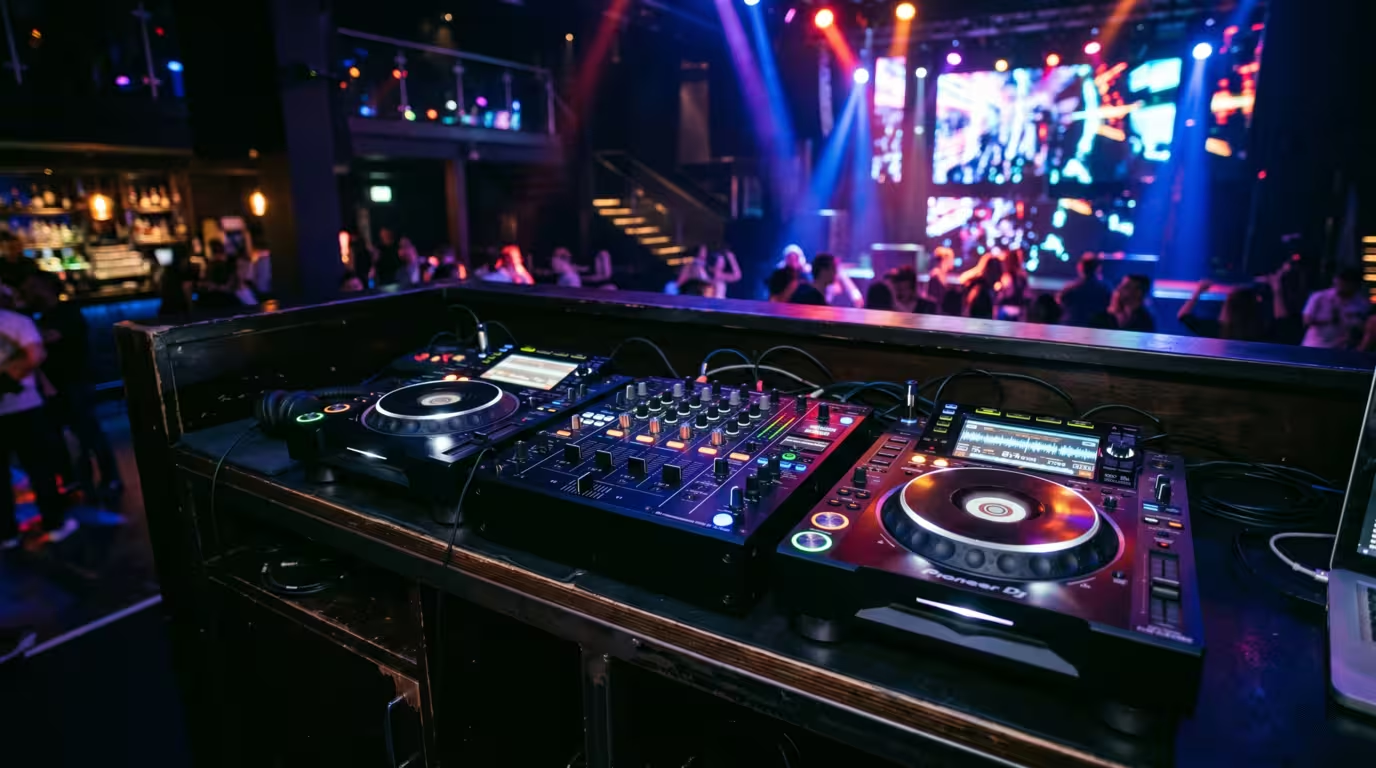
Pick up a CDJ-3000 and the difference is immediate. It has a large, high-torque jog wheel with adjustable feel and a small color LCD in the center showing playhead position and artwork, a 9-inch touchscreen, an aluminum top plate, and a chassis built for around-the-clock abuse in venues. The CDJ-3000X pushes this further with a 10.1-inch glass capacitive touchscreen that, in AlphaTheta's description, brings up to 16 tracks into view at once, plus reengineered jog tension and PLAY/CUE buttons rated for over 500,000 presses each. These are heavy, rigid, premium instruments.
Controllers vary enormously. Budget units like the DDJ-FLX4 use small capacitive jog wheels and a largely plastic body — perfectly good for learning and bedroom use, but not pretending to be club iron. Move up the range and the picture changes: the Rane One puts two 7.2-inch motorized platters with adjustable torque into an all-metal chassis for a true vinyl-style feel, and Denon's hybrids offer large jogs and metal builds. The key tactile gap is the screen. CDJs and standalone systems put waveforms, browse lists, and track info on built-in displays at eye level; most controllers expect you to look at your laptop screen, which changes your posture and your eyeline at the gig.
The Real Cost
Cost is where the gulf is widest, and it is the factor that most often makes the decision. A capable beginner controller is genuinely cheap; a separates-based CDJ rig is a serious capital outlay closer to the price of a used car.
A 2-channel beginner controller runs roughly $130 to $350; the DDJ-FLX4 sells for around $329 (against a $399 MSRP) at major US retailers. A full CDJ setup means buying players and a mixer separately. The CDJ-3000 is about $2,549 each, the CDJ-3000X about $2,999 each, and the DJM-A9 mixer roughly $2,799. Standalone all-in-ones split the difference: the XDJ-RX3 is around $2,269 and the Denon Prime 4+ about $2,199. The cost of a typical purchase at each tier looks like this.
| Setup | Format | Approx. US price |
|---|---|---|
| Pioneer DJ DDJ-FLX4 | Beginner controller | ~$329 |
| Denon DJ Prime 4+ | Standalone all-in-one | ~$2,199 |
| Pioneer DJ XDJ-RX3 | Standalone all-in-one | ~$2,269 |
| Two CDJ-3000 + DJM-A9 | Club separates | ~$7,900 |
| Two CDJ-3000X + DJM-A9 | Club separates (flagship) | ~$8,900 |
In other words, you could buy more than twenty DDJ-FLX4 controllers for the price of one flagship CDJ-3000X-and-DJM-A9 rig. That math is exactly why most DJs start on a controller and why home setups so rarely include separates.
Portability and Weight
Controllers win portability decisively. The DDJ-FLX4 is compact and USB bus-powered — it draws power from the laptop over the same cable that carries data, so there is no separate power brick for basic use, and it slips into a backpack. That makes controllers ideal for mobile gigs, travel, and practice anywhere.
CDJs are the opposite. Each CDJ-3000 weighs 5.5 kg (12.1 lb) per Pioneer DJ's official spec sheet, and you need two of them plus a heavy mixer, plus cabling and cases — a load that usually demands a dedicated flight case or a car. Standalone all-in-ones are a sensible compromise: the Denon Prime 4+ weighs 9.7 kg (21.3 lb) per Denon's official spec, and the XDJ-RX3 around 13.6 kg (30 lb) — heavier than a controller, but a single unit you can actually carry to a gig.
| Unit | Type | Approx. weight |
|---|---|---|
| Pioneer DJ DDJ-FLX4 | Beginner controller | ~2.1 kg / 4.6 lb |
| CDJ-3000 (each) | Standalone player | 5.5 kg / 12.1 lb |
| Denon DJ Prime 4+ | Standalone all-in-one | 9.7 kg / 21.3 lb |
| Rane One | Motorized controller | ~10 kg / 24 lb |
| Pioneer DJ XDJ-RX3 | Standalone all-in-one | ~13.6 kg / 30 lb |
Workflow, Features, and Ecosystems
The workflows feel different day to day. For CDJs you prep in rekordbox and export to USB; rekordbox runs an Export mode (for building and writing USB libraries) and a Performance mode (for playing with a laptop connected). The CDJ-3000 and XDJ-RX3 are Hardware Unlock devices, meaning they unlock rekordbox Performance mode for free without a subscription.
Controllers, because the computer is doing the work, expose the full feature set of the software: deep effects racks, stem separation, samplers, and easy library browsing and crate management on a big laptop screen. That is a real creative advantage. Notably, the flagship CDJ-3000X still does not offer onboard stem separation, while the Denon Prime 4+ added what Denon bills as the first standalone stem separation via its Engine DJ system — a reminder that standalone hardware sometimes leads and sometimes trails software in features.
Connectivity is converging, though. The CDJ-3000X adds built-in Wi-Fi, USB-C, an NFC touchpoint for phone login, and CloudDirectPlay streaming (Beatport, TIDAL), although the streaming and cloud features require a paid rekordbox subscription. Standalone Denon units stream from Amazon Music, TIDAL, Beatport, and more over Wi-Fi. Ecosystem choice matters: rekordbox is the native path to Pioneer/AlphaTheta club gear, while Serato DJ dominates among open-format and scratch DJs and is supported (via USB-HID) on CDJs too. A digital vinyl system (DVS) — timecode control records or CDs feeding software — is another bridge that lets turntablists drive software with real decks.
Who Should Choose Which
For most readers the decision is straightforward once you are honest about where you will play.
Choose a controller if you are a beginner, a bedroom or hobbyist DJ, a mobile or wedding DJ who values light, all-in-one portability, a livestreamer, or simply on a budget. You get the most features per dollar and the gentlest learning curve.
Choose CDJs or a standalone system if you play clubs and festivals, need laptop-free reliability, or want your home practice to match the gear you will face in the booth. If your local venues run CDJ-3000s, practicing on the same ecosystem pays off the first time you plug a USB stick into a strange booth and everything just works.
The hybrid all-in-one — XDJ-RX3 or Denon Prime 4+ — is the smart middle path: standalone, no laptop required, club-style layout, one unit to carry, at roughly a quarter to a third the price of separates. It is the natural second purchase after a starter controller and, for many gigging DJs, the final destination.
A sensible upgrade path is: start on a cheap 2-channel controller to build skills; move to a standalone all-in-one once you are gigging regularly; and only invest in CDJ separates if you are playing rooms that demand them or you want a permanent home replica of the club standard. Keep in mind the categories are blurring — standalone controllers, motorized controllers, and DVS all mix and match the strengths of each format — so controller versus CDJ is increasingly a spectrum rather than a binary.
Key takeaways
• The core difference is laptop dependence: controllers need a computer to process audio; CDJs are standalone and play from USB.
• CDJ-plus-DJM is the global club standard (AlphaTheta holds at least 70% of the market per Digital DJ Tips' Global DJ Census, and near-total presence in pro booths); controllers are rarely installed in booths.
• Controllers are far cheaper (around $329 for a DDJ-FLX4) and far lighter; flagship CDJ separates run well past $7,900 and are heavy to transport.
• Controllers expose full software features (stems, effects, big-screen browsing); CDJs prioritize reliability, build quality, and on-board screens.
• Standalone all-in-ones (XDJ-RX3, Prime 4+) are the middle path: laptop-free and portable without club-rig cost.
• Skills transfer between formats, especially within the rekordbox ecosystem, so a controller is a valid on-ramp to CDJs.
Ready-made, exclusive EDM tracks with full rights — released as your own.
