Walk into almost any club booth on Earth and you will see the same thing: two media players flanking a mixer, all wearing the Pioneer DJ name. That ubiquity hides a confusing reality — the product families (CDJ, DJM, XDJ, DDJ, PLX and more) follow a naming logic that is rarely spelled out, and the company itself is now called AlphaTheta. This guide is a map: what each prefix means, where it sits, and how to read a model name so you buy the right thing.
From Pioneer to AlphaTheta
The DJ gear most people call Pioneer began in 1994 as a division of Pioneer Corporation, launching the CDJ-500, the world's first flat-top DJ CD player. The DJ arm was highly profitable — its CEO Susumu Kotani told Reuters it ran close to a 20% operating margin on sales of 21.6 billion yen in the year to March 2014, with roughly a 60% share of the global market. In September 2014, Pioneer Corporation announced it would sell a majority stake to the private-equity firm KKR (Kohlberg Kravis Roberts). KKR took 85.05% of the new holding company while Pioneer Corporation kept the remaining 14.95%, a deal completed in March 2015 (for about 59 billion yen, roughly $551 million) that established the independent Pioneer DJ Corporation.
On January 1, 2020, Pioneer DJ Corporation renamed itself AlphaTheta Corporation, saying the change better reflected its values and vision and that brand names, including Pioneer DJ, would be unaffected. Shortly afterward, in March 2020, KKR and Pioneer sold their stakes in AlphaTheta to the Japanese holding company Noritsu for 35 billion yen (about $324.9 million). Then in January 2024 — the 30th anniversary of the CDJ-500 — AlphaTheta began launching new products under an AlphaTheta brand name alongside Pioneer DJ. In September 2025, the flagship CDJ-3000X became the first top-of-the-line player to carry the AlphaTheta name.
The practical takeaway: Pioneer DJ and AlphaTheta are not rivals. AlphaTheta is the company; Pioneer DJ is its main DJ-hardware brand; and newer items may wear either badge. The dominance has only grown — by Digital DJ Tips' Global DJ Census research, the company holds at least 70% of the global DJ-equipment market, and effectively 100% in professional environments.
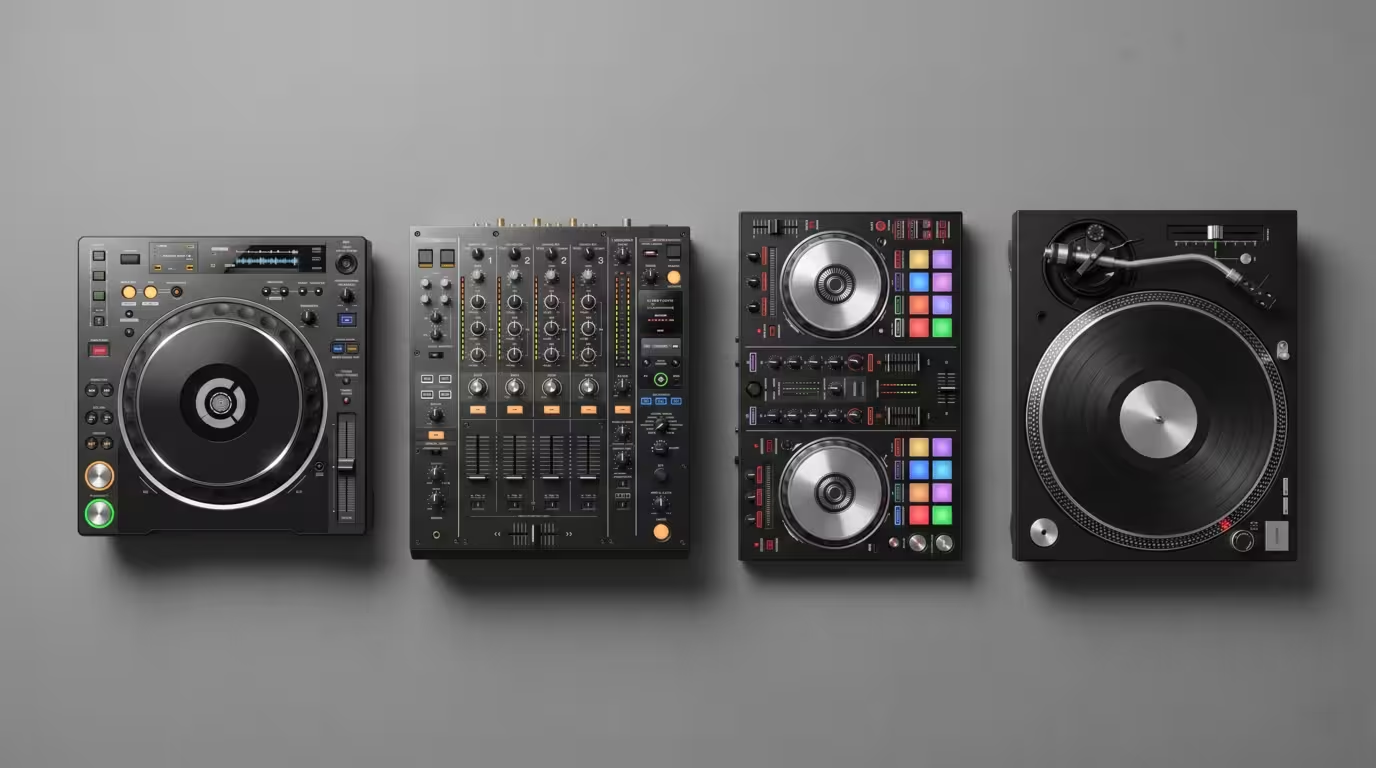
How to Read a Model Name
Every Pioneer/AlphaTheta product name is a prefix plus a number plus optional suffixes. The prefix tells you the family (and therefore the job); the number roughly tracks the tier or generation; the suffix tells you the revision or variant. The prefix is the most important part. Here is the quick decoder for the core families.
| Prefix | What it is | Example |
|---|---|---|
| CDJ | Pro standalone media player | CDJ-3000X |
| DJM | Pro DJ mixer | DJM-A9 |
| XDJ | All-in-one / standalone player | XDJ-AZ |
| DDJ | Controller (usually needs software) | DDJ-FLX4 |
| PLX | Direct-drive turntable | PLX-1000 |
Suffixes carry real meaning. MK2 and MK3 mark hardware revisions (the DJM-750MK2 supersedes the DJM-750). NXS and NXS2 stand for Nexus and Nexus 2, generation labels on the long-running club gear (CDJ-2000NXS2, DJM-900NXS2). On controllers, FLX means flexible and multi-software, REV means a Serato-style battle layout, and legacy SR, SX, SB and RB suffixes denoted Serato or rekordbox dedication. A GT badge (DDJ-FLX6-GT) or colour or edition tag is cosmetic or minor. Once you know the prefix and the suffix, you can place almost any model in the lineup at a glance.
CDJ: The Club-Standard Players
The CDJ line is the flagship professional media-player range — the decks that, in pairs, define the club standard. The lineage runs from the CDJ-1000 (2001), which introduced Vinyl Mode and cemented Pioneer as the booth standard, through the hugely deployed CDJ-2000NXS2, to the current flagship CDJ-3000 (2020) and its successor, the CDJ-3000X (September 2025).
Despite the CD in the name, the CDJ-3000 and CDJ-3000X have no disc drive — they are media players that play rekordbox-prepared tracks from USB, from a networked laptop, or increasingly from the cloud. The CDJ-3000 introduced a dedicated MPU (micro-processing unit), a 9-inch touchscreen and eight Hot Cue buttons. The CDJ-3000X adds built-in Wi-Fi, an NFC touchpoint, a USB-C port, a larger 10.1-inch touchscreen and an upgraded ESS DAC; it launched at $2,999 / £2,399 inc VAT / €2,799 inc VAT.
The defining configuration is two (or more) CDJs plus one DJM mixer. Using Pro DJ Link over Ethernet, up to six CDJ-3000 units can share audio from a single USB stick or SD card and sync their beat and on-air information — the backbone of the modern club booth.
DJM: The Club-Standard Mixers
DJM is the professional mixer range, the natural partner to the CDJ. The line spans from compact two-channel units to creative six-channel boards, so the model maps to the role.
| Tier / type | Model | Notes |
|---|---|---|
| Battle / scratch | DJM-S11, DJM-S7 | 2-channel, Serato-focused |
| Entry club | DJM-450 | 2-channel digital |
| Mid club | DJM-750MK2 | 4-channel workhorse |
| Club standard | DJM-900NXS2 | The long-running pro 4-channel |
| Flagship | DJM-A9 | 4-channel, ESS 32-bit converters |
| Creative | DJM-V10 / V10-LF | 6-channel, four-band EQ |
The DJM-900NXS2 was the de facto club standard for years and remains everywhere. The DJM-A9 is the current 4-channel flagship, inheriting the high-end ESS Technology 32-bit converters first used in the DJM-V10 and adding USB-C, Bluetooth input and dual headphone outputs. The DJM-V10 is the only six-channel mixer in the range, aimed at advanced and hybrid DJ/live performers who need send/return routing and per-channel headroom; an LF long-fader variant swaps the layout for 60 mm channel faders. At the battle end, the DJM-S series (S11, S7, S5) is built for Serato scratch DJs, with the crossfader-centric layout turntablists expect.
XDJ: Standalone Systems Without a Laptop
XDJ covers gear that runs without a computer — the standalone category — but it splits into two distinct sub-types that buyers routinely confuse.
The first is the all-in-one system: players and a mixer fused into one chassis. The XDJ-RX3 is a popular two-channel all-in-one with a 10.1-inch screen, borrowing effects and workflow from the CDJ-3000 and DJM-900NXS2. The XDJ-AZ, released in late 2024, is the flagship four-channel all-in-one and inherits the layout and feel of the CDJ-3000 and DJM-A9; it added Wi-Fi and streaming and effectively replaced the older four-channel XDJ-XZ.
The second sub-type is the standalone player: a single CDJ-style deck without a CD slot, such as the XDJ-1000MK2, which plays rekordbox-prepared media from USB and links over Pro DJ Link, but has no built-in mixer. The simple test: if a unit has a mixer section in the middle, it is an all-in-one; if it is a single deck, it is a standalone player that still needs a separate mixer.
DDJ: Controllers for Software DJs
DDJ is the controller range — the consumer and prosumer tier that (mostly) needs a laptop or phone running DJ software. Controllers have no internal brain of their own; they drive rekordbox or Serato on a connected device. The family ladder runs from entry to flagship, and the full spec comparison lines the tiers up side by side.
| Tier | Models | Best for |
|---|---|---|
| Entry | DDJ-FLX2, DDJ-FLX4, DDJ-REV1 | Beginners |
| Mid | DDJ-FLX6, DDJ-REV5, DDJ-GRV6 | Improvers |
| Flagship | DDJ-FLX10, DDJ-REV7 | Pros / open-format |
Two naming threads matter here. FLX controllers (FLX2, FLX4, FLX6, FLX10) are flexible — they work with multiple software platforms (rekordbox plus Serato, and often djay) and use a club-style layout that mirrors a CDJ-and-DJM booth. REV controllers (REV1, REV5, REV7) use a battle layout that emulates a DJM-S mixer plus PLX turntables, aimed at Serato scratch and open-format DJs; the flagship DDJ-REV7 even has motorized 7-inch jog wheels. The DDJ-FLX10 is the flagship FLX controller, a 4-channel unit that replaced both the DDJ-1000 and DDJ-1000SRT and was the first Pioneer controller to feature real-time stem Track Separation. Legacy SR, SX and SB models were Serato-dedicated, and RB models were rekordbox-dedicated, before the FLX line unified software support.
PLX, Headphones, Monitors and the Rest
Around the four core families sits a ring of supporting lines. The PLX turntables are high-torque direct-drive decks for vinyl and DVS: the professional PLX-1000 and the more affordable PLX-500, which shares the 1000's layout and adds a USB output for digitizing records. Both pair with rekordbox DVS for playing digital files off control vinyl.
The HDJ headphones are the DJ monitoring range, headlined by the HDJ-X series (the flagship HDJ-X10, mid HDJ-X7 and entry HDJ-X5), all tested to the MIL-STD-810G shock standard. On the speaker side, the DM series desktop monitors (such as the DM-50D) are dual-purpose monitors with a DJ/Production switch, while the VM series targets a more studio-leaning monitor role.
For production and performance extras, the Toraiz line marked Pioneer's move into studio territory: the Toraiz SP-16 sampler (built with synth designer Dave Smith and featuring Prophet-6 analog filters) and the Toraiz AS-1 monophonic analog synth. The DJS-1000 is a standalone, CDJ-styled performance sampler and sequencer; the Squid is a hardware step sequencer; and the RMX-1000 is a dedicated effector and sampler. The INTERFACE 2 is a two-channel audio interface that brings rekordbox DVS to any setup, bundled with control vinyl.
The Ecosystem: rekordbox and Pro DJ Link
The glue holding all of this together is rekordbox, AlphaTheta's library-management and performance software. You analyze, cue, beatgrid and organize tracks in rekordbox, then take them to the hardware via USB, a laptop link, or the cloud. Pro DJ Link is the Ethernet networking protocol that lets multiple players and a mixer share one music source and sync beat, tempo and on-air data.
rekordbox uses Hardware Unlock: connecting a compatible device (a CDJ-3000, a DJM-A9, an XDJ-RX3, most DDJ controllers and more) unlocks the software's Performance mode for free, without a paid subscription. The software is sold in tiers — a Free plan plus paid Core, Creative and Professional plans — with the cloud features gated to the higher tiers or a Cloud Option add-on. Cloud Library Sync mirrors your library and metadata (including playlists, Hot Cues and loops) across devices; CloudDirectPlay lets you play cloud-stored tracks directly on the gear; and Cloud Analysis downloads pre-computed BPM, beatgrid and waveform data to skip on-device analysis.
The clear strategic direction is streaming and the cloud. Newer hardware supports StreamingDirectPlay, playing tracks directly from services such as Beatport Streaming, TIDAL and Apple Music without a laptop. The CDJ-3000X also introduced Universal DJ Library, an evolution of rekordbox's Device Library Plus that lets compatible hardware play USB-exported music not only from rekordbox but from other apps like djay Pro and Traktor Pro 4. Two recent AlphaTheta-branded all-in-ones show the same direction: the OPUS-QUAD (a premium four-deck standalone) and the OMNIS-DUO (a battery-powered, portable two-deck standalone that was the first product to bear the AlphaTheta logo). Importantly, the ecosystem is not rekordbox-only: REV and S-series gear is fully Serato-compatible, and most current units run both rekordbox and Serato DJ Pro.
Choosing the Right Family
Reduce the decision to one question: how do you want to play? If you want to learn or perform with a laptop or phone and a tight budget, you want a DDJ controller — FLX for general or club-style mixing, REV for scratch and battle. If you want to ditch the laptop entirely but keep it to one box, you want an XDJ all-in-one (RX3 for two channels, AZ for four). If you are building a club-style rig at home or going fully pro, you want separates: CDJ players plus a DJM mixer. If you spin records or want DVS, you want PLX turntables (plus the INTERFACE 2 if your mixer lacks DVS). And if you produce or want to add live remixing, look to the Toraiz, DJS-1000 and RMX lines.
A final piece of advice: because CDJ-and-DJM is the global club standard, gear whose layout mirrors that standard — the XDJ all-in-ones and the FLX controllers — will transfer your muscle memory most directly to a professional booth. That transferability, as much as the sound quality, is why this lineup dominates.
Key takeaways
• Pioneer DJ is a brand under AlphaTheta Corporation; the company was sold by Pioneer to KKR (2014–15, an 85.05% stake), renamed AlphaTheta in 2020, and sold to Noritsu later in 2020.
• CDJ = pro players, DJM = pro mixers; two CDJs plus a DJM is the club standard, currently the CDJ-3000/3000X and DJM-A9.
• XDJ = laptop-free (all-in-ones like the RX3/AZ, or standalone players like the XDJ-1000MK2); DDJ = controllers that drive software.
• Read the name: prefix = family, suffix = revision (MK2/NXS2) or style (FLX = multi-software, REV = Serato battle).
• rekordbox plus Pro DJ Link tie the hardware together, with Hardware Unlock, cloud sync and streaming as the growth direction; REV and S-series gear is Serato-compatible.
Ready-made, exclusive EDM tracks with full rights — released as your own.
