Most music wants your attention. It pushes a beat, a hook, a voice, a chorus that arrives exactly when you expect it. Ambient music asks for something stranger: it wants to be the room you are sitting in. It prioritises atmosphere, texture, tone and mood over rhythm, structure and melody, with long tones and drifting synth washes, drones and field recordings, and a sense of stillness you can dive into or barely notice. It is, in the genre's founding phrase, music as ignorable as it is interesting. This is the story of how that idea got a name, and how it travelled from a sickbed in London to the beanbag-strewn chill-out rooms of the rave generation.
Blog
The Birth of Ambient Music
From Brian Eno's airport reverie to the chill-out rooms of rave culture, the story of music made as atmosphere.
What Ambient Music Actually Is
Strip ambient down and you find a simple, radical proposition: music can be an environment rather than a performance. Where pop and rock and dance music are built on action and variety, clear rhythms and song structures, ambient music leans the other way, toward homogeneity, spaciousness and a deliberate lack of surprises. It is usually instrumental, frequently electronic, and often slow to the point of seeming motionless, even though a great deal is happening if you choose to listen closely.
The point is the choice. Ambient is designed to reward both the listener who studies every shimmer and the one who lets it dissolve into the background of a room. That double life, foreground and wallpaper at once, is exactly what separates it from elevator music. It does not iron out a space's quirks; it tints them.
Furniture, Drones and Tape: The Precursors
Ambient did not arrive from nowhere. Its conceptual roots run back to the French composer Erik Satie, who around 1917 dreamed up musique d'ameublement, or furniture music, pieces meant to blend into a room and soften the clatter of conversation rather than command the stage. The idea was so ahead of its time that it largely failed during his life and waited decades to be revived.
Other tributaries fed in. John Cage's 1952 silent piece 4'33" reframed the ambient noise of a room as the music itself. American minimalism, through La Monte Young, Terry Riley and Steve Reich, supplied the vocabulary of drones, sustained tones and hypnotic repetition. Musique concrete and tape experimentation made everyday sound a raw material. And in Germany, the kosmische or krautrock scene, from Tangerine Dream and Klaus Schulze to Cluster and Harmonia, pushed long, slow, synthesizer-driven soundscapes that a young Englishman named Brian Eno admired enough to go and record with. The arrival of the synthesizer and the tape machine as affordable studio tools did the rest.
Brian Eno and the Accident That Named a Genre
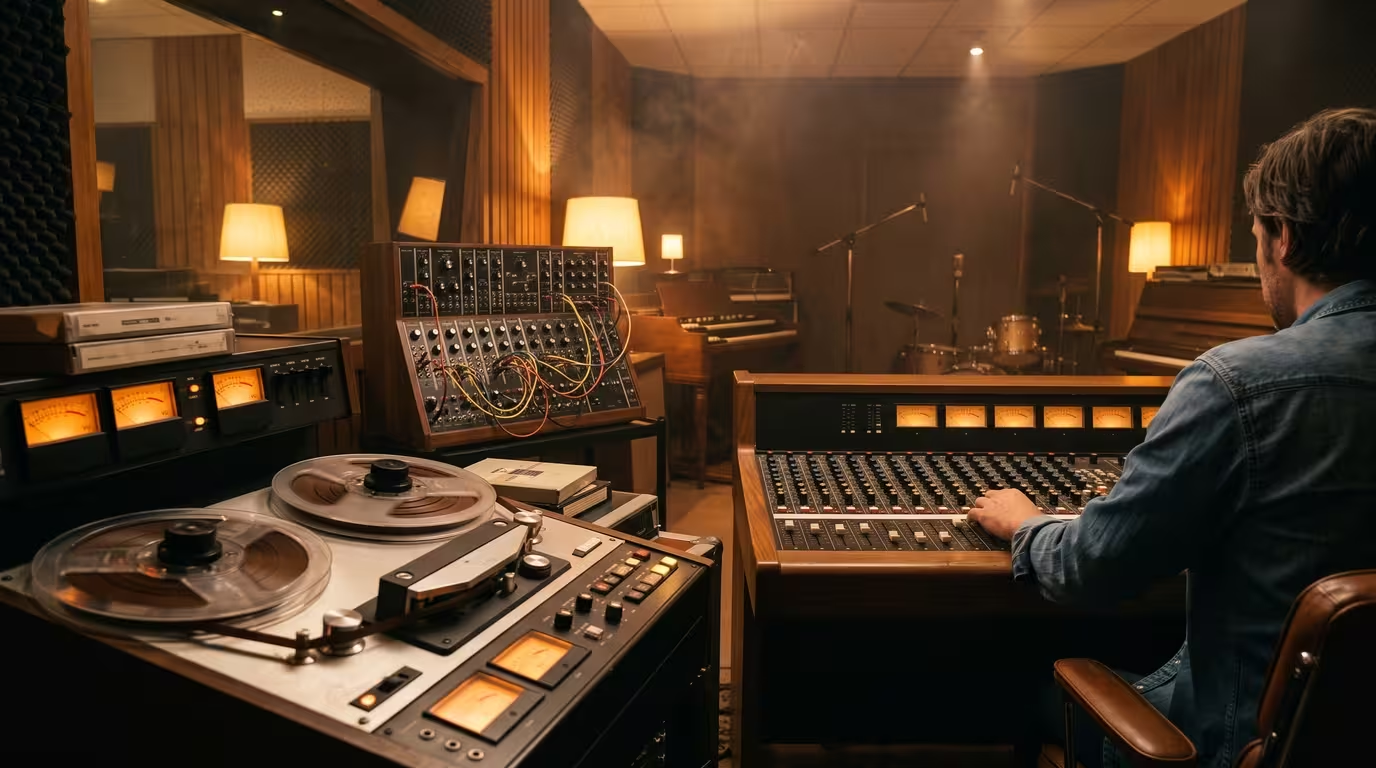
Brian Eno was a refugee from art-rock, the synthesizer player and provocateur who left Roxy Music in 1973, when the founding legend of ambient took place. In January 1975 he was struck by a taxi and left bedridden. As the often-told account goes, his friend Judy Nylon brought him a record of 18th-century harp music; after she left, he realised the amplifier was set far too low and one channel had failed entirely, but he lacked the strength to get up and fix it. The faint notes blurred into the rain outside his window, and he found himself hearing music as part of the environment, a tint on the room rather than the focus of it.
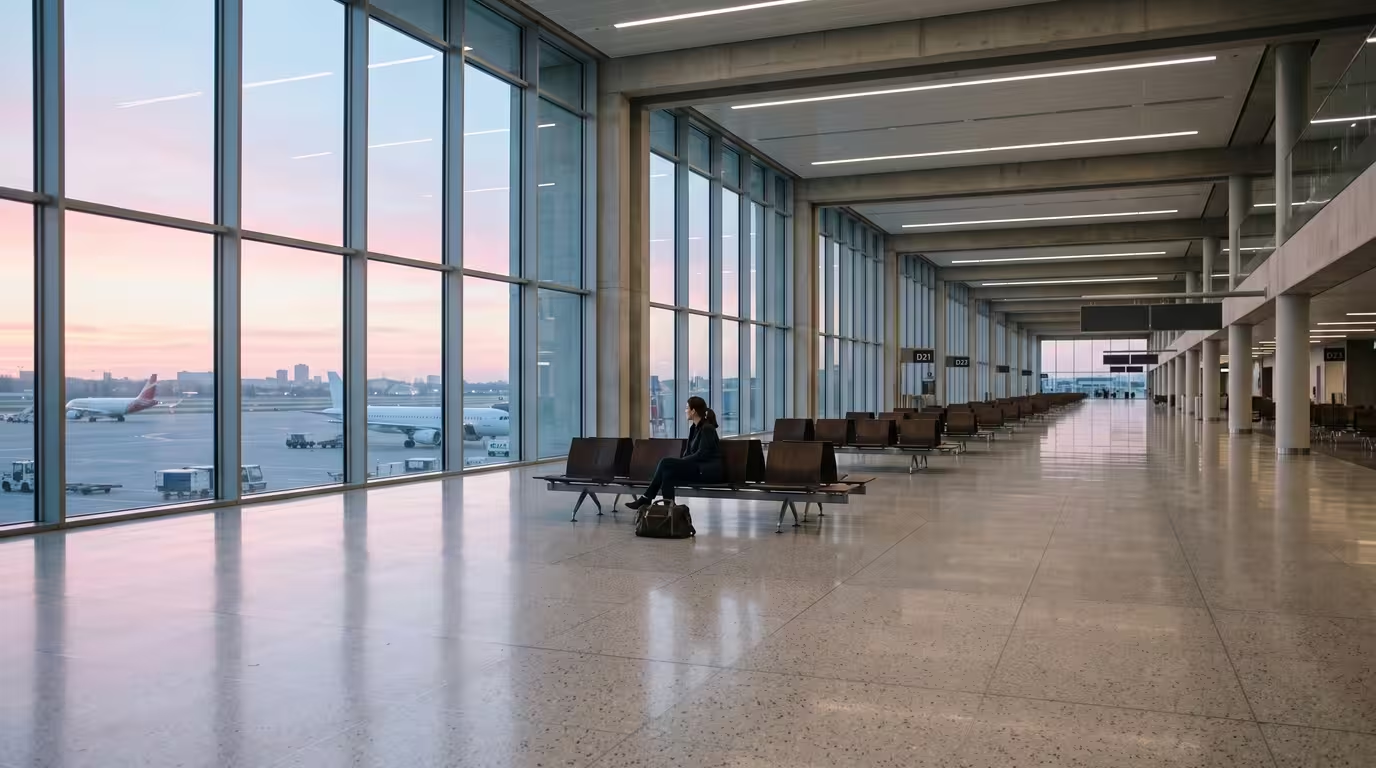
That experience fed directly into Discreet Music (1975), an early proto-ambient work built from a looping tape-delay system, which Eno suggested be played at low volume. But the album that named the genre came three years later: Ambient 1: Music for Airports (1978). Eno built it by layering tape loops of different lengths so they would drift in and out of phase, recording vocal loops with German singers at Conny Plank's studio and using an ARP 2600 synthesizer for the closing piece. He designed it to defuse the anxious atmosphere of an airport terminal, a humane alternative to canned Muzak. In the liner notes he laid out the manifesto, coining the term and writing that ambient music must accommodate many levels of listening attention without enforcing one in particular, that it must be as ignorable as it is interesting, and that it was intended to induce calm and a space to think. Eno was careful about what he had done: other artists had made such music, he later said, but he gave it a name, and by naming something you create a difference.
Brian Eno - 1/1, from Music for Airports

The Ambient Series and the 1980s
Music for Airports opened a four-album Ambient series that turned a concept into a small movement. It ran through Ambient 2: The Plateaux of Mirror (1980), a collaboration with the pianist Harold Budd; Ambient 3: Day of Radiance (1980), performed by Laraaji, whom Eno discovered busking on electric zither in New York's Washington Square Park, and produced by Eno; and Ambient 4: On Land (1982), Eno's own murky, field-recording-laced masterpiece. Around the same time he teamed with the trumpeter Jon Hassell on Fourth World, Vol. 1: Possible Musics (1980), Hassell's vision of a unified primitive and futuristic sound combining features of world ethnic styles with advanced electronic techniques. Ambient ran alongside new-age music for much of the decade like a shadow sister, sharing some tonality and pacing but keeping a colder, more conceptual edge.
The Chill-Out Room: Ambient Meets the Rave
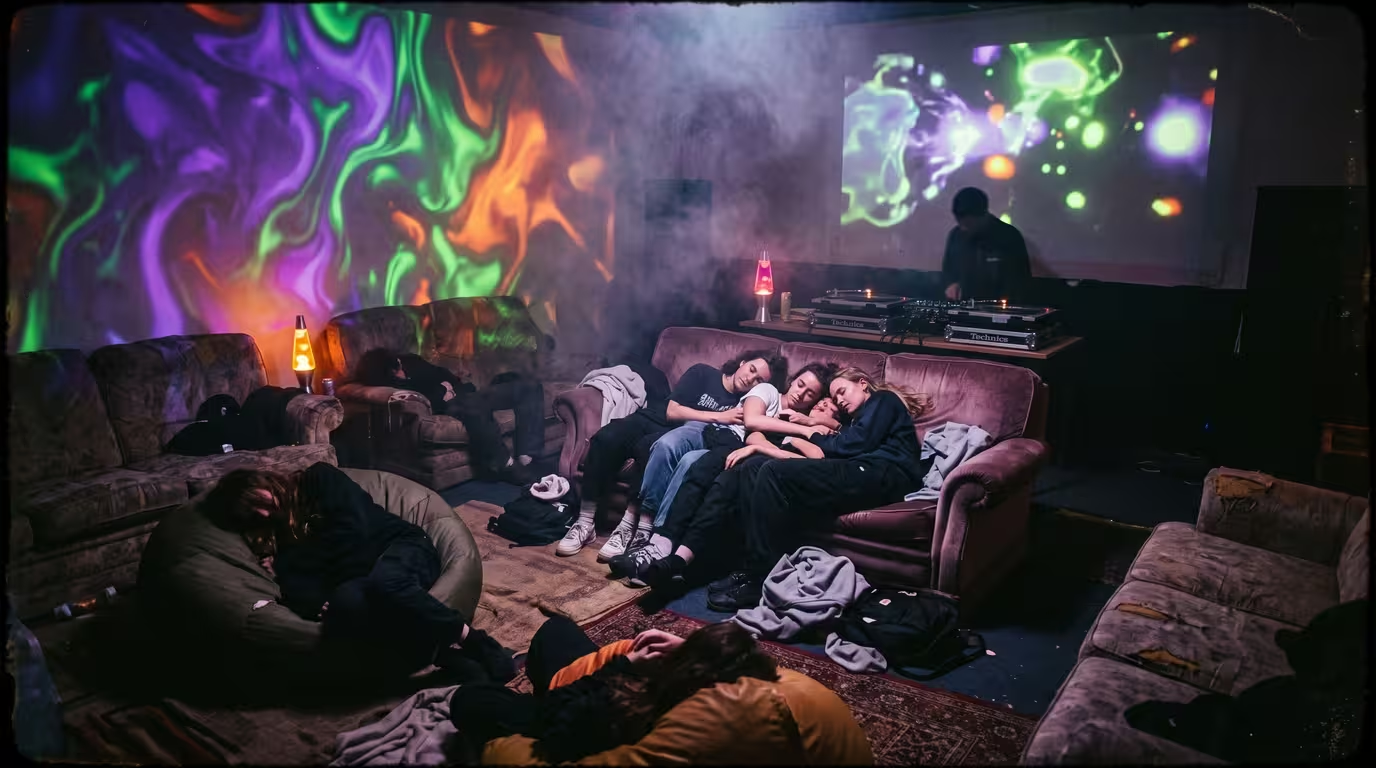
Then acid house happened, and ambient was reborn for a generation that had been dancing all night. As the rave explosion swept Britain in the late 1980s, clubs and parties grew a second space: the chill-out room, a calmer refuge where exhausted dancers could come down, soundtracked by slow, atmospheric music. The very term chill-out music traces to The White Room at London's Heaven nightclub in 1989, where the DJs Jimmy Cauty and Alex Paterson played ambient mixes drawing on Brian Eno, Pink Floyd, Mike Oldfield, 10cc and War.
That White Room, beneath Charing Cross station, was the crucible. Alongside Paul Oakenfold's Monday-night Land of Oz acid house parties in 1989, Paterson and Cauty, sometimes joined by Martin Youth Glover, spun those records at low volume under multiscreen video projections. Out of it came a new hybrid. The Orb, Paterson and Cauty's project, released the sprawling twenty-minute A Huge Ever Growing Pulsating Brain That Rules from the Centre of the Ultraworld in October 1989, threading a sample of Minnie Riperton's Lovin' You through oceanic washes, widely regarded as the first true ambient-house record.
Cauty's other band, the KLF, his partnership with Bill Drummond, gave the style its name and its definitive statement with the album Chill Out, released on 5 February 1990 on KLF Communications: a continuous, sample-laden journey through the American Gulf Coast, complete with pedal steel, train noises and bleating sheep. The music journalist Bob Stanley credited it with pioneering ambient house for its mix of train noises, post-punk dub and pre-punk Floyd, and AllMusic's John Bush gave it five stars as one of the essential ambient albums. The name itself was almost a joke: Cauty told Melody Maker in March 1990 that the term ambient house was basically born out of cynicism, but that once they had come up with it, they figured that if it had to be called something, that was as good a name as any. Paterson then steered the Orb to The Orb's Adventures Beyond the Ultraworld (1991), a double album of spacey, dub-inflected sampledelia that took the chill-out sound onto the charts; its follow-up U.F.Orb, released in July 1992 on Big Life, entered the UK Albums Chart at number one.
Ambient Techno and the Early-90s Boom
The chill-out room's appetite for beatless beauty fed a wider boom in what got called ambient techno and intelligent electronica. Its landmark was Aphex Twin's Selected Ambient Works 85-92, released in November 1992 on Apollo, a subsidiary of the Belgian label R&S, a record of melodic, atmospheric tracks that proved techno could be more than dancefloor fuel. Richard D. James followed it with Selected Ambient Works Volume II, released on 7 March 1994 on Warp Records, largely beatless and far darker. Philip Sherburne, who gave the album a perfect score in Pitchfork, wrote that it changed ambient music forever. The vagueness of ambient house eventually dissolved into a morass of more specific genres, but the principle had crossed over: Eno's idea of music as environment now lived inside dance culture.
The Quiet Conquest
Ambient never stopped evolving. The decades since have produced some of its most powerful work: the orchestral drift of Stars of the Lid, the noise-flecked beauty of Tim Hecker, the Arctic isolation of Biosphere's Substrata, the techno-haunted forests of Wolfgang Voigt's Gas, and William Basinski's The Disintegration Loops, built from magnetic tape literally crumbling as it played and forever bound to the days around September 11, 2001.
Today, Eno's 1978 thought experiment has quietly conquered the listening landscape. Ambient is the dominant mode of background music in the streaming age, the engine behind countless sleep, focus, study and meditation channels, and the lo-fi loops and wellness playlists that soundtrack modern life. In a December 2025 editorial, YouTube's Culture and Trends team noted that the genre Eno coined in the 1970s for close listening has transformed into a vast ecosystem of ambience channels for sleep, relaxation and focus, pointing out that the single channel Soothing Relaxation has drawn more than 4.8 billion views. The music that was once dismissed as too boring to bother with now plays, more or less continuously, in millions of rooms at once.
It is worth pausing on the craft underneath all this. Ambient is texture-and-mood music, which makes it a deep school of sound design, atmosphere and space rather than chords and choruses, a rich and surprisingly demanding world for any producer who wants to build feeling out of tone. That, in the end, is the through-line: ambient music, named and defined by Brian Eno, built on Satie and minimalism and kosmische experimentation, reborn in the chill-out rooms and ambient house of the rave era, has become one of the most quietly influential ideas in modern music, the sound of the room, finally heard.
Key takeaways
• Ambient music prioritises atmosphere, texture and mood over rhythm, structure and melody, designed as an environment to be actively heard or ignored.
• Brian Eno coined and defined the term, crystallising it with Ambient 1: Music for Airports (1978) and its as-ignorable-as-it-is-interesting manifesto.
• Its roots run through Erik Satie's furniture music, minimalism, musique concrete and German kosmische synth music.
• The late-80s and 90s rave chill-out room reinvented ambient as ambient house, through The KLF and The Orb, and ambient techno through Aphex Twin.
• Now ubiquitous in streaming, sleep and focus listening, ambient is among the most quietly influential forms in modern music.
