You can beatmatch two tracks perfectly and the mix can still sound wrong. That nagging off feeling almost always comes down to phrasing: the beats are locked, but the musical sections aren't. This guide is about the skill that separates a clean blend from a clumsy one — counting phrases by ear, aligning the structures of two tracks, and developing the judgment to know exactly when to begin and end a transition.
What Phrasing Actually Means
Beatmatching gets the tempo and phase of two tracks aligned so their kicks and snares land together. Phrasing is the next layer up: aligning the musical phrases and sections so the structure of the incoming track runs parallel to the structure of the track that's already playing. As Wikipedia's entry on Phrasing (DJ) explains, phrasing refers to the alignment of the phrases of two tracks in a mix, letting the transition happen without breaking the musical structure — and it stresses that phrasing is an aspect of beatmatching, not a separate technique. The two work together.
Here's the difference in practice. In a beatmatched-but-phrase-clashing mix, the beats line up but a verse of one track collides with the chorus of another, two vocals talk over each other, or your incoming drop lands in the middle of the outgoing track's breakdown. Everything is in time yet it sounds like a mess. In a properly phrased mix, the sections breathe together: basslines start and stop at the same moment, breakdowns coincide, and the new track's first big element arrives exactly where the old track makes room for it. Some DJ educators call the beatmatched-but-misaligned failure a phrase wreck — the phrasing equivalent of a beatmatching trainwreck.
Mixing on the phrase simply means making your structural changes happen together. When you nail it, the audience never notices the seam.
A Quick Recap of the Phrase Grid
This article assumes you've already met beats, bars, and phrases — they're covered in depth in our Bars, Beats, and Time Signatures article, so here's just the working summary. Almost all dance music is in 4/4: four beats to a bar. Bars group into phrases, and in most modern electronic music the standard phrase is 8 bars (32 beats) long, with larger sections often running 16 or 32 bars. Structural changes — a new element entering, a fill, a drop — almost always land on a phrase boundary, on the first beat of a new 8-bar block.
That regularity isn't an accident; it reflects how Western music is built. The musical concept of a phrase is a unit of musical meter with a complete musical sense of its own, and in popular and dance styles these units stack into tidy multiples of four. For you as a DJ, the practical takeaway is short: count in eights, and expect change on the "one."
A Quick Recap of Song Sections
Phrases are the bricks; sections are the walls they build. Our Electronic Song Structure article covers these in full, but in brief, a typical dance track moves through an intro, build-ups, drops or main sections, breakdowns, and an outro. The beat-driven intro and outro exist largely for DJs — they're the stretches of relatively bare percussion designed to overlap with another track.
Knowing these sections matters because phrasing isn't just about counting — it's about deciding which section of the incoming track should sit over which section of the outgoing one. That judgment is the second half of this article.
How to Count Phrases While DJing
Counting phrases is a learnable mechanical skill before it becomes instinct. Start by finding beat 1 — the downbeat — the first beat of a bar, usually the heaviest, often carrying the kick and frequently marked by a crash, a new element, or the start of a vocal loop.
Then count bars rather than beats. The standard method, used by drummers and DJs alike, is to say the bar number on each downbeat: 1‑2‑3‑4, 2‑2‑3‑4, 3‑2‑3‑4 … 8‑2‑3‑4. When you reach the end of "8," a new 8-bar phrase begins and you reset to 1. Counting this way keeps you aware of where you are in the phrase without having to track every single beat.
Train your ear to the signposts that mark the end of a phrase and the start of the next. Producers telegraph these changes deliberately: a drum fill, a reverse-cymbal swell, a riser, a snare roll, or a sudden moment of silence in the last bar before the change. Listen for the change — a new instrument, a vocal entering, the bass dropping out — and you'll hear the music resolving in blocks of eight. As you improve, you'll stop consciously counting and start feeling the phrase, anticipating the change before it arrives.
The hard part live is doing this for both tracks at once: tracking where the outgoing track is in its phrase while counting the cued track in your headphones. This is why knowing your music in advance is non-negotiable — if you already know a track's structure, you only have to count the one playing out loud.
Aligning Two Tracks' Phrases
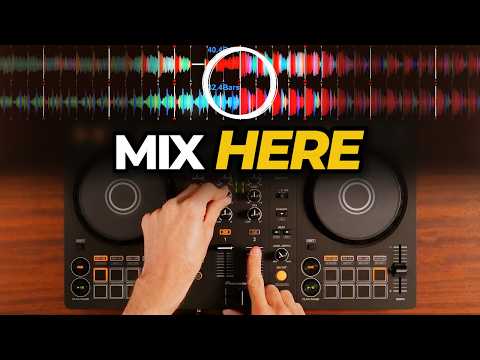
This is the core technique, and the rule is refreshingly simple. Start the incoming track so its phrase 1 / downbeat lands on a phrase boundary — a "one" — in the outgoing track. Drop the new track's intro on the first beat of a fresh 8-bar phrase in the track that's playing, and from that instant the two tracks' phrase grids are locked in parallel. Their basslines, their breakdowns, their drops will all tend to coincide for the rest of the blend instead of colliding.
DJs call this dropping on the one. Because most dance music shares the same simple 8- or 16-bar structure, aligning the phrases is often just a matter of starting the cued track at a phrase boundary in the current one — after that, the productions do the work for you.
The reason precision matters is that being beatmatched but phrase-offset still sounds wrong. If you launch the incoming track 4 beats (one bar) or a few bars late, the beats will still line up perfectly — but the incoming track's "one" now falls on the outgoing track's "five," and every structural change will arrive a bar or a phrase out of step. The mix feels subtly (or not so subtly) off, and when both tracks hit a vocal or a drop at different moments, the clash is obvious.
The practical tool for nailing this is the cue point. Set a hot cue or memory cue exactly on a downbeat — the start of the intro, or the first beat of the phrase you want to launch from — and you can trigger the incoming track precisely in phrase rather than fumbling for the start.
To keep the foundation straight, here's how the three skills stack:
| Skill | What it aligns |
|---|---|
| Beatmatching | Tempo and phase (individual beats) |
| Phrasing | Phrases and sections (musical structure) |
| Phrase + beat together | A mix that sounds intentional |
When to Mix: Timing the Transition
Knowing how to align phrases is half the battle; the other half is choosing which sections to overlap. The governing principle is: match like with like, and never bury the best part.
Where to Start the Blend in the Outgoing Track
Begin bringing the new track in during a stable, lower-energy stretch of the outgoing track — typically as it heads into its outro or breakdown. These beat-driven, less busy sections leave room for a second track. The cardinal sin is starting your mix over the outgoing track's drop, peak, or vocal hook. As Dan Dracott of Beatmatch Guru explains, the chorus is usually the cream of the crop — the most melodic part that people dance and sing along to — so mixing over it both buries the payoff and guarantees a clash. DJ TechTools founder Ean Golden calls the principle "respect the chorus" to remind you to always mind how you're mixing in relation to it. Mix out of the chorus, not over it.
Where to Mix In on the Incoming Track
Bring the new track in on its intro — the beat-driven section producers build specifically for mixing — and time it so the incoming track's first big section (its first drop or vocal) arrives at the right moment, usually just as the outgoing track is bowing out.
Match Like With Like
The safest pairings put structurally similar sections together. This small reference covers the bread-and-butter moves:
| Outgoing track section | Incoming track section |
|---|---|
| Outro | Intro |
| Breakdown | Intro / build |
| End of chorus | Verse / intro |
The opposite — what to avoid — is equally short:
| Don't overlap | Why |
|---|---|
| Two drops at once | Energy and rhythm collide (unless deliberately double-dropping) |
| Two vocals at once | Voices talk over each other |
| New track over the hook | Buries the outgoing track's best moment |
Intro-over-outro is the bread-and-butter long blend and the most failsafe move there is, since it works even when you don't know the tracks well — start the new track as the old one hits its outro and bring it up over the following 16 or so bars. As your control grows you'll mix out of breakdowns and choruses for more energy and variety. A double drop (two drops hitting together) and a breakdown-over-breakdown blend are powerful but advanced — they demand that both sections be the same length, or the drops won't land in sync.
How Long Should a Mix Be?
Phrasing governs the length of the blend. A long blend of 32 or even 64 beats suits house and techno, where intros and outros are generous; shorter, punchier styles often favour quick cuts. As Mixed In Key notes, dance music is generally produced in phrases of 32 beats, while hip-hop and pop songs often use shorter phrasing, with only an 8-beat or 16-beat intro section — so a roughly 32-beat overlap suits shorter intros and up to 64 beats suits house. The key is that the blend should start and finish on phrase boundaries, and you should aim to complete the mix before either track hits a section with more than just beats — a bassline, a melody, a vocal. At the other extreme, a quick cut on the phrase — or a hard cut straight into a drop — is a perfectly valid transition when the music calls for it.
Using Software and Visual Aids
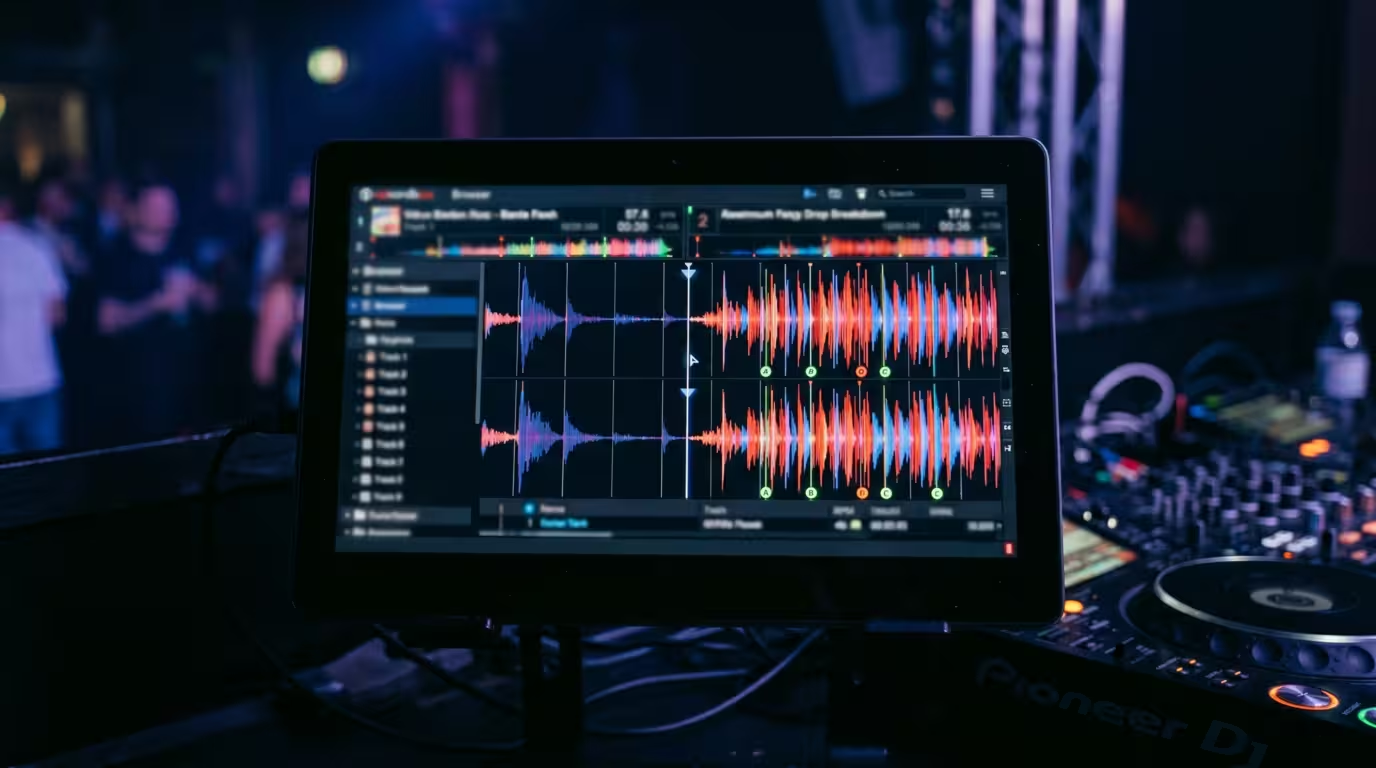
Modern DJ software makes phrasing easier to see, though it never replaces hearing it. The waveform is your first aid: louder, denser sections (drops, choruses) and thinner, quieter ones (breakdowns, intros) are visible at a glance, so you can spot a breakdown coming before you hear it.
Pioneer DJ's rekordbox goes further with Phrase Analysis, which labels each section of a track. According to the official rekordbox Phrase Edit operation guide, the track structure is expressed as a set of phrases: Intro, Up (build-up), Down (breakdown), Chorus, Bridge, Verse, and Outro. The same feature detects Fill In sections — short improvisational changes at the end of a phrase, found at the end of Intro, Up, and Chorus sections (up to four beats) — which are exactly the signpost moments you'd otherwise hunt for by ear.
In Serato DJ, beatgrids and cue points do the heavy lifting. Serato's documentation advises that while paused you can use the platter to fine-tune the playhead placement so your cue point sits exactly on a downbeat, and with Quantize enabled your cue points snap to the beatgrid for a perfect setting. Traktor Pro offers beat jump and a configurable deck header whose Bars per Phrase setting (a bar being four beats) feeds a counter that, as DJ TechTools describes, shows three numbers reading phrase, bar and beat — letting you see your position in the phrase at a glance.
All of this is genuinely useful — hot cues on downbeats, phrase labels, bar counters — but every authority agrees on one thing: the software's analysis can be wrong, and your ear is the final arbiter. Train the ear; let the screen confirm it.
Common Mistakes and Practice Tips
The most common phrasing error is starting the incoming track off-phrase — launching it mid-phrase so its structure is permanently a bar or more out of step. Set cues on downbeats and drop on the one to avoid it.
Losing count during long mixes is the next pitfall; a 64-beat blend is a long time to track two structures, and it's easy to drift. Lean on the signpost sounds and your software's counter to stay oriented. Clashing two drops or two vocals kills a mix instantly — if you must run two busy sections together, EQ one out of the way (drop the mids on one vocal) or pick simpler sections. Mixing in over the outgoing track's vocal or hook wastes the song's best moment. And not knowing the incoming track's structure beforehand leaves you guessing live — always prep.
Finally, remember that not every track is tidy. As Ean Golden points out, while most Western music is built on phrases of 8, 16, and 32 counts, songs can use shorter phrasings — especially in hip-hop and pop, where an 8- or 16-count intro is more common — and some pop, disco, and older tracks use other odd-length sections that will throw your count if you assume a rigid 8. This is precisely why counting and listening beat the software, which can mislabel an irregular track.
To build the skill: count along to tracks away from the decks until it's automatic; set hot cues on phrase starts as you prep your library; and, above all, know your music. Practising in front of an audience (any size) is how the timing becomes instinctive, because where you choose to mix is, in part, decided by them.
Key takeaways
• Phrasing aligns the musical sections of two tracks; beatmatching only aligns the beats. You need both.
• Count in 8-bar phrases (1‑2‑3‑4, 2‑2‑3‑4 … 8‑2‑3‑4) and expect structural change on the "one."
• Start the incoming track on a downbeat at a phrase boundary of the outgoing track — drop on the one — so the two structures run parallel.
• Mix the incoming track's intro over the outgoing track's outro or breakdown; never over its drop or vocal hook (respect the chorus).
• Match like with like (intro/outro, breakdown/breakdown) and avoid clashing two drops or two vocals.
• Use waveforms, rekordbox Phrase Analysis, and cue points to assist — but train your ear, since some tracks have odd-length sections.
Ready-made, exclusive EDM tracks with full rights — released as your own.
