Most beginners practice by loading two tracks they already know, mixing them the same way they did yesterday, and calling it a session. You feel busy, but you barely improve. This article shows you how to practice DJing the way learning scientists and working DJs actually recommend: short, focused sessions built around one clear goal, a progression of specific drills, and the single habit — recording and reviewing — that turns hours behind the decks into real skill. It is about the routine and the method, not the gear.
Why Structured Practice Beats Noodling
Aimlessly jamming feels productive, but it mostly reinforces what you can already do. The psychologist K. Anders Ericsson spent decades studying how experts in music, sport, and chess actually get good, and his conclusion was that the type of practice matters far more than raw hours. In his book Peak, Ericsson describes purposeful practice as having four features: a well-defined specific goal, full focus, immediate feedback, and working just outside your comfort zone. (Strictly, he reserves the term deliberate practice for fields with expert coaches and established curricula; what a solo bedroom DJ can do is best called purposeful practice — the same principles, minus the coach.) The essence is simple: push just beyond your comfort zone in a focused way, with clear goals, a plan to reach them, a way to monitor progress, and a strategy to stay motivated.
Translate that to the decks. A vague goal such as get better at mixing gives you nothing to measure. A specific goal such as beatmatch five random track pairs by ear, sync off, holding each for two minutes tells you instantly whether the session worked. If a drill is easy and automatic, you are not improving — you need to nudge the difficulty up.
Two more findings from learning science should shape your schedule. First, the spacing effect: information and skills stick better when practice is spread over many short sessions rather than crammed into rare long ones. This was first documented by Hermann Ebbinghaus in his 1885 book Memory: A Contribution to Experimental Psychology, and it is among the most robust results in cognitive psychology — a large 2006 synthesis in Psychological Bulletin by Cepeda, Pashler and colleagues reviewed hundreds of experiments confirming that spaced study beats massed study across facts, procedures, and motor skills. For you, that means 30 focused minutes most days beats one three-hour weekend marathon. Second, interleaving: mixing several skills within a session rather than drilling one for weeks. This kind of varied practice feels harder but produces better long-term retention and transfer, which is exactly why the session templates below rotate through warm-up, a focused drill, and free mixing rather than drilling one thing to death.
How to Structure a Single Session
Every good practice session has the same shape: a warm-up, one focused skill drill, a stretch of free mixing or a mini-set, and a record-and-review block. The warm-up gets your ears and hands going on something you can already do. The drill is where the real learning happens — pick one skill and one specific goal. The free-mix block lets you apply that skill under semi-realistic conditions. The review block is non-negotiable (more on that below).
Before you start, decide your single goal for the session and write it down. Keep your library and a prepared crate ready so you are not spending half your time digging. Here are two templates you can use as-is.
| Block | 30-min session | 60-min session |
|---|---|---|
| Warm-up (easy mixing) | 5 min | 10 min |
| One focused skill drill | 10 min | 20 min |
| Free mixing / mini-set | 10 min | 20 min |
| Record review and notes | 5 min | 10 min |
The 30-minute template is the one to default to, because the spacing effect rewards frequency. DJ educator Ben Rainey, in his guide How To Learn DJing From Home, prescribes exactly this kind of split — roughly ten minutes of beatmatching drills, ten minutes of phrasing practice, and ten minutes mixing a short four-to-five-track set as if performing, then recorded and reviewed. It is proof you do not need long sessions to progress quickly if they are focused.
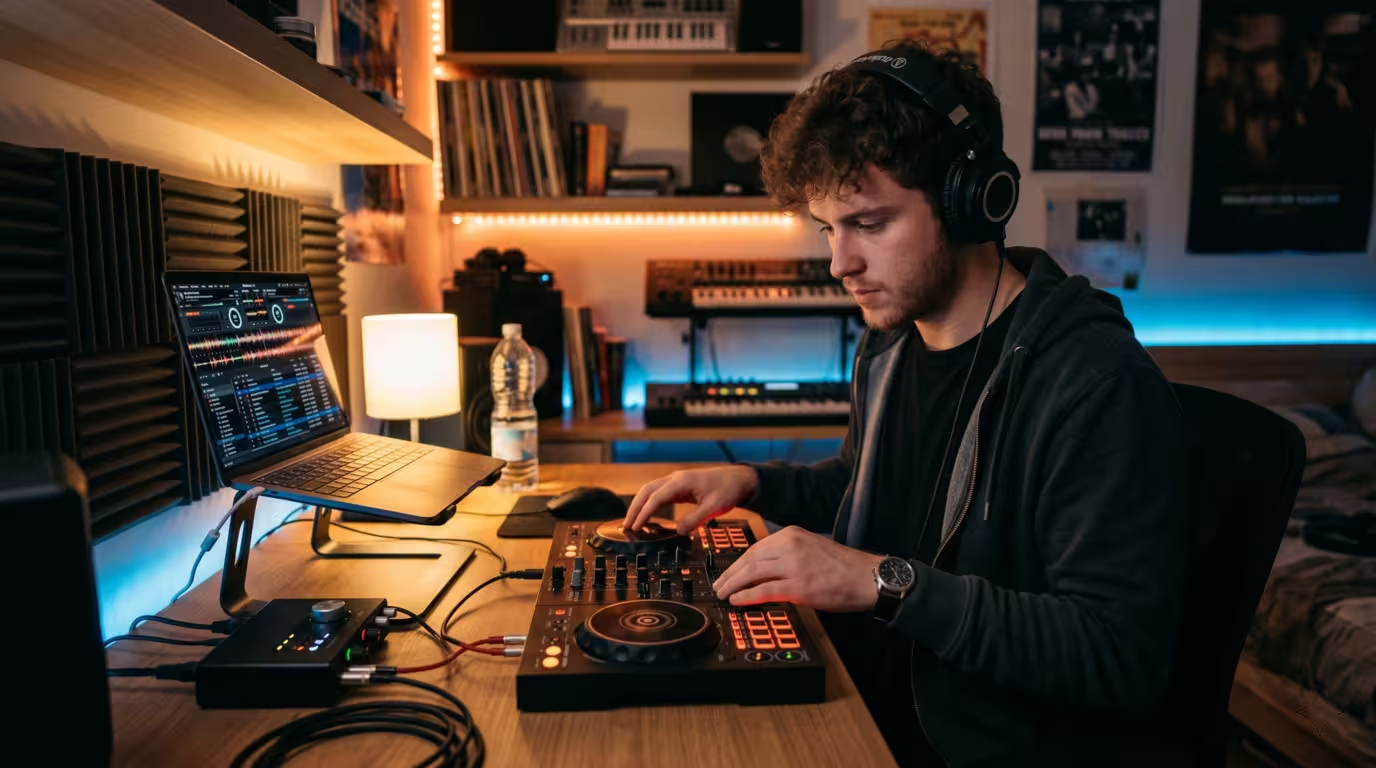
A Progression of Drills, in Order
Work through these roughly in order. Each is a discrete exercise with a clear, testable goal. Spend several sessions on each before moving on, but keep revisiting earlier ones as warm-ups — that is the interleaving advantage.
Know Your Music First
Library familiarity drill. You cannot mix tracks you do not know. Away from the decks, listen to your crate and note each track's intro length, where the breakdown and drop land, and where the outro starts. Beginners who lean on playlists without knowing track structure get caught out by timing. Goal: for ten tracks, recall the shape — say, 16-bar intro, breakdown at the halfway point, 32-bar outro — from memory.
Gain and level drill. Set all gains to minimum, then bring each channel up until the loudest part peaks just below the red on the meter — into the green and occasionally orange, never red. Push channel faders near full, then set the master the same way. Do this for tracks of different loudness so you learn to even them out by ear and eye. As Serato's own guide puts it, when the meters sit just below the red, your signal is as loud as it can be without clipping. Goal: load five tracks of varying volume and level-match them so none jumps out.
Cueing and first-beat drill. Practice finding the first beat (the downbeat) of a track and dropping it precisely. Set a hot cue exactly on beat one of the intro and on the first beat of major phrases. Goal: cue and launch a track on the one, ten times in a row, cleanly.
Build the Timing Fundamentals
Counting and phrasing drill. Almost all dance music is in 4/4, built from bars of four beats grouped into 8-bar (32-beat) phrases, with new elements arriving at phrase boundaries. Count along — one-two-three-four, two-two-three-four, up to eight bars — and listen for the change that signals a new phrase. Goal: predict the next phrase change before it happens, by ear, across three different tracks. This phrasing instinct is the single biggest polish a beginner can add.
Manual beatmatching drill. Cover the screen or hide the waveforms and BPM display, switch sync off, and match two tracks by ear using only the pitch fader and small jog nudges. Beatmatching means nudging an incoming track's tempo until its beats line up with the track already playing. Start with tracks within about 5 BPM of each other; widen the gap as you improve. Goal: hold two tracks in time for two minutes without touching the pitch after the initial match.
Blend and Transition Cleanly
EQ and bass-swap drill. The golden rule: never run two basslines at full at once, or the low end turns to mud on a real system. Practice killing the low EQ on the incoming track, then swapping the bass at a phrase boundary — bring the new low up as you cut the old one. Goal: perform ten clean bass swaps, each landing exactly on the start of a phrase.
Single-transition drill. Pick one transition type (a long EQ blend, a bass swap, or a filter sweep) and repeat it until it is clean, rather than collecting tricks. Interleaving says vary your skills across sessions, but within a single drill, repetition builds the motor pattern. Goal: the same transition, performed cleanly five times with different track pairs.
Put It Together
Short-set-from-memory drill. Choose five to eight tracks in a similar genre and energy, arrange them low-to-high with a cool-down at the end, and perform the set without notes. Goal: a 15-to-20-minute set, mixed start to finish, no restarts.
Recovery drill. Deliberately knock two tracks out of time, then bring them back using nudges and the pitch fader. Mistakes happen live; the skill that separates confident DJs is silent recovery. Goal: drift a track a beat off on purpose and re-align it within four bars, without the listener noticing.
Record and Review Every Single Mix
This is the habit that makes everything else work, and the one beginners skip most. You are too busy performing to hear yourself accurately in the moment — the same reason your recorded voice sounds wrong to you. Recording closes the feedback loop that Ericsson identified as essential to improvement.
Every major DJ application can record internally. In rekordbox, Serato DJ Pro, Traktor, and VirtualDJ you click a record button, set the level so it peaks below clipping, and the file saves automatically — rekordbox, for example, saves an uncompressed WAV. One important catch: Serato's free Lite tier cannot record a set; you need Serato DJ Pro for that. A second catch across all software: recording is usually disabled when you play from streaming services for licensing reasons, so record using tracks you own. If your software cannot record, a phone propped near the speakers or a cheap line-in recorder works fine — the point is to capture it, not to make it broadcast-quality.
When you listen back — ideally away from the gear so you are not tempted to start mixing again — listen specifically for timing drift (beats sliding apart), level jumps between tracks, clashing or doubled basslines, abrupt or mistimed transitions, and phrasing errors (mixing in mid-phrase). Then write it down. Keep a simple practice log: the date, your session goal, what worked, and the one thing to fix next time. That note becomes the specific goal for your next session, and the loop tightens.
Practicing Quietly and on a Budget
You do not need speakers, a controller, or paid software to practice well.
Headphones-only, silent practice. Most mixers and controllers have a cue/mix knob that blends what is in your headphones between the cued track and the master output, so you can monitor everything without speakers. Better still is split cue (also called mono split): it sends the cued track to one ear and the master to the other, letting you beatmatch and mix entirely inside your headphones at low volume — ideal for late-night practice without disturbing anyone. As Digital DJ Tips notes, split cue lets you practise at home with nothing but a pair of headphones. Many entry-level controllers lack a dedicated split-cue button, but software cue/mix monitoring covers the same need.
Software and budget setups. You can DJ with nothing but a laptop. VirtualDJ is free for home use and runs fully on a laptop with keyboard and mouse; Serato DJ Lite is free and includes a Practice Mode that works without any hardware; rekordbox and Mixxx (which is genuinely open-source and free) are also options. There are capable phone and tablet apps too. None of this is a long-term excuse to avoid a controller, but it removes every barrier to starting today.
Simulate Real Conditions
Bedroom practice can drift far from how it feels to actually play out, so build in some realism. Stand up when you practise — DJing is done standing, and your timing and stamina are different on your feet. Occasionally commit to transitions you cannot undo: no rewinding, no second takes, just like a live set, which trains you to recover instead of restart. Play the odd set to an imaginary crowd, even saying an intro out loud, to rehearse the flow rather than just the buttons. When you get the chance, practise on different gear — a friend's CDJs, a controller you do not own — so your skills are not glued to one layout. And every so often, do a full, unbroken set of an hour or more. As the DJ education platform Crossfader points out, you cannot expect to perform a full set if you have only ever practised 10-minute chunks or individual transitions. Long run-throughs build the stamina, concentration, and flow that real gigs demand.
Common Practice Mistakes
The fastest way to improve is to stop doing the things that quietly waste your time. Here are the most common traps and what to do instead.
| Common mistake | Do this instead |
|---|---|
| Replaying the same easy mix every session | Set one new, specific goal each session and work just past your ability |
| Always relying on the sync button | Drill manual beatmatching by ear with sync and the screen off |
| Never recording your practice | Record every session and review it for specific errors |
| Never finishing a full track or set | Do full run-throughs to build stamina and flow |
| Practicing for hours until focus fades | Keep sessions short and frequent; quality over duration |
| Buying new gear instead of building skill | Master the setup you already own before upgrading |
Relying on sync from day one is the most consequential of these. Sync is a legitimate tool, but if you lean on it before your ears develop, you never learn to feel when tracks drift — and you will be stranded the moment the software's beatgrid is wrong or the gear lacks the feature.
Realistic Cadence and Tracking Progress
Consistency beats intensity. The consensus among DJ educators, echoed by Crossfader's practice guide, is that practising 30 to 60 minutes a few times a week beats cramming once every couple of weeks — even short sessions build progress when you are focused. That aligns precisely with the spacing effect. Treat it like a standing appointment: block the time, leave your gear set up and a crate prepared, and show up even when you are not feeling inspired. And give each session a purpose — the goal is not just to mix, it is to improve, so pick one thing, drill it, and build from there.
Track progress across weeks, not days. Skill in motor tasks like beatmatching develops with repetition and will feel slow day to day, but your practice log and your old recordings make the curve visible. Re-listen to a mix from a month ago: tighter timing, smoother transitions, better phrasing, and more confident track choices are the signs it is working. When a drill becomes easy, that is your cue to raise the difficulty — wider BPM gaps, faster transitions, less familiar tracks — and keep yourself at the productive edge of your comfort zone.
Key takeaways
• Practice with intent: one specific, testable goal per session, full focus, and a skill that is just beyond your current ability.
• Short, frequent sessions beat rare marathons (the spacing effect); rotate through warm-up, one drill, free mixing, and review (interleaving).
• Work the drills in order: know your tracks, set levels, cue the first beat, count phrases, beatmatch by ear, EQ and bass-swap, master one transition, then build full sets and practise recovery.
• Record and review every mix — it is the fastest feedback loop — and keep a log of what to fix next time.
• You can practise silently with split cue and headphones, and for free on a laptop; simulate real conditions by standing, committing to mixes, and doing full sets.
• Learn manual beatmatching before leaning on sync, and build skill on the gear you have rather than gear-hopping.
Ready-made, exclusive EDM tracks with full rights — released as your own.
