Strip a techno track of everything you think it needs, the melodies, the breakdowns, the build-and-drop drama, and what survives is a kick, a hi-hat, a sliver of bass and a great deal of space. That residue is not a failure of imagination. It is minimal techno, the genre that took dance music's most contrarian idea, that less can hit harder than more, and turned it into a whole movement. This is the story of how subtraction became a sound.
Blog
Minimal Techno and the Art of Less
How a radical act of subtraction, born in Detroit and perfected in Berlin, turned restraint into one of dance music's most powerful ideas.
What Less Is More Means on a Dancefloor
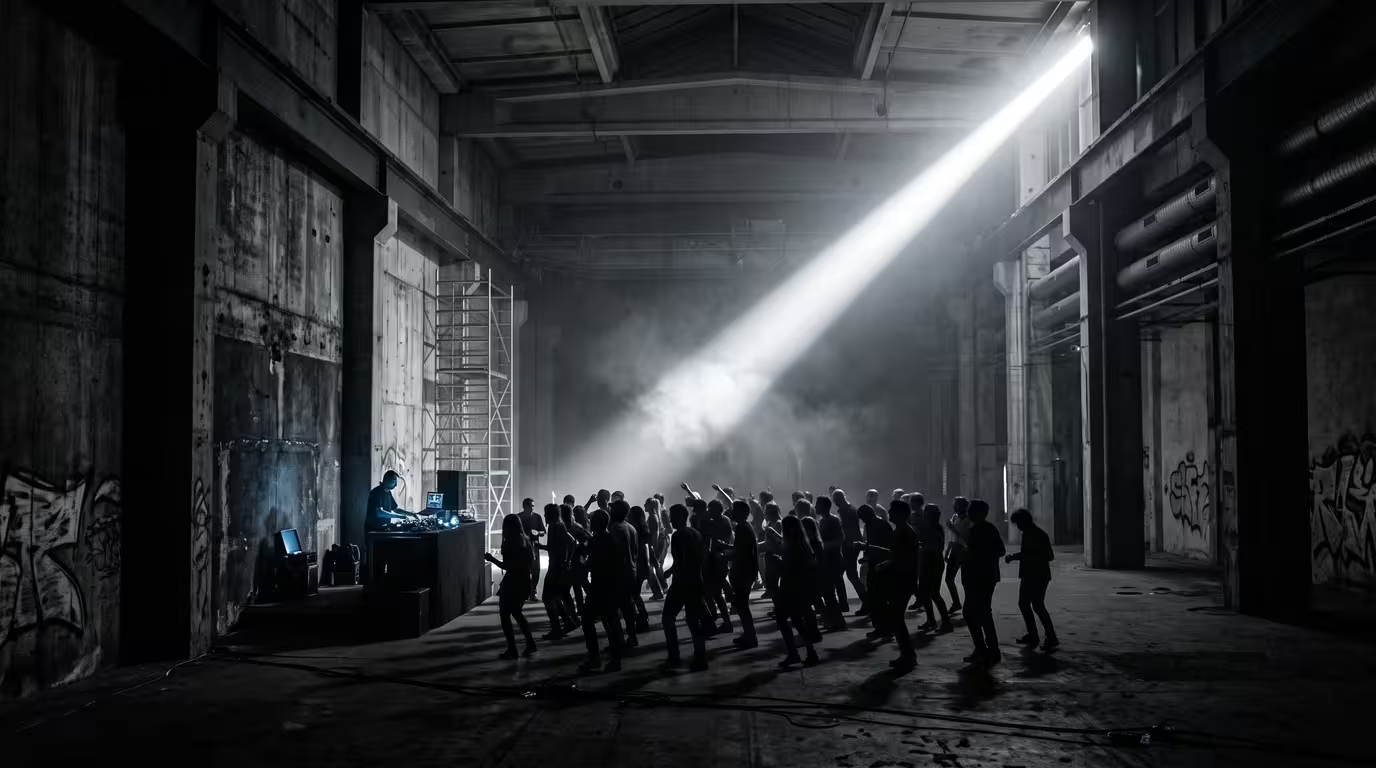
Minimal techno is a stripped-down subgenre of techno built on reduction. Where mainstream club music piles on layers, minimal removes them: few elements, lots of room to breathe, subtle repetition, and a hypnotic groove that rewards patience rather than instant gratification. The drama lives in the details. A filter slowly opening, an extra hi-hat slipping into the pattern, a percussion hit shifting a fraction off the grid; in a track this sparse, each tiny change lands like an event.
The emphasis falls on rhythm, texture, swing and sound design rather than big hooks. Tempos generally sit in the roughly 120 to 130 BPM range, dry and functional, engineered for long DJ sets and the kind of deep listening where your brain locks into the loop. It is music of space as much as sound, and the silences between notes carry as much weight as the notes themselves, an idea the genre's own pioneers stated plainly. As the standard reference entry on minimal techno summarises, it is defined by a stripped-down aesthetic that exploits repetition and understated development.
There is a deeper lineage here too. The broader idea of minimalism in music, reduction to essentials, hypnotic repetition, slowly unfolding change, runs back to twentieth-century composers like Steve Reich and Philip Glass, whose layered, modular repetition has often been cited as part of the same family tree that produced techno's cyclical machine music. The connection should be drawn carefully: minimal techno's architects were club producers, not conservatory disciples. But the philosophy rhymes. Both treat repetition not as monotony but as a doorway.
Detroit, 1994: Stripping Techno to the Bone
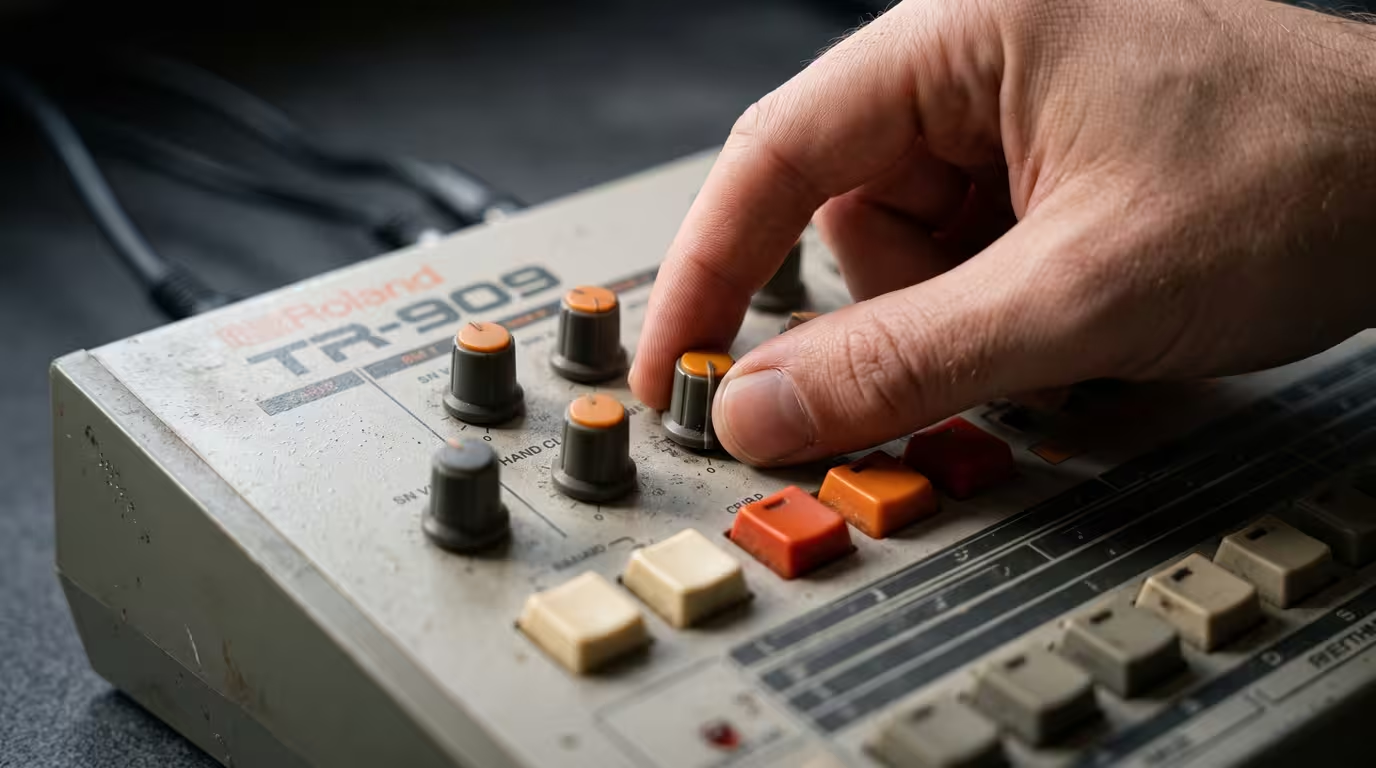
Minimal techno was, above all, a deliberate reduction of techno's elements, and the record most widely credited with naming and defining it came from Detroit. Robert Hood, a founding member of the militant collective Underground Resistance, released Minimal Nation in 1994 on Jeff Mills' Axis Records. It pared techno down to grinding loops, pounding kicks and percussive essentials, retaining a dirty funk that legions of later imitators would miss.
The origin was almost absurdly spare. Hood has recalled fooling around with a Juno 2 keyboard, coming across one chord sound, and realising that with that chord and a particular pattern he did not need anything else. He also framed the album as a protest record against techno's excesses, telling Andrew Weatherall that nobody seemed to get it: techno was becoming one huge sample and the raves were becoming all about drugs. That same year he followed it with Internal Empire on Berlin's Tresor; Resident Advisor later called it truly the first techno record that deserved to be called minimal.
He was not alone. His Underground Resistance comrade Jeff Mills, known as the Wizard, was already pushing a stripped, percussive, relentlessly hypnotic style as a DJ and producer, and Detroit's Daniel Bell is routinely cited alongside Hood as an early architect. The shared instinct was to reduce techno to rhythm and function, to find the trance in the loop. As one account put it, this was a sound forged not through addition but through subtraction.
Robert Hood on the Making of Minimal Nation

Berlin and the European Expansion
If Detroit invented the idea, Europe, and Germany above all, built the movement. In Berlin, Basic Channel, the duo of Moritz von Oswald and Mark Ernestus, fused techno's minimal structures with the echo, delay and cavernous space of Jamaican dub from 1993, spawning dub techno and the hypnotic Chain Reaction sound, all routed through their Hard Wax record store. In Cologne, Kompakt, formally founded in 1998 by Wolfgang Voigt, Michael Mayer and Jurgen Paape out of a record shop, gave minimal a dreamier, pop-tinged face, documented across its long-running Total compilation series. In Frankfurt, and later Berlin, Perlon, run by Zip and Markus Nikolai from 1997, cultivated a warmer, funkier, more patient strain.
Out of this ferment came microhouse, the glitchy clicks-and-cuts hybrid of minimal techno and house. The term was coined by the journalist Philip Sherburne in a July 2001 article for The Wire titled The Rules of Reduction, describing music stripped down to a threefold essence of rhythm, soul and silence, swapping conventional drum hits for clicks, static and tiny bits of noise. Berlin, with clubs like Berghain, its Panorama Bar and the hedonistic riverside Bar25 (2004 to 2010), became the global capital of the sound, with rooms built for marathon sets where a single groove could unspool for hours.
The 2000s Boom and Its Kings
By the mid-2000s, minimal was not a niche; it reigned across the European underground, roughly from 2003 to 2009. Two figures defined its peak. Canada's Richie Hawtin, recording as Plastikman, had already laid groundwork with the acid-minimal Sheet One (1993) and the dark, near-featureless Consumed (1998); his Minus label, founded in 1998, and his move to Berlin made him the defining brand of 2000s minimal. The other was Ricardo Villalobos, the Chilean-German master of the hypnotic, extended track. His 2003 album Alcachofa, home to Dexter and Easy Lee, became a touchstone: Resident Advisor voted it number one on its Top 100 Albums of the 2000s, and in 2025 still ranked it among the greatest electronic records of the century. Villalobos's gift was building entire worlds from a deceptively simple groove; Attack Magazine's breakdown of Dexter shows how delay and a handful of sparse notes imply far more than is actually played.
Then came Romania. In Bucharest, a tight-knit crew turned minimal even further inward, adding organic warmth and a near-spiritual approach to the long set. The trio of Rhadoo, Raresh and Petre Inspirescu, collectively RPR Soundsystem, established the a:rpia:r label in 2007, the same period the Sunwaves festival launched on the Black Sea coast and began exporting the sound the world came to call rominimal: deep, dubby, super-reduced and built for sets that run for many hours. Ricardo Villalobos was an early champion, later releasing his own LP on the label. The Romanian scene proved minimal still had unexplored depths long after the hype crested elsewhere.
Backlash, Evolution and the Lasting Lesson
Domination breeds revolt. By the late 2000s, minimal had become so ubiquitous that the word curdled into something close to a punchline, with critics complaining it had grown bland, soulless and oversaturated, a paint-by-numbers ketamine house. As the oral history of Berlin minimal recounts, by around 2009 the term itself was becoming an insult in the very city that had crowned it. The scene moved on: house came roaring back, techno turned harder and darker again in the 2010s, and minimal's sparse aesthetic bled into the tech house that would conquer clubs worldwide.
But the lesson stuck. Minimal techno permanently rewired how producers think about space, restraint and groove, from the value of surgical EQ to subtle automation and letting a few well-chosen elements breathe. Its purist underground never died; the rominimal scene and labels like Perlon still thrive, and hypnotic, reduced techno remains a living tradition. The discipline at the heart of it, making a handful of sounds groove until they hypnotise, is one of the hardest crafts in electronic music, and one of the most useful for any producer to learn. As Robert Hood proved in a freezing Detroit winter, you do not need everything. You need the right things, and the confidence to leave the rest out.
Key takeaways
• Minimal techno is the art of less: reduction, repetition, space and hypnotic groove over melody and drops, usually around 120 to 130 BPM.
• It was born in early-1990s Detroit, with Robert Hood's Minimal Nation (1994) widely credited as its defining statement.
• Europe built it into a movement through Basic Channel, Kompakt and Perlon, plus the microhouse clicks-and-cuts wave, with Berlin as its capital.
• The 2000s boom crowned Richie Hawtin and Minus alongside Ricardo Villalobos, then spread to Romania's marathon-set rominimal scene.
• A backlash branded it bland, but its core idea, that restraint and groove beat maximalism, reshaped dance music for good.
