A DJ mix is built from other people's copyrighted recordings, so whether it is legal depends almost entirely on context. Playing tracks live in a properly licensed venue is generally covered, but recording a mix and — above all — uploading, distributing, or selling it without permission usually steps on the rights holders' copyrights unless a platform or licence handles the clearance for you. This article explains the nuances in plain English so you can share your mixes the right way.
This article is general educational information, not legal advice. Copyright and music-licensing rules vary by country and by platform, and they change over time. For your specific situation, consult a qualified music attorney and always check the current terms of any platform you use.
The short answer: it's nuanced
A DJ mix (also called a DJ set) is a sequence of tracks blended into one continuous piece of audio. Because almost every track you mix is somebody else's intellectual property, the legal question is not really are DJ mixes legal but legal to do what, and where?
Recall the foundation covered in our Copyright Basics for Producers article: every commercial track carries two copyrights — the musical composition (the song itself) and the sound recording (the master). The owners of those copyrights hold a bundle of exclusive rights, including the rights to reproduce, distribute, and publicly perform the work. Using someone's copyrighted music in ways that touch those rights generally needs permission or a licence.
That single idea explains everything that follows. Different DJ-mix activities touch different rights:
• Playing out live touches the public-performance right — which the venue typically licenses.
• Recording, uploading, distributing, or selling a mix touches the reproduction and distribution rights — which usually nobody has licensed on your behalf.
So the honest summary is: live play in a licensed venue is generally fine; a recorded mix of copyrighted tracks shared publicly is, strictly speaking, usually infringing unless it is licensed (by you or, more realistically, by the platform). In practice this is a well-known gray area — widely tolerated, but tolerated is not the same as permitted.
The table below sketches the general picture. Treat it as a simplified guide, not a legal ruling.
| DJ-mix activity | General copyright status |
|---|---|
| Playing tracks live in a licensed venue | Generally covered (venue's PRO/public-performance licence) |
| Recording your set for private/personal use | Lower risk, but still a reproduction |
| Uploading a mix to a non-licensed platform | Often infringing; commonly flagged or removed |
| Uploading to a licensed platform (e.g. Mixcloud) | Legitimate where the platform clears and pays rights |
| Selling a mix of uncleared tracks | More clearly infringing |
| A mix of your own / cleared / royalty-free music | Fully legal |
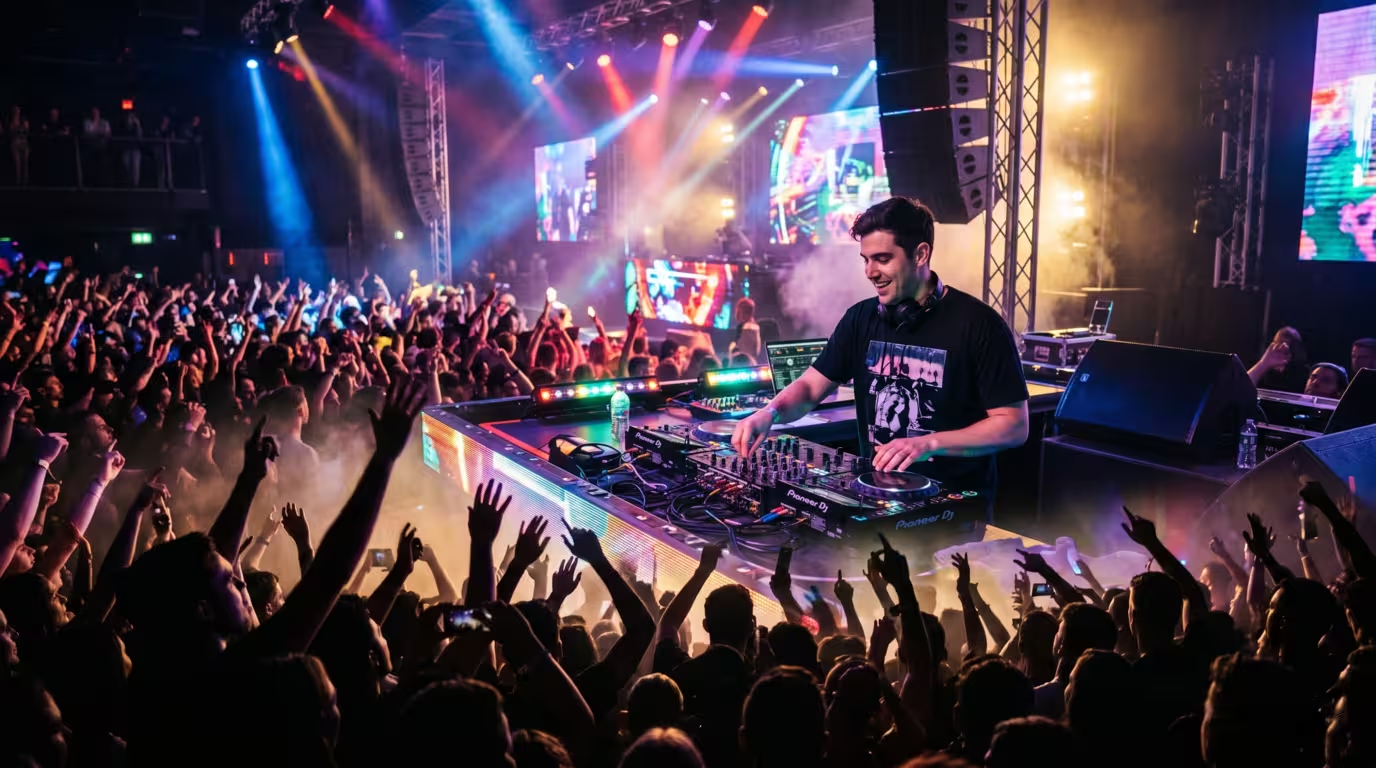
Playing out live is generally covered
The clearest case is a club night. When you DJ at a licensed venue, the venue or promoter — not you — pays public-performance licence fees to the relevant performing rights organisations (PROs) and collecting societies. Those blanket licences cover the public performance of the works you play, which is why spinning other people's records in a properly licensed club is legal from the public-performance side.
In the United States, PROs such as ASCAP, BMI, and SESAC license the public performance of musical compositions. In the United Kingdom, venues buy a single combined licence administered by PPL PRS, called TheMusicLicence, which covers both the song (PRS for Music, on behalf of songwriters and publishers) and the recording (PPL, on behalf of labels and performers). UK government guidance is blunt about why this matters: playing live or recorded music in public without a licence infringes copyright.
The practical takeaway: in a licensed venue, the establishment handles the public-performance side, so you can play copyrighted tracks without personally clearing them. We cover this in depth in Getting Paid for Club Plays and PROs and Royalty Collection — the key point here is simply that the venue's licence is what makes live DJing of copyrighted music fine, and that this licence covers performance, not reproduction.
Two caveats worth knowing. First, responsibility can shift: if you promote your own event or play somewhere that is not a traditional licensed venue, you (or the event) may be the one who needs the licence. Second, the specific bodies, tariffs, and who-pays rules differ by country, so don't assume the US or UK model applies where you are.
Recording a mix: a new right comes into play
The moment you record your set to a file, you have made a reproduction — a fixed copy that combines multiple copyrighted recordings. That is a different right from public performance.
Recording a mix purely for your own private listening is relatively low-risk in practice. The legal picture changes sharply when you distribute that recording — sharing it publicly, uploading it, putting it up for download, or selling it. Distribution and reproduction of someone else's master and composition generally require permission you almost certainly don't have. As DJ TechTools has put it, a live set in the moment isn't a fixed medium of expression, but any recording of it — audio or video — can technically breach copyright.
This is the conceptual hinge of the whole topic: the venue's licence covers the performance when you play live; it does not give you the right to reproduce and distribute a recording of that performance. For the technical how-to of capturing a set cleanly, see Recording Your DJ Mix in the Mixing Techniques category — this article is only about the legal status of doing so.
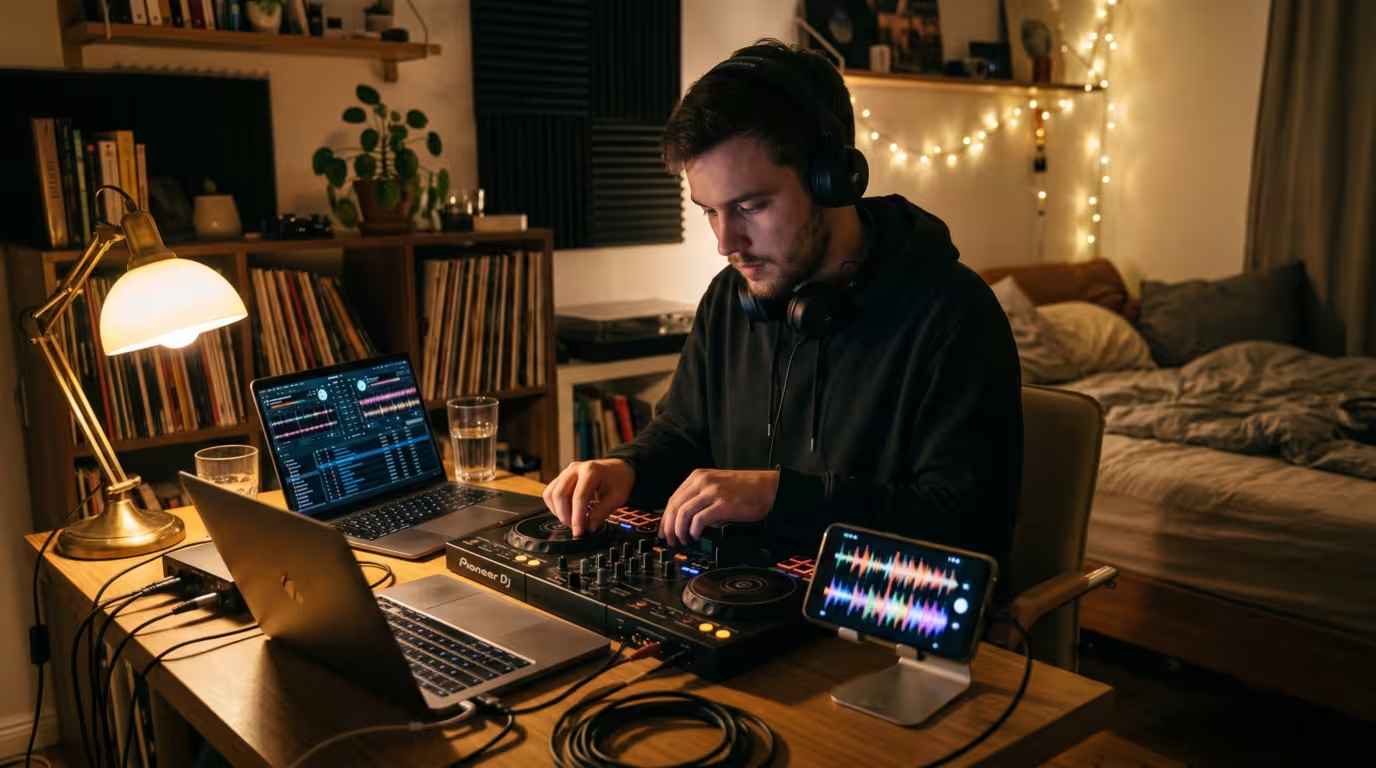
Uploading mixes to platforms: the core issue
Here is where most DJs actually run into trouble. Uploading a mix of copyrighted tracks to a platform that is not licensed for that purpose technically infringes the rights holders' copyrights — and platforms increasingly detect it automatically.
Content ID and automated detection
YouTube's Content ID is the best-known system. As YouTube's own help pages explain, it works from a database of audio and visual files submitted by copyright owners: every upload is automatically scanned against that database, and if Content ID finds a match the video gets a Content ID claim. The rights holder then chooses what happens — the claim can monetize the upload (ads run, revenue goes to the rights holder), block it (in some or all countries), or track it. Actions can be country-specific, so a mix may play in one territory and be blocked in another.
Crucially, a Content ID claim is not the same as a copyright strike. A claim is an automated match that usually affects one video's monetization or availability; a strike results from a formal legal removal request and is far more serious. On YouTube, repeated strikes can terminate an account.
SoundCloud runs its own content-identification system. Its help centre is explicit that a mix can be removed and that fair use does not save a promotional mix: if you use parts of a track in a DJ set you need the rights holder's explicit permission to upload that mix, and uploading a DJ mix for non-commercial, promotional purposes does not fall within the fair-use exemption. SoundCloud also notes you need permission for all tracks in the mix, not just the one the system happened to flag.
DMCA takedowns and strikes
Separately from automated matching, rights holders can send takedown notices under the US Digital Millennium Copyright Act (DMCA). Platforms that want the law's safe-harbor protection from liability must remove flagged content and adopt a policy to terminate repeat infringers. That is why uploads get pulled and why accounts with multiple strikes can be shut down. The system is voluntary for platforms only in the sense that they comply to keep their safe-harbor shield.
The net effect: uploading mixes to platforms that are not blanket-licensed for DJ mixes is risky. Your upload may be muted, blocked, monetized for someone else, removed, or — with repeated problems — cost you your account.
Licensed platforms: how Mixcloud differs
The cleaner solution is a platform that has done the licensing for you. Mixcloud is the prime example. It was founded in 2008 by Nikhil Shah, Nico Perez, Mat Clayton, and Sam Cooke specifically to build a licensed home for long-form audio like DJ mixes and radio shows.
Mixcloud's own help centre states plainly that it operates a fair and legal streaming service in support of artists, and is proud to be licensed and partnered with many of the largest rights holders, labels and publishers worldwide. The company says it has direct deals with the major labels (Universal, Sony, Warner) plus hundreds of independents via the Merlin organisation, and deals on the publishing/songwriter side with PROs such as ASCAP, BMI, SESAC, and PRS. Because of those deals, Mixcloud pays royalties on the music in your shows, so — in its words — DJs can upload without fear of DMCA takedowns.
That licensing comes with rules. To keep things legal, Mixcloud operates a streaming-only model (no downloads) and enforces Featured Artist Rules derived from sound-recording licensing limits. As Mixcloud's help centre currently states, a show available to all listeners should include a maximum of 3 songs from one release (e.g. EP/album/compilation, and no more than 2 consecutively) and up to 4 songs from one artist (and no more than 3 consecutively); you can include up to eight songs from one artist, but shows with 4 to 8 songs from one artist are only available to Premium subscribers. These specific limits are current at the time of writing and can change — always check Mixcloud's help pages before you plan a mix around them.
By contrast, SoundCloud and YouTube are not blanket-licensed for DJ mixes in the same way. SoundCloud has struck some licensing deals over the years, and back in 2016 reports suggested it would stop taking down mixes — but as Billboard reported at the time, the protection did not cover everything, and in practice mixes still get flagged and removed. YouTube relies on Content ID claims rather than a DJ-mix licence. So while mixes constantly appear on both, neither offers the structural your-mix-is-licensed-and-the-artists-get-paid guarantee that Mixcloud is built around.
The comparison below is a snapshot; platform policies change frequently.
| Platform | How it generally treats DJ mixes |
|---|---|
| Mixcloud | Licensed for mixes; pays royalties; rules on tracks-per-artist |
| SoundCloud | Some licensing, but mixes still flagged/removed by content ID |
| YouTube | Not mix-licensed; Content ID can block, mute, or monetize |
| Apple Music | Hosts officially licensed mixes via track-ID and label deals |
Mainstream subscription services have started solving the multi-rights-holder problem too. Apple Music partnered with rights-clearing firm Dubset in 2016 to stream remixes and mixes, and in September 2021 launched a system built on Shazam technology to identify and pay every creator in a DJ mix; TechCrunch noted at the time that Apple already hosted thousands of mixes, including sets from Tomorrowland's digital festivals from 2020 and 2021. In Apple's own words, it developed a new process to identify and fairly compensate all the individual creators featured in those thousands of DJ mixes, paying rights holders directly through deals with major and independent labels. Spotify, by contrast, does host some continuous (DJ Mix) releases, but rights there are cleared upstream by labels or distributors; Spotify's own support pages state that its catalog is for personal, non-commercial use and that playing its music in mixes, venues, or livestreams isn't permitted.
Live streaming: the Twitch lesson
Live-streaming a DJ set runs into the same wall as uploading, because a stream is a public transmission of copyrighted recordings. The defining episode came in 2020. As Twitch later acknowledged in its own November 2020 blog post, until May of that year streamers had received fewer than 50 music-related DMCA notifications a year on the platform — but from May, representatives for the major labels began sending thousands of DMCA notifications a week, mostly targeting snippets of tracks in years-old Clips. The problem recurred: in May 2021, PC Gamer reported a fresh wave in which Twitch told creators around 1,000 individual claims had arrived from various music publishers, with the company believing labels were using automated tools to scan VODs and Clips. The stakes are real — as one IP-and-media-law analysis summarised, three takedown notices aimed at the same Twitch streamer can result in a permanent ban. Twitch's music guidelines still list DJ sets as content you may not stream unless those recordings are owned by you, or you have permission from the relevant copyright holders.
The general lesson: live-streaming copyrighted music without licensing hits copyright problems, and the safe routes are a licensed live platform (Mixcloud Live markets itself on exactly this) or stream-safe/cleared music. As always, this area moves quickly and varies by service.
Selling mixes and the mixtape gray area
Selling a mix of copyrighted tracks is the riskiest scenario of all. Adding a commercial transaction strengthens the rights holders' position, and free does not automatically make a mix legal either — as one music-law analysis of hip-hop mixtapes notes, someone who makes or distributes a free mixtape containing samples can still be sued for copyright infringement.
This is why legitimately released DJ-mix albums are licensed. Commercial mix series clear every track. The long-running DJ-Kicks series on !K7 Records, for instance, has been described as one of the first officially licensed commercial DJ-mix series — each included track is licensed from its rights holders, which is precisely why DJs say a label release changes the whole direction of your mix compared with a free online set. To sell a mix legally you generally need both the master rights (from the labels) and mechanical clearance (for the compositions) for every track — a slow, expensive process usually handled by a label or a licensing consultant.
Why mixes are tolerated — and why that's not the same as legal
If strictly uploading a mix of copyrighted tracks usually infringes, why are millions of mixes online? Because rights holders often tolerate them. A well-made mix is free promotion, most mixes are posted by smaller DJs, and chasing them all down would be pointless. Labels have historically looked the other way for promotional, non-commercial use.
But tolerance is a business choice, not a legal permission. Rights holders can act — through Content ID claims, DMCA takedowns, or, in rare cases, lawsuits — and automated systems increasingly act for them by default. The safe and durable routes are the same three every time: use a licensed platform, use cleared or royalty-free music, or use music you own.
How to share your mixes legally
Practical guidance, framed as how things generally work — your circumstances and country may differ:
• Use a licensed platform for recorded mixes. Mixcloud is the standard legal home for DJ mixes because the platform clears the rights and pays the artists. Follow its current upload rules.
• Expect Content ID issues on YouTube and SoundCloud. Mixes there may be muted, blocked, monetized for the rights holder, or removed. If you upload anyway, understand the risk.
• Build mixes from music you can legally share. A set made of your own productions, royalty-free/Creative Commons tracks, or tracks you've properly cleared is fully legal to record, upload, and even sell.
• Live play is the venue's job. Don't worry about clearing tracks you play in a licensed club — but know that covers performance, not a recording of it.
• Credit your tracklist. It's good etiquette, and licensed platforms use track metadata to identify songs and route royalties to the right artists.
• Don't sell mixes of uncleared tracks. Commercial sale is the clearest form of infringement and the most likely to draw action.
• When in doubt, license, own, or clear — and check the platform's current terms.
The ownership angle: a mix of tracks you own
There is one situation with no gray area at all: a mix made entirely of music you own the rights to. If every track is your own production — or an exclusive, ready-made track whose rights you have acquired, such as a ghost-produced track bought with full rights — then you control the reproduction, distribution, and performance rights yourself. You can record it, upload it anywhere, monetize it, and sell it without anyone else's permission.
This is one more reason ownership matters for working DJs and producers. For how that works, see Buying Ready-Made Tracks and Ghost Production Contracts and Rights, and revisit Copyright Basics for Producers for what owning those rights actually means.
Common mistakes to avoid
• Assuming that uploading any mix to any platform is fine.
• Confusing the public-performance right (covered live by the venue) with the reproduction and distribution rights (implicated by recording and uploading).
• Treating free or promotional as a legal exemption — it generally isn't, and fair use rarely applies to a full DJ mix.
• Selling mixes built from uncleared copyrighted tracks.
• Ignoring platform rules and Content ID, then being surprised by mutes, blocks, or strikes.
• Believing that because mixes are tolerated, they are therefore permitted.
Key takeaways
• DJ mixes use other people's copyrighted music, so legality depends on context: live, recorded, uploaded, or sold.
• Live play in a licensed venue is generally covered because the venue pays public-performance fees to PROs.
• Recording and especially uploading or selling a mix touches the reproduction and distribution rights and usually needs licensing.
• Content ID and DMCA takedowns are why mixes get muted, blocked, or removed on YouTube and SoundCloud; repeated strikes can end an account.
• Mixcloud is the standard licensed home for mixes because it clears rights and pays artists, subject to upload rules that can change.
• A mix of music you own or have cleared is fully legal — and this is general educational information, not legal advice, so check current platform terms and consult an attorney.
Ready-made, exclusive EDM tracks with full rights — released as your own.
