A DJ press kit — almost always called an electronic press kit, or EPK — is the single professional package that tells a promoter, booker, label, or journalist everything they need to know about you and makes booking you easy. It is your calling card, your sales tool, and usually your first impression on the industry, all condensed into one shareable link. This guide explains what an EPK is, the components it should contain, how to build and format it, how to write the all-important bio, and how to actually use it to land gigs and opportunities.
What a DJ press kit actually is
An EPK is a pre-packaged set of promotional materials that present an artist to the people who can book, sign, or write about them. The concept long predates the internet: a traditional press kit was a physical folder of documents, publicity photos, and a demo, mailed to a newspaper, magazine, or venue. As print declined and email took over, that folder went digital. The electronic press kit — a web page, link, or PDF that holds your bio, music, photos, stats, and contact details — has now largely replaced the mailed package.
In practice, today's DJ EPK is a one-stop online profile. Think of it as your industry-facing resume: not the fan-facing feed where you post clips and memes, but the organized, business-facing page a talent buyer opens when deciding whether to put you on a lineup. Music marketers at CD Baby's DIY Musician describe it as a digital portfolio that gathers your music, bio, visuals, and press materials onto a single page for easy reference, which you use to pitch press, venues, festivals, labels, and booking agents. The crucial distinction is that your website is fan-facing while your EPK is business-facing — a fan does not need your streaming stats or tech rider, but a booker does.
Why you genuinely need one
The core purpose of an EPK is twofold: it makes you look professional, and it makes evaluating and booking you effortless. Industry people are busy — festival bookers review hundreds of submissions, venue talent buyers field pitches daily, and curators receive thousands of tracks a week. An EPK cuts through that noise by packaging everything they need in one place so a decision can be made in a minute or two.
Working promoters confirm this is exactly how they operate. A Blasthaus promotions resident in San Francisco, writing for DJ TechTools, noted that the first thing they ask for is always a mix and an EPK, because together those are a quick way to gauge how serious someone is — and that surprisingly few DJs bother to put one together, with fewer still making an effective one. That is the opportunity: a clean, complete EPK separates you from the crowd sending scattered links and messy DMs. It signals you take your career seriously and that you will be easy to work with — which matters as much to a booker as your mixing, because they are minimising risk.
This is also where your EPK connects to outreach. As covered in How to Get DJ Gigs, you approach promoters with a concise, personalised message — and the EPK is the link you drop into it. The pitch is short; the EPK does the heavy lifting.
The components: what to include
There is no single legally-mandated format, but reputable EPK guides converge on a consistent core set of elements. The table below summarises them; the sections that follow explain the most important ones in detail.
| Section | What it should contain |
|---|---|
| Bio | Short (50-100 words) and long (150-300 words) versions, third person |
| Music / mixes | Your best mix plus standout tracks, embedded or linked |
| Press photos | High-resolution, downloadable, varied orientations |
| Logo / branding | Wordmark or logo, ideally a transparent PNG |
| Stats / social proof | Followers, streams, notable gigs, releases, press, artist support |
| Video | A live-set clip or promo video |
| Past performances | Notable venues, festivals, residencies played |
| Press / features | Pull quotes, reviews, interviews, premieres |
| Contact | Booking email, management/agent if any |
| Technical rider | Gear and booth requirements (especially as you grow) |
| Social / streaming links | Links to the platforms where you are active |
Bio (the heart of it)
Your bio is the most important text element and, for many bookers, where the kit is won or lost. The widely-recommended approach is two versions: a punchy short bio of roughly 50 to 100 words (the elevator pitch, also used for social profiles and festival programs) and a fuller long bio of about 150 to 300 words. Both should be written in the third person, which reads as more professional and lets a promoter copy-paste it directly into event marketing. Lead with what is compelling — your sound, your strongest achievements — then tell your story. Bio-writing detail is covered further in Building a DJ Brand; for the EPK, keep it concise, honest, and free of cliché and hype.
Music and mixes
This is the proof of what you do, and for a DJ it is non-negotiable. Feature one standout mix that captures your sound and a couple of your best tracks or productions, embedded or linked from streaming platforms like SoundCloud, Mixcloud, YouTube, or Spotify rather than as files to download. As promoter Téa Abashidze told Storydoc, the essential thing is a SoundCloud profile with your actual sets uploaded — some artists post only the tracks they produce, which doesn't show a booker what or how they actually play. Choose material that fits the kind of gigs you want — a peak-time festival mix and a warm-up set send very different signals. The mix itself is covered in Recording Your DJ Mix; in the EPK, lead with your strongest, most representative work.
Press photos
High-quality, professional press photos are essential because promoters' designers use them on flyers, social posts, and event pages — and they will only work with good imagery. Provide several high-resolution shots — a common standard is a mix of high-resolution images (300 DPI) for print and lower-resolution (72 DPI) versions for web — in both landscape and portrait, and make them downloadable. A transparent or white-background PNG is invaluable for cropping into posters. Avoid clichéd, badly-lit, or phone-camera shots; they read as amateur. This visual identity ties back to Building a DJ Brand.
Stats and social proof
Social proof is the credibility layer: follower and streaming numbers, notable venues and festivals played, label releases, press features, and support from other artists. Include what is genuinely impressive and relevant, and present it honestly — bookers can smell hype, and several promoters note that follower counts alone do not prove you can DJ. Pull a short, strong quote from any review or press feature and make it immediately visible. How to build and present these numbers is covered in Social Media for DJs; in the EPK, the rule is honest, relevant, and specific.
Video, track record, press, contact, and rider
A short live-set clip or promo video lets a booker see you perform — something audio cannot convey — and even a well-shot phone clip of a packed room is compelling social proof. A past-performances list (notable venues, festivals, residencies) is your track record; keep it to identifiable highlights rather than an exhaustive log. Press features add third-party credibility. Contact information must be unmissable — a dedicated artist email at minimum, plus management or agent details if you have them. Finally, a brief technical rider — the gear and booth setup you need, such as a Pioneer CDJ/DJM configuration and a booth monitor — signals professionalism and prevents night-of problems; it becomes more important as you move up to bigger stages.
How to build and format it
The modern best-practice format is a single, clean, mobile-friendly link: a dedicated one-page EPK or a press page on your own website. Most music-marketing guides favour a web-based EPK over the old PDF-attachment approach because more emails are now opened on phones, links are easier to update, and a hosted page does not clog inboxes. Pirate's guide states plainly that the best format for an EPK is web-based, noting the old PDF approach is harder to update and poorly suited to mobile. That said, opinions are not unanimous — some bookers still like a tidy downloadable PDF they can save — so the pragmatic move many DJs make is to host a web page and also offer a downloadable version.
You do not need to code. Dedicated EPK and website builders exist, and many artists use a simple one-page site builder such as Carrd, a full website builder, or a link-in-bio hub like Linktree as a starting point; purpose-built music platforms (historically Sonicbids and ReverbNation, among others) also offer EPK templates. Whatever you choose, the principles are the same:
• One clean, professional, shareable link — not five different sites.
• Concise and scannable; bookers skim, so put your strongest material first.
• Mobile-friendly and fast-loading.
• Downloadable assets (high-res photos, transparent logo) available, ideally as individual files plus an optional zip.
• Easy to access — no logins, no expiring WeTransfer links, no broken links.
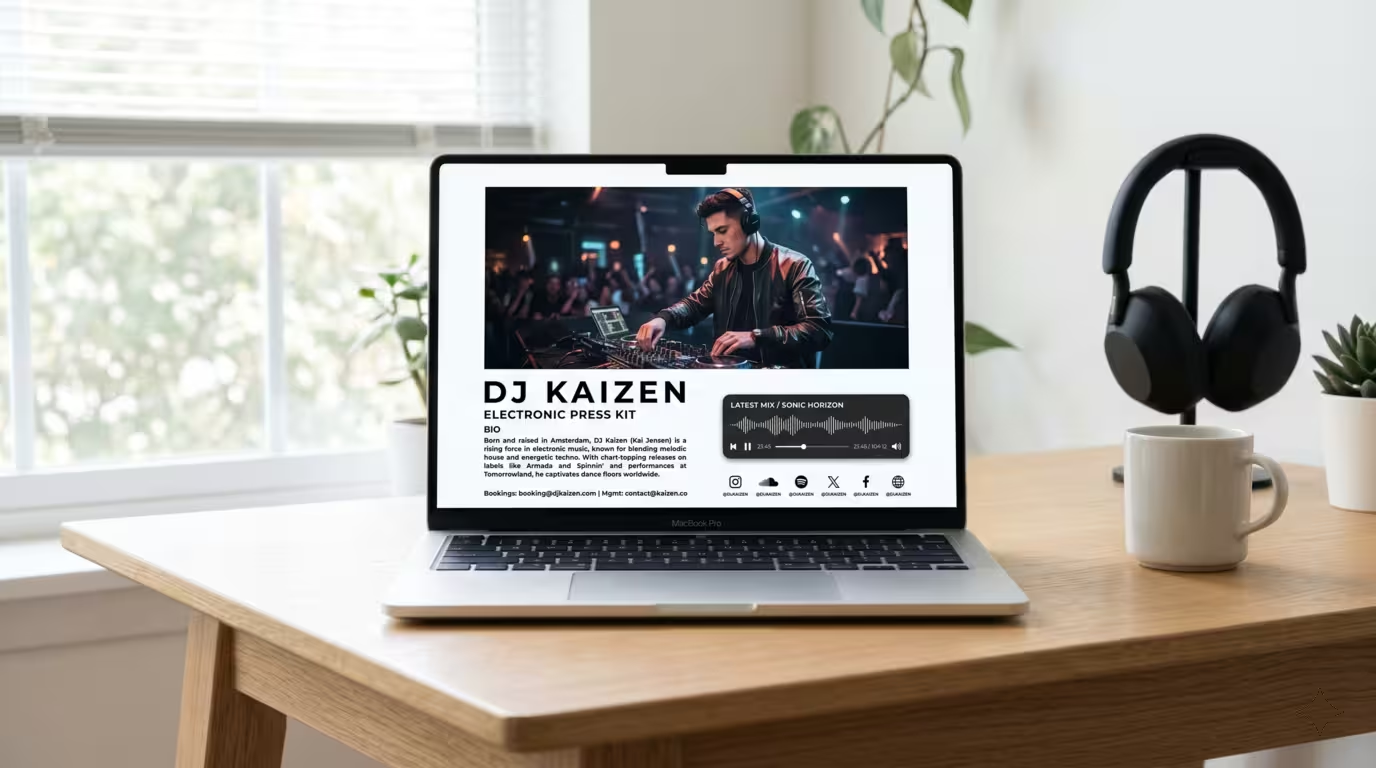
Writing the bio well
Because the bio carries so much weight, it is worth getting right. Draft the long version first, then trim a short version from it. Open the short bio with your single most compelling fact — a notable release, residency, festival, or a vivid one-line description of your sound. Write in third person and active voice; avoid passive constructions and empty superlatives like boundary-pushing. A useful test from artist-bio specialists: can your first sentence make a reader almost hear your music? Keep the long bio to a few tight paragraphs, weave in real achievements and honest social proof, and end the short version with a light call to action (available for bookings, with your contact). If writing is not your strength, it is worth paying someone, because a clean, well-edited bio stands out in a sea of sloppy ones — and a sloppy, typo-ridden bio reads as unprofessional.
Keeping it current and tailoring it
An EPK is a living document, not set-and-forget. Nothing undermines you faster than listing gigs that already happened, old photos, dead links, or stats less impressive than your current numbers. Refresh it on a schedule — many guides suggest a quick review every month or quarter — and always after a new release, a big booking, fresh press, or a rider change. Remove anything outdated.
You should also tailor emphasis to the recipient. A club booker cares most about your mix, your draw, and your past venues; a label wants your productions and release history; a journalist wants a strong story, pull quotes, and downloadable assets. Many platforms let you keep one core EPK and lead with different material depending on who you are pitching. If you are pitching for a specific slot, reorder your music so the most relevant set is first.
How to use it to get booked
The EPK only works if it reaches the right people. The proven approach is a short, personalised message plus the single link — not a wall of text and not a pile of attachments. An industry email guide from Soundfly's Flypaper walks through a sample booking email and concludes that fifty-nine words is all you need — you don't even have to paste your whole bio. The same writer keeps a short description of the kit's contents right in the email signature, reasoning that spelling out what's in the EPK is more helpful than a bare link labelled EPK, so contacts never have to go hunting. Send streaming links, never large MP3 attachments. Then follow up politely; the same guide suggests that checking back roughly once every ten days is reasonable.
Beyond cold outreach, put the link everywhere it makes sense: your website, your link-in-bio, and ready to paste whenever a promoter says send me your info. As covered in How to Get DJ Gigs, the goal is to make booking you frictionless — the answer to almost any industry question becomes it's all here.
Common mistakes to avoid
The errors that sink DJ press kits are remarkably consistent across promoters and music marketers. The table below pairs the most common ones with the fix.
| Common mistake | Do this instead |
|---|---|
| Too long, cluttered, overwhelming | Keep it tight, scannable, strongest material first |
| Outdated gigs, photos, or stats | Update regularly; remove old info |
| Low-quality or no press photos | Invest in professional, high-res, downloadable shots |
| No clear contact / booking info | Make a dedicated email unmissable |
| Over-claiming or fabricating stats | Be honest; let real proof speak |
| Huge files / attachments instead of a link | Host one clean link; stream, don't attach |
| Missing music or broken links | Test every link; lead with a standout mix |
| Generic, no personality or brand | Let your sound and identity come through |
| Hard to access (logins, expired links) | No gates; permanent, working URLs |
A few practical tips tie it together: a great set of photos and one strong mix are the foundations; honest, relevant social proof beats inflated numbers; clear contact info is mandatory; keep it mobile-friendly and current; tailor when it matters; and let the whole thing express your brand. Done well, your EPK quietly does the selling for you long after you have closed the email.
Key takeaways
• A DJ EPK is one professional, shareable digital package (a web page/link, optionally a PDF) that presents your bio, music, photos, stats, and contact to bookers, labels, and press.
• Its job is to look professional and make booking you easy — busy promoters decide fast, and a clean kit beats a scattered pitch.
• Core components: short and long third-person bios, a standout mix and tracks, high-res downloadable photos, honest social proof, video, track record, press, clear contact, and a tech rider.
• Format it as one clean, mobile-friendly, easy-to-access link with downloadable assets — not a giant email attachment.
• Keep it current, tailor it to each recipient, and use it by pasting the link into a short, personalised pitch.
Ready-made, exclusive EDM tracks with full rights — released as your own.
