Ask a dance music fan to picture Carl Cox and they will see a big grin and dark glasses before they hear a single beat. That instant recognition is what a brand actually is — and it is one of the most powerful career assets a DJ can build. This guide explains what a DJ brand really is, why it matters in a crowded scene, and how to build one that is genuinely yours. It is the identity foundation; for the tactical work that sits on top of it, this article points to companion guides on gigs, networking, social media, and press kits.
What a DJ brand actually is
A brand is not your logo, and it is not just your name. In marketing terms, a brand is the perception that lives in other people's minds — the gut feeling, reputation, and set of associations they attach to you. Branding author Marty Neumeier argued in The Brand Gap that a brand is neither a logo nor a corporate identity system, but a person's gut feeling about a product, service, or company. Because it exists in other people's heads, you influence it but never fully control it. The same idea is often summed up in a line widely attributed to Amazon's Jeff Bezos: "Your brand is what people say about you when you're not in the room."
For a DJ, that gut feeling is the sum of everything you put out: how you sound, how you look, how you communicate, and how you behave. It is what you are known and remembered for. The encyclopedic definition of a brand — a name, term, design or symbol that distinguishes one seller's goods from another's — captures the identifying function, but for an artist the modern, perception-based meaning matters more. Your brand is your reputation plus your identity plus your aesthetic, experienced as one coherent impression.
The elements below are the raw materials. The brand is what they add up to in the listener's mind.
| Brand element | What it is |
|---|---|
| Sound / niche | The musical style, genre lane, and signature you are known for |
| Name | The artist name fans search, say, and remember |
| Visual identity | Logo, press photos, colors, typography, and overall aesthetic |
| Story / positioning | Your narrative, influences, values, and angle in the scene |
| Reputation | How you behave and what people say about you |
Why a brand matters
The scene is more saturated than ever: an average of 106,000 new tracks were uploaded to streaming services every day in 2025, up 7% from 99,000 a day in 2024 according to Luminate's year-end music report, and on any given night a promoter can choose from a long list of available DJs. In that environment, talent alone does not make you memorable — a clear identity does. A defined brand helps you stand out, get remembered, and attract the right fans, bookings, and opportunities, because promoters, labels, and listeners connect with a distinct artist far more readily than a generic, interchangeable one.
This is also a business reality, not vanity. Digital DJ Tips notes that many DJs lean on the strength of their brands to command higher fees, win the choice slots in front of the most discerning audiences, and form lucrative tie-ups with other brands. A strong brand is a long-term, compounding asset — the more consistently you build it, the faster it works for you. It is worth stressing that branding is not selling out. As Digital DJ Tips' Joey Santos writes, it isn't about selling your soul or vapid self-promotion; it's about being honest about who you are and deciding how to present that honest version of yourself to the world.
Defining your identity and sound
Everything starts here. Before you touch a logo or a color palette, you need to know who you are as an artist. The foundational question, repeated across artist-branding advice, is simple: what do you want to be known for? Are you a brooding, Berlin-leaning techno selector, or a high-energy festival DJ who plays for big rooms? Get clear, write it down, and stick to it.
Your sound is the core of this. In a saturated market, sounding like everyone else guarantees you get lost; a signature sound is what makes your sets and productions instantly recognizable and builds audience loyalty, because listeners know what to expect from you. You do not invent it from nothing — you find it by paying attention to the choices you make instinctively, the records you always reach for, and where your genuine taste and influences intersect. As a Soundfly mentor puts it, you cannot go hunting for your niche — your niche finds you, if you just listen.
A useful exercise from the DJ-education world: write down what you stand for — partying, educating a crowd on underground techno, pushing boundaries — and treat it as a personal credo you can return to whenever you feel creatively lost. This document becomes the filter for every later branding decision.
Choosing a DJ name
Your name is usually the first impression you make and the thing fans must search to find you. A good artist name is memorable, easy to say and spell, distinctive, and — critically — ownable. Many DJs simply use their real name (Carl Cox, Charlotte de Witte, David Guetta), which is perfectly legitimate; others choose an alias for creative freedom, a degree of privacy, and a clean separation between their personal life and stage persona. As a Wikipedia overview of stage names notes, performers adopt them for reasons including avoiding confusion with an existing act, cultivating a persona, or escaping a birth name that is hard to spell or projects the wrong image.
Whichever route you take, run the checks before you commit. The practical pitfall is real: distributors warn that releasing under a name another artist already uses can cause your music to be grouped onto the wrong profile on streaming services, splitting your streams and confusing fans. An ungoogleable name made of common words is nearly as damaging, because people simply cannot find you. Marshmello is a neat example of dodging search competition by design — his stage name is an alternative spelling of marshmallow, an approach (and a mascot head) inspired by deadmau5, who likewise uses an alternate spelling.
Before you settle on a name, work through this checklist.
| Check | Why it matters |
|---|---|
| Search Google, Spotify, Beatport, SoundCloud | Confirms no established artist already owns it |
| Social handles + .com domain available | Lets you be consistent and findable everywhere |
| Easy to say on a mic and spell from memory | If people can't pronounce or type it, they can't find you |
| Not too generic, limiting, or "embarrassing later" | Protects the name's longevity over a whole career |
Avoid names that box you into one trend or one genre you may outgrow, and consider that you will say this name thousands of times. If you are a brand-new DJ still finding your feet, there is no shame in starting with your real name and refining later. Pioneer DJ suggests living with a shortlist for a while and testing which names people actually remember weeks later.
Visual identity
Once you know your sound and story, give them a face. A DJ's visual identity is the logo or wordmark, professional press photos, a color palette, typography, and artwork style — and the look should match the sound. Charlotte de Witte's minimal black-and-white aesthetic tells you roughly how she sounds before you press play; deadmau5's mouse helmet and Aphex Twin's A logo are recognizable instantly. A sensible starting point used across music design: choose a palette of two or three core colors that reflect your vibe — dark and moody for techno, neon for fun house, minimal black-and-white for underground — and use it everywhere.
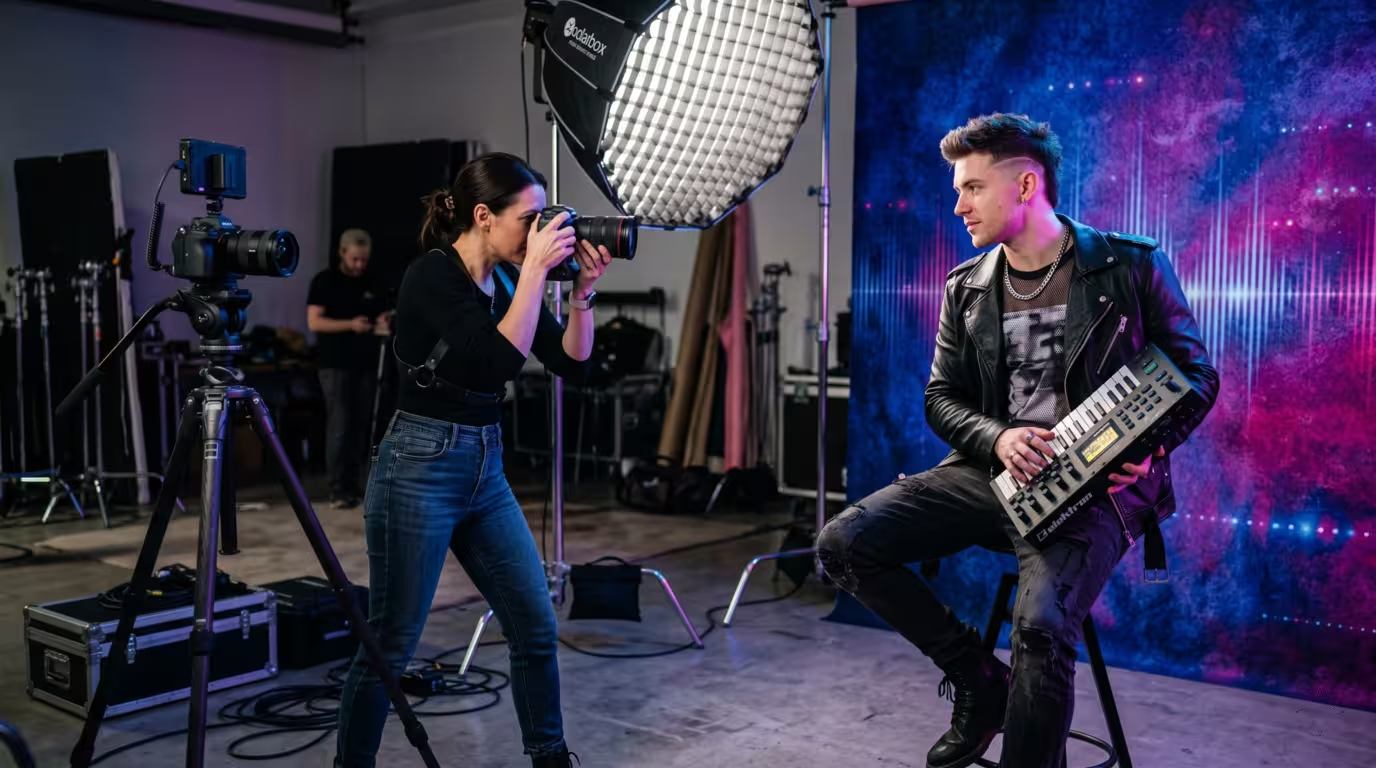
Professional presentation matters because it is often the first touchpoint. Promoters and bookers need high-resolution images they can drop into flyers and artwork; without them, the attention simply goes to other acts whose graphics are ready to use. Investing in a real photographer for press shots — ideally a range of portrait and landscape, light and dark backgrounds — is one of the highest-leverage things a serious DJ can do. A good test of visual strength, suggested by Digital DJ Tips: if a stranger can identify you from a graphic or photo without your name on it, your aesthetic is working.
Consistency across touchpoints
A brand only becomes recognizable when it is consistent. Brand-management research backs this up: Lucidpress's 2019 State of Brand Consistency report, surveying more than 400 brand professionals, found that consistent branding can increase revenue by 33%. Inconsistent logos, colors, and messaging do the opposite — they dilute recognition and confuse people. For a DJ, the touchpoints are your name, your handle, your visuals, your tone of voice, and your sound — spread across social media, mixes, cover art, your bio, press shots, and live performances.
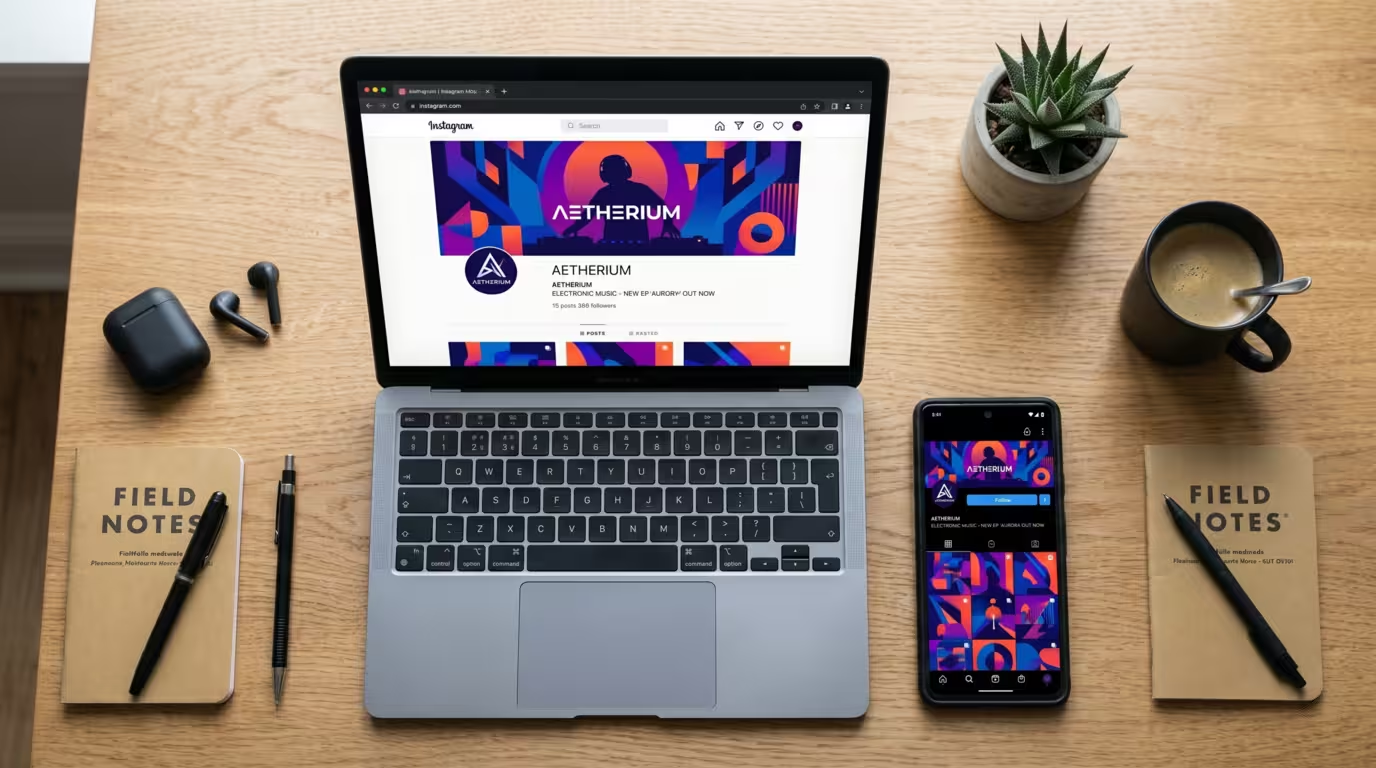
The practical rule: use the same name and, ideally, the same username on every platform, the same photos and color treatment across profiles, and a consistent voice in how you communicate. When a fan sees a flyer, lands on your Instagram, and opens your latest mix, all three should feel like the same artist. That coherence is what turns scattered activity into a memorable, trusted presence.
Your story and positioning
People connect with stories and personalities, not just audio. Your narrative — where you are from, your influences, what drives you, what makes you distinct — is part of the brand and a powerful differentiator. CD Baby's DIY Musician describes a brand as the mark you leave on someone's imagination when they think about you, your music, your image, and your story. A compelling, authentic story gives fans something to latch onto and gives journalists and promoters something to write about.
Positioning is simply where you sit in the scene relative to everyone else, and what you uniquely offer. Once you are clear on it, weave your story into your bio, your content, and your interviews. You do not need a dramatic backstory — you need a true one, told clearly.
Authenticity is the whole game
Here is the principle that underpins all of the above: a brand must be a genuine extension of who you really are, not a manufactured persona you cannot sustain. It is trivially easy to fabricate an image online, which is exactly why authenticity has become so valuable. Audiences and industry professionals are good at sensing a disconnect; a fake act erodes the trust a brand depends on, and maintaining it is exhausting. As scene commentators note, industry pros can spot a fake a mile away, and the chase for manufactured clout tends to be a dead end compared with a career built on real skill and identity.
The test Digital DJ Tips offers is memorable: a brand has to align with your real personality and values, so being a sober vegan minimalist in real life while projecting a party-hard, excessive-lifestyle DJ brand isn't a good idea. Authenticity does not mean oversharing or having no strategy — it means being a real, distinct, amplified version of yourself rather than a copy of a successful DJ. Don't clone someone else's image; you will only ever be the off-brand version of the original. The strongest brands are the ones where the person and the persona are congruent.
Online presence and building an audience
Your social media, mixes, videos, and content are where your brand actually lives day to day — it is expressed, not just described, through what you post and how you sound. The goal at the brand level is consistency of identity online; the tactical how-to (which platforms, what to post, how often, growth mechanics) belongs in the planned companion guide on DJ social media and marketing, so this article does not duplicate it.
A clear brand is what converts casual listeners into actual fans: people connect to an identity, then a community forms around it. That fanbase is itself a career asset — a following makes you more bookable, a point covered in How to Get DJ Gigs, and reputation is built relationship by relationship, as covered in Networking in Dance Music and Booth and Club Etiquette. For turning the brand into bookings via an electronic press kit, see the planned EPK guide.
Evolving the brand without losing it
Brands are not cages. As you mature as an artist, your sound, look, and story can and should evolve — the key is keeping a recognizable core so fans still recognize you through the changes. David Bowie reinvented himself repeatedly while remaining unmistakably Bowie; the throughline was evolution itself.
A full rebrand — especially a name change — is a different matter and is genuinely costly. Change your artist name and you can lose followers, playlist placements, search ranking, and the momentum you spent years building; on many platforms a new name effectively starts a new profile from zero. Rebrands can be the right call when a name is taken by a bigger act, carries a connotation you are no longer comfortable with, or no longer fits your music — but do it deliberately, secure the new name everywhere first, and communicate the change clearly. Evolve often; rebrand rarely.
Practical tips and common mistakes
The fundamentals, distilled:
• Define your sound and identity first. The brand flows from substance; figure out what you want to be known for before designing anything.
• Be authentic, not a copy. A genuine, amplified version of you beats a borrowed persona every time, and it is sustainable.
• Choose a strong, ownable name. Check Google, streaming platforms, social handles, and the domain before you commit.
• Keep visuals and handles consistent everywhere. Same name, same look, same voice across every touchpoint builds recognition.
• Tell your genuine story. Give fans and press a real narrative to connect with.
• Invest in professional presentation. Decent photos and artwork signal that you take this seriously.
• Don't chase every trend at the expense of identity. Evolve with intention; keep a consistent core.
• Back the brand with real substance. As Digital DJ Tips warns, a slick page won't carry forgettable music — keep getting better at DJing and producing. A brand is identity and reputation, not just a logo.
Key takeaways
• A DJ brand is the gut feeling and reputation people hold about you — your sound, name, visuals, story, and behavior combined — not just a logo.
• In a crowded scene, a clear, authentic identity is what makes you stand out, get remembered, and attract fans and bookings.
• Start by defining your sound and what you want to be known for; everything else expresses that core.
• Pick a memorable, ownable name and keep your name, handle, visuals, and tone consistent across every platform.
• Stay authentic and let the brand evolve over time, but protect a recognizable core — and rebrand only when truly necessary.
Ready-made, exclusive EDM tracks with full rights — released as your own.
