A DJ's headphones are not a hi-fi accessory — they are a working tool for hearing a cue signal over a thumping system and lining up beats under pressure. That job rewards a very different set of specifications than the flat, open, comfortable headphones built for critical studio mixing. This guide walks through every spec that matters — isolation, driver size, impedance, loudness, build, ear-cup design and connection type — so you can match a pair to how you actually play rather than to a marketing label.
Why DJ Headphones Are a Different Tool
Audiophile and studio reference headphones aim to reproduce sound as neutrally as possible in a quiet room. DJ headphones have a narrower, harder job: let you hear the kick and bassline of an incoming track clearly while a loud PA is pounding the room, often with only one ear cup pressed to your head. That means a DJ headphone prioritises strong sound isolation, durability, swivelling cups for single-ear monitoring, and enough efficiency to get loud from a mixer or controller — not perfectly flat response.
This is why a top studio headphone is not automatically a good DJ headphone, and vice versa. The two are optimised for different problems. Sennheiser markets its long-running HD 25 explicitly for this working role, highlighting high SPL handling, strong isolation and a rotating capsule for single-ear monitoring — the traits that keep it a booth and field favourite in noisy environments.
Closed-Back vs Open-Back
The single most important design split is closed-back versus open-back. DJs almost always use closed-back headphones, where the rear of each driver is sealed inside the ear cup. Open-back models — popular for studio mixing — vent the back of the driver to the air, which lowers distortion and produces a wider, more natural soundstage, but offers essentially no isolation in either direction.
As Sound On Sound explains, an open-back design exposes the rear of the diaphragm to the outside world, which improves sound quality because the diaphragm is not pushing against a sealed pocket of air — but it also lets outside noise reach your ear and lets your audio leak out. In a club that lack of isolation is fatal: the room drowns out your cue and your cue bleeds into nothing useful. Closed-back cans seal the loud room out and keep the cue signal in. The trade-off engineers accept is that a sealed rear chamber tends to emphasise and slightly colour the bass — which, for DJ monitoring, is often a feature rather than a bug.
Sound Isolation in a Loud Club
DJ headphones rely on passive isolation: the physical barrier of the sealed cup plus the seal of the earpad and the clamping force holding it against your head. There is no battery or electronics involved. This matters because club and DJ-booth sound levels are punishing — a 2004 study of disc jockeys by Bray, Szymanski and Mills in The Journal of Laryngology and Otology recorded nightclub sound levels of up to 108 dB(A), with a typical session averaging 96 dB(A), above the level at which employers in industry must provide ear protection.
Crucially, DJs generally do not want active noise cancellation (ANC). ANC is tuned to cancel steady low-frequency drones like aircraft cabin noise, can introduce its own artefacts and latency, needs power, and is the opposite of what a monitoring tool needs — you want an honest, immediate cue signal, not a processed one. Passive isolation from a good closed-back seal is what keeps you able to monitor at a sane volume.
Over-ear (circumaural) cups that fully enclose the ear generally isolate better and spread clamping pressure around the ear rather than on it; on-ear (supra-aural) cups sit on the ear and isolate somewhat less, but legendary on-ear DJ models like the HD 25 are prized because they isolate well for their size while staying very light.
Driver Size and Sound Signature
The driver is the small loudspeaker inside each cup. DJ and monitoring headphones typically use dynamic drivers around 40 mm to 50 mm in diameter. Larger drivers can move more air for deeper, louder bass; the exact figure matters less than how the driver is tuned.
That tuning is where DJ headphones diverge from reference cans. Studio headphones chase a flat, uncoloured response so you can judge a mix honestly. DJ headphones are commonly tuned with an emphasised, punchy bass so the kick and bassline cut through a loud room — essential when you are beatmatching by ear. Representative driver sizes from manufacturer specs: the Pioneer DJ HDJ-X10 uses a 50 mm driver quoted at 5 Hz to 40 kHz; the HDJ-X7 a 50 mm driver at 5 Hz to 30 kHz; the HDJ-X5 a 40 mm driver at 5 Hz to 30 kHz; the Sennheiser HD 25 a closed dynamic transducer quoted around 16 Hz to 22 kHz; and the Audio-Technica ATH-M50x a 45 mm driver at 15 Hz to 28 kHz. A wider quoted frequency range looks impressive but tells you little on its own — tuning and seal matter far more than the headline numbers.
Impedance, Sensitivity and Loudness
Two electrical specs decide how loud a headphone gets from your gear. Impedance, measured in ohms, is the electrical resistance the headphone presents; sensitivity (often in dB SPL per milliwatt or per volt) is how efficiently it turns power into volume.
DJ headphones are deliberately low impedance so they go loud and are easy to drive straight from a mixer or controller headphone output, with no separate amplifier. Studio reference headphones are often sold in high-impedance versions that need a powerful amp to shine. The Beyerdynamic DT 770 PRO is the classic illustration: it is sold in 32-ohm, 80-ohm and 250-ohm versions, where the lowest-impedance model is optimised for mobile and portable use and the 250-ohm version is intended for stationary studio sources driven by a proper headphone amplifier. Here is how the representative DJ and crossover models compare on the two specs that decide ease of driving.
| Model | Impedance | Driver |
|---|---|---|
| Pioneer DJ HDJ-X10 | 32 Ω | 50 mm |
| Pioneer DJ HDJ-X7 | 36 Ω | 50 mm |
| Sennheiser HD 25 | 70 Ω | on-ear dynamic |
| Audio-Technica ATH-M50x | 38 Ω | 45 mm |
Note how every DJ-oriented model sits well under 100 ohms, versus the 250-ohm studio option above. Pioneer DJ quotes the HDJ-X10 at a 106 dB output sound level and 32 ohms impedance, which is why it stays loud and clean even when a mixer's headphone output is turned down. Sensitivity matters alongside impedance: a low-impedance, reasonably sensitive headphone reaches a useful monitoring volume from modest gear, while a high-impedance, low-sensitivity pair can sound thin and quiet on the same output.
Loudness and Hearing Safety
A DJ headphone has to be able to get loud — but that capability is exactly why hearing protection deserves a section of its own. DJs already work in dangerously loud rooms, and the headphone adds a second exposure right at the ear.
The reference figures worth memorising come from occupational health bodies. The US NIOSH sets a recommended exposure limit of 85 dBA averaged over an eight-hour day, and applies a 3-dB exchange rate: every 3 dBA increase in level halves the safe exposure time. The WHO's safe-listening guidance echoes this — you can safely listen at 80 dB for up to 40 hours a week, but at 90 dB the safe time drops to about four hours. At 100 dBA — roughly a loud club — safe time collapses to around 15 minutes.
The risk to DJs is not theoretical. The same 2004 study of dance-music DJs found that 70% reported a temporary threshold shift after sessions and 74% reported tinnitus, concluding that DJs are at substantial risk of noise-induced hearing loss. The practical takeaway: buy headphones with strong isolation so you can monitor at lower volumes, and resist the urge to crank them. Good isolation is a hearing-protection feature, because it removes the temptation to turn up the cue to beat the room.
Build Quality and Durability
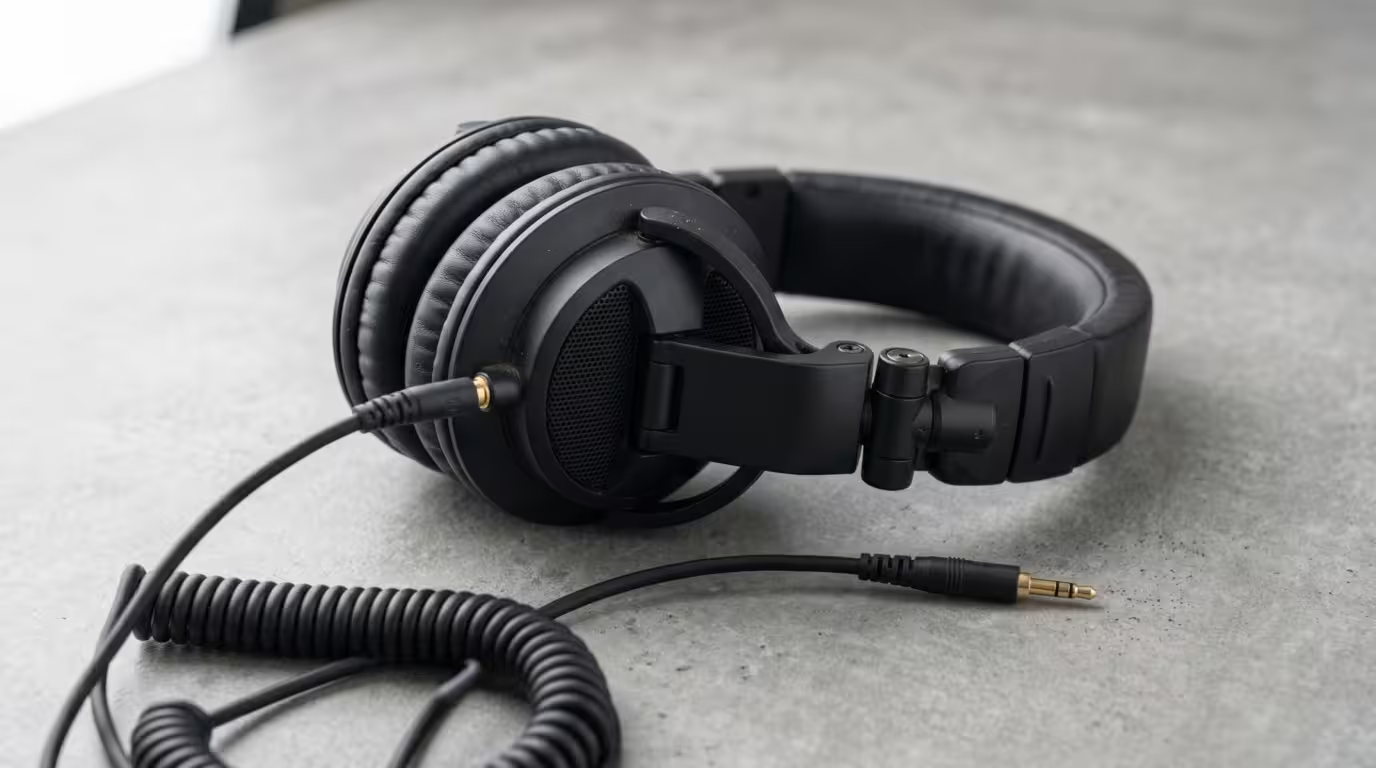
DJ gear gets thrown in bags, sweated on, yanked by cables and dropped. Durability is a core spec, not a luxury. The signs of a road-ready design are replaceable parts — earpads, headband cushions and especially cables — plus robust hinges and swivels and quality materials.
Some professional models are explicitly tested to military durability standards. Pioneer DJ says its entire HDJ-X range cleared the US Military Standard shock test (MIL-STD-810G), using durable metal in the moving parts. The flagship HDJ-X10 adds a sweat- and dirt-resistant nano-coating on its polyurethane ear pads and headband. AIAIAI takes a different durability route with its modular TMA-2 system, where every part — drivers, headband, earpads and cable — can be swapped or replaced individually, and V-MODA backs its Crossfade M-100 Master with steel-frame construction and an Immortal Life replacement program. The common thread is repairability: a headphone you can fix is one that survives touring.
Swivel Cups and Ear-Cup Design
Single-ear monitoring — one cup on the ear, the other pushed aside so you hear the room — is fundamental to DJing. That makes rotating, swivelling cups a genuine functional spec rather than a gimmick. The Sennheiser HD 25's signature feature is a capsule that swivels up to 180 degrees away from your ear on a split headband; the Audio-Technica ATH-M50x and Pioneer HDJ-X models use 90-degree swivelling cups; and the Technics EAH-DJ1200 carries forward the famous 270-degree swivel mechanism of its long-running RP-DJ1200 predecessor, with a lock to hold position during energetic head movement.
Ear-cup format is a real trade-off. Over-ear (circumaural) cups enclose the ear for better isolation and comfort over long sets but are bulkier; on-ear (supra-aural) cups are lighter and more portable and make the one-on, one-off move easy, at some cost in isolation and long-session comfort. Neither is better — they suit different DJs.
Comfort and Fit
Sets run for hours, so comfort is a spec too — and it pulls against isolation. Tight clamping force improves the seal and isolation but increases fatigue and pressure, especially for anyone wearing glasses; lighter clamp is comfier but lets more sound leak in. Earpad material is part of the equation: leatherette or protein-leather pads seal and isolate better but trap heat, while velour breathes and stays cooler but isolates less. Weight and headband padding round it out — the HD 25 weighs only about 140 g without cable, which is a big reason DJs tolerate its firm on-ear clamp through long sessions. There is no universal right answer; the best fit is the one you forget you are wearing while still getting a solid seal.
Cables, Connectors and Wired vs Wireless
Look for a detachable, single-sided cable: detachable means a damaged cable is a cheap fix rather than a dead headphone, and single-sided entry keeps the cable out of your way during the one-ear move. Coiled cables stretch to reach the mixer and retract out of the way; straight cables are lighter. The connector standard for DJ and mixer headphone outputs is a 3.5 mm (1/8-inch) plug with a screw-on 6.35 mm (1/4-inch) adapter — the screw thread stops the adapter falling off mid-set. The HDJ-X10, ATH-M50x and Technics EAH-DJ1200 all ship with this arrangement.
On wired versus wireless, the verdict for cueing is clear: use wired. Standard Bluetooth introduces far too much latency for beatmatching. The common SBC codec adds roughly 100 to 150 ms of latency and AAC around 150 to 200 ms, while even aptX Low Latency only drops to about 40 to 50 ms — all far above the roughly 10 to 15 ms threshold at which a human notices a sync error, which is why ordinary Bluetooth headphones are not usable for studio or live work. A new class of proprietary ultra-low-latency wireless DJ headphones (such as the AIAIAI TMA-2 DJ Wireless, which claims latency under 10 ms via its W+ Link system) is changing this at the high end, but ordinary Bluetooth remains strictly for casual listening, not cueing.
How to Choose: Match Specs to Your Use
The right pair depends on how and where you play. A club or festival DJ should prioritise isolation, durability and low impedance — a rugged over-ear like the Pioneer HDJ-X7/X10 or a tough on-ear like the HD 25. A mobile or wedding DJ values the same toughness plus comfort for very long days. A bedroom or learning DJ can spend less while still insisting on closed-back, low-impedance, swivel-cup basics. A producer who also DJs faces the real tension: flat studio-reference headphones and DJ-monitoring headphones are genuinely different tools, and a crossover like the ATH-M50x or V-MODA M-100 is a compromise that does both jobs adequately rather than either perfectly. Use this priority order when comparing models.
| Priority | What to check |
|---|---|
| Essential | Closed-back, strong isolation, low impedance |
| Essential | Swivel cups, detachable cable, durability |
| Secondary | Driver tuning, comfort, weight, foldability |
The headline frequency range and driver size sell headphones, but they should sit at the bottom of your checklist. Get the closed-back design, isolation, impedance and build right first; those are the specs that determine whether a headphone actually does the DJ job.
Key takeaways
• DJ headphones are a monitoring tool, not a hi-fi product: prioritise isolation, durability and loudness over flat response.
• Choose closed-back, low-impedance (roughly 32–70 Ω) cans with swivel cups and a detachable single-sided cable.
• Strong passive isolation lets you monitor at lower, safer volumes; skip active noise cancellation.
• Respect hearing limits — NIOSH's 85 dBA over eight hours and the 3-dB exchange rate — because DJs face high tinnitus and hearing-loss risk.
• Stay wired for cueing; ordinary Bluetooth latency makes beatmatching unreliable.
Ready-made, exclusive EDM tracks with full rights — released as your own.
