Few moments test a new DJ's composure like a stranger leaning over the booth, phone in hand, asking you to play their song. Handle it badly and you can sour someone's night, lose your focus, or derail a dancefloor that was working. Handle it well and you turn a potential nuisance into a connection — and sometimes into a genuinely better set. This guide is the dedicated, practical playbook for handling song requests: why they happen, how they differ wildly by context, how to evaluate them, and how to say both yes and no like a professional.

Why people request songs
Before you can handle a request well, it helps to understand what one really is. A request is rarely a literal command — it is usually a bid for connection. Music is wired into the brain's reward and memory systems; a particular track can pull someone straight back to a specific person, place, or moment in their life. When a guest asks for a song, they are often asking to feel part of the night, to relive a memory, to get hyped with their friends, or simply to be acknowledged by the person controlling the room's energy. The American Psychological Association's Speaking of Psychology podcast has explored exactly this with Princeton music-cognition researcher Elizabeth Margulis: music, memory, and emotion are deeply intertwined, which is why their song feels so urgent to the person asking.
Reframing requests this way changes everything about your response. A request is a sign of engagement — proof that people care enough about the music to walk over and talk to you. Respond with empathy rather than annoyance and you keep the requester on your side, even when the answer is no. As experienced DJs repeatedly point out, the person who feels heard goes back to the dancefloor; the person who feels brushed off tells their friends the DJ was rude and moves on. The smart starting posture is warmth, not defensiveness.
Context is everything
There is no single rule for requests, because their appropriateness varies enormously by gig. The single most important skill is knowing what kind of night you are playing and what the people in front of you expect. Phil Morse of Digital DJ Tips — a former resident at Ibiza's Privilege who founded what has grown into one of the world's largest online DJ schools — puts the spectrum plainly: touring DJs, top-tier pros, respected underground producers and celebrity DJs generally don't play requests, but for everyone else getting out of them is not so easy, and a blanket no-requests policy is probably a bad idea for most DJs.
The table below maps the spectrum. Read your gig before you decide your policy.
| Gig type | Requests expected? | Approach |
|---|---|---|
| Wedding / private / mobile | Yes — part of the job | Serve the client; gather lists in advance; work guests' songs in |
| Open-format bar / club / party | Often | Take good ones, on your timing; protect the flow |
| Underground club / artist booking | Largely not | People came for your sound; polite declines are normal |
Weddings, private events and mobile gigs
At weddings, parties, and corporate events, requests are not an intrusion — they are the assignment. You were hired to please a room of guests across several generations, and the people who booked you have a direct say in the music. The professional move here is to pre-empt live chaos with planning. Gather a short must-play list and, just as importantly, a do-not-play list from the couple or client in advance. This convention is so standard that consumer wedding authority The Knot, in its 2024 guide to do-not-play wedding songs, tells couples that once they've booked a DJ they'll likely be asked to provide a list of songs not to play. Working wedding DJs describe the same intake from their side — the HiFi Productions blog notes that alongside a must-play list and a list of suggestions, they always ask couples for a do-not-play list too. Common do-not-play picks cited by The Knot include the Chicken Dance, the Macarena, and the Cha-Cha Slide.
A word of caution that experienced wedding DJs stress: keep the must-play list short. A list so long it fills the whole reception strips the DJ of the ability to read the room. As Cleveland's A Bride's DJ puts it, with a lengthy must-play list the DJ has lost all control to adjust the music to the crowd. Gather the essentials and the hard nos, then trust your reading for the rest. (For how that energy management works across the night, see Warm-Up, Peak-Time, and Closing Sets.)

Open-format bars, clubs and parties
In bars, open-format clubs, and general parties, you will get requests and most of the time you should be open to them — but on your terms and your timing. Here you are setting a mood for people who mostly did not come specifically to see you. A good request can be useful intelligence about what the room wants, and the people asking are sometimes other DJs, promoters, or the venue owner — people it pays to stay on good terms with. Take the good ones, defer or decline the rest, and never let the request stream knock you off your game.
Underground clubs and artist bookings
At the other end, when you are booked as the artist — a credible underground club night, a headline slot, a guest the promoter flew in specifically for your sound — requests are largely not the norm, and politely declining is completely normal and expected. The crowd paid to hear your curated journey, and taking pop requests would undermine the very thing you were booked for. The understanding is cultural: you don't request from a headliner playing their own sound. The flip side is that some requesters don't know the code — and a tiny minority react badly. House veteran DJ Dan was punched by a club-goer's boyfriend at the Red Maple in Baltimore in 2014 after repeatedly and politely declining a mainstream request; by his own account, a girl who clearly knew nothing about him or the night kept asking for a track he didn't have and would never play, and he simply, politely told her he didn't have it. It's a vivid reminder that declining is legitimate — and that staying calm matters most.
How to evaluate a request
Once a request lands, run it through a quick mental filter before you commit to anything. Ask yourself:
• Does it fit the vibe, energy and genre right now? A track that clashes in mood, BPM, or key can empty a floor that was full.
• Is it a quality track that mixes? Will it actually work in the flow, or is it a hard left turn?
• Would it work now — or later? A song that's wrong at a 10pm warm-up might be perfect at peak time.
• Does it serve the whole floor, or just one person? One request on its own means little; there will always be someone who wants something completely rogue.
That last question is the crucial one. As the team at We Are Crossfader puts it, you don't have to play everything you're asked or you'll quickly become a human jukebox — one request on its own doesn't mean much, but when you start hearing the same kind of request again and again, that's the pattern worth noticing. Treat the room as a single organism: a steady stream of similar requests is information to act on; one outlier usually isn't. (This is the request-specific application of crowd-reading — see Reading the Crowd for the broader skill.)
Saying yes gracefully
When a request genuinely fits, working it in is a win-win — but yes almost never means right now. The professional skill is slotting it into the flow at the right moment rather than dropping everything to play it next. A simple "great choice — I'll work it in soon" makes the requester feel heard while keeping your set's structure intact. (For why timing within the arc matters, see Building a DJ Set.)
Don't underestimate the upside. A request can be a forgotten gem you'd dropped from rotation, or a piece of free feedback most industries pay for. And there is real magic in it: as one veteran DJ writing for Heavy Hits describes, the look on someone's face when they recognise their song coming on is genuinely heart-warming. When a great, timely request lands and the floor erupts, that's the system working exactly as it should.
Saying no politely
Most requests you will decline — and the entire art is doing so without ever being rude, dismissive, or issuing a flat no. A blunt refusal risks the requester's ego and, worse, can spread bad feeling through their whole group. The golden rule, in Phil Morse's words, is to always stay polite, respectful and diplomatic — and that a small white lie beats an outright refusal. The goal is a warm, brief, non-committal response that manages expectations without making a promise you won't keep.
DJBooth frames the most useful tactic as the soft no and the considering-it response — acknowledge genuinely, give a reason, make no promise. The table below collects field-tested scripts.
| Scenario | What to say |
|---|---|
| Good track, wrong moment | "Love that one — I'll find a spot for it later, can't promise exactly when." |
| Doesn't fit the set at all | "Great song, but it doesn't quite fit the vibe I've got going right now." |
| You don't have it | "I don't have that one with me, but I've got something similar coming." |
| You're mid-mix | "Give me a sec — write it down here and I'll see what I can do." |
| Underground/artist set | "Not tonight, I'm afraid — but stick around, there's good stuff coming." |
A few cautions. Many experienced DJs warn against saying "I don't have it" too freely, because it often invites "well, what DO you have?" and an attempt to climb into the booth. Keep responses vague and non-committal when you don't intend to play something — "I'll see what I can do" is the classic for a reason. And don't over-explain or argue: acknowledge, redirect, move on. If you've said yes to be polite but never get to it, that's usually fine — as Digital DJ Tips notes, it's a party, not a court of law.
Difficult, persistent and drunk requesters
Sooner or later you'll meet the requester who won't take a graceful no. Stay calm — your composure is the whole game. Drunk people are often blunt without meaning to insult you, and there is, as the Heavy Hits writer puts it, zero benefit to losing your cool: if you let it get personal you raise the odds of a complaint or a bad review. Keep the moral high ground every time.
For the persistent requester, set a kind but firm boundary. A with-you-in-one-second finger gesture while you finish your mix works remarkably well — many wander off within thirty seconds. Don't engage in a battle; acknowledge, redirect, and don't let one person hijack your focus from the whole room. For people crowding the booth, body language does a lot: a smile and a raised hand can say stop without words, and you can calmly say you need space to work. Never let anyone hold drinks over your gear. (For booth boundaries in general, see Booth and Club Etiquette.)
If a situation turns aggressive, do not try to win it yourself — that is what staff and security are for. Talk to the venue before your set about how to handle hassle, and lean on the team if a requester crosses from annoying into threatening. You have every right to have someone removed so you can keep working safely.
Responsive, not a jukebox
This is the central tension of the whole topic: be responsive to the crowd without becoming a human jukebox who plays whatever anyone shouts and loses all flow and identity. Digital DJ Tips captures the trap precisely — if you noted down and played everything a vocal few asked for, they'd only do it more, and your DJing would suffer; you'd end up playing ill-considered music that pleased fewer people than if you'd followed your training and instincts. It's a lose-lose.
The resolution is to honour the spirit of requests without obeying them literally. If lots of people want a more commercial, high-energy direction, that's real information — find a way to serve that energy while still representing the music you're there to play. As Phil Morse advises about the inevitable Beyoncé request: you don't have to play it and abruptly switch to a set of commercial tunes, but if you're fielding a lot of requests in that vein, ask what it's telling you and whether there's a way to turn that knowledge to your advantage. You are responsible for the whole floor's experience, not one person's ego — including your own.
Protecting your set and flow
A request that clashes harmonically, sits at the wrong BPM, or kills the energy can derail a working dancefloor, and it is entirely professional to decline or defer such tracks. Your job is the overall arc, not a single song slotted in at the wrong time. If a request could work later, say so honestly and defer it to a better moment — a track that's wrong during the warm-up may be exactly right at peak time. This is where request-handling and set construction meet: the energy arc you've built is an asset worth protecting. (See Building a DJ Set for how that arc is constructed, and Warm-Up, Peak-Time, and Closing Sets for slot context.)
Tools and systems for requests
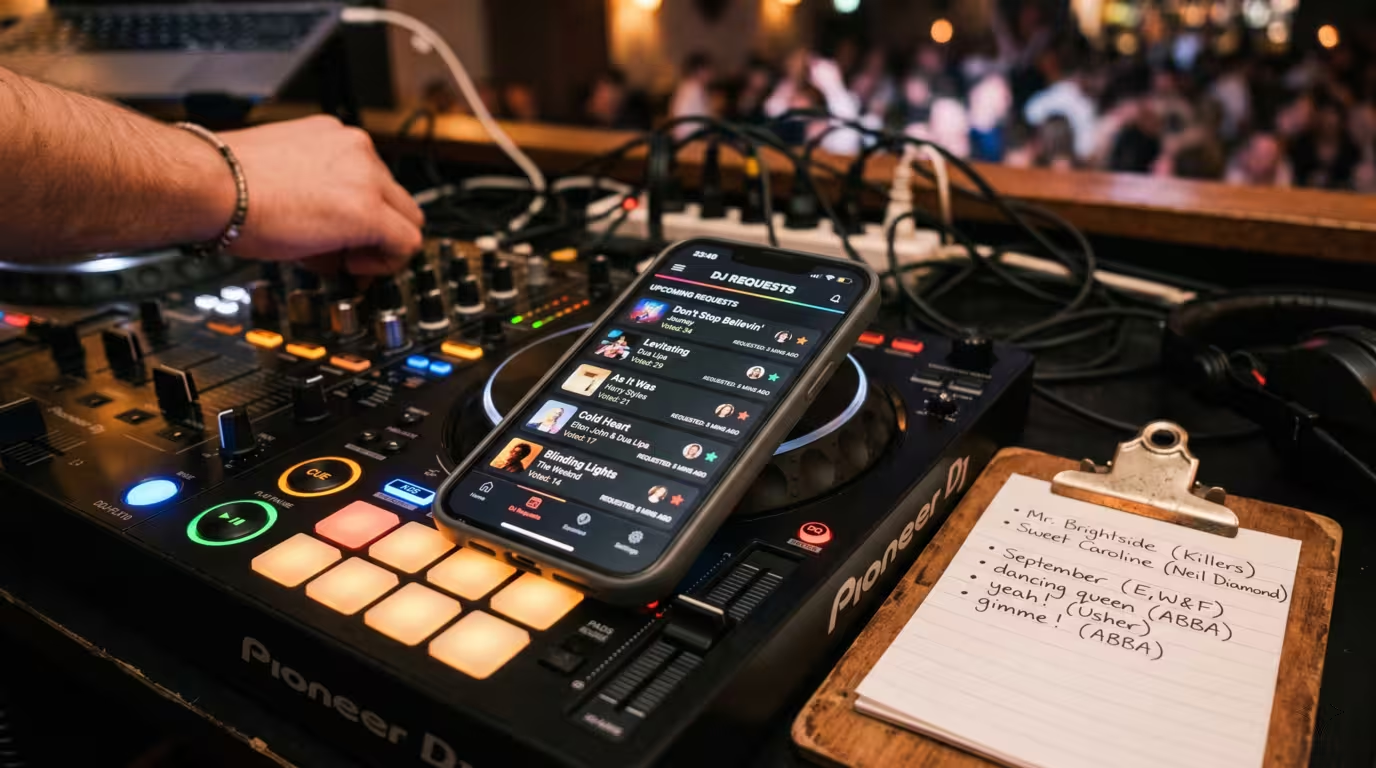
You don't have to manage requests with your bare hands. A pen and paper or a clipboard at the booth is the time-honoured tool — hand it over when you're mid-mix so people can write the artist and title, which doubles as a way to deflect attention and to remember tracks you might want to buy later. For weddings and upmarket events, a printed request form looks more professional.
Digital systems have matured considerably. Text- and web-based services — RequestNow, Lime DJ, and similar QR-code platforms — let guests submit songs to a dashboard you check at your own pace, replacing shouted requests and lost paper slips, and many add tipping. Virtual DJ even has a built-in Ask the DJ feature. Streaming integration (TIDAL, Beatsource, SoundCloud, Beatport) in modern DJ software and hardware means you can pull up a reasonable request you don't own, though pros advise testing any streaming setup thoroughly at home first, as connectivity can fail. Underpinning all of it: a broad, well-organized library is what lets you say yes at request-friendly gigs in the first place.
Practical tips and common mistakes
• Know your gig. Don't take requests at an underground artist set; do embrace them at a wedding. Context decides your whole posture.
• Never be rude, even when declining. A polite white lie beats a blunt refusal every time.
• Take your time. A yes doesn't mean now — slot it where it fits the flow.
• Read one person vs. the floor. Patterns of requests matter; lone outliers usually don't.
• Don't over-promise. Manage expectations; "I'll see what I can do" beats a promise you'll break rudely.
• Don't argue with drunk or aggressive requesters. Stay calm and lean on staff or security if it escalates.
• Keep diplomatic phrases ready, and a broad library to back them up.
• Gather wedding must-play and do-not-play lists in advance to pre-empt live requests.
• Don't take it personally. A request is engagement; respond with empathy and protect the dancefloor's experience over any one ego — including yours.
Key takeaways
• A request is usually a bid for connection, not a command — respond with empathy, not annoyance.
• Context decides everything: requests are part of the job at weddings and open-format gigs, and largely not the norm at underground/artist bookings.
• Evaluate whether a request fits the moment and serves the whole floor, then work good ones in on your timing.
• Decline politely with diplomatic scripts — never a flat no, never rude.
• Stay responsive without becoming a jukebox; protect your set's flow and the room's overall experience, and lean on security if a requester turns aggressive.
Ready-made, exclusive EDM tracks with full rights — released as your own.
