If you want one number for what DJs charge, you will be disappointed: there isn't one. DJ performance fees range from nothing at all for a first warm-up slot to seven figures for a superstar's festival headline. What you can actually charge depends on the gig, the market, what you bring, and who you are. This guide lays out realistic, researched ranges for the main contexts, the factors that move the dial, and how to price, negotiate and collect like a professional.
There is no single DJ rate
The most important thing to understand about DJ pay is how wide the spread is. A beginner playing an early bar slot might earn a few drinks and a token fee. A working mobile DJ doing a Saturday wedding in a mid-sized US market typically earns somewhere around four figures. A touring club DJ with a following commands several thousand per night. And at the very top, a handful of names earn life-changing sums for a single set.
UK dance magazine Mixmag, which interviewed agents, managers and promoters for its feature on what DJs really earn, sketched the journey well: a fledgling local resident often plays for free for exposure or makes around a hundred pounds a night, while a tirelessly-touring global fixture might make between £2,000 and £5,000 a show. At the very top, Mixmag reports, a couple of hours at a small venue would still pull at least £10,000, and for a stadium-filling superstar most shows are in massive clubs or, more likely, festival main stages, where £20,000 is the minimum. Those bands aren't rules — they're an illustration of how steeply the curve rises as your draw grows.
So the honest answer to how much DJs charge is: it depends entirely on context. The useful question is how much should I charge, for this gig, in my market? The rest of this guide answers that.
The factors that set your fee
Before looking at numbers, understand the levers. Roughly the same DJ can be worth $150 or $1,500 on the same night depending on who's asking and what's involved. These are the main factors that determine a rate.
| Factor | Effect on your fee |
|---|---|
| Experience, skill and reputation | Higher skill and a known name push fees up sharply |
| Your draw / following | The more paying guests you reliably bring, the more you're worth |
| Event type | Weddings and corporate pay more than bar/club slots |
| Market and location | Big cities and high-cost regions pay more than rural areas |
| Slot and set length | Headline beats warm-up; longer sets and full-day cover cost more |
| Gear and full service | Providing PA, lighting and MC duties commands premium rates |
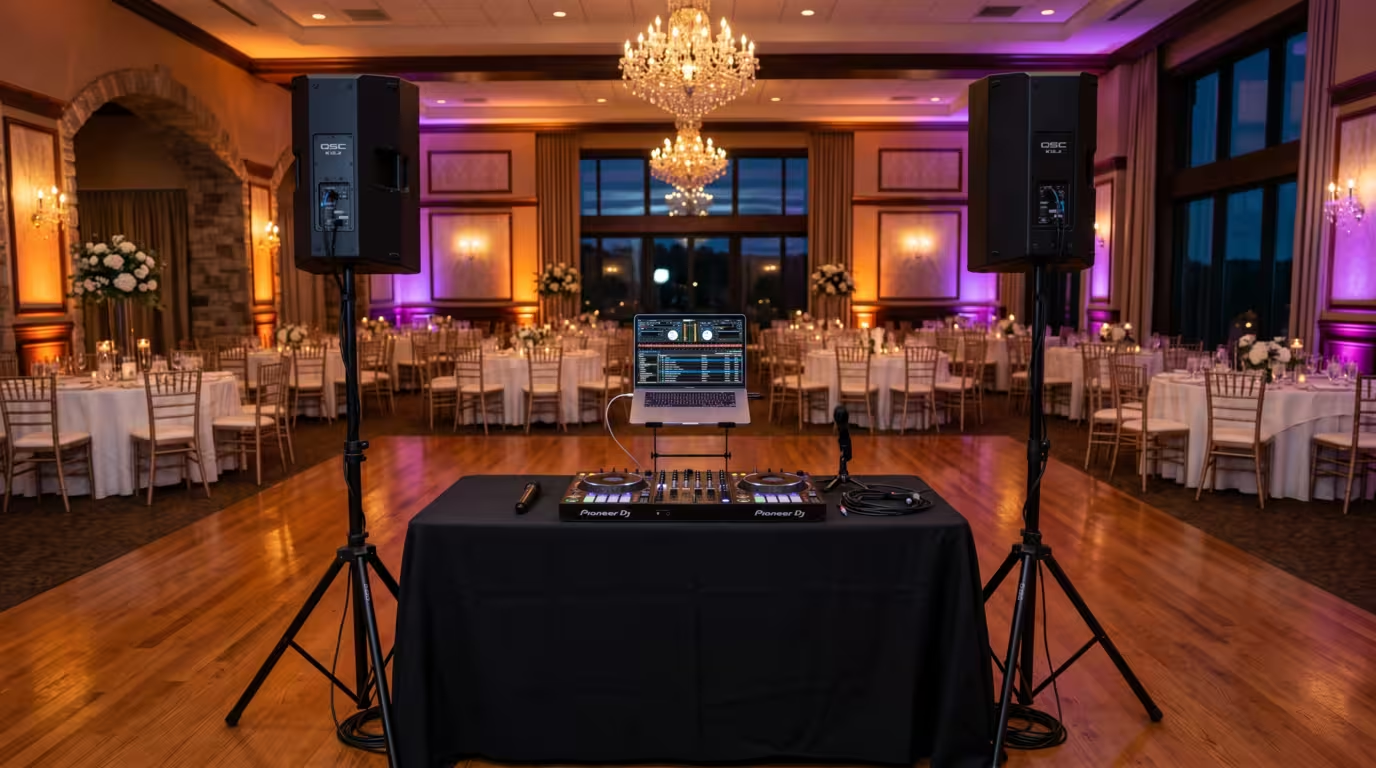
Two factors deserve special emphasis. The first is the draw you bring. As Club Ready DJ School puts it, the bigger your fanbase, the more you are worth to a venue, because a club is a business that needs new faces through the door — once promoters approach you, you can start raising your price. The second is what you physically provide. A club DJ may stroll in with a USB stick and plug into the house system; a mobile DJ brings and sets up a full sound system, lighting, microphones and often acts as MC, which is why mobile and wedding work pays far more per event.
Typical rate ranges by context
The figures below are approximate, researched ranges drawn from DJ-industry and wedding-vendor sources. Treat them as illustrative starting points, not authoritative absolutes — real rates vary enormously by market, experience, season and time, and they change year to year.
| Context | Approximate typical range (USD) |
|---|---|
| Beginner / first paid gigs | Free to roughly $50-$200 per gig |
| Local bar / club resident | About $100-$500 per night |
| Touring club DJ with a draw | Around $1,000-$1,500+ per night |
| Wedding / private (mobile, full service) | Roughly $800-$2,500, average near $1,000-$1,800 |
| Corporate event | Often higher than comparable private parties |
| Festival (lower to mid tiers) | Several thousand to tens of thousands |
| Superstar headliner | Six to seven figures per show |
A few of these deserve unpacking. For bar and club work, a rate guide aimed at working DJs put a mid-size club resident at roughly $200 to $500 per night, with a touring DJ who has a following pulling $1,000 to $1,500 for a single set; the same guide noted club pay often depends on the deal structure — a flat fee, a door split (commonly 10 to 20% of door revenue), or a guarantee plus a percentage. Festival pay has the widest spread of all: an up-and-coming act on a side stage might earn several thousand, a mid-tier name considerably more, and only the top tier reaches the headline-grabbing numbers.
At the very top, those numbers become genuinely extreme. Billboard, citing music-business sources, reported that a superstar DJ — a Calvin Harris, Tiësto, Diplo or Chainsmokers — can still pull a low seven-figure fee for a single club appearance, and upwards of $300,000 a show for residencies, adding that in 2015 a major casino typically paid $175,000 for a bankable DJ before demand drove the price to $350,000. These are outliers, not benchmarks — useful to know the ceiling exists, but irrelevant to pricing a local gig. (For how DJs build income across multiple streams beyond performance fees, a future income-focused guide will cover that ground; this article stays focused on what to charge per gig.)
Weddings, mobile and corporate work
For most working, non-famous DJs, private events — weddings especially — are the best-paying and most reliable work. They also involve the most work, which is exactly why they pay more.
The wedding industry publishes the most solid pricing data of any DJ context because platforms survey real couples every year. The Knot now puts the US average at $1,800, based on its 2026 Real Weddings Study of 10,474 couples married in 2025 — noting that the average live wedding band, at $4,500, costs 150% more than the average DJ at $1,800, up from roughly $1,700 in the prior study. WeddingWire reports a lower national figure, putting the average wedding DJ at around $1,000 with most couples spending between $780 and $1,495. The gap between the two reflects different samples and methods, which is itself a lesson: even authoritative data disagrees, so always treat any single average with caution. Both agree the realistic spread runs from a few hundred dollars to $5,000 and up depending on experience, region and package.
Why do weddings pay more than a bar night? Because, as wedding-vendor sources stress, the fee is not for the four or five hours on the dance floor. A wedding DJ acts as MC, manages a timeline, coordinates with other vendors, meets the couple beforehand, builds custom playlists, and brings backup gear. As a Wikipedia overview of mobile DJs notes, mobile DJs tour with their own portable sound, lighting and sometimes video systems — that equipment, transport and setup is bundled into the price. One mobile-DJ rate guide estimated that a single event can absorb 30 hours or more of total work once prep, communication, travel, setup and breakdown are counted.
Corporate events typically pay well because companies have real budgets and value reliability — a product launch or holiday party often pays a multiple of a comparable private party, though it can come with content restrictions and tight timelines. Even on an hourly basis the premium shows: vendor platform Thumbtack gives an example of a DJ charging $75 per hour for corporate parties and $100 per hour for weddings. Most pros price weddings and corporate work as packages rather than by the hour, bundling hours, gear, lighting and extras such as uplighting or a photo booth.
How to set your own rate
Setting a rate is part research, part self-assessment. Here's a practical approach.
Research your local market first. Find out what DJs at your level, in your area, doing your kind of event actually charge. The DJ-education site DJ TechTools recommends simply asking other working DJs directly — it can feel taboo, but community over competition beats guessing — and asking recently-married friends what they paid. Wedding platforms and DJ directories help you triangulate.
Cost it from the bottom up. Don't just price the hour on stage. Phil Morse of Digital DJ Tips suggests separating the value of your DJing from the value of your gear, then building a number you can confidently raise as your equipment and reputation improve. Factor in prep time, travel, music purchases, insurance, gear wear and the unpaid admin around the booking. A useful gut check: a $150 five-hour set, minus five hours of prep, your own gear and $50 of new music, can quietly drop below minimum wage.
Price by context and value, then add multipliers. A bar slot, a wedding and a corporate gig are different products. Apply higher rates where you deliver more — MC duties, planning meetings, custom playlists, full PA and lighting. Charge more for peak demand, too: Saturday nights and wedding high season (broadly late spring through early autumn) command more than a wet Tuesday.
Don't undervalue yourself — but don't overprice past your market either. Racing to the bottom hurts you and the wider scene, and free or cut-price work trains clients to expect it. At the same time, a price far above what your draw and experience justify will simply lose you bookings. The sweet spot is a confident rate that reflects real value and that the market will bear — and you raise it deliberately as demand, skill and reputation grow. A strong brand and following is one of the most powerful fee-raisers there is.
Negotiating, contracts and getting paid
Talking about money is a skill, and handling it professionally protects both your income and your reputation.
Quote with confidence and be specific about what's included. Spell out hours, gear, travel, MC duties and what happens if the event runs long. Build an overtime rate into the conversation and the paperwork so you're never working extra for free; whether you charge a premium or your normal rate for overtime, get it agreed in advance.
For private events, always use a written contract and take a deposit. This is the standard professional norm, not optional. DJ TechTools' guidance on mobile DJ contracts recommends a non-refundable deposit to secure the date, with the balance due before the event for private clients, and clear terms covering cancellation, what's provided, and what happens if you can't perform (typically arranging a suitable replacement or refunding). Deposits commonly run 25 to 50% of the total. The Knot's lawyer-backed guide to DJ contracts stresses spelling out the total fee, payment schedule, cancellation and rescheduling terms in writing — vague terms are where payment disputes start.

Collect promptly and professionally. For club and bar gigs that pay cash on the night, agree who pays you and when, and collect before you leave. For private events, follow your deposit-plus-balance schedule so you're not chasing money after the party. Treat all of this as running a business — keep records and set aside for tax, because it is self-employed income whether you think of it that way or not. (Handling payment well also gets you rebooked; the companion guide on getting DJ gigs goes deeper on that side.)
Handle lowball offers without underselling. Know your floor and be willing to walk. Sometimes the right move is to hold firm; sometimes, for a date you'd otherwise leave empty or a client you want to build a relationship with, a modest, clearly-stated discount makes sense. The key, per multiple DJ educators, is to frame any discount as a one-off so your standard rate stays intact for next time.
The free gig and "exposure" question
Few topics divide DJs more than playing for free. The honest position is that it's sometimes reasonable and sometimes exploitative — and telling the difference matters.
Free or near-free can be legitimate early in your career: your very first gigs, a trial slot to prove you can hold a dancefloor, your own night, a charity event, or a genuine opportunity at a venue that would never otherwise hire a DJ. Digital DJ Tips, which historically argued DJs shouldn't work for free, has softened to a nuanced stance: if you're not taking work from another DJ and you're gaining real-world experience or supporting a cause, a free set can be worth it — and it suggests a one-dollar method, where you quote your normal fee but offer to demonstrate for a token amount, so your perceived value stays intact and future bookings are at full rate.
It becomes exploitative when established, paying venues and events that clearly can pay ask you to work for exposure instead. As Digital DJ Tips warns, every time you play for nothing you risk telling the market that DJ services have no value and contributing to a race to the bottom. Mixmag has gone further, running pointed features on the pay-to-play model — where promoters make young DJs buy and sell tickets to earn a low slot — calling it a genuine threat to dance music culture and urging DJs to attach value to what they and their colleagues do. The same magazine's reporting on headline culture, where promoters spend the bulk of a budget on one big name, describes a squeezed middle tier and warns it doesn't create a healthy scene. The takeaway: be strategic about free work, set clear expectations about your future rate, and never undercut other working DJs as a default tactic.
Value beyond the fee
Cash isn't the only thing a gig pays. Sometimes a lower-paid or free booking is genuinely worth it for the platform — a strong support slot in front of the right crowd, a residency that builds your reputation and reliability, or a relationship with a promoter who books bigger rooms. A residency in particular can pay modestly but deliver development, regular practice in front of a crowd, and standing in a scene that's hard to buy; our Getting a DJ Residency guide weighs that value beyond money.
The flip side is just as real, and it's the engine of higher fees: as your brand, following and reputation grow, your rate grows with them. That's not a contradiction — it's the whole arc of a DJ career. You weigh the full value of early opportunities honestly, you build a name (the work covered in How to Get DJ Gigs), and that name is what eventually lets you charge what the top of your market pays. Pricing well is simply making sure that at every stage you're paid fairly for the value you actually deliver — no less, and no more than the market will bear.
Key takeaways
• There is no single DJ rate: fees run from free for first gigs to seven figures for superstars, so price for your gig, market and level.
• Your fee is driven by experience, draw, event type, location, slot, set length and whether you provide gear and full service.
• Weddings, private and corporate events pay best for working DJs; US wedding DJ averages range from about $1,000 (WeddingWire) to $1,800 (The Knot), but spreads are wide.
• Research local rates, cost from the bottom up (prep, travel, gear, admin — not just stage time), and don't undervalue yourself.
• Use written contracts and deposits for private events, be clear on what's included, and collect payment promptly and professionally.
• Free work can be smart early on or for genuine opportunity/charity, but beware the "exposure" trap from those who can clearly pay.
Ready-made, exclusive EDM tracks with full rights — released as your own.
